
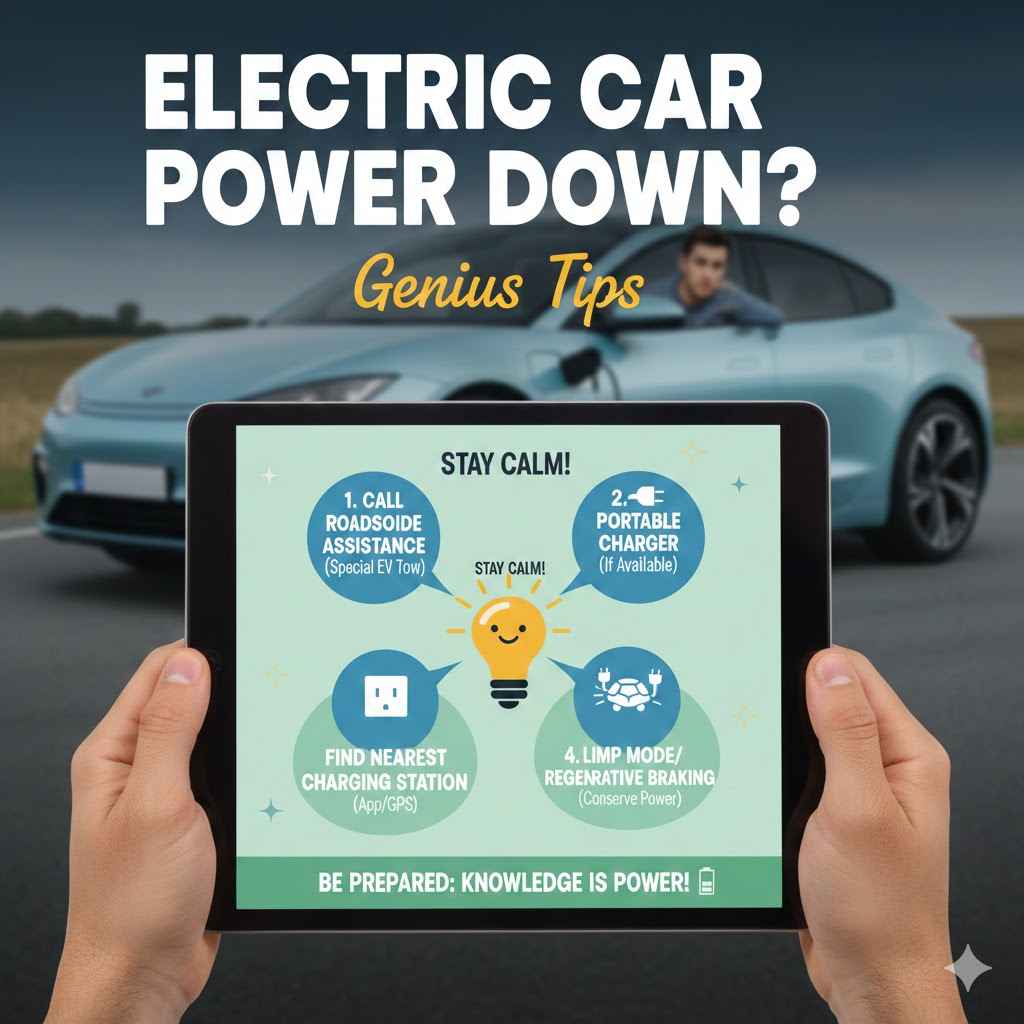
If your electric car runs out of power, immediately pull over to a safe location and turn on your hazard lights. Your best option is to call a roadside assistance service that offers mobile EV charging or can provide a flatbed tow to the nearest charging station. Stay inside your vehicle until help arrives.
The thought of your electric car running out of power can be scary. This fear is so common it even has a name: “range anxiety.” But what if it actually happens? Will you be stranded for good? The simple answer is no. Running out of charge in an electric vehicle (EV) is a rare and totally manageable situation.
You are not alone in worrying about this. Many new EV drivers feel the same way. The good news is that your car is designed to help you, and help is almost always just a phone call away. In this guide, we will walk you through the exact steps to take. You will learn what to do, who to call, and how to prevent it from ever happening again. Let’s get you prepared and confident for any journey.
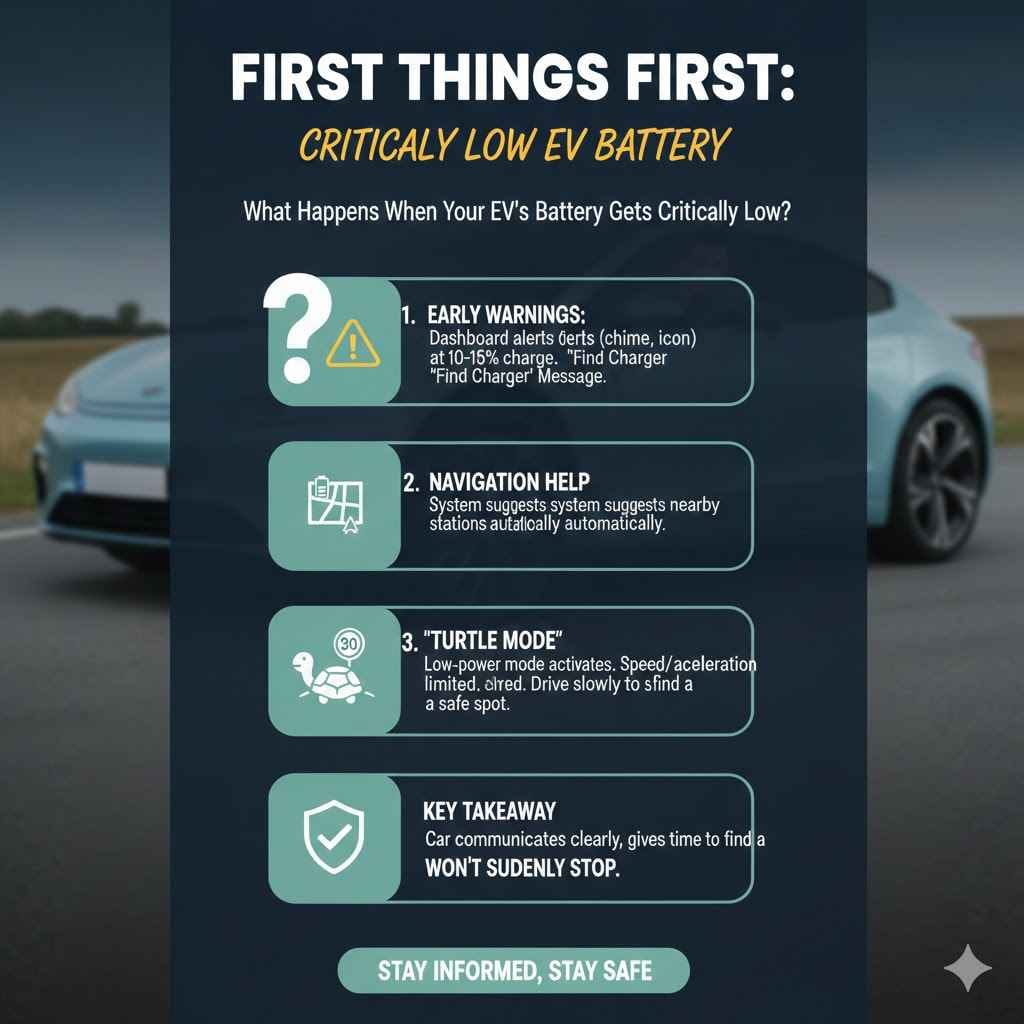
First Things First: What Happens When Your EV’s Battery Gets Critically Low?
One of the biggest fears is that your EV will just stop dead in the middle of traffic. Thankfully, that’s not how it works. Modern electric cars are very smart. They are designed to give you plenty of warning long before the battery is completely empty. They won’t leave you suddenly stranded without a chance to react.
Here’s what you can expect as your battery level drops:
- Early Warnings: Your car will start showing you alerts on the dashboard when the battery gets low, usually around 10-15% charge. It might chime, show a yellow or red battery icon, and display a message urging you to find a charger.
- Navigation Help: Most built-in navigation systems will automatically suggest nearby charging stations when the charge level becomes critical.
- Entering “Turtle Mode”: This is the most important feature. When the battery is almost completely drained, your car will enter a low-power mode to conserve every last bit of energy. People often call this “turtle mode” because a turtle icon may appear on the dash. In this mode, the car will limit your speed and acceleration. You will still be able to drive, but much more slowly. This is a clear signal that you need to pull over immediately. The car is giving you a final chance to get to a safe spot off the road.
The key takeaway is this: your car will not just shut off without warning. It will communicate with you clearly, giving you the time and ability to find a safe place to stop.
What to Do Immediately When Your EV Runs Out of Power
Seeing that final low battery warning can be stressful, but having a clear plan makes all the difference. Follow these simple steps to handle the situation safely and efficiently.
- Stay Calm and Scan for a Safe Spot: The moment you realize you won’t make it to a charger, take a deep breath. Panicking won’t help. Instead, focus on your surroundings. Look for a safe place to pull over. Ideal spots include a highway shoulder, a quiet side street, an empty parking lot, or a gas station. Avoid stopping in a lane of traffic or on a blind curve.
- Pull Over and Secure Your Vehicle: Signal your intention to pull over. Once you have moved your car completely out of the flow of traffic, put it in Park. Engage the electronic parking brake. Then, turn on your hazard lights immediately. This makes your car visible to other drivers, which is the most important safety step.
- Assess Your Location and Options: Take a look around. Are you close to any businesses or homes? Open a map app on your phone, like Google Maps or PlugShare, to see if a charging station is miraculously within a very short walking distance. In most cases, it won’t be, but it’s worth a quick check. Your main goal now is to figure out the best way to get help.
- Conserve Remaining Power: Even when the main battery is too low to move the car, a separate 12-volt battery powers your lights, locks, and infotainment system. To preserve its power, turn off anything you don’t need, such as the radio, interior lights, and climate control system. Keeping your hazard lights on is the priority.
Your Top 3 Solutions for a Depleted EV Battery
Once you are safely pulled over, you have three main options to get your EV charged and back on the road. Your choice will depend on your location, your insurance provider, and the tools you might have with you.
Option 1: Call for Roadside Assistance (Your Best Bet)
This is the most common and reliable solution. Nearly all roadside assistance providers are now equipped to handle electric vehicles. When you call, be very specific about your situation.
Tell the dispatcher:
- “I am driving an electric vehicle.”
- “My high-voltage battery has run out of power.”
- “I am in a safe location at [your address or cross-streets].”
Some providers, like AAA, have trucks with mobile EV chargers that can give you enough of a boost (a few miles of range) to get you to the nearest public charging station. If mobile charging isn’t available, they will send a tow truck. Crucially, you must request a flatbed tow truck. Towing an EV with its drive wheels on the ground can severely damage the electric motors.
You can find the closest charging station for the tow truck driver by using the U.S. Department of Energy’s station locator on your smartphone.
| Service Provider | EV-Specific Services | What to Expect |
|---|---|---|
| AAA | Yes (in select areas) | Some trucks offer mobile charging. All locations can arrange a flatbed tow. |
| Manufacturer Roadside (Tesla, Ford, etc.) | Yes | Included with new vehicles for a certain period. They are experts in handling your specific model. |
| Your Car Insurance Provider | Usually | Most insurance companies offer roadside assistance as an add-on. They will contract with local tow companies. Be sure to specify you need a flatbed. |
Option 2: Use a Portable EV Charger (A Great Backup Plan)
A portable EV charger is a fantastic tool to keep in your trunk for emergencies. These devices plug into a regular wall outlet (like the one in a home or at a business) and can slowly add charge to your car.
There are two main types:
- Level 1: Plugs into a standard 120-volt household outlet. It’s very slow, adding only 3-5 miles of range per hour of charging. However, in an emergency, an hour or two of charging could be enough to get you to a proper station.
- Level 2: Plugs into a 240-volt outlet (like an electric dryer). It’s faster but finding a compatible outlet is much harder.
If you have a Level 1 portable charger and have run out of power near a friendly business or residence, you could ask permission to plug in for a while. It’s not a fast solution, but it’s a great self-rescue option that gives you peace of mind.
Option 3: Get a Tow to the Nearest Charging Station
If mobile charging isn’t an option, a tow is your guaranteed solution. As mentioned before, you must insist on a flatbed tow truck. This is not negotiable for most electric vehicles.
Why is a flatbed so important? Most EVs have motors connected directly to the wheels. When the wheels spin, the motors spin, which can generate electricity (this is called regenerative braking). Towing the car with its drive wheels on the pavement can force the motors to spin without the system being properly powered on, leading to expensive damage. A flatbed truck lifts the entire car off the ground, ensuring it is transported safely without any risk to the drivetrain.
Proactive and Genius: How to Prevent Running Out of Power in the First Place
The best way to deal with a dead EV battery is to never let it happen. With a few simple habits, you can make range anxiety a thing of the past.
Know Your ABCs: Always Be Charging
This is the golden rule of EV ownership. Treat your car like your smartphone. The easiest and cheapest way to charge is at home overnight. If you have a garage or driveway, get into the habit of plugging in your car every evening. This way, you wake up to a “full tank” every single day. You will rarely need to worry about your state of charge for daily driving.
Plan Your Trips, Especially Long Ones
For road trips that go beyond your car’s single-charge range, a little planning goes a long way. Use apps like PlugShare, A Better Routeplanner (ABRP), or ChargePoint. These tools allow you to enter your destination and will map out the best charging stops along your route. You can see what kind of chargers are available (fast chargers vs. slower ones) and even read recent user reviews to see if they are working properly.
Understand Factors That Affect Your Range
The range estimate on your dashboard is just that—an estimate. Real-world conditions can have a big impact on how far you can actually go. Being aware of these factors will help you manage your battery more effectively.
| Factor | Impact on Range | Simple Tip |
|---|---|---|
| Cold Weather | Significant Decrease | Precondition your car’s battery and cabin while it’s still plugged in. Use heated seats and steering wheel instead of blasting the cabin heat. |
| High Speeds | Moderate Decrease | Driving at 65 mph instead of 75 mph can significantly extend your range. Use cruise control to maintain a steady speed. |
| Aggressive Driving | Moderate Decrease | Avoid rapid acceleration and hard braking. Smooth, gentle driving is much more efficient. |
| Uphill Driving | Moderate Decrease | Driving up steep inclines uses a lot of energy. However, you’ll regain some of it through regenerative braking on the way down. |
| Heavy Cargo | Slight Decrease | The more weight your car is carrying, the more energy it needs to move. Remove any unnecessary heavy items from your trunk. |
Pay Attention to Your Car’s Warnings
This sounds simple, but it’s easy to ignore. When your car tells you the battery is low and suggests a charging station, listen to it! Don’t try to push it to the absolute limit. Modern EV navigation systems are very good at predicting your energy usage and will often warn you if you are trying to reach a destination without enough charge. Heed these warnings and build in a comfortable buffer.
What About the 12-Volt Battery?
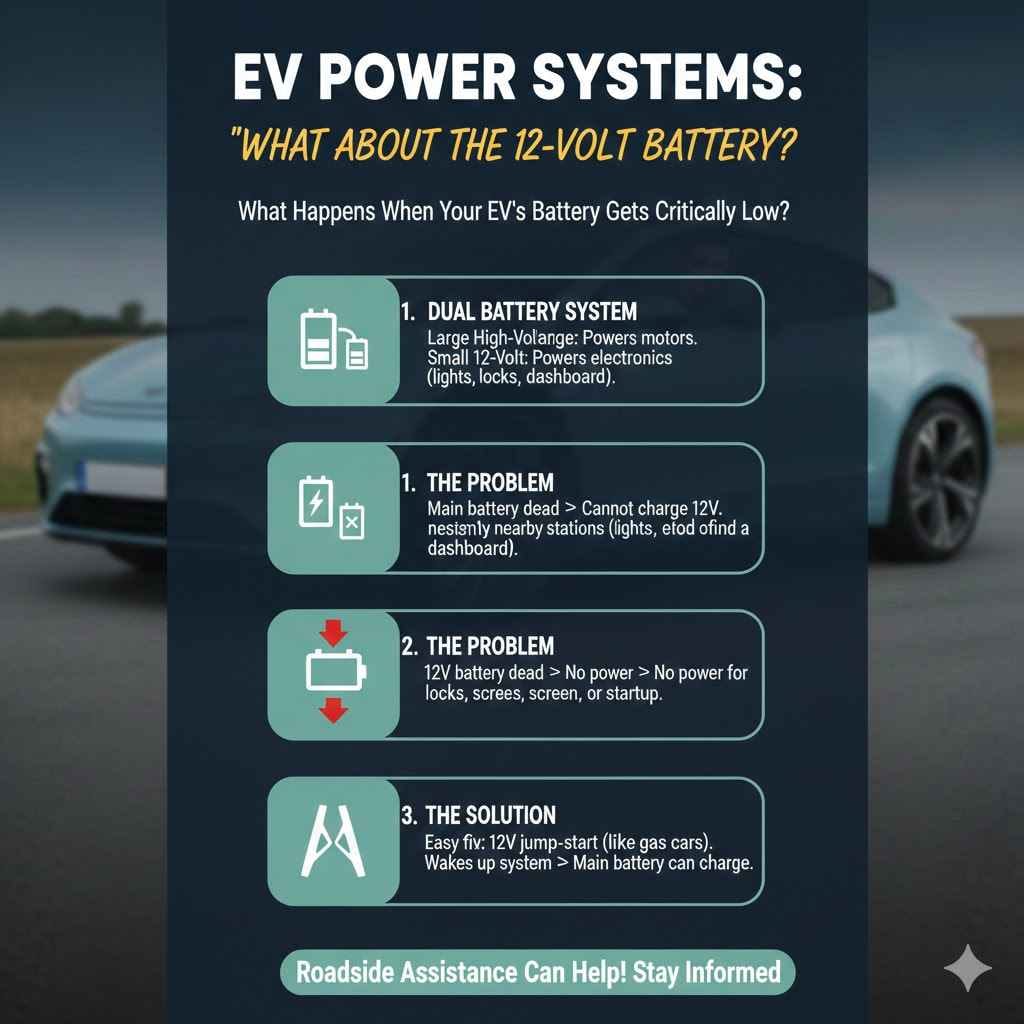
Your EV has two batteries. The giant, high-voltage lithium-ion battery is what powers the motors and makes the car go. But there is also a small 12-volt battery, just like the one in a gasoline-powered car. This little battery is responsible for powering your car’s electronics: the lights, the door locks, the dashboard screen, and the computers that “wake up” the car.
The main battery keeps the 12-volt battery charged. However, if the main battery is completely dead, it can no longer top off the 12-volt battery. Eventually, the 12-volt battery can also run out of power. If this happens, you won’t be able to unlock your doors or turn the car on, even if you get it to a charger.
The good news is that this is an easy fix. Roadside assistance can give your 12-volt battery a jump-start, just like they would for a gas car. For more details on how different batteries work, resources like Battery University offer in-depth explanations. Once the 12-volt system is awake, the car can begin charging the main battery as normal.
Frequently Asked Questions (FAQ)
1. Does an electric car die suddenly when it runs out of power?
No. Electric cars give you many warnings as the battery gets low. They will then enter a reduced-power “turtle mode” that limits speed and acceleration to give you time to pull over safely. They do not just shut off abruptly in traffic.
2. Can you push an electric car when it runs out of power?
It is not recommended. Many EVs automatically engage the parking brake when they power down. Even if you can get it into Neutral, pushing or towing it with the wheels on the ground can damage the electric motors. Always call for a flatbed tow truck.
3. How far can an EV go in “turtle mode”?
This varies by manufacturer, but you can typically expect to go another one to three miles, sometimes more, at a very slow speed. This mode is designed only to get you to the side of the road or an emergency pull-off area, not to the next town.
4. Does running out of power damage the EV battery?
Doing it once is unlikely to cause any long-term harm. The car’s battery management system has built-in safeguards to protect the battery from a truly complete discharge. However, repeatedly running the battery to zero is not healthy for its long-term lifespan. It’s best to keep the charge between 20% and 80% for daily use.
5. Can another EV charge my car?
Some newer EVs, like the Ford F-150 Lightning and Hyundai Ioniq 5, offer Vehicle-to-Load (V2L) or Vehicle-to-Vehicle (V2V) charging. This allows them to act as a mobile generator and share power with another EV through a special adapter. This technology is still new but may become a common roadside solution in the future.
6. What is the best roadside assistance for an EV?
Services like AAA are investing in EV-specific support, including mobile charging trucks in some cities. Your vehicle manufacturer’s included roadside assistance is also an excellent choice, as they are specialists for your model. The most important thing is to confirm that they can provide either mobile charging or a flatbed tow.
Conclusion: Drive with Confidence, Not Anxiety
Running out of power in an electric car might seem like a nightmare, but in reality, it’s a simple problem with clear solutions. Your car is designed to give you ample warning, and a network of roadside professionals is ready to help. By remembering to stay calm, pull over safely, and make the right call, you can handle the situation like a pro.
Even better, by adopting a few easy habits—like charging at home, planning long trips, and understanding what affects your range—you can virtually eliminate the risk of ever running dry. So charge up, get out there, and enjoy all the benefits of driving electric. You are prepared, you are capable, and you can drive with confidence, not anxiety.