
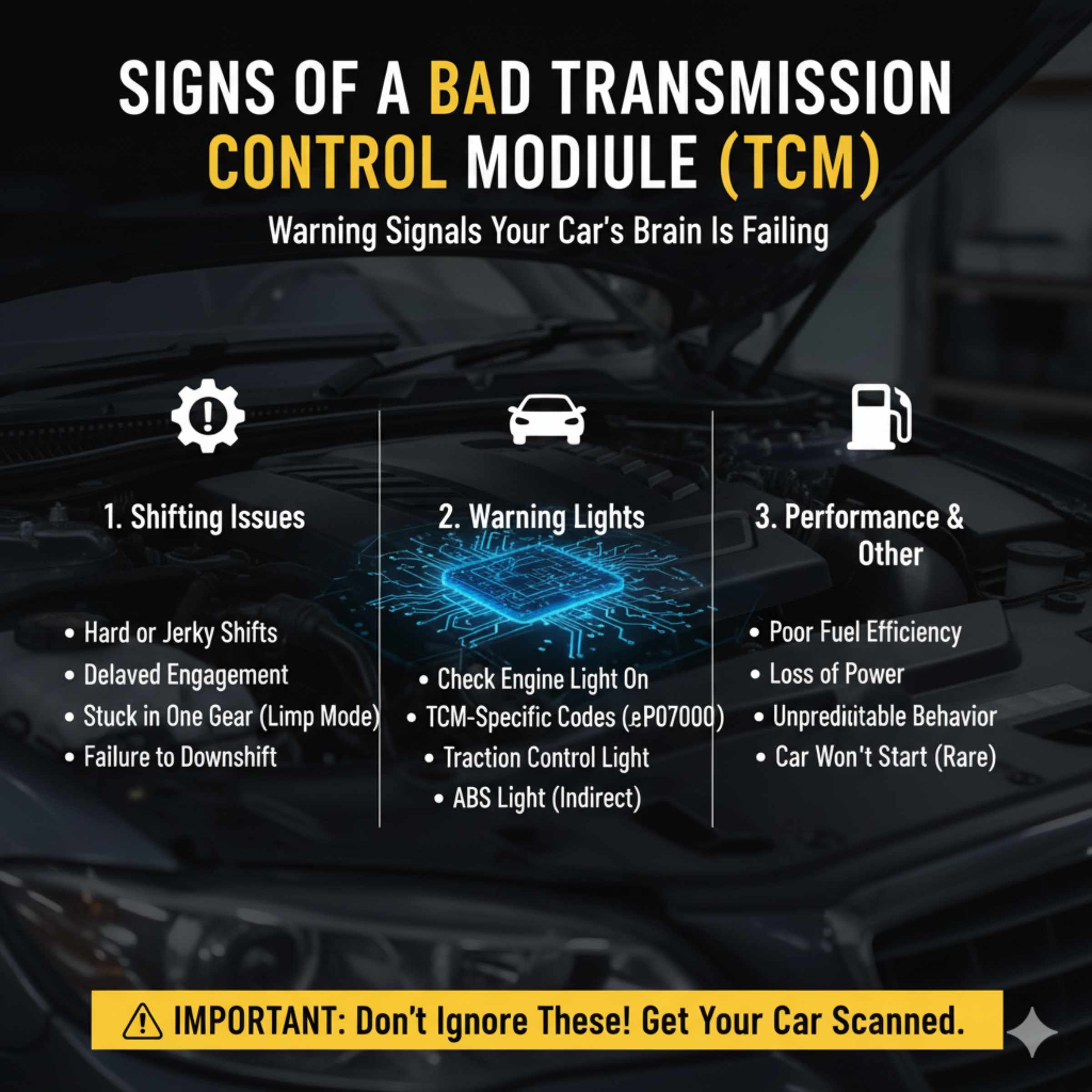
Signs of a bad transmission control module (TCM) include erratic shifting, warning lights, strange noises, and poor fuel economy. Recognizing these essential alerts early can save you significant repair costs and keep your driving safe by addressing the issue promptly.
Is your car suddenly shifting gears like it’s confused? Dealing with unexpected bumps or lags when you accelerate can be incredibly frustrating, and it often leaves drivers worried about a massive repair bill. You might have heard of the Transmission Control Module, or TCM, but what exactly is it, and how do you know if it’s failing? Don’t worry! The TCM is just a small computer that manages your transmission’s brainpower. This guide will walk you through the clear, simple signs that your TCM might need attention. We’ll break down the confusing symptoms into easy-to-understand alerts so you can feel confident talking to your mechanic or even exploring basic fixes yourself. Let’s demystify those dashboard warnings and get you back on the road smoothly!
Understanding the Transmission Control Module (TCM)
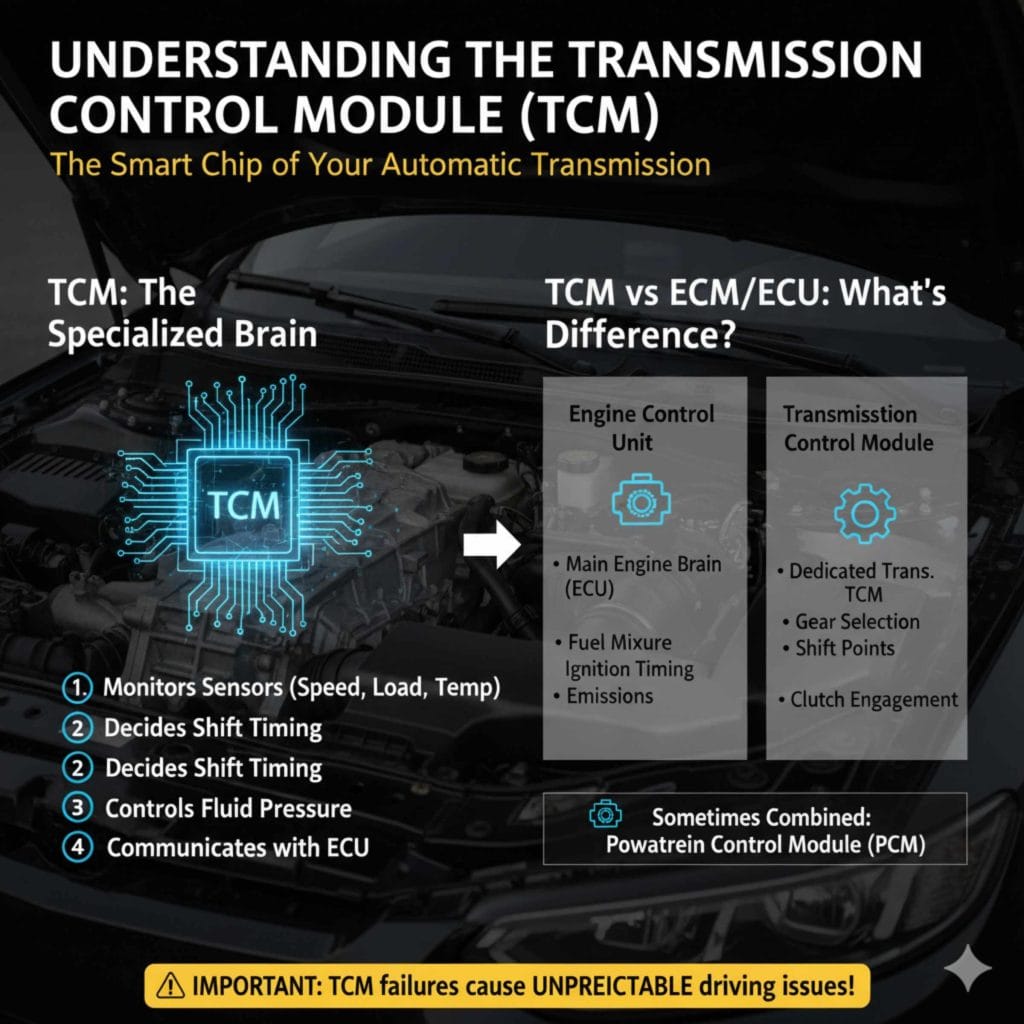
Think of your car’s engine as the muscle and the transmission as the gearbox that sends power to the wheels. The Transmission Control Module (TCM) is the smart chip—the dedicated computer—that oversees all the precise timing and actions within that gearbox, especially in automatic transmissions. It talks constantly to the Engine Control Unit (ECU), reading sensors about speed, engine load, and throttle position.
This constant communication ensures that your car shifts into the right gear at the right time, giving you smooth acceleration and good gas mileage. When the TCM starts to malfunction, that slick, seamless operation disappears. Because it’s an electronic component, its failures often show up as frustrating, unpredictable driving behaviors rather than simple mechanical wear and tear.
TCM vs ECM/ECU: What’s the Difference?
This part often confuses new DIYers, so let’s quickly clear it up. Your car has several “brains.”
- Engine Control Unit (ECU) or Engine Control Module (ECM): This is the main brain focusing on the engine—things like fuel mixture, ignition timing, and emissions.
- Transmission Control Module (TCM): This is the specialized brain dedicated solely to the transmission. It focuses on clutch engagement, gear selection, and shift points.
In some modern vehicles, these two modules are combined into one unit, often just called the Powertrain Control Module (PCM). However, in many cars, they remain separate, and a failure in the TCM specifically targets the shifting behavior.
Essential Alerts: Key Signs of a Bad Transmission Control Module
Recognizing a failing TCM often means noticing changes in how your vehicle performs. These signs usually start small but become progressively worse. Here are the most common and essential alerts you should never ignore.
1. Erratic or Inconsistent Shifting Behavior
This is often the first and most noticeable sign. The TCM is responsible for telling the transmission exactly when to shift up or down. If it’s sending bad information, the shifting will go haywire.
- Slipping Gears: You hit the gas, the engine revs higher, but the car doesn’t speed up immediately, or it feels like it has momentarily popped out of gear.
- Hard Shifts (Clunking/Jerking): Instead of a smooth transition between gears, you feel a noticeable, harsh jolt or thud when the car shifts. This can happen both when accelerating (upshifting) and slowing down (downshifting).
- Delayed Engagement: When you put the car in Drive (D) or Reverse (R), there is a long pause—sometimes several seconds—before the transmission actually engages and the car starts moving.
- Stuck in Gear (Limp Mode): The transmission refuses to shift out of a specific gear, often second or third. This is a safety feature, sometimes called “limp home mode,” where the system locks the transmission to prevent further damage, but it severely limits your speed.
2. The Check Engine Light (CEL) Illuminates
Because the TCM communicates directly with the main computer (ECU), any significant malfunction will trigger an alert on your dashboard. While the Check Engine Light can mean hundreds of things—from a loose gas cap to a major engine issue—a TCM failure will typically result in specific diagnostic trouble codes (DTCs).
If the light comes on and you notice concurrent shifting problems, you should check the codes immediately. Even simple code readers can reveal codes pointing toward transmission solenoids or communication errors between modules.
3. Transmission Warning Light Glows Red
Some vehicles, especially those with sophisticated automatic transmissions, have a dedicated transmission temperature or warning indicator, often symbolized by a gear icon with a thermometer inside or simply the word “Trans.” If this light stays on, it means the transmission system itself is detecting a serious problem that requires immediate attention. Ignoring a dedicated transmission light is risky, as overheating or severe electrical faults can lead to total transmission failure.
4. Poor Fuel Economy
When the TCM fails, it might command the car to stay in a lower gear for too long, forcing the engine to run at higher RPMs than necessary. Alternatively, it might fail to properly engage the lock-up torque converter. Both scenarios cause the engine to work much harder than it should to maintain cruising speed.
If you notice your fuel gauge dropping faster than normal, even when driving habits haven’t changed, a faulty TCM could be forcing inefficient gear selection, wasting fuel.
5. Overheating Transmission Fluid
Proper gear control is essential for managing heat. If the TCM causes the torque converter to remain partially engaged when it shouldn’t be, or if it struggles to circulate fluid correctly, the transmission generates excessive heat. You might notice a burning smell, or the transmission temperature sensor might report high readings (if your vehicle displays this information).
Excessive heat is the sworn enemy of automatic transmissions. If you suspect overheating alongside shifting issues, stop driving when safe and have it checked. High temperatures rapidly break down the transmission fluid, leading to friction and wear. For more information on how automatic systems manage heat, reliable resources like educational automotive engineering sites provide detailed diagrams of fluid dynamics.
6. Total Transmission Failure or Inability to Drive
In severe, prolonged cases of TCM failure, the system might shut down entirely, leaving you stranded. The car might refuse to shift into any gear, or it might only allow you to select Park, Neutral, or Drive, with no other options available.
This is the module completely failing to communicate, often indicated by the car staying in a high gear when starting from a stop (impossible to move) or staying in a low gear (unable to reach safe road speeds).
7. Weird Noises from the Transmission Area
While noises like grinding often point directly to internal mechanical damage, electronic issues caused by a bad TCM can sometimes trigger unusual sounds. This usually happens when the TCM incorrectly commands a solenoid to operate, causing a solenoid chatter or a grinding noise as gears try to mesh improperly due to incorrect timing.
Diagnosing the Root Cause: TCM vs Other Components
It’s crucial to understand that many symptoms of a bad TCM overlap with problems in other, often cheaper, components. A good diagnostic process helps ensure you replace the right part.
| Symptom | Possible TCM Issue | Other Common Causes |
|---|---|---|
| Harsh Shifting | Faulty internal TCM processor sending bad commands. | Low/dirty transmission fluid, failing shift solenoids. |
| Check Engine Light | TCM Internal power failure or communication bus error. | Oxygen sensor failure, vacuum leak, bad spark plugs. |
| Delayed Engagement | TCM failing to quickly activate the shift solenoids. | Low transmission fluid level or clogged filter. |
| Slipping Gears | Incorrect pressure commands from the module. | Worn clutches/bands inside the transmission itself. |
The Role of Solenoids in Shifting
TCMs communicate with the transmission fluid pressure system via electrical components called solenoids. Solenoids are like tiny electronic gates. The TCM tells a solenoid to open or close, which directs hydraulic fluid pressure to engage clutches for a specific gear.
If the shift feels sluggish, it might be a solenoid sticking, OR it might be the TCM sending the wrong voltage or command signal to that solenoid. Testing the signals coming from the TCM is what separates a solenoid replacement from a much pricier TCM replacement.
Corrosion and Wiring Harness Issues
Remember, the TCM is computer, and computers hate moisture and vibration. A very common cause for “bad TCM” diagnosis is actually not the module itself, but the wires connecting it.
- Corrosion: Check the electrical connector plug going into the TCM unit. Green or white powdery buildup (corrosion) can block the electrical signals, making the TCM appear faulty when it’s just “deaf” or “mute.”
- Wiring Damage: Look for any visible signs of chewed wires, pinched lines, or connections that have vibrated loose. A broken wire sending signals to the TCM sensor array will result in the same bizarre shifting behavior as a broken TCM.
How to Confirm a TCM Failure: The DIY Check
As a beginner driver looking to save money, you shouldn’t rush out and buy a new TCM immediately. Here are safe, preliminary steps you can take to narrow down the suspects.
Step 1: Check Fluid Levels and Condition
This is the easiest maintenance check and often solves 50% of all perceived transmission problems.
- Safety First: Ensure your car is parked on level ground, the engine is running (often required for accurate AT fluid checks), and the parking brake is firmly set. Consult your owner’s manual for the exact procedure for your make and model.
- Inspect the Fluid: Pull the dipstick (if available). The fluid should be pinkish-red and translucent. If it looks dark brown or black, or if it smells burnt, the fluid is degrading, which contributes to poor solenoid performance.
Step 2: Read Diagnostic Trouble Codes (DTCs)
If your Check Engine Light is on, getting the code read is vital. Most major auto parts stores will read these codes for free. You are looking specifically for codes related to:
- P07xx range codes (These usually point directly to transmission performance issues).
- Codes indicating communication failure between modules (e.g., U-codes).
If you get a code like P0750 (Shift Solenoid A Malfunction), the solenoid is the primary suspect, not necessarily the TCM sending the signal. A specialized mechanic’s scanner that can read live data (sensor reporting rates, solenoid activation signals) provides the best confirmation.
Step 3: Inspect the TCM Connector and Ground Points
If you can locate your TCM (often near or mounted directly on the transmission housing, though sometimes under the dash or in the ECM bay), perform a visual inspection.
- Unplug and Inspect: Carefully unplug the main electrical harness connector. Look closely at the pins inside the connector and on the module itself. Are any pins clearly bent, mashed, or corroded?
- Check Grounds: A module needs a solid electrical ground to function correctly. Look up where the primary transmission ground straps are in your vehicle’s service manual. If the ground wire connection is loose or rusty, replace or clean the connection point. A poor ground can make any electronic component act erratically.
When discussing ground points, remember that electrical continuity is key. You can learn more about proper automotive grounding techniques from organizations focused on automotive repair best practices.
Location, Location, Location: Where is the TCM?
The location of the TCM dramatically impacts its vulnerability to environmental factors like water and heat. Knowing where it is helps you check for external damage.
Common TCM Locations by Vehicle Type:
| Vehicle Type | Typical TCM Location | Vulnerability Risk |
|---|---|---|
| Older Domestic Cars (Pre-2000s) | Often located inside the cabin, away from the engine bay. | Low – Protected from heat and water intrusion. |
| Many Modern Cars | Mounted directly on or near the transmission case (valve body). | High – Constant exposure to road salt, heat, and moisture. |
| Some Front-Wheel Drive (FWD) Vehicles | Near the firewall or fender well. | Medium – Risk of water splashing up from the road splash area. |
If your TCM is mounted directly onto the transmission casing, it bears the brunt of engine heat and road vibration. This harsh environment often leads to internal component failure over time, even if the external wiring looks fine.
When Do You Need Professional Help?
While checking fluid and reading codes is accessible for beginners, there are points where professional expertise is necessary to avoid unnecessary part replacement.
1. When Diagnostic Scanners Show Inconsistent Live Data
A professional mechanic uses expensive, advanced scanners that show the actual real-time signals the TCM is sending to the solenoids. If the scanner shows the TCM is commanding a shift, but the commanded pressure doesn’t match the resulting actual pressure, or if the signal drops out entirely while driving, that strongly points toward the TCM or its internal connection.
2. When Shifting Issues Only Appear Under Load
If the car drives perfectly fine for the first five minutes around the block but starts slipping once the transmission heats up (after 15–20 minutes of driving), this suggests a thermal issue. Heat often causes electrical resistances to change. This intermittent failure is very hard to track down without professional equipment that can monitor data logs over an extended drive cycle.
3. After Replacing Solenoids Yields No Change
If you or a technician replace the shift solenoids (the cheaper potential fix) and the harsh shifting or warning lights persist, the logical next step is proving the command signal itself is faulty, which leads back to the TCM.
The Cost Factor: Repairing vs Replacing the TCM
One of the scariest aspects of a TCM failure is the potential cost. TCMs are specialized electronic components, and replacement can be expensive, especially if you need dealership programming.
Options for Addressing a Faulty TCM:
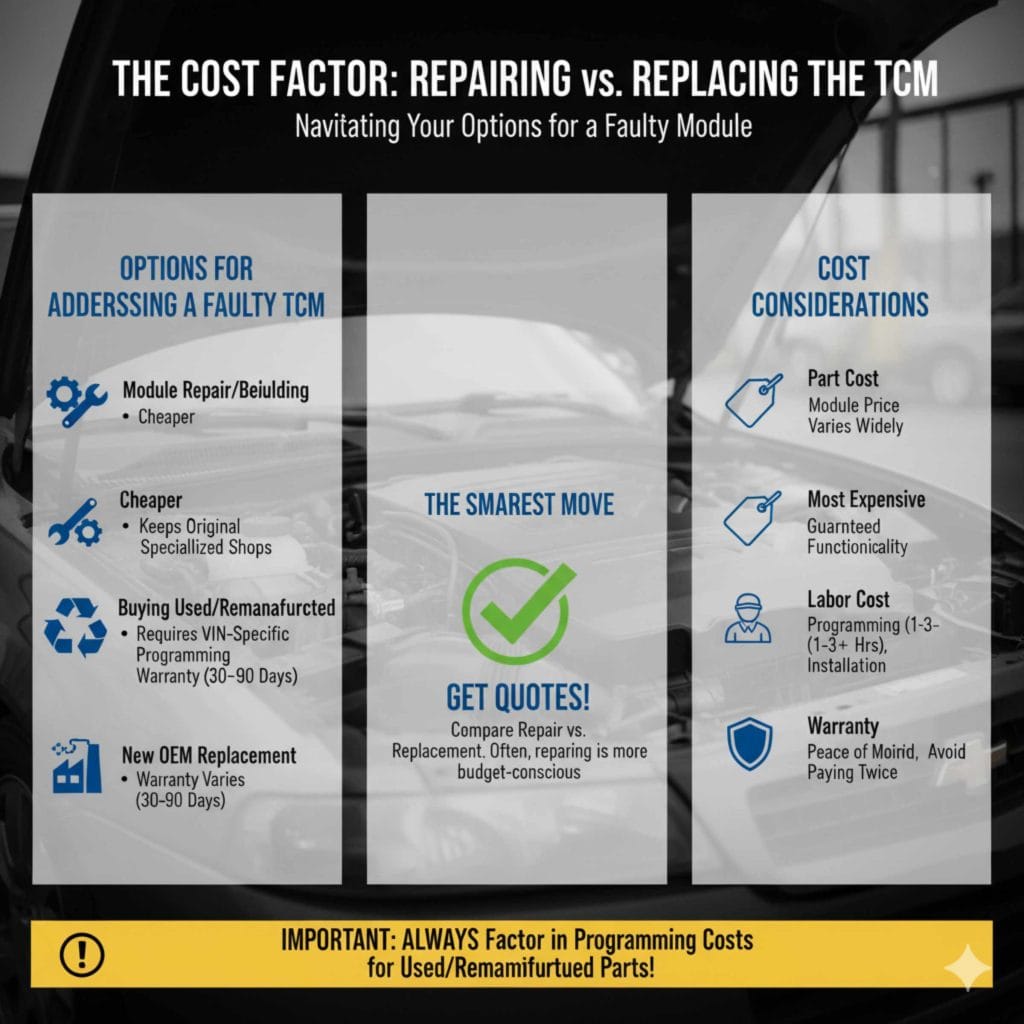
- Module Repair/Rebuilding: Some specialized electronics repair shops can test and repair failed TCMs. They address the faulty capacitors or burnt traces inside the unit. This is often significantly cheaper than a new module and keeps your original programming.
- Buying Used/Remanufactured: You can often find used TCMs from salvage yards or remanufactured units online. Be warned: most modern TCMs require VIN-specific programming by a dealer or specialized shop to communicate properly with your specific vehicle’s ECU and immobilizer system. Without this programming, the used part simply won’t work.
- New OEM Replacement: This is the most expensive but most guaranteed route for functionality. It includes the cost of the part and often several hours of specialized labor for programming and reintegration into your car’s network.
Always get quotes for both repair and replacement options before committing. Sometimes, repairing the existing module is the clear winner for budget-conscious drivers.
Frequently Asked Questions (FAQ) for Beginner Drivers
Q1: Can I safely drive my car if I suspect the TCM is failing?
A: It depends on the severity. If the car is limp-moded (stuck in low gear) or if you smell burning, you must stop driving immediately. Light, occasional hiccups might allow you to drive carefully to the nearest shop, but continued driving risks total, expensive transmission failure.
Q2: How long does a Transmission Control Module usually last?
A: A well-protected TCM can last the entire lifetime of the vehicle. However, modules mounted directly on hot transmissions often fail between 80,000 and 150,000 miles due to heat stress and vibration damaging internal solder joints.
Q3: Why does my car shift hard when it’s cold, but it’s fine later?
A: This is a classic sign of a developing electronic issue, perhaps a failing solenoid or a TCM component affected by temperature. Cold temperatures can cause slight expansion or contraction, temporarily hiding the fault. As the system warms up, the failing connection or component begins to act up reliably.
Q4: Does a dead battery ever cause TCM symptoms?
A: Yes. Low voltage—either from a weak battery or a failing alternator—can cause major issues for the sensitive electronics in the TCM. Before replacing the module, always ensure your vehicle’s charging system is functioning perfectly.
Q5: If I replace the TCM, will I lose my car’s settings?
A: You might lose some non-essential learned settings (like saved radio presets or idle parameters). Crucially, the new or replacement TCM often needs to be “flashed” or programmed with your specific car’s details.
Conclusion: Catching TCM Problems Early Protects Your Car and Your Wallet
A failing Transmission Control Module doesn’t usually break all at once—it warns you first. Erratic shifting, warning lights, delayed gear engagement, poor fuel economy, or strange transmission behavior are your car’s way of asking for attention. Ignoring these alerts can turn a manageable electronic issue into a full transmission failure that costs thousands.
The good news is that understanding what the TCM does and how it fails puts you in a powerful position. Many symptoms that feel scary at first can be narrowed down with simple checks like fluid inspection, code scanning, and visual wiring checks. In some cases, the problem isn’t the TCM at all but a sensor, solenoid, grounding issue, or low voltage—repairs that are far less expensive.
If the TCM is truly at fault, acting quickly gives you more options: repair, rebuild, remanufactured replacement, or professional reprogramming. Waiting too long limits those choices and increases the risk of permanent transmission damage.
In short, early recognition is your biggest advantage. Pay attention to how your car shifts, respond quickly to warning lights, and don’t guess—diagnose. Whether you’re a beginner driver or a budget-conscious DIYer, informed decisions can save you money, reduce stress, and keep your vehicle driving safely and smoothly for years to come.
When your transmission starts “acting confused,” now you know exactly what to listen for—and what to do next!