
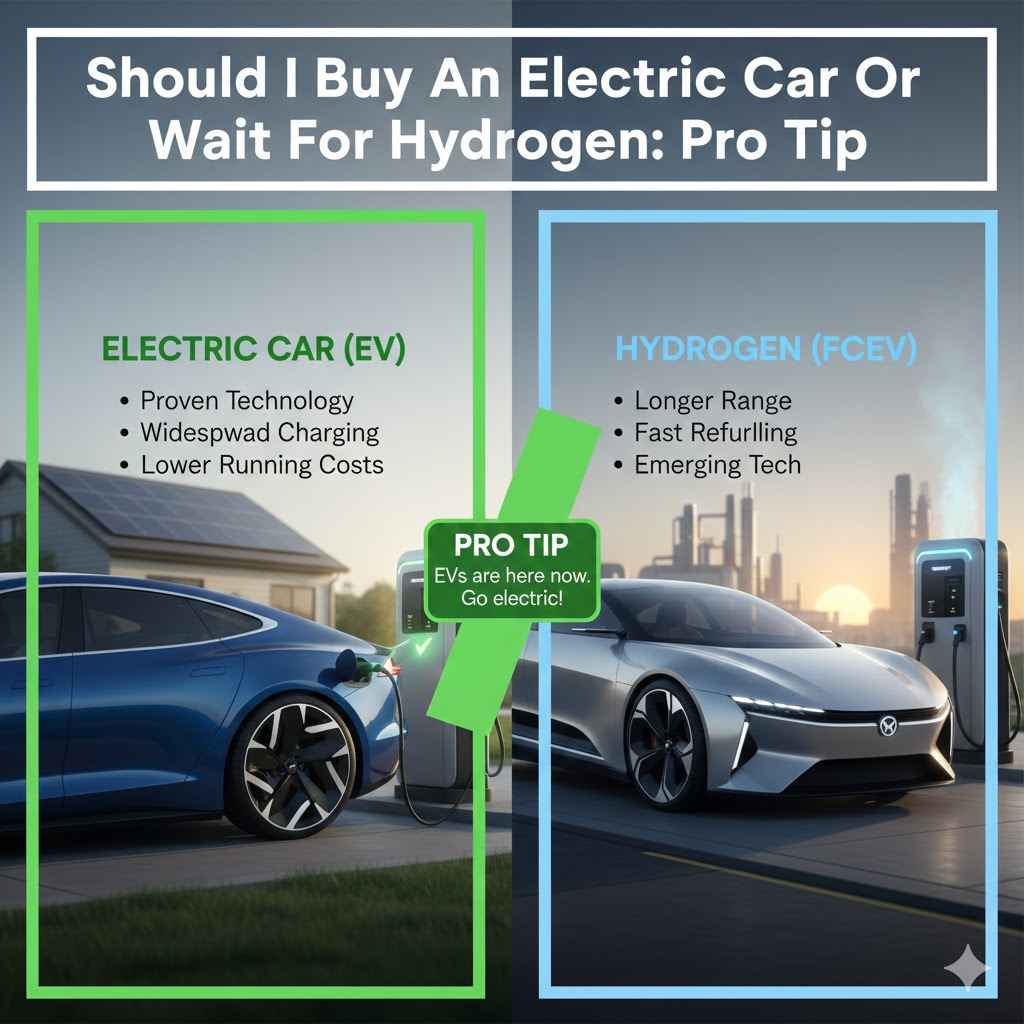
For most drivers today, buying an electric car (EV) is the clear and practical choice. EVs have a wide range of models, a growing public charging network, and the convenience of home charging. Hydrogen cars are promising but face major hurdles with extremely limited vehicle options and a near-nonexistent refueling infrastructure, making them impractical for almost everyone right now.
Are you thinking about your next car? It feels like the world of driving is changing fast. You hear about electric cars everywhere, but then someone mentions hydrogen cars as the real future. It can be confusing trying to figure out which path to take. You want to make a smart choice that saves you money and is good for the long run, but the technology sounds complicated.
Don’t worry. You don’t need to be an engineer to understand the difference. We’re going to break down electric and hydrogen cars in simple, everyday terms. By the end of this guide, you’ll feel confident and know exactly which option is the right one for you today. Let’s get started.
What’s the Big Difference? Electric vs. Hydrogen Explained
Before we dive into the pros and cons, let’s get a basic idea of how these two types of cars actually work. Think of it like comparing two different kinds of phones—they both get the job done, but they get their power in very different ways.
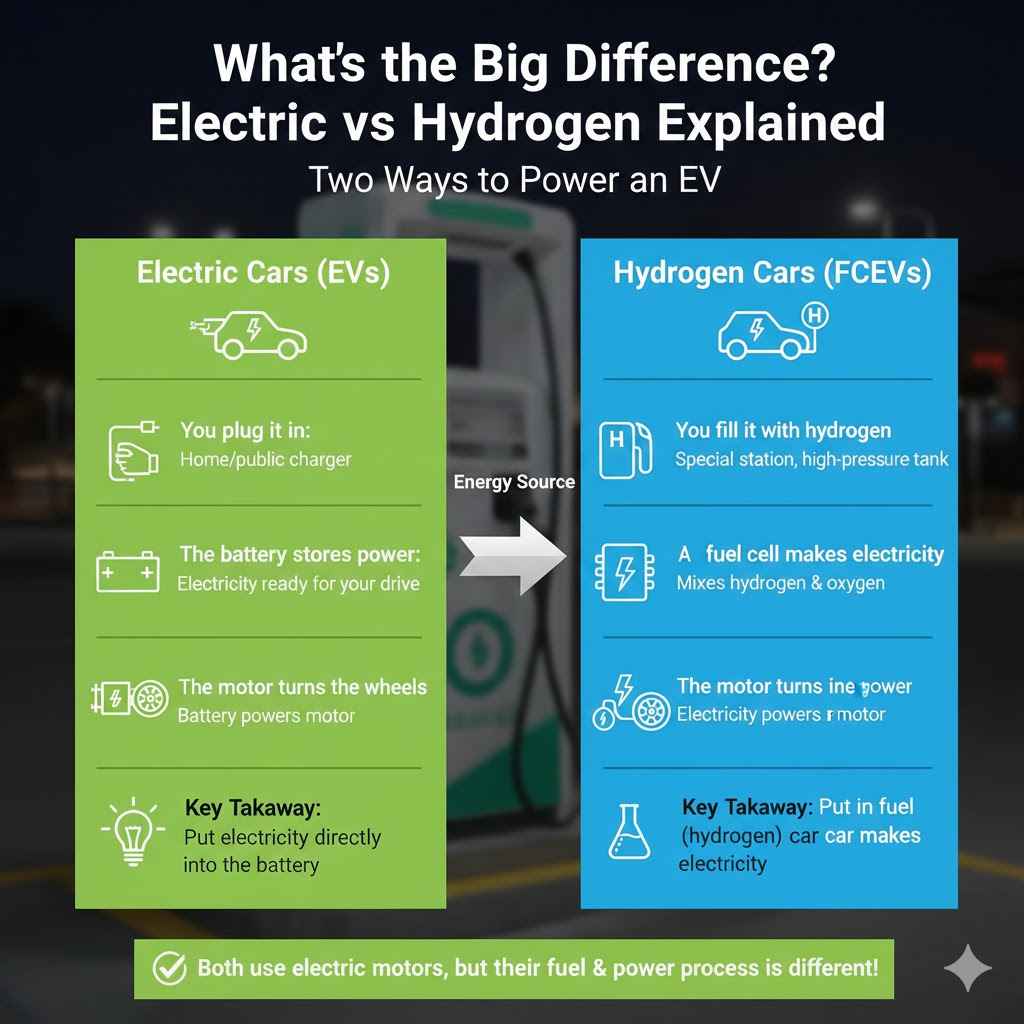
How Electric Cars (EVs) Work
An electric car, or EV, is pretty simple at its core. It’s powered by a large battery pack, much like the one in your smartphone, just a lot bigger. Here’s the process:
- You plug it in: You charge the car by plugging it into an electrical outlet at home or a public charging station.
- The battery stores power: The battery stores this electricity, getting ready for your drive.
- The motor turns the wheels: When you press the accelerator, the battery sends electricity to one or more electric motors, which turn the wheels. That’s it!
There’s no engine, no oil, no gasoline, and no exhaust pipe. It’s a quiet, smooth, and direct way to power a car. The key takeaway is that you are putting electricity directly into the car’s “tank” (the battery).
How Hydrogen Cars (FCEVs) Work
A hydrogen car, officially called a Fuel Cell Electric Vehicle (FCEV), is a bit more complex. It’s also an electric car because it uses an electric motor to turn its wheels. But instead of storing electricity in a big battery, it makes its own electricity on the go. Here’s how:
- You fill it with hydrogen: You go to a special station and fill a high-pressure tank in the car with hydrogen gas. This takes just a few minutes, similar to filling up with gasoline.
- The fuel cell makes electricity: Inside the car, a device called a fuel cell stack mixes the hydrogen from the tank with oxygen from the air.
- A chemical reaction creates power: This reaction creates two things: electricity and water.
- The motor turns the wheels: The electricity powers the electric motor, and the only thing that comes out of the tailpipe is clean water vapor.
So, a hydrogen car is like a mini power plant on wheels. It doesn’t burn anything; it creates electricity through a chemical process. The key takeaway here is that you put a fuel (hydrogen) into the car, and the car converts it into electricity.
The Real-World Showdown: Which is Better for You Today?
Now that you know the basics, let’s compare them on the things that matter to every driver: convenience, cost, and availability. This is where the practical differences really start to show.
Refueling and Charging: Convenience is Key
How you get energy into your car is one of the biggest factors in your day-to-day life. This is where EVs and FCEVs are worlds apart.
Electric Cars (EVs):
- Home Charging is a Game-Changer: The biggest advantage of an EV is waking up to a “full tank” every morning. Most EV owners install a Level 2 charger in their garage or driveway, which can fully charge the car overnight. It’s as easy as plugging in your phone.
- Public Charging is Growing: When you’re on the road, you use public charging stations. The network of these stations is growing rapidly. You can find them at shopping centers, rest stops, and dedicated charging hubs. A DC fast charger can add hundreds of miles of range in 20-40 minutes. You can find charging locations through the U.S. Department of Energy’s station locator.
- The Downside: Charging still takes longer than pumping gas. While you can plan for it on road trips, it does require a shift in mindset.
Hydrogen Cars (FCEVs):
- Fast Refueling: This is hydrogen’s main selling point. You can fill up a hydrogen tank in about 5 minutes—the same time it takes to fill a gasoline car. There’s no waiting around.
- The Massive Downside: Where do you find a hydrogen station? For almost everyone in the world, the answer is nowhere. As of today, the vast majority of public hydrogen stations are in California, with a tiny handful elsewhere. If you don’t live very close to one of these few stations, a hydrogen car is simply not an option.
- Infrastructure is the Hurdle: Building a hydrogen station is incredibly expensive, far more than an EV charger. This is the single biggest barrier to hydrogen cars becoming common.
Cost: What’s the Damage to Your Wallet?
Everyone wants to save money. Let’s look at the upfront cost to buy the car and the long-term cost to run it.
Upfront Cost:
- EVs: The price range for new EVs is huge. You can find affordable models starting around $27,000 and luxury models well over $100,000. The used EV market is also growing, offering even more budget-friendly options. Government tax credits can also lower the price significantly.
- FCEVs: Your choices are extremely limited. There are only a couple of models for sale (like the Toyota Mirai and Hyundai Nexo), and they start at a high price point, often over $50,000. Because so few are sold, the used market is tiny.
Running Cost:
- EVs: Electricity is much cheaper than gasoline. Charging at home typically costs the equivalent of about $1 to $2 per “gallon” of gasoline. Even public fast charging is usually cheaper than gas. Maintenance is also lower, with no oil changes, spark plugs, or exhaust systems to worry about.
- FCEVs: Hydrogen fuel is very expensive. It can cost significantly more per mile to run a hydrogen car than even a gasoline car. While maintenance is also lower than a gas car, finding a mechanic qualified to work on a fuel cell system is extremely difficult and can be costly.
Availability: Can You Even Buy One?
This is a simple but critical point. What can you actually go out and buy today?
- EVs: Dozens and dozens of models are available. Sedans, SUVs, trucks, sports cars—you name it. Nearly every major car manufacturer either has multiple EVs on the market or has plans to release them very soon. You have a huge amount of choice in size, style, price, and range.
- FCEVs: As mentioned, there are only two main models available, and they are only sold in specific areas of California where fueling stations exist. Your choice is practically zero unless you live in a very specific neighborhood.
A Clear Comparison: EV vs. Hydrogen Side-by-Side
Sometimes a simple table makes everything clearer. Here’s a direct comparison of the key features for the average driver.
| Feature | Electric Cars (EVs) | Hydrogen Cars (FCEVs) |
|---|---|---|
| Refueling/Charging Time | Overnight at home (full). 20-40 minutes at a public fast charger for significant range. | ~5 minutes at a hydrogen station. |
| Fuel Availability | Growing public network. Can charge anywhere there’s an outlet, especially at home. | Extremely rare. Almost exclusively in California. |
| Vehicle Availability | Hundreds of models from nearly all manufacturers (sedans, SUVs, trucks). | Only 2-3 models available, and only in very limited markets. |
| Upfront Cost | Wide range of prices, with many affordable options and a growing used market. Tax credits available. | Very expensive, with few choices and a small used market. |
| Running Cost per Mile | Low. Electricity is significantly cheaper than gasoline. | High. Hydrogen fuel can be more expensive than gasoline. |
| Maintenance | Very low. No oil changes, spark plugs, or exhaust systems. Tire rotation and brake fluid are main items. | Low, but specialized fuel cell service can be hard to find and expensive. |
Environmental Impact: Green vs. Greener?
Many people switch to new technologies to help the environment. Both EVs and FCEVs have zero tailpipe emissions, which is a huge win for air quality in our cities. But the full picture is a bit more complex.
For EVs, the environmental impact comes from two main sources: how the electricity is made and how the batteries are produced. If your electricity comes from solar or wind power, driving an EV is incredibly clean. If it comes from a coal power plant, it’s less clean, but still typically better than a gasoline car. Manufacturing large batteries also requires energy and mining for minerals like lithium and cobalt, which has an environmental footprint.
For FCEVs, the impact comes from how the hydrogen is produced. This is the “dirty little secret” of hydrogen. Currently, over 95% of hydrogen is produced from natural gas in a process that creates a lot of carbon dioxide. This is called “gray hydrogen.” The ideal is “green hydrogen,” made by splitting water using renewable energy, but this method is very expensive and not widely used. You can learn more about the different hydrogen production processes from the Department of Energy.
For now, the infrastructure for green electricity is far more developed and widespread than the infrastructure for green hydrogen, giving EVs a practical edge in being “greener” today.
The Pro Tip: Making the Right Choice for You
So, after all that information, what’s the simple answer to our big question? Here’s my pro tip, broken down for you.
You Should Buy an Electric Car if…
- You want a car for today, not a science project. The technology, vehicles, and charging infrastructure for EVs are here and ready for you to use right now.
- You can charge at home. If you have a driveway, garage, or even a dedicated parking spot with an outlet, an EV will be incredibly convenient for you.
- You want choice. Whether you need a family SUV, a commuter car, or a powerful truck, there is an EV model that fits your needs.
- You want to save money on fuel and maintenance. The long-term running costs of an EV are consistently lower than gas cars and, currently, hydrogen cars.
You Should Wait for Hydrogen if…
Honestly, for almost everyone reading this, there is no practical reason to wait for hydrogen. It’s a technology that holds promise for the distant future, especially for heavy-duty applications like trucking and shipping where massive batteries are a problem. But for personal cars, the obstacles are just too big right now.
You might only consider it if:
- You happen to live and work right next to one of the few public hydrogen stations in California.
- You are a dedicated early adopter who is willing to accept major limitations in vehicle choice, fuel availability, and cost.
For 99.9% of drivers, the answer is clear. The debate isn’t really a debate at all when it comes to practical, everyday driving in the world we live in today.
Conclusion: Your Road Ahead is Electric
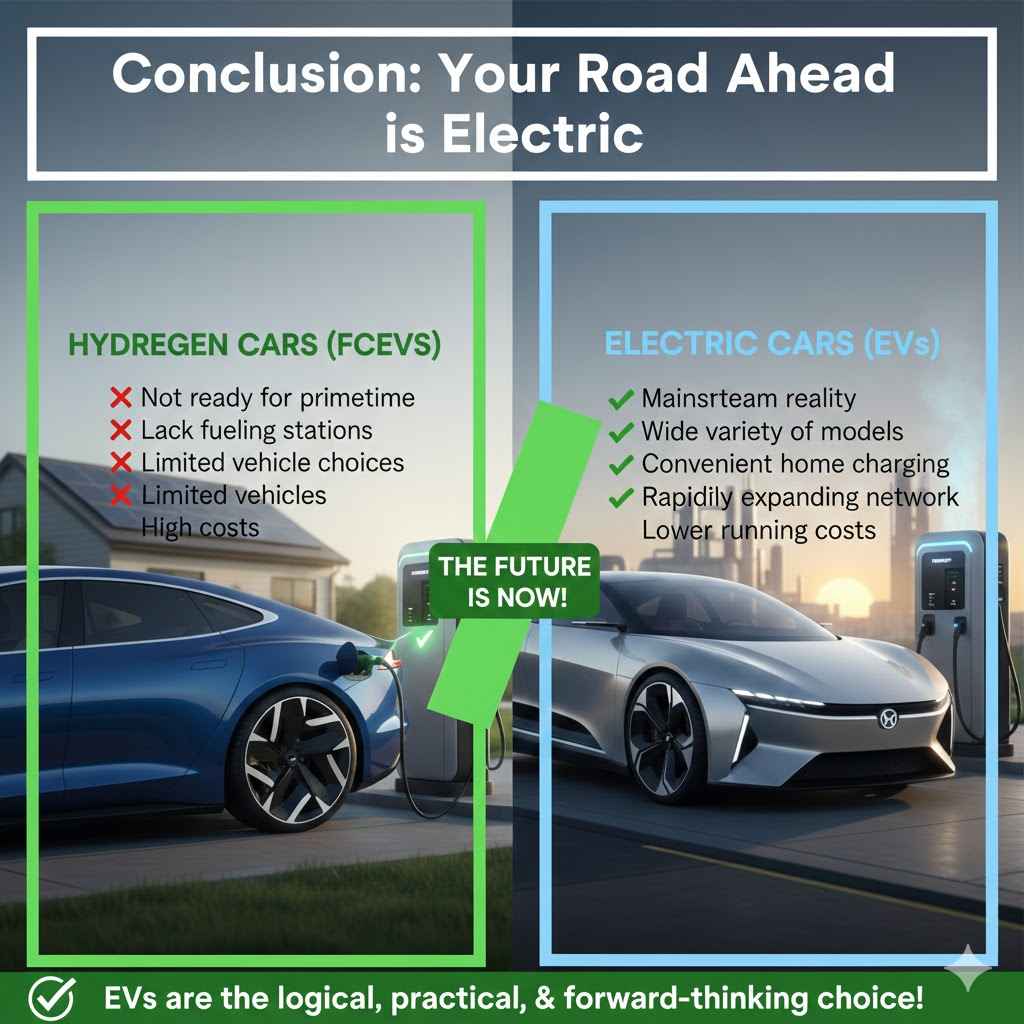
Choosing a new car is a big decision, and it’s smart to look at all the options. While hydrogen fuel cell technology is fascinating and may one day play an important role in transportation, it is not ready for primetime. The lack of fueling stations, limited vehicle choices, and high costs make it an impractical choice for the average driver.
Electric cars, on the other hand, have crossed the line from a niche product to a mainstream reality. With a wide variety of models, the unbeatable convenience of home charging, a rapidly expanding public charging network, and lower running costs, EVs are the logical, practical, and forward-thinking choice. You don’t need to wait for the future of driving—it’s already here, and it’s electric.
Frequently Asked Questions (FAQ)
Is hydrogen safer than electricity in a car?
Both technologies are designed with extremely high safety standards. Hydrogen cars have incredibly strong carbon fiber tanks designed to withstand severe impacts. Similarly, EV batteries are housed in armored, protected casings. Both are considered very safe, and one is not inherently “safer” than the other in modern, well-engineered vehicles.
How long do EV batteries last?
Most manufacturers guarantee their EV batteries for 8 years or 100,000 miles. However, real-world data shows that most batteries last much longer, often for the entire lifespan of the car, with only a gradual and manageable decrease in range over time.
Will hydrogen cars ever become common?
It’s possible, but it would require a massive and incredibly expensive global effort to build out a hydrogen production and fueling infrastructure. Many experts believe hydrogen is better suited for heavy-duty transport (semitrucks, ships, planes) rather than personal cars, where battery-electric technology is already so far ahead.
What happens if I run out of charge in an EV?
Running out of charge is similar to running out of gas. Your car will give you multiple strong warnings when the battery is low. If you do run out, you’ll need to call for roadside assistance to tow you to the nearest charging station. This is why planning ahead for charging on long trips is important, just like planning for gas stations in a remote area.
Are electric cars really cheaper to own than gas cars?
Often, yes. While the initial purchase price of an EV can sometimes be higher, the total cost of ownership is frequently lower. This is thanks to significant savings on fuel (electricity is cheaper than gas), much lower maintenance costs (no oil changes, etc.), and potential government tax incentives.
Can I get a tax credit for buying an EV or hydrogen car?
Yes, federal, state, and even local governments often offer tax credits or rebates for purchasing new (and sometimes used) zero-emission vehicles. These incentives change frequently, so it’s best to check the official fueleconomy.gov website for the latest information on what credits your specific vehicle qualifies for.
Why isn’t there a bigger push for hydrogen cars?
The main reason is efficiency and cost. It takes a lot of energy to create, compress, and transport hydrogen. Much of that energy is lost along the way. Using electricity to directly charge an EV battery is a much more efficient and direct use of energy, which also makes it cheaper. The massive cost of building a new fueling infrastructure from scratch is another major barrier.