
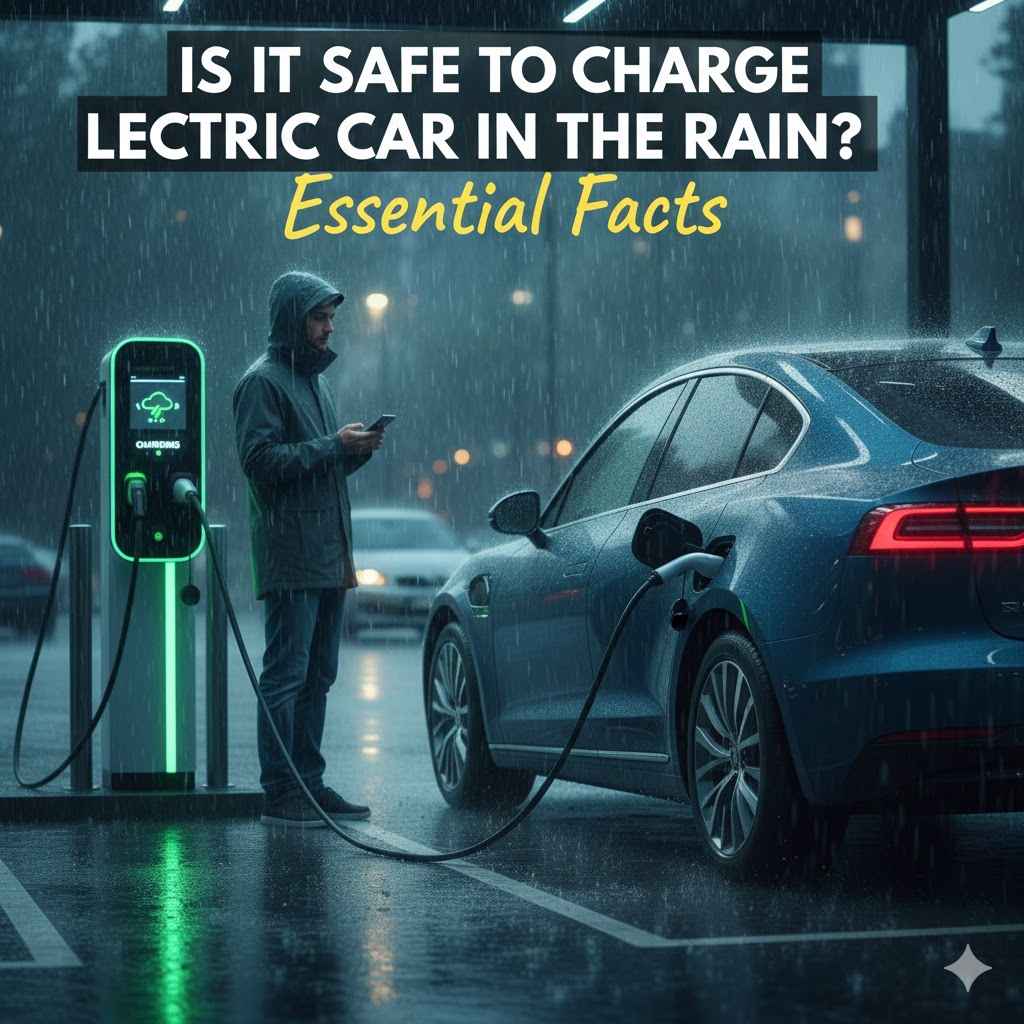
Yes, it is completely safe to charge your electric car in the rain. Electric vehicles (EVs) and charging stations are specifically designed and rigorously tested to be weatherproof. Multiple layers of safety features, including sealed components and automatic shut-offs, prevent any risk of electric shock, ensuring you can power up safely, rain or shine.
Have you ever pulled up to a charging station on a rainy day and hesitated? You’re not alone. The old rule we all learned as kids—water and electricity don’t mix—makes many new EV owners feel a little nervous. It’s a perfectly normal concern to have when you’re handling a high-powered cable in the middle of a downpour.
But here’s the good news: you can put that worry aside. Car manufacturers and charging companies have spent years perfecting the technology to make it incredibly safe. Your car isn’t going to short-circuit, and you’re not going to get a shock. In this guide, I’ll walk you through exactly why it’s so safe, the smart technology that protects you, and a few simple checks you can do for extra peace of mind.
Why Charging an EV in the Rain is Safe: The Built-In Protections
Thinking about charging in the rain might feel strange, but electric vehicles and their chargers are built like fortresses against the weather. They are packed with safety systems that work together to protect you and your car. Let’s break down the key features that make rainy-day charging a routine and worry-free task.
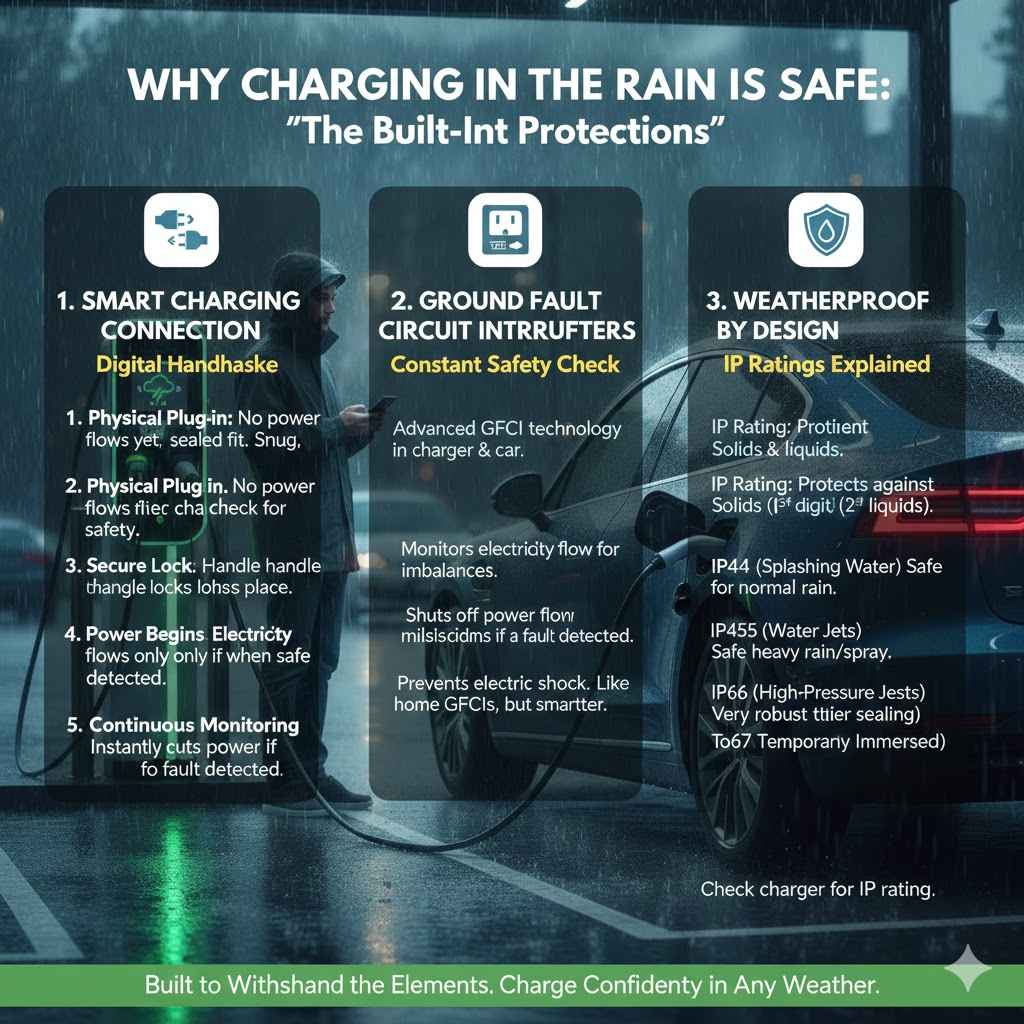
The Smart Charging Connection
Plugging in your EV isn’t like plugging in a toaster. It’s a “smart” process. Before any electricity starts flowing, your car and the charger have a digital conversation to make sure everything is perfectly safe and secure. This “handshake” process is a crucial safety step.
Here’s how it works, step-by-step:
- Physical Connection: First, you physically plug the charging handle into your car’s port. At this point, no power is flowing. The handle is designed to fit snugly, creating an initial barrier against moisture.
- Digital Handshake: The charger and your car begin communicating. They check that the plug is fully seated, locked in place, and that there are no faults in the system.
- Secure Lock: Once the connection is confirmed as secure, the charging handle locks into your car’s port. This prevents it from being accidentally pulled out while electricity is flowing.
- Power Flow Begins: Only after all these checks are complete and the connection is locked does the charger begin sending power to your car’s battery.
- Continuous Monitoring: Throughout the entire charging session, the system continuously monitors the connection. If it detects any issue, like a change in electrical resistance or a ground fault, it will instantly cut the power.
This communication process ensures that electricity only flows when it has a completely safe, sealed, and secure path to your car’s battery.
Ground Fault Circuit Interrupters (GFCIs)
You might already have Ground Fault Circuit Interrupters (GFCIs) in your home. They are the special outlets with “TEST” and “RESET” buttons you see in kitchens and bathrooms. Their job is to protect you from electric shock by monitoring the flow of electricity.
EV charging systems use this same life-saving technology, but on a much more advanced level. Both the charging station (whether it’s a public station or your home unit) and your car’s onboard charger have GFCI protection. They watch the electrical current very closely. If they detect even the tiniest imbalance—which could happen if electricity were to stray from its intended path—they shut off the power in a fraction of a second. This happens long before it could ever pose a danger to you or your vehicle.
Weatherproof by Design: IP Ratings Explained
EV charging equipment is built to live outdoors. To prove it, manufacturers test their products and give them an Ingress Protection (IP) rating. An IP rating is a standard that tells you exactly how well a device is protected against solids (like dust) and liquids (like rain).
An IP rating has two numbers:
- The first number (0-6) rates protection against solid objects. A higher number means better protection.
- The second number (0-9) rates protection against liquids. This is the one we care about for rain.
Most EV chargers have a high IP rating, meaning they are designed to handle everything from a light drizzle to a heavy, driving rainstorm. Here’s a simple breakdown of what these ratings mean for your charger.
| IP Rating | Protection Against Liquids | What It Means for You |
|---|---|---|
| IP44 | Protected against splashing water from any direction. | This is a common minimum rating. It’s perfectly safe for normal rain. |
| IP55 | Protected against low-pressure water jets from any direction. | This offers even better protection and can easily handle heavy rain and spray. |
| IP66 | Protected against high-pressure water jets from any direction. | This is very robust protection, suitable for chargers in exposed locations. |
| IP67 | Protected against temporary immersion in water (up to 1 meter for 30 minutes). | This is top-tier weatherproofing. While you shouldn’t submerge your charger, this rating shows it’s extremely well-sealed. |
You can usually find the IP rating on the charger itself or in its manual. This rating is a guarantee from the manufacturer that their equipment is built to withstand the elements safely.
What You Need to Check: Simple Safety Tips for Rainy Day Charging
While EV charging systems are incredibly safe, it never hurts to be mindful. Just like you’d check your tires or mirrors before driving, a quick visual check before charging in the rain can add an extra layer of confidence. These are simple, common-sense habits that are good to develop for any charging session, rain or shine.
Inspect Your Equipment Before You Plug In
Take 10 seconds to look over the charging equipment. You’re just checking for any obvious signs of damage or wear and tear. This is especially important at public charging stations, which are used by many different people.
- Check the Charging Cable: Look at the thick cable that runs from the station to the handle. Are there any deep cuts, cracks, or exposed wires? If you see anything that looks damaged, it’s best to move to a different charger and report the issue to the station owner.
- Inspect the Charging Handle (Connector): Look at the plastic handle and the pins inside. Does the plastic look cracked or broken? Are any of the metal pins bent or corroded? It should look clean and in good condition.
- Glance at the Car’s Charging Port: Before you plug in, take a quick look at your car’s charging port. Is it clear of debris like leaves, dirt, or ice? A quick wipe with a cloth is all it needs if you see anything. The port has drainage holes to get rid of water, so a little rain inside is no problem.
If everything looks good, you’re ready to plug in. If you notice any damage, simply choose another station. Your safety is always the top priority.
Avoid Standing in Deep Puddles
This is less about your EV and more about general electrical safety. The charging system is sealed and grounded, so the risk of shock is virtually zero. However, standing in a large, deep puddle of water around any high-powered electrical device is something to be avoided out of an abundance of caution. If the area around the charger is flooded, it might be wise to find another station. For normal puddles from rainfall, you have nothing to worry about.
Using Home Chargers vs. Public Stations
The safety principles are the same whether you’re charging at home or on the go, but there are a few specific things to keep in mind.
- Home Chargers (Level 1 & 2): A professionally installed Level 2 charger is your best bet for home charging. An electrician will ensure it is properly wired, grounded, and weatherproofed for outdoor installation. If you use a Level 1 charger (the one that plugs into a standard wall outlet), make sure you are using a GFCI-protected, weather-resistant outlet. The U.S. Department of Energy strongly recommends against using a standard extension cord for EV charging, as they are not designed for the sustained power draw and can be a fire hazard.
- Public Chargers (DC Fast Chargers): Public charging stations, especially DC fast chargers, are heavy-duty commercial units. They are built to the highest safety and durability standards and are designed for constant outdoor use in all weather conditions. They undergo regular inspections and maintenance, so you can use them with a very high degree of confidence.
Common Myths About Charging in the Rain Debunked
There’s a lot of misinformation out there about electric vehicles, especially when it comes to safety. Let’s clear up a few common myths about charging in the rain so you can feel completely at ease.
| Myth | Fact |
|---|---|
| Myth: You can get electrocuted just by touching your car while it’s charging in the rain. | Fact: This is impossible. The car’s entire chassis is grounded. The charging system will not activate until it has a secure, sealed connection. Multiple safety layers, including the GFCI, are ready to cut the power instantly if any fault is detected. You are perfectly safe. |
| Myth: Rainwater can seep into the charging port and short-circuit the battery. | Fact: Your EV’s battery is housed in a heavily reinforced, completely waterproof and sealed container. The charging port itself is also designed to be weatherproof and has drainage paths to handle any water that gets in. A little rain in the port won’t cause any harm. |
| Myth: If lightning strikes nearby, your car will explode while charging. | Fact: While a direct lightning strike is extremely dangerous for any object, an EV is no more at risk than a gasoline car. The car’s metal body acts as a Faraday cage, directing the current around the occupants to the ground. Additionally, both the car and the charging station have built-in surge protectors. However, as a general safety precaution, the National Weather Service advises people to avoid being outdoors and handling conductive materials during a thunderstorm. It’s wise to pause charging and wait for the storm to pass, just as you would avoid using a landline phone. |
| Myth: The charging handle becomes “live” with electricity as soon as you pick it up. | Fact: The charging handle is completely inert until it is securely locked into your vehicle’s port and the digital handshake is complete. You can hold the handle in the pouring rain, and even drop it in a puddle (though not recommended!), and it will not have any electrical current running through it. |
What to Do If Something Looks Wrong
In the rare event that you notice something amiss with a charging station, knowing what to do can keep you and other drivers safe. If you see signs of damage, or if the charger isn’t working correctly, follow these simple steps.
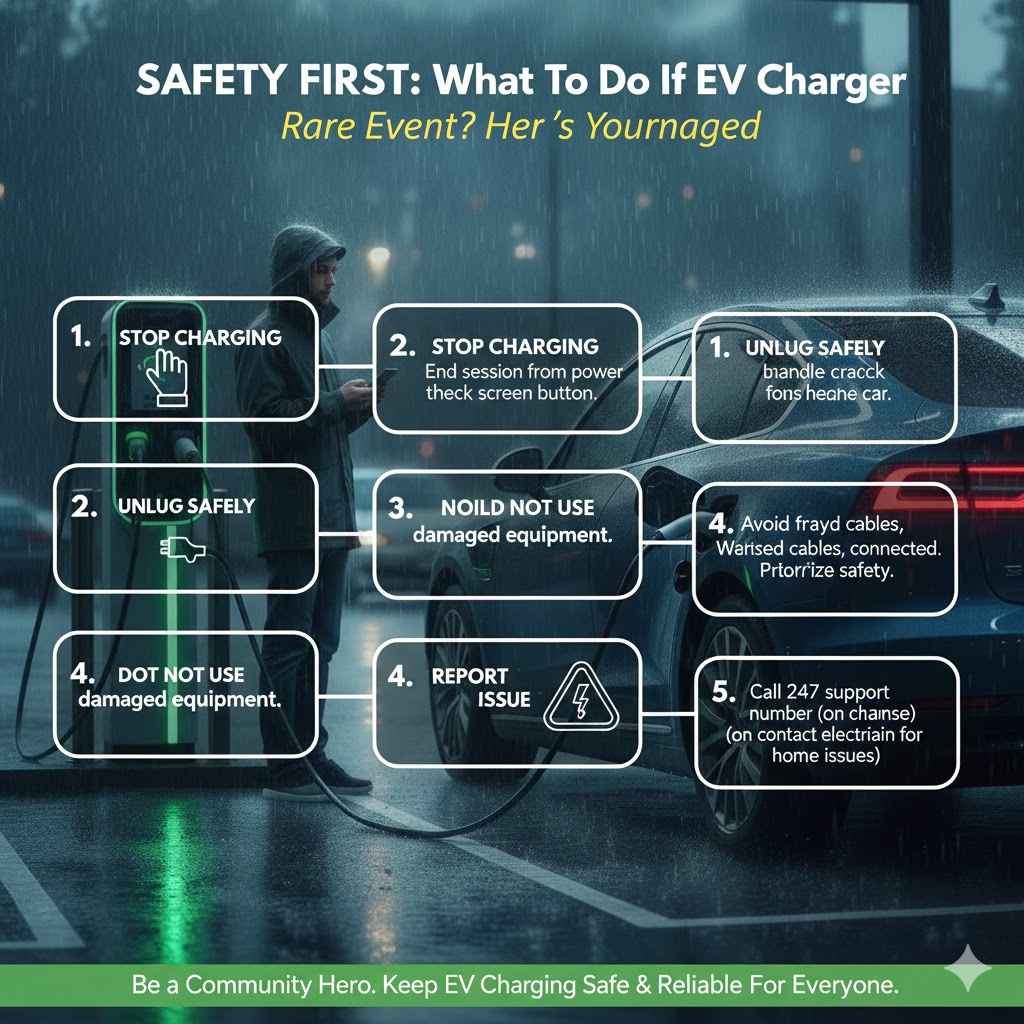
- Stop the Charging Session: If your car is already charging, stop the session immediately. You can usually do this from your car’s infotainment screen, a button near the charge port, or on the charging station’s screen.
- Unplug the Charger: Once the session has stopped, safely unplug the charging handle from your vehicle.
- Do Not Use Damaged Equipment: If you see frayed cables, a cracked connector, or any other signs of significant damage, do not attempt to use the charger. Your safety is more important than a few extra miles of range.
- Report the Issue: Look for a phone number or a QR code on the charging station. Most have a 24/7 customer support line. Call them and report the station number and the issue you observed. This helps the operator fix the problem quickly and keeps the next driver safe. For a home charger issue, contact a qualified electrician.
By reporting a faulty station, you’re being a helpful member of the EV community. It ensures the infrastructure stays safe and reliable for everyone.
Frequently Asked Questions (FAQ)
Can I use an extension cord to charge my EV in the rain?
No, you should never use a standard extension cord to charge your electric vehicle, especially not in the rain. EV manufacturers and safety organizations like the National Fire Protection Association (NFPA) strongly advise against it. Standard extension cords are not designed to handle the high, sustained power draw required for EV charging and can overheat, creating a serious fire risk. They also lack the necessary weatherproofing and safety features.
What happens if I drop the charging handle in a puddle?
Nothing will happen. The charging handle does not carry any electrical current until it is securely plugged into and locked with the vehicle. The power only flows after the “digital handshake” confirms a safe connection. While you should try to avoid dropping it, a momentary dip in a puddle will not cause a dangerous situation.
Is it safe to use a public DC fast charging station during a heavy downpour?
Yes, absolutely. Public charging stations, particularly DC fast chargers, are commercial-grade equipment built to withstand severe weather conditions, including heavy rain, snow, and ice. They have very high IP ratings and undergo rigorous testing to ensure they are safe for public use in all weather.
Does rain affect the charging speed of my EV?
No, rain itself has no impact on charging speed. The charging process is managed by the car’s battery management system and the charger, which are not affected by precipitation. Extreme ambient temperatures (very hot or very cold) can sometimes cause the charging speed to be slightly reduced to protect the battery, but rain will not.
Should I cover my car’s charging port or the charger handle when it’s raining?
It is not necessary. Both the port on your car and the charging handle are designed to be weatherproof. The critical electrical contact points are well-protected from direct exposure to water. While adding a cover won’t hurt anything and might give you extra peace of mind, it is not required for a safe charging session.
Are all EV chargers completely waterproof?
EV chargers are highly water-resistant, but not technically “waterproof” in the sense that they can be fully submerged in water. Their IP ratings (like IP55 or IP67) ensure they can easily handle exposure to rain, sleet, and even pressure washing. You should never use a charger that is sitting in standing water or is partially submerged.
Conclusion: Charge with Confidence, Rain or Shine
Charging your electric car in the rain is one of those things that might seem worrying at first, but is actually a normal, everyday activity. The combination of smart technology, redundant safety features, and robust, weatherproof engineering ensures that every charging session is as safe as possible. From the digital handshake that confirms a secure connection to the GFCI that stands ready to cut power in an instant, the entire system is designed with your safety as the top priority.
So the next time you need to charge up and the weather isn’t cooperating, you can plug in with complete confidence. Just remember to perform a quick visual check of the equipment, and you’ll be ready to power up safely and get back on the road, no matter what the sky looks like. Welcome to the safe, simple, and reliable world of electric vehicle ownership.