
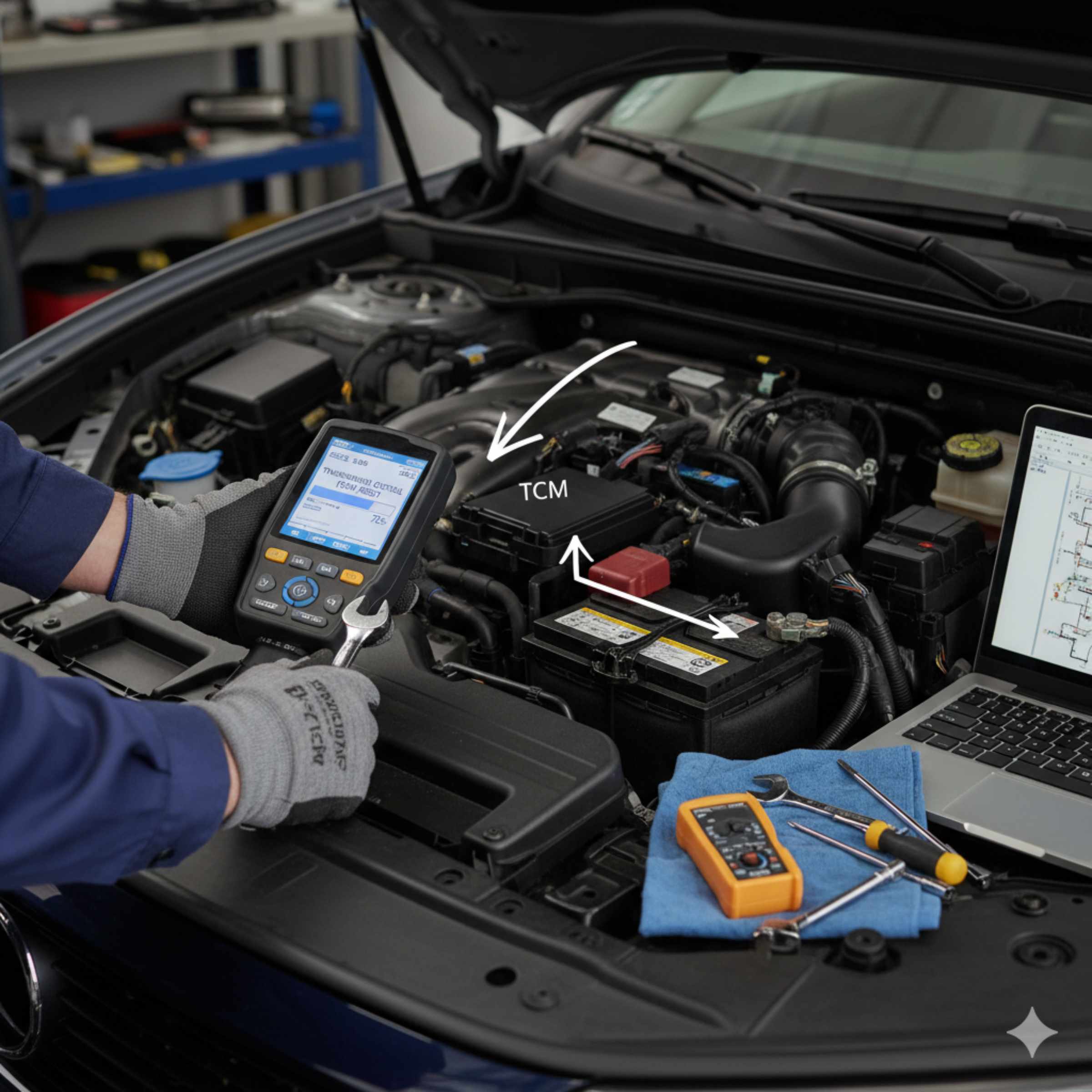
Resetting your Transmission Control Module (TCM) is often a simple, free fix for rough shifting or warning lights. This guide shows you exactly how to perform a basic power/battery disconnect reset safely, even if you’ve never worked on your car before. Follow these easy steps to get your transmission shifting smoothly again.
Does your car suddenly feel jumpy when shifting gears, or do you see a troubling warning light on your dash? It can be frustrating when your automatic transmission starts acting strange. Often, this strange behavior is caused by bad data stored in the Transmission Control Module (TCM). Think of the TCM as your transmission’s small brain. Sometimes, this brain just needs a quick reboot!
The good news is that you don’t need a mechanic for a basic reset. We are going to walk through the simplest, safest way to clear out those temporary glitches. This beginner-friendly guide will give you the confidence to try this simple fix yourself. Ready to learn how to clear those phantom problems and restore smooth driving?
What Exactly Is the Transmission Control Module (TCM)?
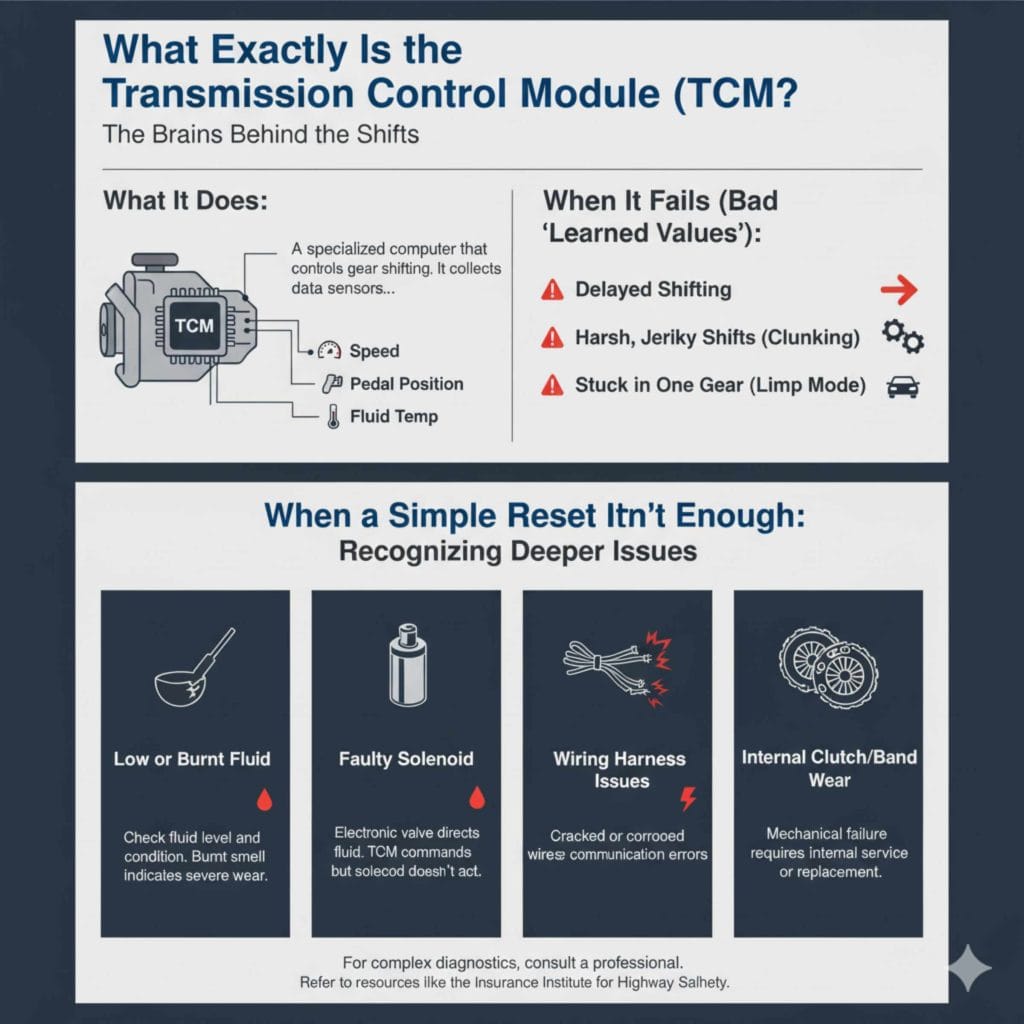
Before we touch anything, let’s quickly understand what we are resetting. The Transmission Control Module, or TCM, is a specialized computer inside your vehicle. It’s dedicated entirely to controlling how your transmission shifts gears.
This little powerhouse constantly collects information from various sensors—like how fast you are going, how hard you press the gas pedal, and the temperature of the transmission fluid. Based on this data, it decides the perfect moment to shift up or down.
When it works right, you never notice it. When it has bad or corrupted data stored (often called “learned values”), it can cause issues like:
- Delayed shifting when accelerating.
- Harsh, jerky shifts (clunking).
- The transmission staying stuck in one gear (limp mode).
Why Would You Need to Reset the TCM?
A reset is essentially forcing the TCM to forget its recent, flawed learning history and start fresh. It’s like restarting your phone when an app freezes. Here are the main reasons a reset might help:
- After Minor Repairs: If you replaced a simple sensor or cleaned something near the engine, clearing the old errors can help the TCM adapt faster to the new, correct data.
- Correcting Strange Shifting Patterns: If your car started shifting weirdly after a long trip or heavy towing, a reset clears the skewed “learned” driving style.
- Clearing Intermittent Trouble Codes: Sometimes, minor glitches throw a code that isn’t a permanent part, but a soft reset can clear it before it requires an expensive scan tool.
Important Note: A reset will not fix broken internal parts, severe electrical problems, or major mechanical failures. If your “Check Engine” light is on for a serious issue, a simple battery disconnect might only make the light go off temporarily.
Preparing For Your TCM Reset: Safety First!
Safety is always our number one priority. Working with your car’s electrical system, even just disconnecting the battery, requires a few simple precautions. Do not skip these steps!
Tools You Might Need
For the most common and beginner-friendly method (the battery disconnect), you usually only need a few basic tools:
- Wrench or socket set (usually 10mm or 13mm for battery terminals).
- Safety glasses.
- Gloves (optional, but recommended).
- A small piece of cardboard or insulated cloth (to prevent accidental reconnection).
Safety Precautions checklist
Before you pop the hood, go over this quick list:
- Ensure the car is parked on a flat, level surface.
- Engage the parking brake firmly.
- Make sure the ignition is completely off and remove the key.
- Do not attempt this while the engine is hot. Let the car cool down for at least 30 minutes.
The Beginner’s Guide: How to Reset the TCM via Battery Disconnect
This method is the most straightforward way to perform a “hard reset” on most modern vehicles. It cuts power to all computer modules, including the TCM, forcing them to reload their factory default settings.
Step 1: Locate the Battery
Open the hood. The battery is usually a large black box located on one side of the engine bay. Check your owner’s manual if you can’t find it right away.
Step 2: Disconnect the Negative Battery Terminal (Crucial Step)
This is the most important step. You MUST disconnect the negative cable first.
- Identify the two terminals. The negative terminal will have a minus sign (-) symbol and is almost always connected by a black cable.
- Using your wrench, loosen the nut on the clamp connected to the negative post. Don’t remove the nut completely—just loosen it enough so the clamp wiggles freely.
- Carefully pull the negative cable off the post completely.
- Tuck the cable safely away from the battery post so it cannot accidentally touch it while you wait. The National Highway Traffic Safety Administration reminds us that safety around vehicle power sources is paramount.
Step 3: The Waiting Period (Drain Capacitors)
Now that the battery is disconnected, you need to wait. This waiting time allows the small electrical charges stored in the capacitors of the TCM (and other modules) to drain completely. Without this wait, the memory might not clear.
- Recommended Wait Time: Wait for a minimum of 15 to 30 minutes. For older vehicles or persistent issues, waiting 45 minutes is even better.
Step 4: Reconnect the Battery
Once the waiting time is over, it’s time to reconnect power:
- Take the negative cable and firmly place the clamp back onto the negative battery post (-).
- Tighten the nut securely. It should not wiggle at all.
- Double-check that the cable is seated properly and tightly clamped.
Step 5: Initiate the Relearn Procedure
Even after a hard reset, many modern transmissions require a short “relearn” period to start learning your driving habits again.
- Turn the ignition to the “ON” position (do not start the engine) for about 60 seconds.
- Turn the ignition OFF.
- Start the engine. Let it idle for about 5 minutes without touching the gas pedal.
- Gently drive the vehicle through various speeds, allowing it to shift normally. Do not accelerate aggressively for the first 10 minutes of driving.
You should feel the shifting smoothness return as the TCM adjusts. If the transmission light was on, it should now be off.
Advanced Reset Method: Using Scan Tools (The Mechanic’s Way)
For those who own or borrow an advanced OBD-II scan tool (like those used in professional shops), you can reset the TCM codes directly without disconnecting the battery. This is faster and keeps your radio presets intact.
When to Use a Scan Tool Reset
- When you only want to clear transmission-specific codes (not all stored data).
- When you want a more precise, targeted reset.
Steps for Using an OBD-II Scanner
This is a basic overview; specific menu navigation varies by tool brand.
- Locate the OBD-II port. This is usually under the dashboard on the driver’s side, near your knees.
- Plug the scan tool in and turn the ignition key to the “ON” position (engine off).
- Navigate the scanner menu to “Read Codes” first to see what is stored. Note down any codes!
- Find the “Pinch/Erase Codes” or “Clear Learned Values” option. Select the menu specific to the Transmission Control Module (TCM).
- Confirm the erase command. The tool will confirm when the codes are cleared.
- Follow Step 5 from the battery section (the driving relearn procedure) afterward.
TCM Reset vs Battery Reset: Understanding the Difference
It is helpful to know what you are clearing. Not all resets are the same. We covered two main types here:
| Reset Type | What It Clears | Time Involved | Best For |
|---|---|---|---|
| Battery Disconnect (Hard Reset) | All learned values, radio presets, permanent memory in ALL modules. | 30–60 minutes (waiting time). | Persistent, minor electronic glitches across multiple systems. |
| OBD-II Scan Tool Reset | Specific diagnostic trouble codes (DTCs) selected by the user, often just TCM related. | 5–10 minutes. | Targeted clearing of transmission-specific fault codes. |
For a beginner just trying to smooth out rough shifts, the battery disconnect is the easiest starting point because it requires minimal specialized equipment.
What Happens After Resetting the TCM?
Keep in mind that “reset” means “default.” The TCM loses all its personalized data about how you drive. This is totally normal!
Initial Driving Behavior
For the first few days of driving after a reset, you might notice:
- The transmission might shift too early or too late—it’s being overly cautious.
- The idle speed might seem slightly higher than usual.
- Your automatic start/stop feature (if equipped) might not work immediately.
This is the TCM running on its factory settings. As you drive normally—city driving, highway cruising—it begins monitoring and saving new “learned values.” This process usually takes between 50 to 100 miles of varied driving.
When the Light Comes Back On
If you perform the reset and the Check Engine Light (or a dedicated Transmission Warning Light) comes back on quickly despite the smooth driving:
This means the issue is physical or electrical, not just a data glitch. At this point, professional diagnosis is needed. You might have a failing solenoid, low transmission fluid pressure, or a damaged wiring harness. It’s time to schedule a visit with a trusted technician who understands modern transmission diagnostics.
Resetting the TCM on Specific Vehicles: Volkswagen (VW) Note
If you are specifically looking into how to reset the transmission control module on a Volkswagen, manual battery resets are often effective, but VWs (especially DSG dual-clutch automatics) sometimes have very specific procedures.
For many modern Volkswagen models (Jetta, Golf, Passat), a simple battery disconnect will reset the basic control modules. However, if you have a complex automatic transmission like the DSG (Direct-Shift Gearbox), a true “reset” often involves specialized software to run adaptation procedures, which is beyond a simple DIY battery pull.
For these VW specific systems, after a battery disconnect, you often need to perform what VW calls basic settings adaptation using a tool like VCDS or ODIS software. If your VW is driving poorly after a battery reset, it likely needs that dedicated software adaptation run, not another physical reset.
Common Pitfalls and How to Avoid Them
Even simple tasks have ways to go wrong. Here are a few common mistakes beginners make when performing a battery disconnect reset:
| Pitfall | Result | Simple Fix |
|---|---|---|
| Disconnecting the Positive (+) Cable First | You can accidentally short the wrench between the post and the metal body of the car, causing sparks and potential damage. | ALWAYS disconnect the Negative (-) cable first, and reconnect it last. |
| Not Waiting Long Enough | Capacitors hold a charge for a while. The TCM memory state might not be fully cleared. | Wait at least 30 minutes before reconnecting the battery. |
| Forgetting Radio Codes | Many older European cars (like some VW models) require a security code to reactivate the radio after a total power loss. | Check your owner’s manual for the radio security code before disconnecting the battery. |
When a Simple Reset Isn’t Enough: Recognizing Deeper Issues
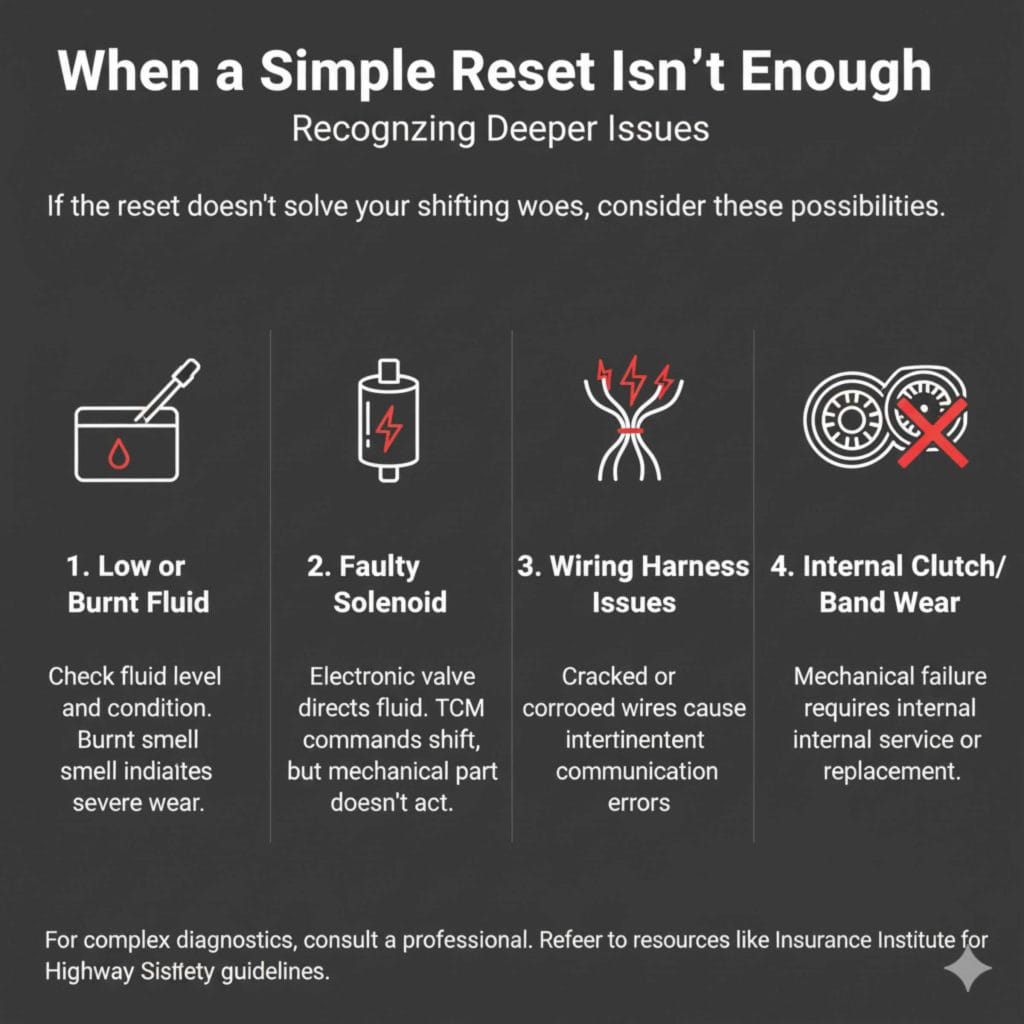
While refreshing the TCM memory is a great first step, it’s important to know when the problem lies elsewhere. If the reset does not solve your shifting woes, consider these possibilities:
- Low or Burnt Fluid: The fluid is the lifeblood of the transmission. If it’s low or smells burnt, the TCM can’t compensate for mechanical weakness. Check your fluid level according to your manual.
- Faulty Solenoid: Solenoids are electronic valves inside the transmission that direct fluid pressure to engage gears. If one fails, the TCM might be correctly commanding a shift, but the mechanical part isn’t working.
- Wiring Harness Issues: Wires leading to the TCM or between the transmission and TCM can get cracked or corroded from heat and moisture, causing intermittent communication errors that a simple reset cannot fix.
- Internal Clutch/Band Wear: This is mechanical failure, meaning the transmission needs internal service or replacement.
For complex diagnostics, always consult resources like the Insurance Institute for Highway Safety guidelines regarding vehicle reliability, or seek professional diagnostics that can read live data from the TCM.
Frequently Asked Questions (FAQ) About TCM Resets
Q1: Will resetting the TCM erase my car’s performance tune or saved settings?
A: Yes, a full battery disconnect reset will erase non-volatile memory across all modules. This includes radio presets, saved seat positions, and any custom performance tuning applied to the Engine Control Unit (ECU), which can affect the TCM’s input slightly.
Q2: How long does it take for the transmission to relearn after a reset?
A: The initial basic relearn happens within the first 10–20 miles of gentle driving. A full adaptation to your typical driving style and road conditions can take up to 100 miles accumulated over a few days.
Q3: Is it bad for my transmission to disconnect the battery often?
A: No, occasionally resetting the battery will not harm the physical components of your transmission. However, doing it constantly suggests you are masking an underlying problem that needs fixing, not just resetting.
Q4: Do all cars have a separate TCM?
A: Most vehicles built after the mid-1990s with automatic transmissions use a dedicated TCM or an integrated unit within the main Engine Control Unit (ECU). Modern cars almost always have a distinct module for transmission control.
Q5: Can disconnecting the battery reset the “limp mode” on my car?
A: A hard battery reset often clears the temporary ‘limp mode’ activation, provided the underlying sensor or issue that triggered limp mode was a transient (temporary) fault. If the fault is active when you restart the car, limp mode will likely re-engage immediately.
Q6: What is the difference between clearing codes and resetting the TCM learned values?
A: Clearing codes just wipes the error history (DTCs). Resetting learned values wipes out the driving behavior data the TCM stored to optimize shifting for you. For rough shifting issues, resetting learned values is often more effective than just clearing codes.
Conclusion: Driving Confidently After Your Reset
You’ve taken a great step in understanding and maintaining your vehicle. Resetting the Transmission Control Module via a simple battery disconnect is a safe, zero-cost way to troubleshoot many frustrating automatic transmission symptoms. Remember that you are just rebooting its temporary memory, giving it a chance to learn better shifting patterns based on correct data.
Follow the steps carefully—especially disconnecting the negative terminal first and waiting the full 30 minutes. Be patient during the relearn phase over the next 100 miles. If the transmission begins acting up again, you have successfully determined the problem isn’t a fleeting electronic glitch, allowing you to move on to the next logical (and perhaps professional) step in diagnostics with greater knowledge. You’ve got this—happy driving!