
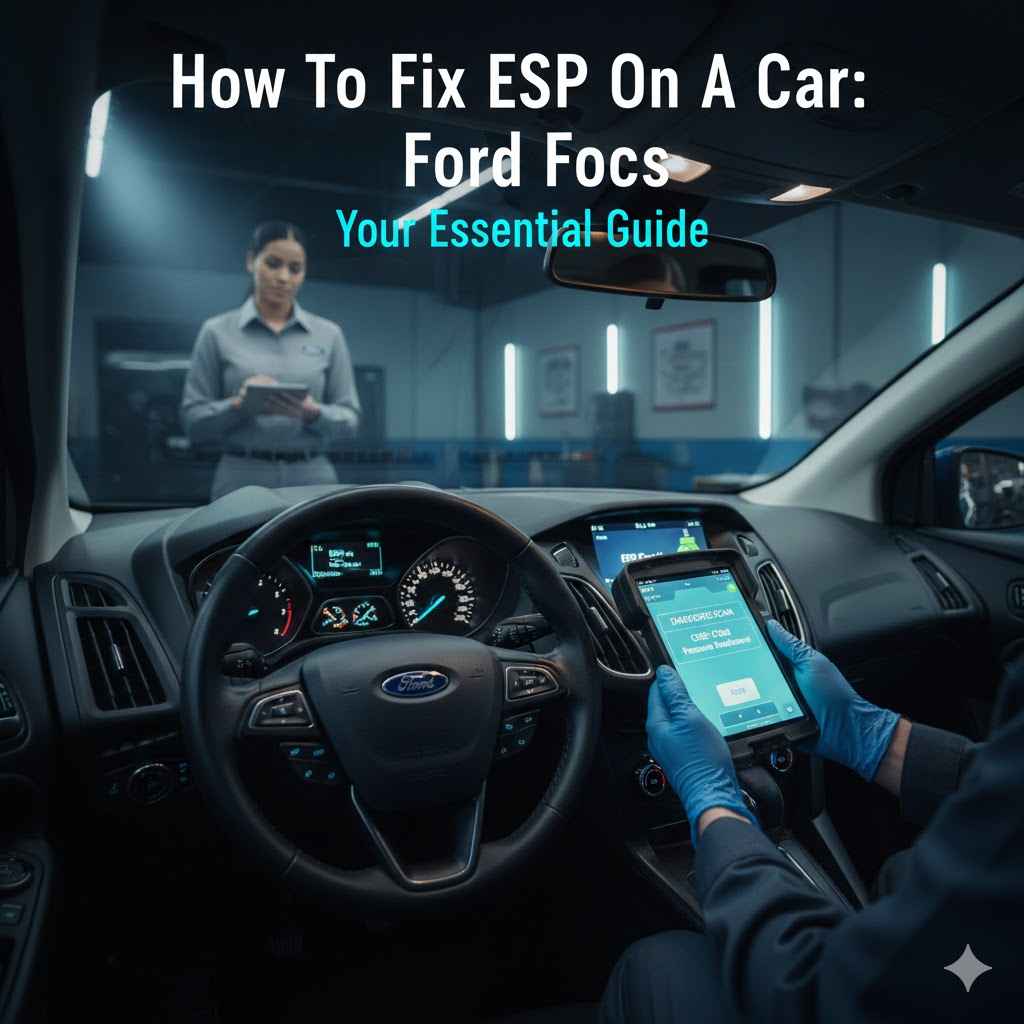
To fix the ESP on a Ford Focus, first use an OBD-II scanner to read the trouble codes. The most common issues are a faulty wheel speed sensor, a bad steering angle sensor, or low battery voltage. Start by checking your tire pressure and cleaning the wheel speed sensors before moving on to more complex electrical checks.
Seeing a warning light pop up on your dashboard can be stressful. The “ESP” light is one of those that can cause worry. What does it mean? Is it serious? The good news is, you’ve come to the right place. Many times, the fix for an ESP issue on your Ford Focus is something you can handle yourself.
This guide is here to help you understand the problem. We will walk through the steps to find the cause. You can learn how to fix it without a costly trip to the mechanic. Let’s get your car back to being safe and reliable, one simple step at a time.
What is ESP and Why is it So Important?
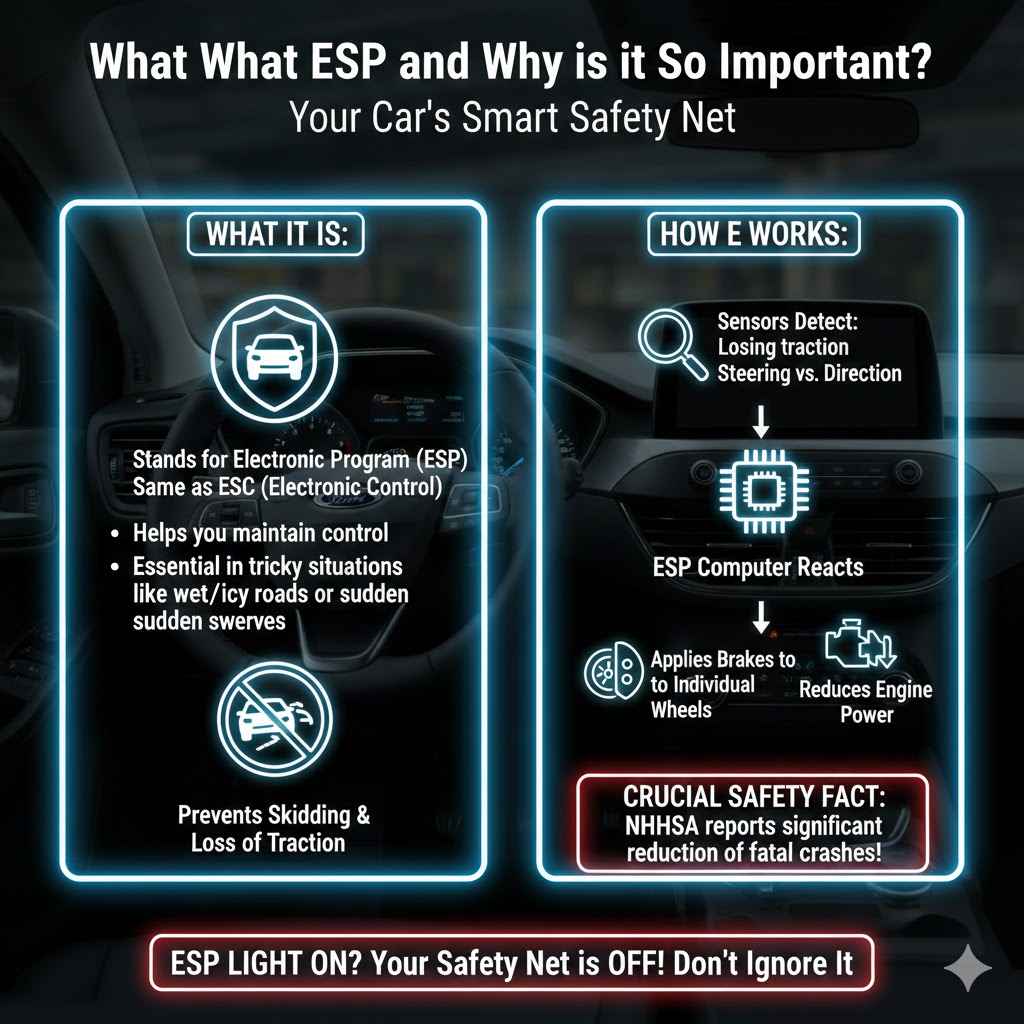
Before we dive into fixing it, let’s quickly talk about what ESP is. ESP stands for Electronic Stability Program. You might also see it called ESC (Electronic Stability Control). Think of it as a smart safety feature that helps you stay in control of your car, especially in tricky situations.
Imagine you’re driving on a wet or icy road and you have to swerve suddenly. Your car could start to slide or skid. This is where ESP jumps into action. It uses a network of sensors to detect if your car is losing traction or heading in a different direction than you’re steering. When it senses a problem, it automatically applies the brakes to individual wheels and may even reduce engine power to help you regain control.
The ESP system is a crucial part of your Ford Focus’s safety net. According to the National Highway Traffic Safety Administration (NHTSA), this technology significantly reduces the risk of fatal single-vehicle crashes. When that light comes on, it means this important safety system is turned off. That’s why we need to figure out what’s wrong and get it fixed.
Common Reasons Your Ford Focus ESP Light is On
Your car’s computer is smart. When it turns on the ESP light, it has stored a “trouble code” that tells us where to look. While an OBD-II scanner is the best way to know for sure, here are the most common culprits behind that glowing light.
- Faulty Wheel Speed Sensor: Each wheel on your Focus has a sensor that tells the computer how fast it’s spinning. The ESP system needs this information to know if a wheel is slipping. If one of these sensors gets dirty, damaged, or fails, the system can’t work correctly. This is one of the most frequent causes.
- Steering Angle Sensor Issues: This sensor is located in your steering column. It tells the computer which way you are trying to steer. If this information doesn’t match what the car is actually doing, the ESP system gets confused and shuts down. Sometimes this sensor just needs to be recalibrated.
- Low Battery Voltage: Modern cars are packed with electronics. The ESP system is very sensitive to voltage. If your car battery is old, weak, or the alternator isn’t charging it properly, it can cause all sorts of random warning lights, including the ESP light.
- Faulty Brake Light Switch: This small switch near your brake pedal does more than just turn on your brake lights. It also tells the ESP system when you are braking. If the switch fails, the ESP system loses a key piece of information and will turn itself off as a precaution.
- ABS Module Problems: The ESP system is closely tied to your Anti-lock Braking System (ABS). They often share the same computer module. If there’s a problem with the ABS module, it will almost always trigger the ESP light as well. This is usually a more serious and expensive fix.
- Incorrect Tire Pressure or Size: The system expects all four tires to be the same size and spinning at similar speeds (when going straight). If you have one tire that is low on air or if you have mismatched tire sizes, it can fool the wheel speed sensors and trigger the ESP light.
Essential Tools You’ll Need
You don’t need a professional workshop to handle the most common ESP issues. Having a few basic tools will make the process much easier and safer. Here’s a list of what you should have on hand.
- OBD-II Scanner: This is the most important tool. It plugs into a port under your dashboard and reads the trouble codes stored in your car’s computer. You can get a basic code reader for a very reasonable price online or at an auto parts store.
- Jack and Jack Stands: If you need to inspect the wheel speed sensors, you’ll have to safely lift the car. Never work under a car supported only by a jack.
- Wheel Chocks: These are essential for safety when jacking up your car. They prevent the car from rolling.
- Basic Socket and Wrench Set: For removing wheels or loosening bolts on sensors.
- Multimeter: This tool is used to test electrical voltage. It’s perfect for checking your battery and alternator.
- Brake Cleaner Spray: A simple can of brake cleaner is great for cleaning grime off the wheel speed sensors.
- Safety Glasses and Gloves: Always protect yourself when working on your car.
Step-by-Step Guide to Diagnosing and Fixing the ESP Issue
Ready to get your hands a little dirty and solve this problem? Let’s walk through the process step-by-step. Remember to be patient and work carefully. Your safety is always the top priority.
Step 1: Safety First!
Before you do anything else, make sure you are working in a safe environment.
- Park your Ford Focus on a flat, level surface like a garage or driveway.
- Turn off the engine and put the car in “Park” (for automatic) or in gear (for manual).
- Engage the parking brake firmly.
- If you plan on lifting the vehicle, place wheel chocks behind the wheels that will remain on the ground.
Step 2: Read the Trouble Codes with an OBD-II Scanner
This step is your roadmap. The trouble codes will point you in the right direction and save you from guessing. It’s the first thing a mechanic would do.
- Locate the OBD-II port in your Ford Focus. It’s usually under the dashboard on the driver’s side, near your knees.
- Plug the scanner into the port.
- Turn the ignition key to the “On” position, but do not start the engine.
- Follow the instructions on your scanner to read the Diagnostic Trouble Codes (DTCs).
- Write down any codes the scanner finds. They will usually start with a letter followed by four numbers (e.g., C1288).
Once you have the codes, you can look them up to see what they mean. Here is a table of common codes related to ESP issues on a Ford Focus.
| Trouble Code | Common Meaning | What to Check First |
|---|---|---|
| C1145, C1155, C1165, C1175 | Wheel Speed Sensor Input Circuit Failure | The specific wheel speed sensor (Right Front, Left Front, etc.), its wiring, and connector. |
| C1288 | Pressure Transducer Main/Primary Circuit Failure | This often points to an issue within the ABS control module. |
| C1277, C1994 | Steering Wheel Angle Sensor Circuit Malfunction | The steering angle sensor itself or its calibration. Check for loose connections. |
| U0121 | Lost Communication With ABS Control Module | Fuses, wiring, and the main connector to the ABS module. Could also be a failing module. |
Step 3: Check the Simple Stuff First
Before you start taking things apart, always check the easy things. You would be surprised how often a simple oversight causes a complex-looking problem.
- Tire Pressure: Get a tire pressure gauge and check all four tires. Make sure they are inflated to the pressure recommended on the sticker inside your driver’s side door jamb. A significantly underinflated tire can spin at a different rate, confusing the ESP system.
- Brake Fluid Level: Open the hood and locate the brake fluid reservoir. It’s usually a small, semi-transparent container. Make sure the fluid is between the “MIN” and “MAX” lines. Low fluid can sometimes indicate a leak or worn brake pads, which can indirectly affect the system.
Step 4: Inspect and Clean the Wheel Speed Sensors
If your OBD-II scanner pointed to a specific wheel speed sensor, this is your next stop. Even if it didn’t, it’s a good idea to check them all. These sensors live in a harsh environment and often get covered in brake dust and road grime.
- Safely jack up the car and place it on jack stands.
- Remove the wheel corresponding to the sensor you want to inspect.
- Locate the sensor. It is a small, typically black plastic sensor mounted near the back of the brake assembly. A wire will be leading from it.
- Follow the wire to its connector. Unplug the connector and check for any corrosion or bent pins. Clean it if necessary.
- Unbolt the sensor (usually just one small bolt) and carefully pull it out.
- The tip of the sensor is magnetic. Wipe it clean with a rag and some brake cleaner. Also, inspect the toothed “reluctor ring” that the sensor reads. Make sure it’s clean and not damaged.
- Reinstall the sensor, plug it back in, and put the wheel back on.
- Repeat this process for the other wheels if needed.
After cleaning the sensors, clear the codes with your scanner and take the car for a short drive to see if the light comes back on.
Step 5: Test Your Car’s Battery and Alternator
A weak electrical system can cause chaos for your car’s computers. A simple voltage check can rule this out.
- Set your multimeter to the DC Voltage setting (20V is a good range).
- With the car completely off, touch the red probe of the multimeter to the positive (+) battery terminal and the black probe to the negative (-) terminal.
- A healthy, fully charged battery should read around 12.4 to 12.6 volts. If it’s below 12.2 volts, your battery is weak and may need charging or replacement.
- Now, have a friend start the car while you keep the probes on the battery. The voltage should not drop below 10 volts while cranking.
- With the engine running, the reading should jump up to around 13.7 to 14.7 volts. This shows that the alternator is working correctly to charge the battery. If the voltage stays low, you may have an alternator problem.
Step 6: When You Might Need Professional Help
While many ESP issues are DIY-friendly, some problems are best left to a professional mechanic. Knowing when to stop is just as important as knowing how to start.
Consider calling a pro if:
- The code points to the ABS module: Replacing and programming an ABS module is a complex job that requires specialized tools.
- The issue is the steering angle sensor: While you can check the connection, replacing or recalibrating this sensor often requires specific diagnostic software.
- You have tried all the steps above and the light is still on: A mechanic will have advanced diagnostic equipment to find deeper issues in the wiring or computer systems.
- You don’t feel comfortable: There is no shame in asking for help. If any of these steps seem too difficult or unsafe, it’s always better to trust a professional.
Here’s a table to give you a rough idea of what to expect for repair costs if you do need to visit a shop. Please note these are just estimates and can vary widely based on your location and specific vehicle model.
| Repair Job | Estimated Parts Cost | Estimated Labor Cost | Estimated Total Cost |
|---|---|---|---|
| Wheel Speed Sensor Replacement | $40 – $100 | $80 – $150 | $120 – $250 |
| Steering Angle Sensor Replacement | $150 – $400 | $100 – $200 | $250 – $600 |
| Brake Light Switch Replacement | $15 – $30 | $50 – $100 | $65 – $130 |
| ABS Module Replacement/Repair | $500 – $1500+ | $200 – $400 | $700 – $1900+ |
Preventing Future ESP Problems
Once you’ve fixed the issue, the last thing you want is for it to come back. A little bit of preventative maintenance can go a long way.
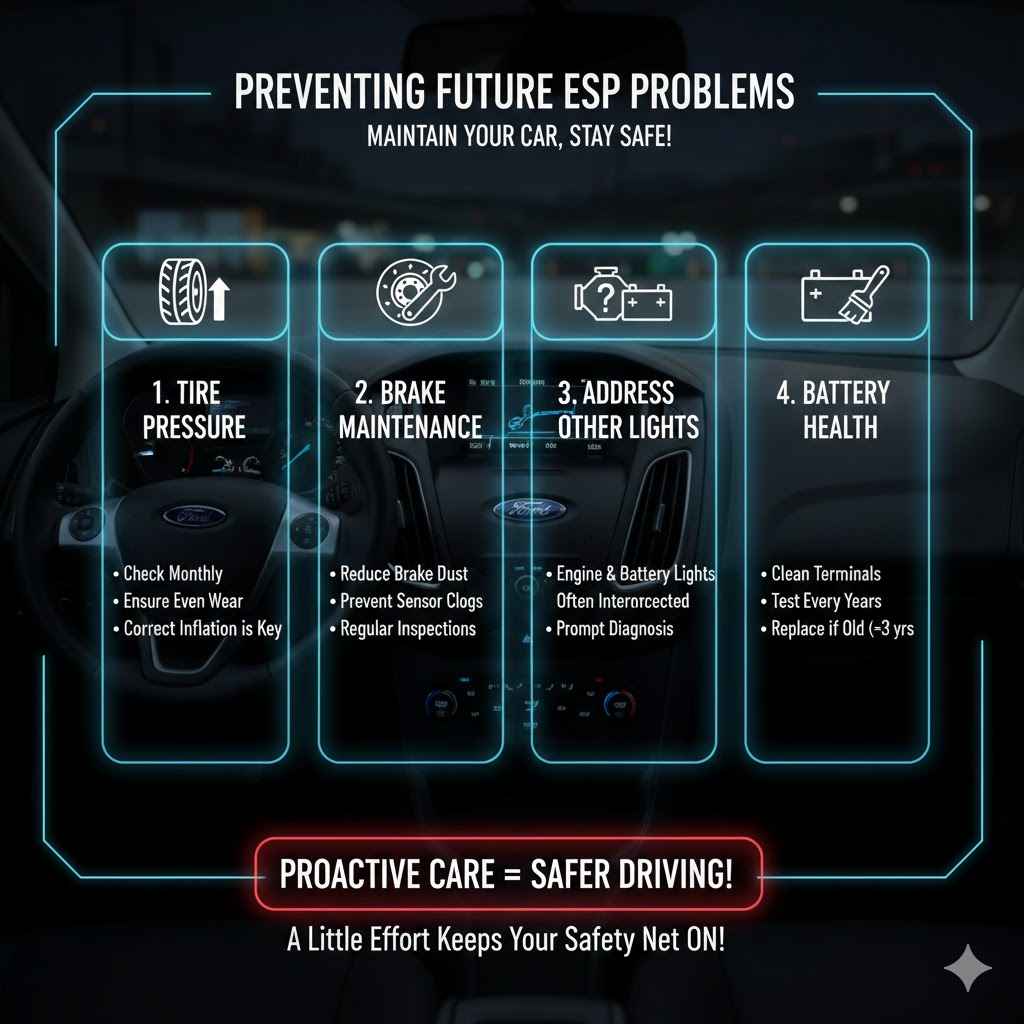
- Regularly check your tire pressure. Make it a habit to check it at least once a month.
- Keep up with brake maintenance. Worn brakes create more dust, which can coat the wheel speed sensors.
- Address other warning lights promptly. A check engine or battery light can sometimes be related to the ESP system.
- Keep your battery terminals clean and have your battery tested every couple of years, especially if it’s over three years old.
Frequently Asked Questions (FAQ)
Can I drive my Ford Focus with the ESP light on?
Yes, you can technically drive the car. The engine and basic braking will still work. However, the Electronic Stability Program safety feature will be disabled. This means the car will not assist you in a skid. You should drive more cautiously, especially in wet or slippery conditions, and get the issue fixed as soon as possible.
How much does it cost to fix an ESP problem?
The cost varies greatly depending on the cause. A simple fix like cleaning a sensor or replacing a brake light switch might cost you less than $50 if you do it yourself. A more complex issue like a failed ABS module could cost over $1,000 at a repair shop.
What does the “ESP Off” button do?
Most Ford Focus models have a button that allows you to manually turn off the ESP system. This is typically used in specific situations, like trying to get unstuck from snow or mud, where you want the wheels to spin freely. If you press this button, the “ESP Off” light will come on. This is different from the ESP warning light, which indicates a system fault.
Will a dead or weak battery cause the ESP light to come on?
Absolutely. The ESP system relies on a steady supply of electricity. If your battery is weak or the voltage drops, the sensitive electronic modules can malfunction and trigger a warning light, even if there’s nothing mechanically wrong with the ESP components.
Can I reset the ESP light myself?
Yes. After you perform a repair, you can use your OBD-II scanner to clear the trouble codes from the computer’s memory. This will turn off the light. If the underlying problem is not truly fixed, the light will come back on after you drive for a short time.
Are the ABS and ESP systems the same thing?
They are not the same, but they are very closely related and work together. The ABS (Anti-lock Braking System) prevents your wheels from locking up during hard braking. The ESP (Electronic Stability Program) uses the ABS hardware to apply individual brakes to prevent skids during turns. A fault in the ABS system will almost always disable the ESP system too.
Conclusion
Facing a dashboard warning light can be intimidating, but it doesn’t have to be a mystery. As we’ve seen, the ESP light on your Ford Focus is often triggered by issues that are straightforward to diagnose and fix. By starting with the simplest checks—like your tires and battery—and using an OBD-II scanner to guide you, you can pinpoint the problem with confidence.
Whether it’s cleaning a wheel speed sensor or simply tightening a loose connection, taking the time to understand your car empowers you to save money and stay safer on the road. Remember to always prioritize safety, and don’t hesitate to consult a professional if a repair feels beyond your comfort zone. You’ve got this!