
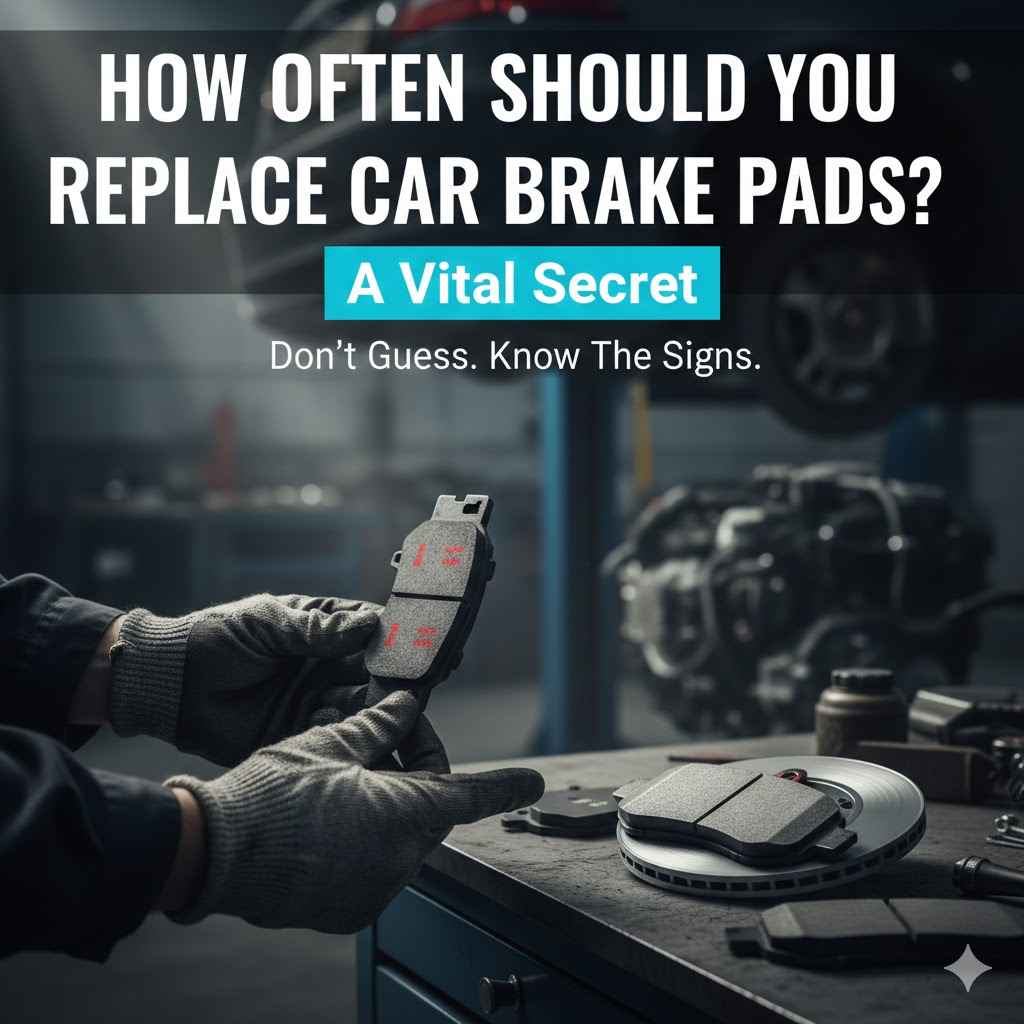
Most car brake pads should be replaced every 30,000 to 70,000 miles. However, this range varies greatly based on your driving style, the type of brake pads you have, and your vehicle. The best way to know for sure is to listen for warning sounds and visually inspect your brake pads regularly for wear.
Have you ever worried about your car’s brakes? It’s a common feeling. Your brakes are one of the most important safety features on your vehicle. But knowing exactly when to replace the brake pads can feel like a mystery. You might hear different numbers from different people, which can be confusing.
Don’t worry! Understanding your brake pads is much easier than you think. You don’t need to be a professional mechanic to know when it’s time for a change. This guide will show you the simple secrets to brake pad life, the warning signs to look for, and how you can stay safe on the road. Let’s make car care simple, together.
What Do Brake Pads Actually Do? A Simple Explanation
Before we talk about replacing them, let’s quickly understand what brake pads do. Imagine riding a bicycle. When you want to stop, you squeeze the brake levers. This pushes rubber pads against the spinning wheel, and the friction slows you down.
Your car’s brakes work in a very similar way, just with stronger parts. Here’s the team:
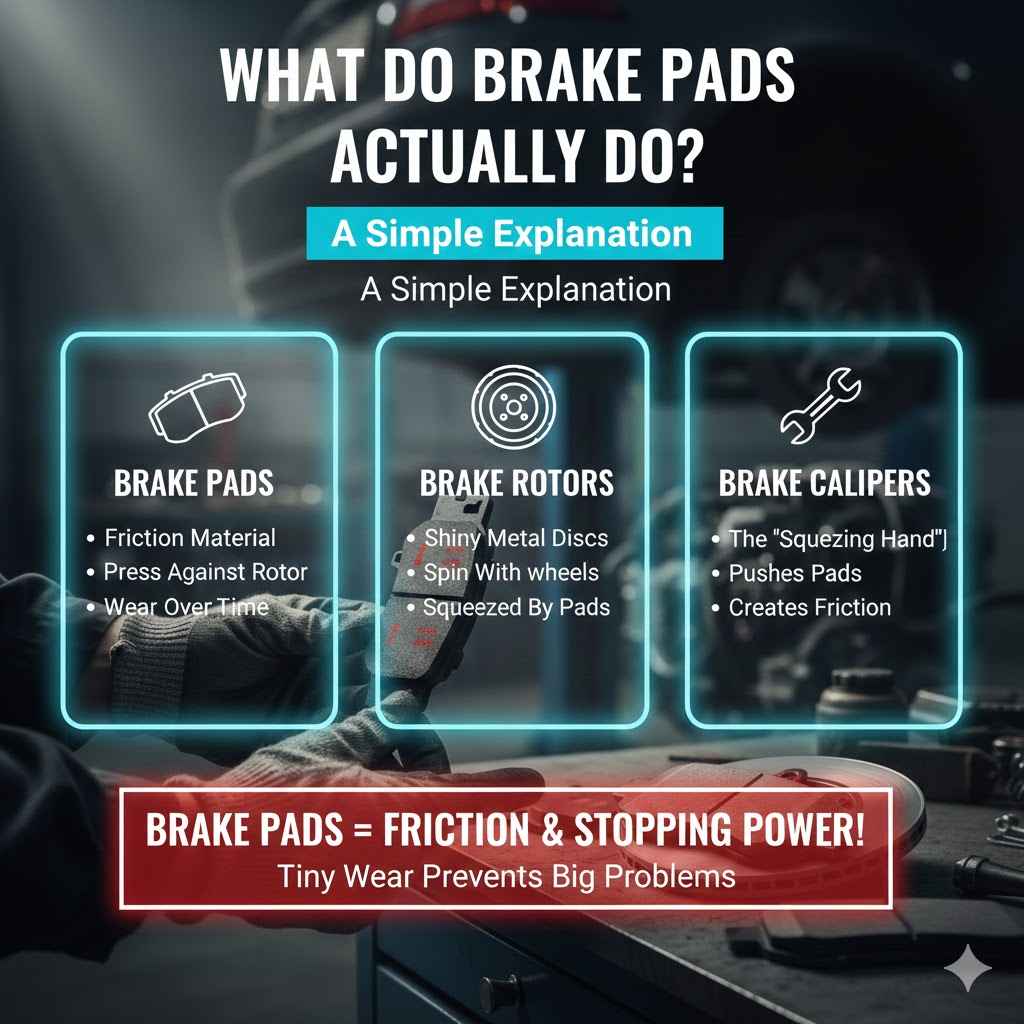
- Brake Pads: These are the “rubber pads” from our bicycle example. They have a friction material on one side that presses against the rotor.
- Brake Rotors: These are shiny metal discs that spin with your wheels. The brake pads squeeze the rotors to stop the car.
- Brake Calipers: The caliper is like the hand that squeezes. When you press the brake pedal, the caliper pushes the brake pads against the rotor.
Every time you brake, a tiny bit of the friction material on the pads wears away. Over thousands of miles, this wear adds up until the pads become too thin to work safely. That’s when they need to be replaced.
The “Secret” to Brake Pad Lifespan: It’s Not Just About Miles
The biggest secret about brake pads is that there is no single magic number for replacement. A friend might tell you they replace theirs every 30,000 miles, while a mechanic might say 70,000 miles. Both can be right! The real answer depends entirely on a few key factors.
Your Driving Habits Make the Biggest Difference
How you drive is the number one factor that determines how long your brake pads last. Think about it: the more you use your brakes, the faster they wear out.
- City Driving vs. Highway Driving: If you drive mostly in the city with lots of stop-and-go traffic, you are using your brakes constantly. This wears them out much faster. A highway driver who brakes less often will see their pads last much longer.
- Aggressive vs. Gentle Driving: Do you tend to brake hard and at the last minute? This aggressive style creates a lot of heat and friction, wearing down pads quickly. A gentle driver who anticipates stops and coasts more will preserve their brakes.
- “Riding” the Brakes: Resting your foot on the brake pedal while driving, especially downhill, causes constant friction and wears out your pads extremely fast. It’s a habit to avoid!
The Type of Brake Pad Matters
Not all brake pads are created equal. They are made from different materials, and each type has its own pros and cons for lifespan, noise, and performance. Understanding the type you have can give you a better idea of what to expect.
| Brake Pad Type | Description | Lifespan | Pros | Cons |
|---|---|---|---|---|
| Organic (NAO) | Made from a mix of non-metallic materials like rubber, glass, and resins. Often the standard pad on new cars. | Shorter | Quiet, soft on rotors, inexpensive. | Wear out faster, create more dust, don’t perform as well in extreme heat. |
| Semi-Metallic | Made with 30% to 65% metal, like steel wool or copper, mixed with other materials. | Longer | Durable, excellent stopping power, handles heat well. | Can be noisy, harder on rotors, can produce more dark dust. |
| Ceramic | Made from dense ceramic fibers and non-ferrous filler materials. A premium option. | Longest | Very quiet, produce very little light-colored dust, stable in a wide range of temperatures. | Most expensive, may not stop as quickly as semi-metallic pads in very cold weather. |
Your Vehicle and Environment Play a Role
Finally, your car itself and where you drive it can change the equation.
- Vehicle Weight: Heavier vehicles like trucks and SUVs need more force to stop. This means more work for the brakes and faster pad wear compared to a small, lightweight car.
- Towing or Hauling: If you frequently tow a trailer or carry heavy loads, you are putting a massive extra strain on your braking system. Expect to replace your pads more often.
- Terrain: Driving in a hilly or mountainous area requires much more braking than driving on flat land. All that downhill braking generates a lot of heat and wears pads down quickly.
So, What’s the General Rule of Thumb?
Even though it varies, you probably still want a general number to keep in mind. Most mechanics and manufacturers suggest a range of 25,000 to 70,000 miles. It’s a wide range, but it covers most situations.
To help you narrow it down, here is a simple table that gives you a better estimate based on your driving style. Find the description that sounds most like you.
| Driving Profile | Typical Driving Environment | Estimated Brake Pad Lifespan |
|---|---|---|
| Aggressive City Driver | Lots of stop-and-go traffic, hard braking, heavy vehicle or towing. | 20,000 – 35,000 miles |
| Average Commuter | A mix of city and highway driving, moderate braking. | 35,000 – 60,000 miles |
| Gentle Highway Driver | Mostly highway miles, anticipates stops, gentle on the brakes. | 60,000 – 80,000+ miles |
Remember, these are just estimates! The most important thing is to learn how to recognize the warning signs that your brakes are wearing out.
5 Warning Signs That Your Brake Pads Need Replacing (Don’t Ignore These!)
Your car is great at telling you when something is wrong. You just have to know what to listen and feel for. If you notice any of these signs, it’s time to get your brakes checked right away.
- High-Pitched Squealing or Screeching
This is the most common and earliest warning sign. Most brake pads have a small metal piece called a “wear indicator.” When the pad material gets too thin, this metal tab scrapes against the rotor, making a loud squealing noise whenever you brake. It’s an audible alert system designed to tell you: “Time for new pads soon!” - Deep Grinding or Growling Sounds
If you hear a low, harsh grinding noise, this is a much more serious warning. It often means you have completely worn through the brake pad material, and now the metal backing plate of the pad is grinding against the metal rotor. This is not only unsafe but can also severely damage your brake rotors, leading to a much more expensive repair. Stop driving and see a mechanic immediately. - Vibration or Pulsing in the Brake Pedal
Do you feel a shaking or pulsing sensation in the brake pedal or steering wheel when you slow down? This often points to a warped brake rotor. Rotors can become uneven from excessive heat caused by hard braking. While this isn’t a direct sign of worn pads, the two issues often happen together. - Your Car Pulls to One Side When Braking
When you hit the brakes, your car should stop in a straight line. If it consistently pulls to the left or right, it could mean the brake pads are worn unevenly. It could also signal a problem with the brake caliper or brake fluid. This is a safety issue that needs to be inspected. - The Brake Pedal Feels “Spongy” or “Soft”
If your brake pedal feels mushy or goes down further to the floor than usual, it can be a sign of very worn pads or, more seriously, a problem in your brake’s hydraulic system (like air in the brake lines). Your brakes may not be providing their full stopping power, so this requires immediate attention.
How to Check Your Brake Pads Yourself (It’s Easier Than You Think!)
You don’t always have to wait for a warning sign. You can do a quick visual check of your brake pads yourself. It only takes a few minutes and can give you great peace of mind. For your safety, always do this when the car is parked on a flat, level surface and the engine is off and cool.
Step 1: Look Through Your Wheels
You may not even need to take the wheel off. Many modern cars have wheels with open spokes that allow you to see the brake caliper and pads. Grab a flashlight and kneel down so you are level with the wheel.
Step 2: Find the Brake Pad and Caliper
Look behind the spokes of your wheel for the shiny metal brake rotor. Clamped around it is the brake caliper. Between the caliper and the rotor, you will see the brake pad pressed against the rotor. You are looking for the thickness of the friction material on the pad.
Step 3: Check the Pad Thickness
You will see the thick metal backing plate and, pressed against the rotor, the pad material itself. A new brake pad is about 8-12 millimeters thick (about 1/2 inch). A good rule of thumb is to replace them when they get down to about 3-4 millimeters (about 1/4 inch). If they look thinner than that, it’s time to schedule a replacement.
For official guidance on vehicle safety and maintenance, resources like the National Highway Traffic Safety Administration (NHTSA) provide valuable information for all drivers.
Replacing Your Brake Pads: DIY vs. Professional Mechanic
So you’ve determined you need new brake pads. Now what? You have two choices: do it yourself (DIY) or take it to a trusted mechanic. Both are great options, depending on your comfort level, time, and budget.
Doing It Yourself (DIY)
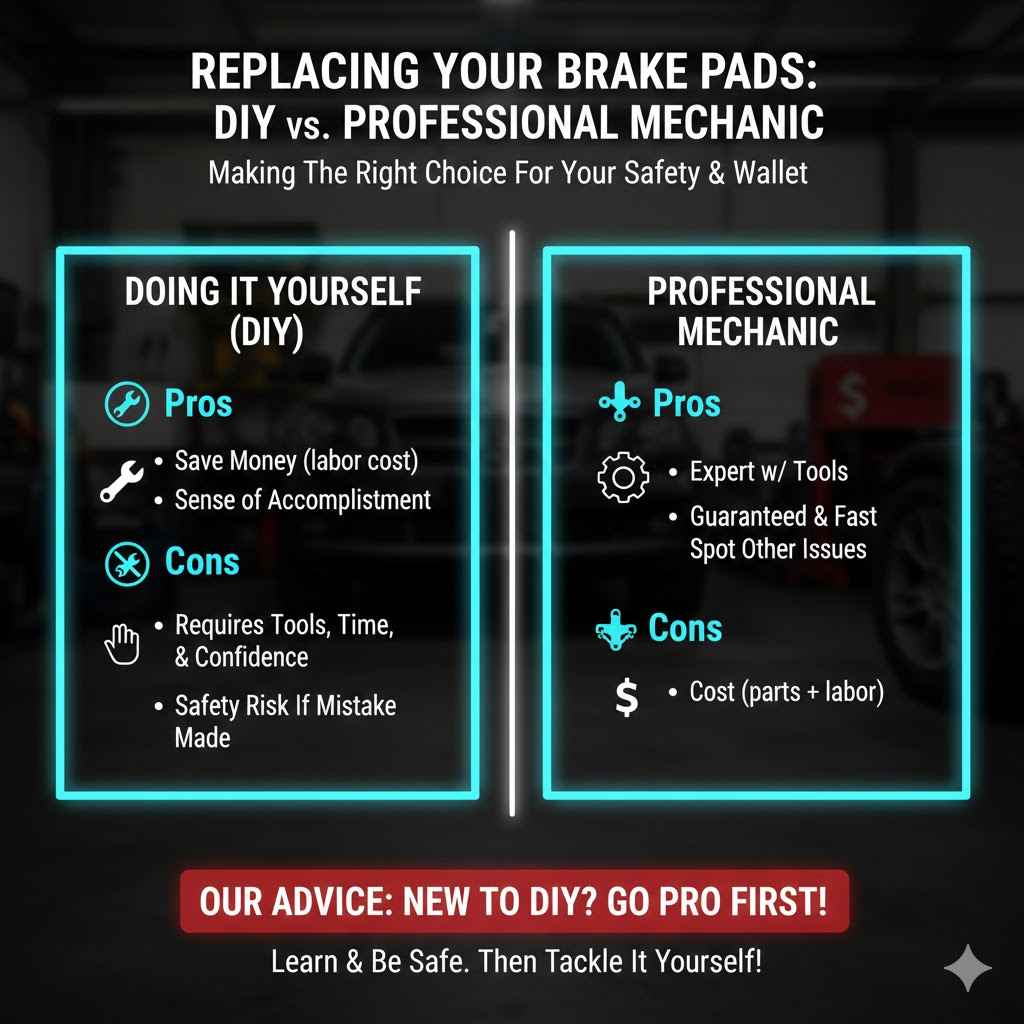
- Pros: The biggest advantage is saving money on labor costs. You only pay for the parts. Many people also find a great sense of accomplishment in learning to work on their own car.
- Cons: It requires specific tools (like a jack, jack stands, and a lug wrench), time, and some mechanical confidence. Brakes are a critical safety system, so if you make a mistake, the consequences can be serious.
Going to a Professional Mechanic
- Pros: You get the job done by an expert who has the right tools and experience. The work is often guaranteed with a warranty, and it’s fast and safe. A professional can also spot other potential issues with your braking system.
- Cons: The main drawback is the cost, as you will be paying for both parts and labor.
Our Advice: If you are new to car repair, it’s wise to have a professional handle your first brake job. You can watch and ask questions to learn. If you’re feeling confident and have done your research, the DIY route can be very rewarding.
Frequently Asked Questions (FAQ)
How much does it cost to replace brake pads?
The cost can vary widely, from around $150 to over $300 per axle (front or rear). It depends on your car’s make and model, the type of pads you choose, and local labor rates. Luxury and performance cars will cost more.
Should I replace the rotors at the same time as the pads?
Not always, but it’s often a good idea. Rotors wear down and can become warped over time. If your rotors are too thin, grooved, or warped, they must be replaced. Many mechanics recommend replacing pads and rotors together for the best performance and safety.
What are brake rotors?
Brake rotors are the large metal discs that your wheels are attached to. The brake pads squeeze against the rotors to create the friction needed to stop your car. They are a vital part of the braking system.
Can I just replace the front brake pads?
Yes. The front brakes on most cars do about 70% of the stopping, so they tend to wear out much faster than the rear brakes. It’s very common to replace only the front or only the rear pads as needed.
What’s that burning smell after new brakes are installed?
A slight burning smell is normal for the first few dozen miles after getting new brakes. This is usually the resins and materials on the new pads “curing” as they heat up for the first time. The smell should go away quickly. If it persists, have your mechanic check their work.
How long do new brakes take to “break in”?
New brake pads need a “bedding-in” period to properly mate with the rotor surface. This usually takes the first 200-300 miles of mixed driving. During this time, try to avoid hard, panic stops. Gentle, moderate braking will help them perform their best for years to come.
What’s the difference between brake pads and brake shoes?
Brake pads are used in disc brake systems (with rotors), which most modern cars have on all four wheels. Brake shoes are used in older drum brake systems. Instead of squeezing a rotor, shoes push outward against the inside of a metal drum. Some cars still have drum brakes on the rear wheels.
Your Brakes, Your Safety: A Final Word
Knowing how often to replace your brake pads isn’t about memorizing a mileage number. It’s about building a relationship with your car. By understanding how your driving habits affect your brakes and learning to spot the common warning signs, you take control of your vehicle’s safety.
Don’t ever put off a brake inspection. Whether you check them yourself or ask your mechanic during an oil change, regular checks are the key. Listening to your car and trusting your instincts will keep you, your passengers, and everyone else on the road safe. You’ve got this!