
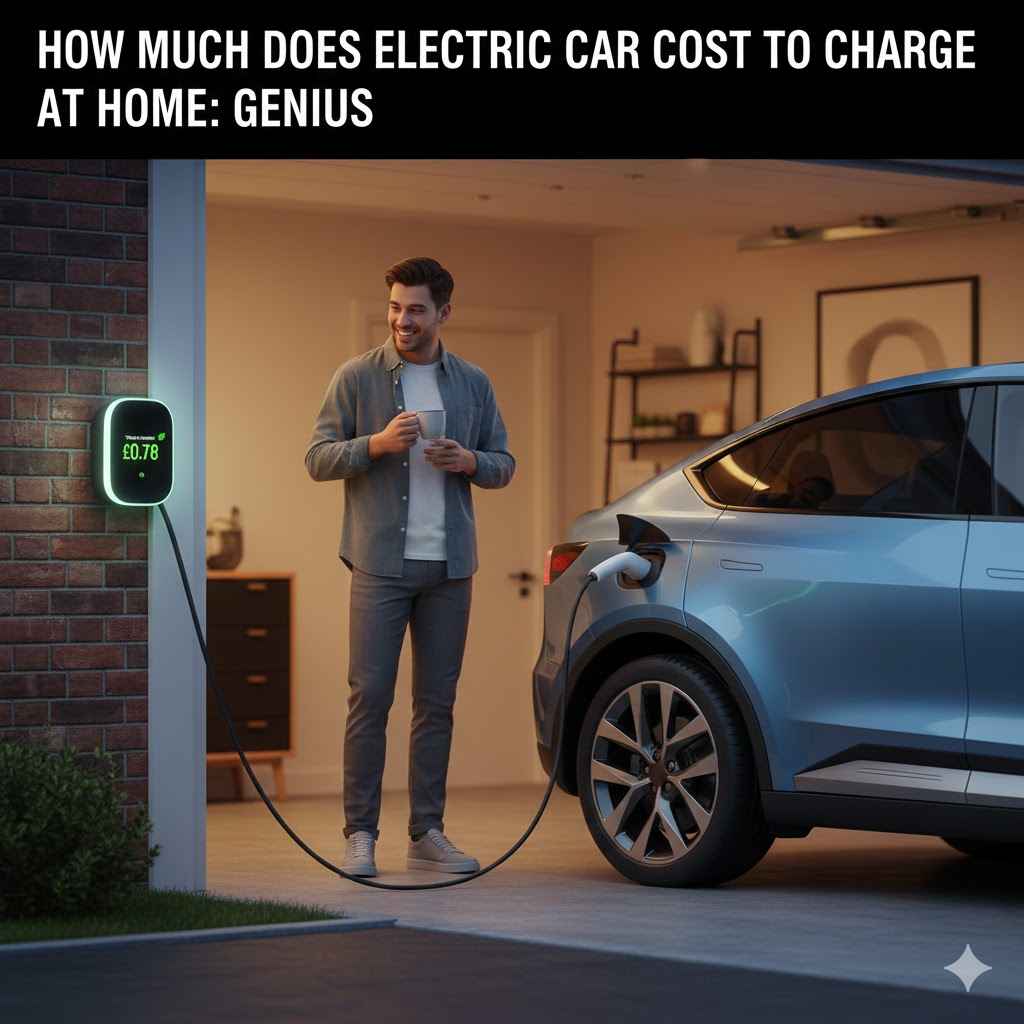
Charging an electric car at home typically costs between $5 and $15 for a full charge, making it significantly cheaper than gasoline. The exact cost depends on your local electricity rate (cents per kWh), your car’s battery size, and when you charge. Using a simple formula, you can easily calculate your personal charging cost.
Thinking about an electric car? That’s exciting! But you probably have one big question on your mind: “How much will this actually cost me to charge at home?” It can feel like a complicated puzzle with talk of kilowatts, chargers, and peak hours. Many people worry it will be confusing or make their electricity bill skyrocket.
Don’t worry, I’m here to help. Figuring out your home charging cost is much easier than you think. You don’t need to be an electrician or a math genius. We’re going to break it down together, step-by-step, with simple language and clear examples. You’ll see just how affordable and convenient it can be. Let’s get you ready to charge with confidence!
Welcome, drivers! My name is Dustin Hall, and today we’re demystifying one of the most common questions about electric vehicles (EVs). Forget the confusing jargon. We’re going to make this simple, practical, and clear. By the end of this guide, you’ll know exactly how to figure out your charging costs and see why home charging is a game-changer for your wallet.
What Determines Your Home Charging Cost?
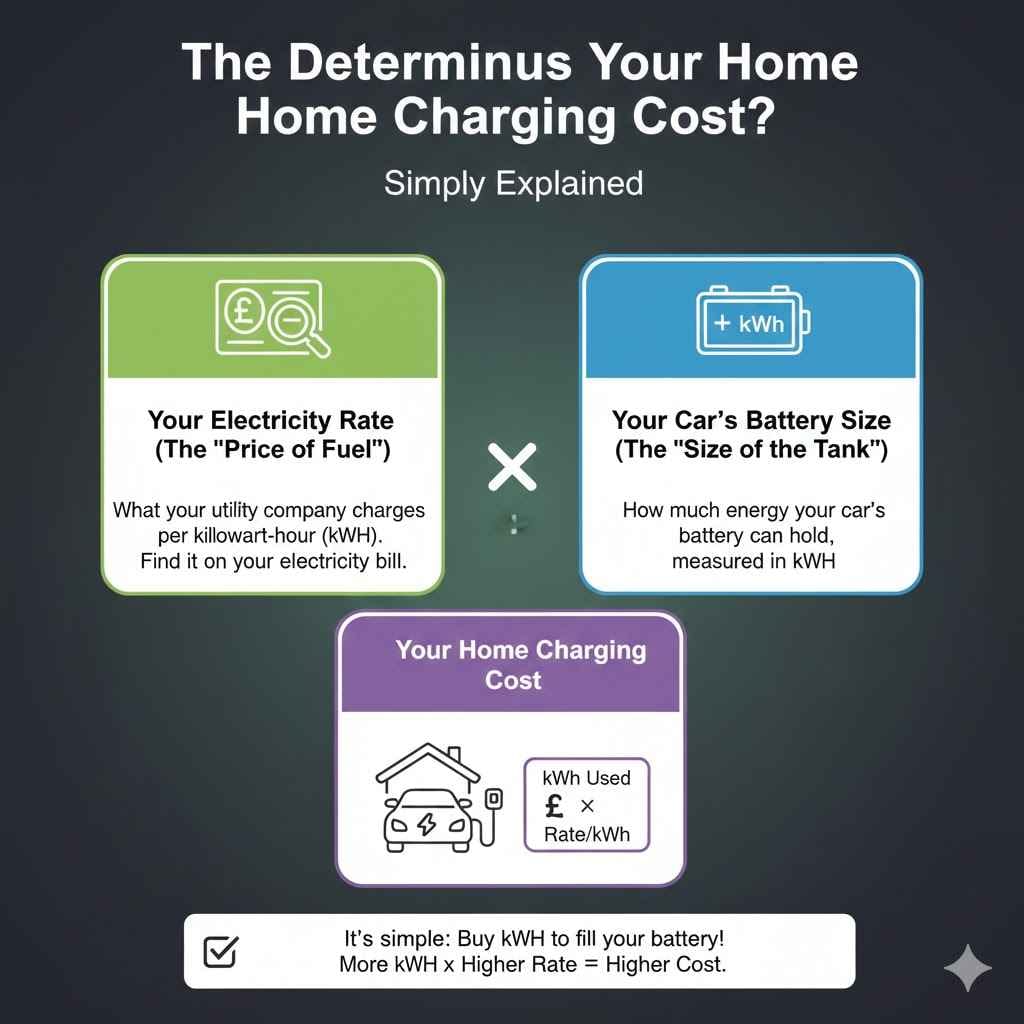
At its core, the cost of charging your EV at home comes down to two simple things. Think of it just like filling up a gas car—you need to know the size of the tank and the price of the fuel.
- Your Electricity Rate (The “Price of Fuel”): This is what your utility company charges you for electricity. It’s measured in cents per kilowatt-hour (kWh). A kilowatt-hour is just a unit of energy, like a gallon of gas. You can find this rate right on your monthly electricity bill.
- Your Car’s Battery Size (The “Size of the Tank”): This is how much energy your car’s battery can hold, also measured in kWh. A bigger battery is like a bigger gas tank—it holds more energy and takes you farther, but it also costs more to fill from empty.
That’s it! When you charge your car, you are simply buying kilowatt-hours from your utility company to fill up your car’s battery. The more kWh you need, and the higher your rate, the more it will cost.
A Simple Formula to Calculate Your Charging Cost
Ready for some simple math? I promise it’s easy. To find out the cost of a full charge from empty to full, you just multiply the two numbers we just talked about.
The Formula: (Your Car’s Battery Size in kWh) x (Your Electricity Rate in $/kWh) = Cost for a Full Charge
Let’s walk through it together.
Step 1: Find Your Electricity Rate
Grab your latest electricity bill. Look for a line item that shows “Price to Compare” or “Supply Charge,” and you should see a price listed as cents per kWh. For our example, let’s use the U.S. national average, which is around $0.17 per kWh. You can find up-to-date average rates for your state from the U.S. Energy Information Administration (EIA).
Remember to convert cents to dollars for the formula! So, 17 cents becomes $0.17.
Step 2: Know Your Car’s Battery Size
You can find your car’s battery size in your owner’s manual or with a quick online search for your specific model. They vary quite a bit. For example:
- A Chevrolet Bolt EV has about a 65 kWh battery.
- A standard-range Tesla Model 3 has about a 60 kWh battery.
- A Ford Mustang Mach-E (extended range) has a 91 kWh battery.
Step 3: Do the Math!
Let’s put it all together. Imagine you own a Chevrolet Bolt EV with a 65 kWh battery and your electricity costs the national average of $0.17 per kWh.
Calculation: 65 kWh (Battery Size) x $0.17 (Electricity Rate) = $11.05
That’s it! It would cost you just over $11 to charge your car from completely empty to completely full. Most of the time, you won’t be charging from zero, so your daily costs will be even lower. You might just be topping up 10 or 20 kWh, which would only cost a couple of dollars.
Estimated Charging Costs for Popular EVs
To give you a better idea, here’s a table showing the estimated cost for a full charge for some popular EV models using the national average electricity rate of $0.17 per kWh.
| Electric Vehicle Model | Approx. Battery Size (kWh) | Estimated Cost for a Full Charge (at $0.17/kWh) |
|---|---|---|
| Tesla Model 3 (Standard Range) | 60 kWh | $10.20 |
| Chevrolet Bolt EV | 65 kWh | $11.05 |
| Hyundai Ioniq 5 (Long Range) | 77 kWh | $13.09 |
| Ford Mustang Mach-E (Extended Range) | 91 kWh | $15.47 |
| Ford F-150 Lightning (Extended Range) | 131 kWh | $22.27 |
Factors That Can Change How Much You Pay
While our simple formula gives you a great starting point, a few other things can affect your final cost. Understanding these can help you save even more money.
Your Location Matters (A Lot!)
The single biggest variable in home charging cost is where you live. Electricity rates are not the same everywhere. Some states have very cheap power, while others have very expensive power. This can make a huge difference in your annual “fuel” savings.
For example, charging that same 65 kWh Chevy Bolt could cost less than $7 in a state with low rates but over $25 in a state with high rates. It pays to know what electricity costs in your area.
| State | Approx. Average Electricity Rate (per kWh) | Cost to Fully Charge a 65 kWh Battery |
|---|---|---|
| Washington | $0.12 | $7.80 |
| Texas | $0.15 | $9.75 |
| Florida | $0.16 | $10.40 |
| New York | $0.23 | $14.95 |
| California | $0.30 | $19.50 |
Note: These rates are approximate and can change. Always check your local utility for the most accurate prices.
Time-of-Use (TOU) Plans: Your Secret Weapon for Savings
Many electric companies offer special rate plans called “Time-of-Use” or TOU plans. This is fantastic news for EV owners. These plans make electricity cheaper during “off-peak” hours (usually late at night) and more expensive during “peak” hours (usually late afternoon when everyone is using power).
Why is this a secret weapon? Because you can set your EV to only charge during those super-cheap, off-peak hours! You plug your car in when you get home, but it waits until 11 PM or midnight to start charging, saving you a ton of money. Your electricity rate could drop from $0.25/kWh during the day to just $0.10/kWh at night. This can cut your charging costs by more than half without you having to do anything.
Check with your local utility provider to see if they offer a TOU plan. It’s one of the easiest ways to maximize your EV savings.
The Type of Charger You Use
At home, you’ll generally use one of two types of chargers:
- Level 1 Charger: This charger comes with your car and plugs into a standard 120-volt wall outlet, just like your toaster. It’s very slow, adding only about 3-5 miles of range per hour.
- Level 2 Charger: This is a more powerful charger that uses a 240-volt outlet, like an electric dryer. It charges much faster, adding about 25-40 miles of range per hour. This is what most EV owners install in their garage.
While both chargers use electricity from the same source at the same rate, Level 2 chargers are slightly more efficient. During charging, a little bit of energy is always lost as heat. Level 2 systems are about 5-10% more efficient, meaning less energy is wasted. Over a year, this can add up to small but nice savings.
The Weather and Your Driving Habits
Just like a gas car, how you drive and the weather outside can affect your EV’s efficiency. Cold weather is the biggest factor. Batteries don’t perform as well in the cold, and you’ll also be using energy to heat the cabin. This can reduce your car’s range, meaning you’ll need to charge more often to cover the same distance.
Similarly, aggressive driving with lots of fast acceleration will use up your battery faster than smooth, steady driving. Being a gentle driver not only is safer but also saves you money on charging!
How Does Home Charging Compare to Gas and Public Chargers?
Now that you know how much home charging costs, let’s put it into perspective. How does it stack up against filling up at the pump or using a public charging station?
Home Charging vs. Gasoline
This is where you’ll really see the savings shine. Let’s compare the cost per mile for an average gas car and a typical EV.
Gas Car Example:
- A car that gets 30 miles per gallon (MPG).
- Gas price is $3.60 per gallon.
- Cost per mile: $3.60 ÷ 30 miles = $0.12 per mile.
Electric Car Example:
- An EV that gets 3.5 miles per kWh (a common efficiency rating).
- Electricity price is $0.17 per kWh.
- Cost per mile: $0.17 ÷ 3.5 miles = $0.048 per mile (about 5 cents).
The difference is huge! In this example, driving the EV costs less than half as much per mile as the gas car. If you drive 12,000 miles a year, your annual fuel cost would be about $1,440 for the gas car versus just $576 for the EV. That’s over $850 in savings every year, just from charging at home.
Home Charging vs. Public Charging Stations
You’ve probably seen public charging stations at malls, grocery stores, or along highways. These are great for road trips or if you need a quick boost while you’re out. However, they are almost always more expensive than charging at home.
- Level 2 Public Chargers: These are often similar in price to home charging, and sometimes even free as a perk from a business.
- DC Fast Chargers: These are the super-fast chargers you use on a road trip. They can charge a car up to 80% in just 20-30 minutes. But convenience comes at a price. DC fast chargers can cost anywhere from $0.30 to $0.70 per kWh, making them two to four times more expensive than charging at home.
Think of it this way: charging at home is your everyday, low-cost “fuel.” Public fast chargers are your convenient, but pricier, option for long-distance travel.
What About the Cost to Install a Home Charger?
This is the one-time, upfront cost to consider. While charging itself is cheap, getting set up for faster home charging can have a cost.
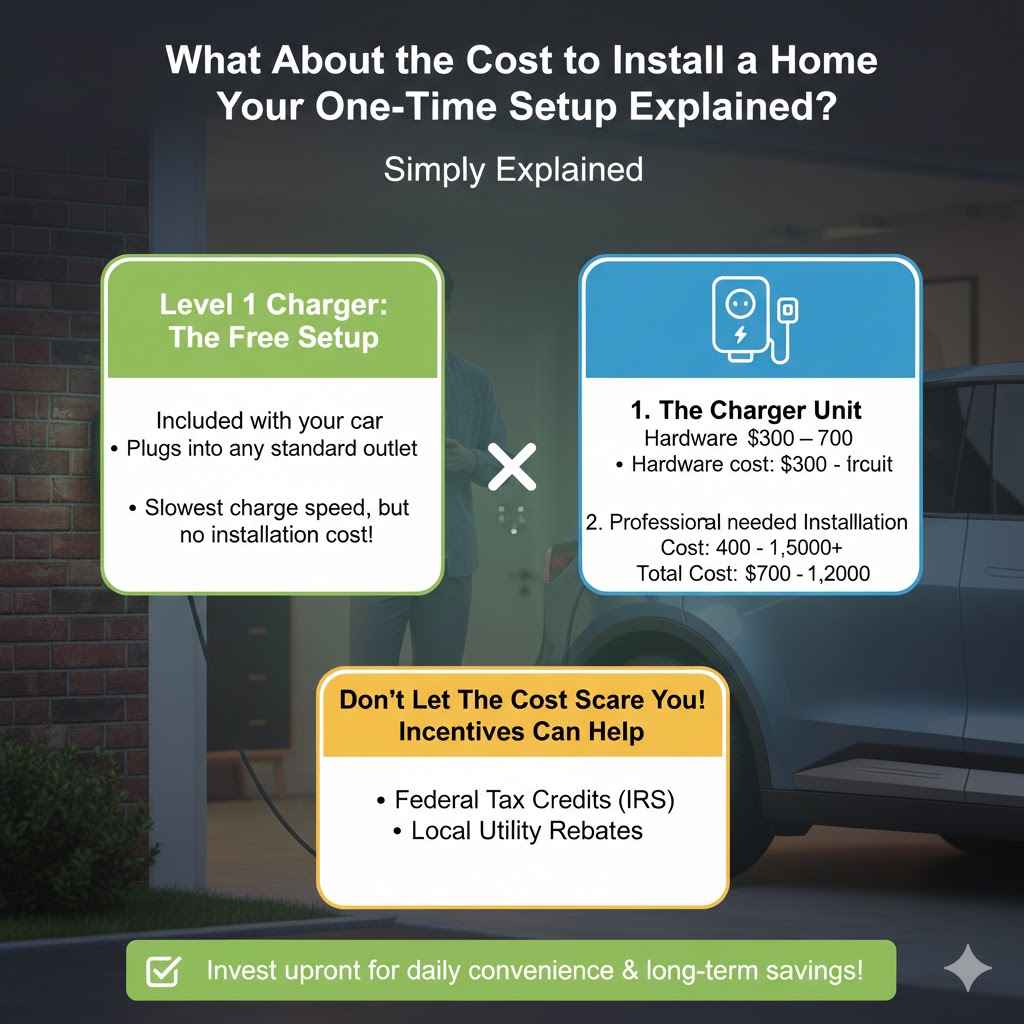
A Level 1 charger requires no installation. It’s included with your car and plugs into any standard wall outlet. It’s slow, but it’s free to set up.
A Level 2 charger is what most people choose for daily use because of its speed and convenience. The cost for this has two parts:
- The Charger Unit: The hardware itself typically costs between $300 and $700.
- Installation by an Electrician: A licensed electrician needs to install a 240-volt circuit in your garage or driveway. This cost can range from $400 to over $1,500, depending on how far the circuit needs to run from your home’s main electrical panel.
The total cost for a Level 2 installation is often between $700 and $2,200. However, don’t let that number scare you! There are often government incentives to help. Check for federal tax credits, which can cover a portion of the cost. The IRS offers information on the Alternative Fuel Vehicle Refueling Property Credit. Many local utility companies also offer rebates to encourage home charger installation. A quick search on your utility’s website could save you hundreds of dollars.
Frequently Asked Questions About EV Home Charging Costs
Is it really cheaper to charge an EV at home than to buy gas?
Absolutely, yes. For the vast majority of people in the U.S., the cost per mile for driving on electricity from home is significantly lower than the cost per mile for driving on gasoline. On average, you can expect your “fuel” costs to be 50-60% less.
How much will my electricity bill go up with an EV?
This depends on how much you drive. If you drive an average of 1,000 miles a month, you might use around 300 kWh of electricity. At an average rate of $0.17/kWh, that would add about $51 to your monthly bill. But remember, you’d be saving over $100 on gasoline during that same month!
Do I need a special charger to charge at home?
No, you don’t absolutely need one. Every EV comes with a Level 1 charger that plugs into a regular household outlet. This is very slow, but it works perfectly fine if you don’t drive very far each day. Most people choose to install a faster Level 2 charger for convenience, so they can get a full charge overnight.
How can I find the cheapest time to charge my car?
Contact your electric utility company and ask if they offer a Time-of-Use (TOU) or specific EV charging rate plan. If they do, they will tell you exactly which hours are “off-peak” and have the lowest rates. Then, you can simply program your car or charger to only run during those hours.
Does charging an EV at home use a lot of electricity?
An EV is a large appliance, similar to a central air conditioner or an electric water heater. While it does use a significant amount of energy during the charging session, it’s spread out over several hours, usually overnight when other energy use in the house is low. Modern homes are well-equipped to handle it.
Can I use a regular extension cord to charge my car?
It is strongly recommended that you do not. The chargers pull a lot of power for a long time, and a standard household extension cord can overheat, creating a serious fire hazard. Only use the cord that came with the car, and if you must use an extension, it needs to be a heavy-duty, properly rated cord designed for high-power applications (usually 12-gauge or thicker).
You’re in Control of Your Fueling Costs
Switching to an electric car and charging it at home is more than just a new way to drive—it’s a new way to think about fueling. You’re no longer at the mercy of fluctuating gas prices. Instead, you have a stable, predictable, and much lower cost to power your daily journeys. Waking up every morning with a “full tank” for just a few dollars is a feeling of freedom and control that never gets old.
As you can see, calculating the cost is straightforward once you know your electricity rate and your car’s battery size. With smart strategies like charging during off-peak hours, you can drive those costs even lower. You have the power to make smart decisions that save you money and simplify your life. Welcome to the world of home fueling!