

The typical cost for a Transmission Control Module (TCM) replacement ranges from $600 to $1,500, depending heavily on your vehicle’s make and model. This price covers the part itself and the labor needed for professional installation and programming.
If your car is acting strange—maybe shifting gears roughly, slipping, or refusing to move—it can be really stressful. Often, the culprit is a failing Transmission Control Module, or TCM. This little ‘brain’ for your transmission is vital, but replacing it sounds scary and expensive. Don’t worry! I’m Dustin Hall, and I’m here to break down exactly what a TCM is, why it fails, and the real costs you can expect for a replacement. We will look at DIY options versus professional fixes, ensuring you gain the confidence to tackle this issue without getting taken for a ride. Let’s demystify these repair bills together!
What Exactly is a Transmission Control Module (TCM)?
Think of your car’s engine like the body and the transmission like the legs. If the engine is the heart, the Transmission Control Module (TCM) is the nervous system controlling those legs. It’s a small, specialized computer dedicated only to managing your automatic transmission.
The TCM takes information from many sensors throughout your car—like speed, engine load, and throttle position—and uses that data to decide the perfect moment to shift gears. A smooth ride depends entirely on the TCM sending the right signals to the transmission solenoids (little electronic valves) at the right time.
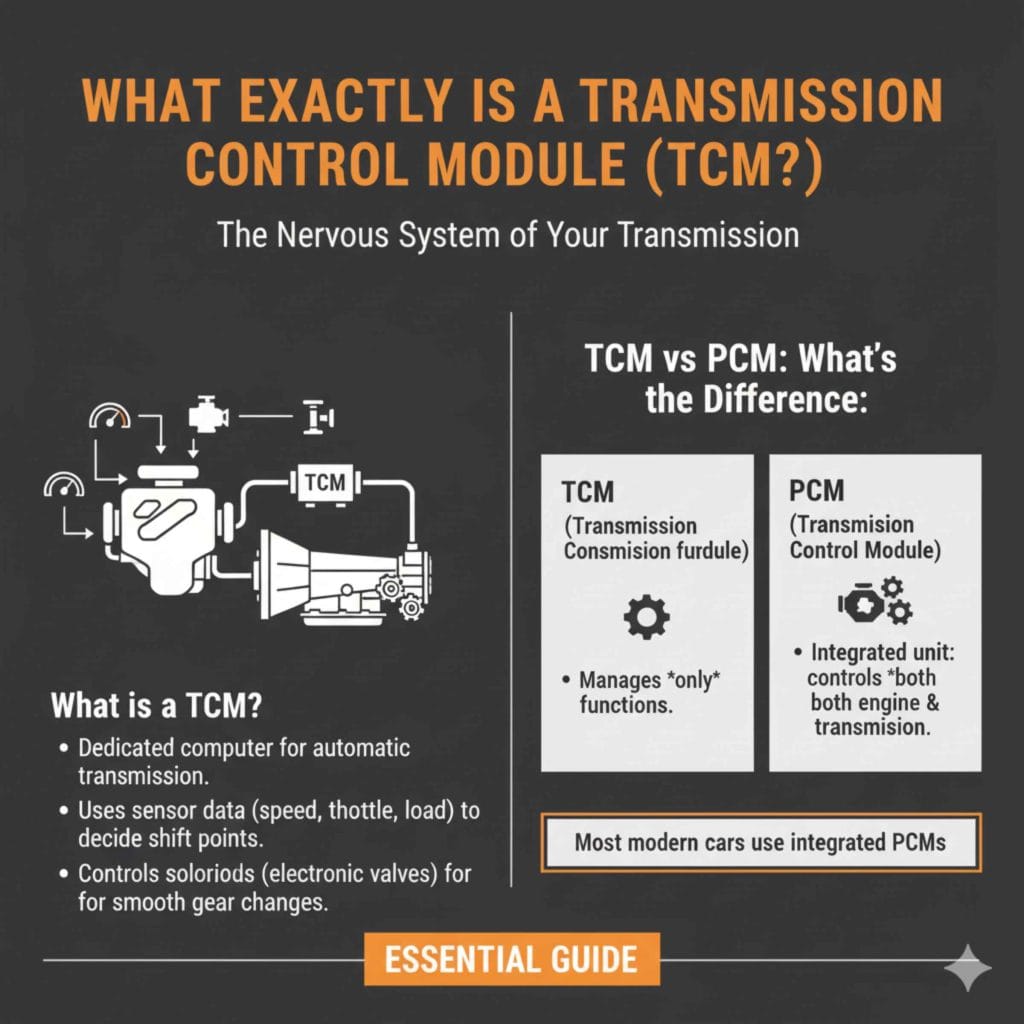
TCM vs. PCM: Understanding the Difference
Sometimes you hear the terms TCM and PCM used interchangeably, but they are usually different, especially in modern vehicles:
- TCM (Transmission Control Module): This computer manages only the transmission functions. It’s common in vehicles where the engine computer (PCM) and transmission computer are separate units.
- PCM (Powertrain Control Module): In many newer cars, the PCM is an integrated unit that controls both the engine and the transmission. If your car has a PCM, replacing it means replacing the entire engine brain, which often costs more.
For our discussion, we will focus primarily on the dedicated TCM, as that is what most drivers ask about when transmission shifting goes wrong.
Signs Your Transmission Control Module Might Be Failing
The symptoms of a failing TCM are often frustrating because they mimic other, cheaper transmission problems. If you catch these signs early, you can save yourself time and money. Here are the telltale signs that your TCM might need attention:
Common Failure Symptoms
- Erratic Shifting: This is the biggest giveaway. The car might suddenly lurch, shift too early, shift too late, or refuse to shift into a specific gear altogether.
- Check Engine Light or Transmission Warning Light: The TCM has internal diagnostics. If it sees a problem, it immediately alerts the driver via dashboard lights.
- Slipping Gears: The engine revs high, but the car doesn’t accelerate normally because the transmission isn’t fully engaged.
- Limp Mode Activation: Many cars will intentionally enter “limp mode” when the TCM detects a critical fault. In limp mode, the car limits itself to one or two gears (usually second gear) to protect the transmission from further damage.
- Inaccurate Speedometer Readings: Since the TCM relies on speed sensors, a module failure can sometimes feed bad data to other systems, causing the speedometer to act strangely.
How Much Does A Transmission Control Module Replacement Cost? The Breakdown
When answering how much does a transmission control module replacement cost, we have to look at three main components: the cost of the part, the labor involved, and the crucial step of programming or flashing the module.
1. The Cost of the TCM Part Itself
The price of the module varies significantly based on whether you buy an Original Equipment Manufacturer (OEM) part, an aftermarket unit, or a refurbished/remanufactured component.
| TCM Part Type | Estimated Cost Range (Part Only) | Best For |
|---|---|---|
| OEM (Dealer Part) | $400 – $900+ | Guaranteed fit and compatibility. Highest upfront cost. |
| Aftermarket/Direct Replacement | $250 – $500 | Good balance of price and quality for many common cars. |
| Remanufactured/Used (with Warranty) | $150 – $350 | Budget-conscious repairs, but usually requires professional setup. |
Expert Insight: Always check if the part you buy is “plug-and-play” or if it requires professional programming. Many modern TCMs are VIN-locked and must be programmed by the installer, which impacts installation cost.
2. Labor Costs for Installation
Replacing the TCM is often easier than replacing the engine control unit (ECU), but it still requires specific tools and knowledge, especially regarding connections and electrical integrity. Labor rates depend on where you have the repair done.
- Dealership: Highest hourly rates ($$120 – $180+$ per hour). They are often the only ones equipped to handle proprietary programming for brand-new modules.
- Independent Mechanic: Mid-range rates ($$80 – $120$ per hour). They can handle installation and often have specialized scanners for programming generic or remanufactured units.
- DIY: $0 in labor, but the risk and cost of specialized tools are higher.
Installation itself usually takes between 1 to 3 hours, depending on how hard it is to access your specific TCM.
3. Programming and Flashing: The Hidden Cost
This is the step that trips up most cost estimates. A brand-new TCM needs to be programmed to “talk” to your car’s specific Vehicle Identification Number (VIN) and all its associated modules. If you skip this, the car will not run correctly, or it may not run at all.
Programming usually involves:
- Flashing Existing Data: Copying certain learned data from the old module (if accessible) to the new one.
- VIN Alignment: Inputting your car’s VIN so security systems recognize the new component.
- Software Updates: Ensuring the module has the latest manufacturer software updates to prevent immediate failure.
Programming can add anywhere from $100 to $350 to the final bill, often done by a dealership or a specialized shop with advanced diagnostic tools. For more technical information on vehicle electronic systems, you can review guidelines from organizations that help set industry standards, such as those related to automotive software maintenance.
Putting It All Together: Total Estimated Cost Scenarios
To give you a clear picture, here are three common replacement scenarios for a standard four-cylinder sedan:
| Scenario | Part Used | Labor & Programming | Total Estimated Cost |
|---|---|---|---|
| Budget-Friendly Fix | Remanufactured Unit ($250) | Independent Shop ($350) | $600 – $750 |
| Standard Professional Repair | Quality Aftermarket ($450) | Independent Shop ($500) | $950 – $1,100 |
| Dealer Replacement | New OEM Module ($700) | Dealership Labor/Special Programming ($550) | $1,250 – $1,500+ |
Factors That Increase the Cost
Be aware that some vehicles naturally cost more to repair. Location and complexity matter significantly:
- Luxury or Performance Vehicles: Parts for German, high-end Japanese, or specialty performance cars are significantly more expensive, sometimes starting at $1,000 for the part alone.
- Vehicle Age: Very old vehicles might use proprietary, obsolete parts that are hard to find, driving up costs.
- Location: Shop rates in high cost-of-living areas (major cities) will be higher than in rural areas.
- Integrated PCM: If your car uses a combined PCM, the part cost will be substantially higher than a standalone TCM.
Can I Save Money? DIY Transmission Control Module Replacement
For the handy driver, replacing the TCM might seem like a great way to save on those labor costs. It can be done, but you must proceed with caution, especially concerning the programming step.
Tools You Will Likely Need
- Basic socket set and wrenches.
- Torque wrench (essential for reconnecting components correctly).
- Dielectric grease (to protect electrical connections).
- A high-end OBD-II scanner capable of performing module replacement procedures (this is the specialized tool you might need to rent or buy).
The Step-by-Step DIY Process (Simplified)
Always disconnect the negative battery terminal first to prevent electrical shorts!
- Locate the TCM: In many cars, the TCM is located near or attached directly to the transmission housing. Consult your vehicle’s service manual for the exact location.
- Disconnect Wiring Harnesses: Carefully release the locking tabs and disconnect the main electrical connectors leading into the module. Look for corrosion.
- Remove Mounting Bolts: Unbolt the module from its bracket or housing. Note how it was seated.
- Install New Module: Mount the new TCM and gently reconnect the wiring harnesses until they click securely. Apply a small amount of dielectric grease to the pins.
- Program and Initialize: This is the hardest part. Use your specialized scan tool to connect to the vehicle’s network. You must program the VIN and perhaps perform a transmission relearn procedure. If you cannot get past this step, you will still need to pay a shop for this service, negating some of your savings.
- Test Drive: Perform a careful, slow test drive, monitoring shifter performance and dashboard lights.
A Word of Caution: If you are not comfortable with advanced electrical diagnostics or initializing new automotive computers, leaving the programming stage to a professional is wise. A poorly programmed module can cause serious, expensive damage to the transmission itself.
Why Your TCM Failed in the First Place
It is helpful to know why the old module died. If you replace it without fixing the root cause, the new one might fail quickly too. TCMs rarely fail on their own; they usually succumb to external factors.
Top Causes of TCM Failure:
- Heat and Vibration: Located near hot engine and transmission components, excessive heat degrades the sensitive internal electronics over time.
- Wiring Harness Issues: Corrosion, rodent damage, or loose connections can cause intermittent power surges or shorts that take out the module.
- Transmission Fluid Contamination: If the transmission seals fail, fluid can wick up the wiring harness and contaminate the connector pins on the TCM, leading to electrical shorts. This is a very common issue.
- Voltage Spikes: Issues with the vehicle’s alternator or parasitic drains can send unhealthy voltage spikes through the system, frying the circuit board.
If your mechanic suspects fluid contamination, addressing the faulty transmission seal must happen before or immediately after the TCM replacement to ensure the new unit lasts.
Finding the Right Repair Shop for Your TCM Replacement
Choosing where to get this job done directly impacts both the quality of the repair and how much does a transmission control module replacement cost.
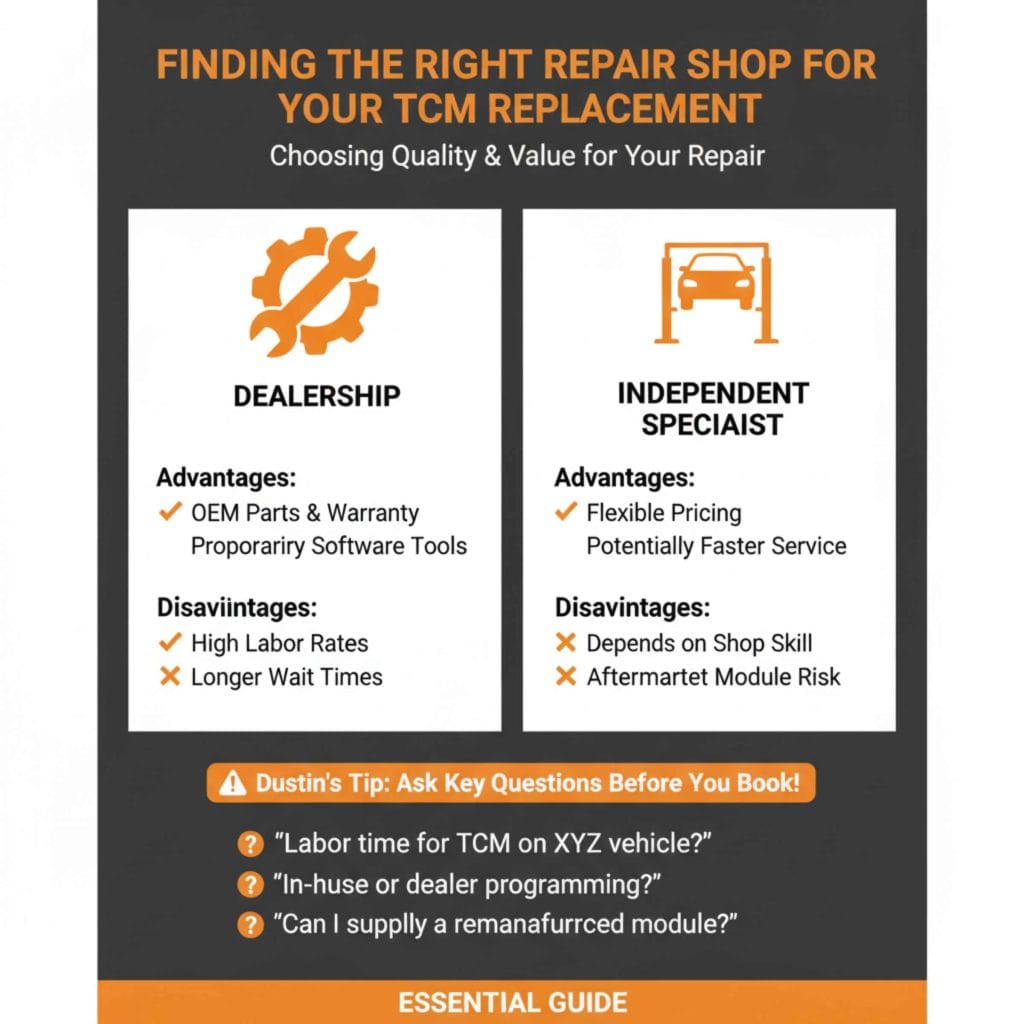
Dealership vs. Independent Specialist
Both have pros and cons:
- Dealership Advantages: They use guaranteed-to-work OEM parts and possess proprietary software tools needed for the highest level of integration and warranty protection on the entire job.
- Dealership Disadvantages: High hourly labor rates and sometimes a longer wait time for parts ordering.
- Independent Specialist Advantages: Often more flexible pricing and potentially faster service. A good transmission specialty shop often has the diagnostic equipment needed for aftermarket modules.
- Independent Specialist Disadvantages: Success depends entirely on the shop’s specific diagnostic skill level with your vehicle’s brand.
Dustin’s Tip: Before you book an appointment, call two independent transmission shops and one dealership. Ask them specifically:
- “What is your standard labor time estimate for a TCM replacement on XYZ vehicle?”
- “Do you program the module in-house, or does it require specialized dealer programming?”
- “Can I supply a remanufactured module if it comes with a warranty?”
Getting clear answers on programming requirements helps you compare apples to apples on pricing.
Frequently Asked Questions (FAQ) about TCM Replacement
Q1: Can I drive my car if the TCM is failing?
A: You can try, but it is risky. If the TCM fails completely or puts the transmission in limp mode, you risk overheating the transmission, which can cause major internal damage, turning a $1,000 repair into a $3,000+ transmission rebuild.
Q2: How long should a new TCM last?
A: When properly installed and programmed, the new TCM should last for the remaining life of the vehicle, assuming the underlying environmental causes (like heat or fluid leaks) are resolved.
Q3: Will replacing the TCM fix hard shifting issues?
A: Usually, yes, if the TCM is the root cause. However, if the hard shifting is caused by faulty solenoids inside the transmission or low transmission fluid pressure, replacing the TCM alone won’t fix those mechanical issues.
Q4: Do I need to flash or program a used TCM?
A: In almost all modern vehicles, yes. A used TCM must be reprogrammed to match your car’s VIN and mileage data. Many specialized services online will flash a used module for you before you buy, which saves on shop time.
Q5: What is the cheapest way to deal with a faulty TCM code?
A: The absolute cheapest way is a DIY replacement using a reliable, warranted remanufactured part. However, the total cost hinges on whether you need to pay a professional for the final programming hookup.
Q6: Is the TCM covered under an extended warranty?
A: Often, yes. Because the TCM is an electronic control unit, manufacturers usually cover it under powertrain components. Always check your specific warranty documentation first to see if it’s covered before paying anything out of pocket.
Conclusion: Gaining Control Over Your TCM Repair
Facing a TCM replacement can certainly feel overwhelming when you look at a repair estimate. The key to mastering how much does a transmission control module replacement cost is recognizing that the price is split between the component, the installation labor, and the essential software programming. For most drivers, budgeting between $900 and $1,300 at a reputable independent shop offers the best mix of quality parts and fair labor practices.