
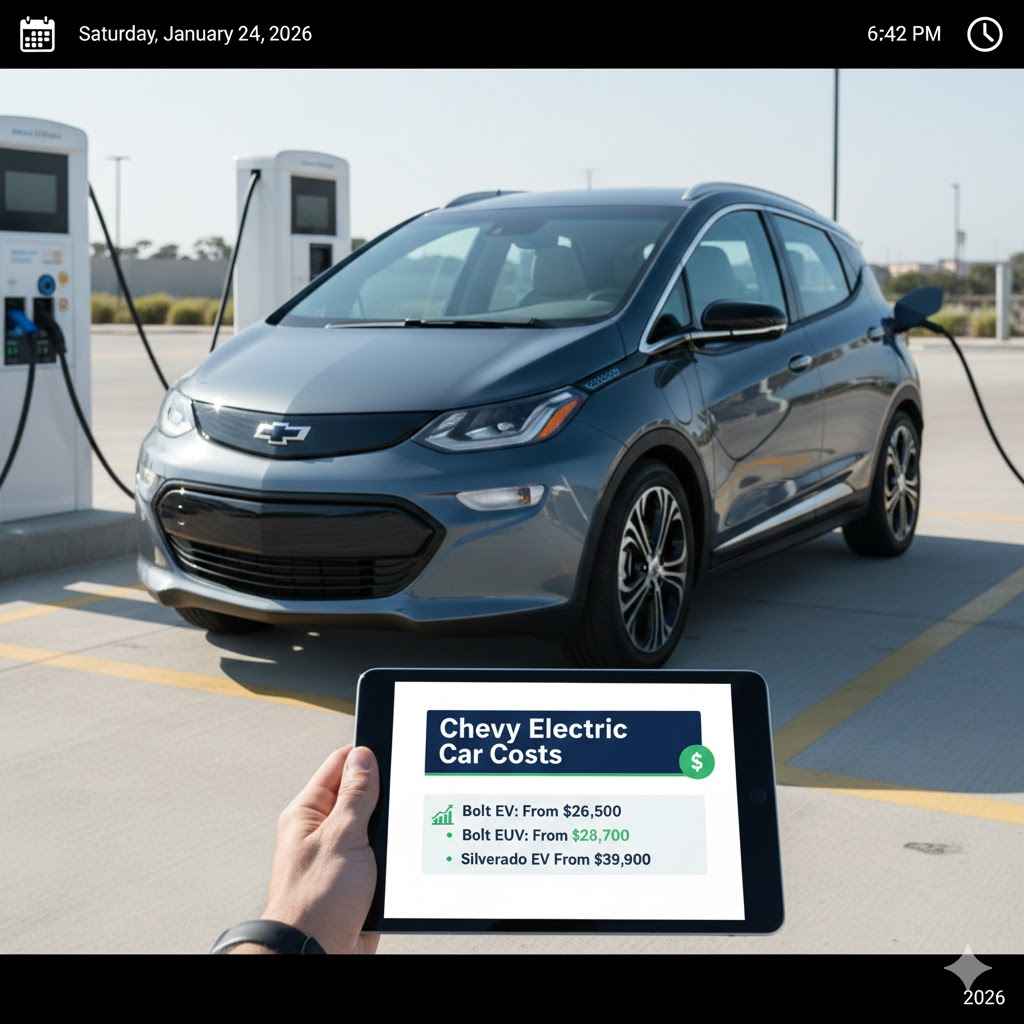
A new Chevy electric car can cost anywhere from around $30,000 for a base model Equinox EV to over $100,000 for a top-tier Silverado EV. The final price depends heavily on the model, trim level, optional features, and available government tax credits, which can significantly lower the upfront cost for qualifying vehicles and buyers.
Thinking about switching to an electric car? That’s a great move! You’re probably seeing more and more of them on the road, and Chevrolet has become a big player in the EV game. But one question always comes up first: “How much does it actually cost?” It can feel confusing with all the different models, tax credits, and charging options.
Don’t worry, I’m here to help clear things up. My name is Dustin, and I love making car topics simple for everyone. We’re going to break down the cost of a Chevy electric car, piece by piece. We’ll look at the sticker price, the amazing savings you can get from incentives, and even the long-term costs. By the end of this guide, you’ll feel confident and ready to decide if a Chevy EV is right for you.
The price on the window sticker is just the beginning of the story. To get the full picture, we need to look at each model, the different versions (or “trims”) available, and the powerful incentives that can bring the price down. Let’s dive in and explore what you can expect to pay for a brand-new electric vehicle from Chevrolet.
A Look at the Current Chevy EV Lineup and Prices
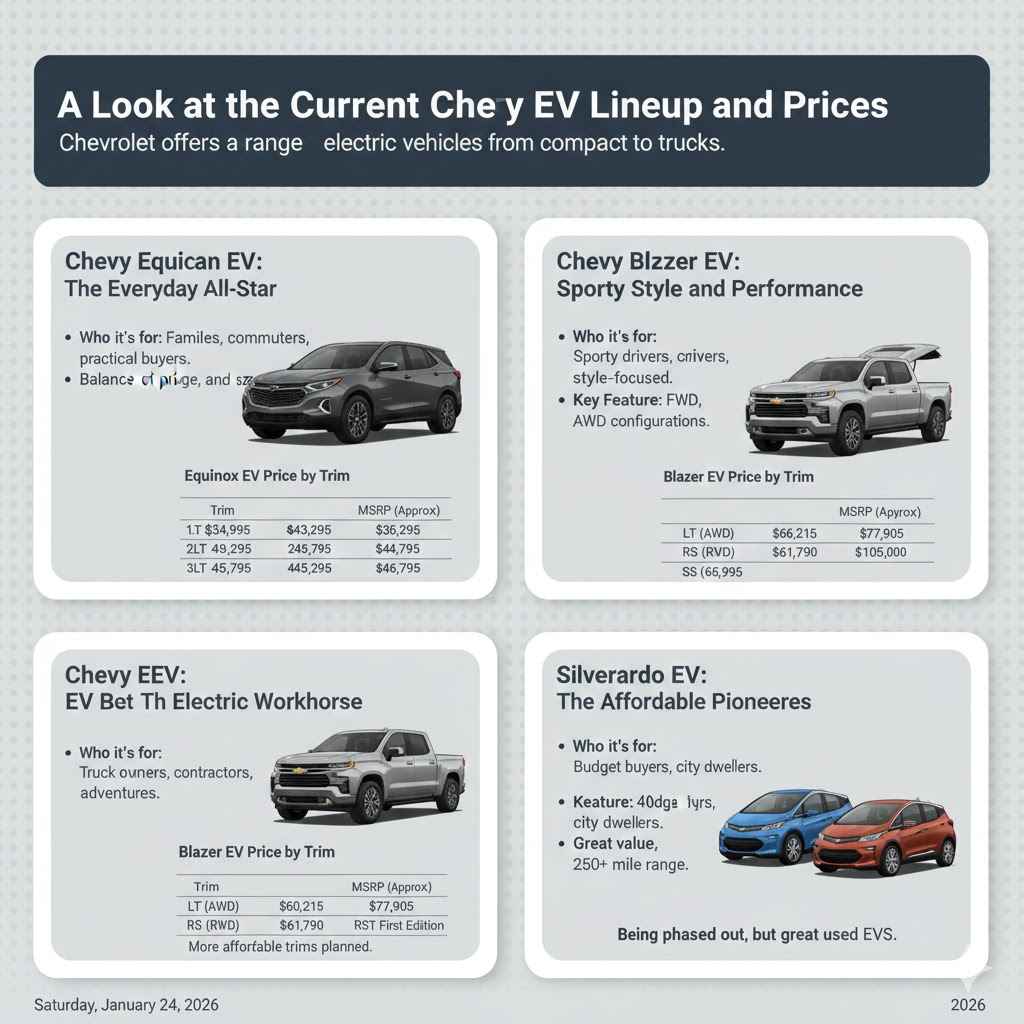
Chevrolet offers an exciting range of electric vehicles designed to fit different lifestyles and budgets, from compact crossovers to powerful trucks. Here’s a breakdown of the main models and their starting prices. Keep in mind that these are Manufacturer’s Suggested Retail Prices (MSRP) and don’t include taxes, destination fees, or any potential dealer markups.
Chevy Equinox EV: The Everyday All-Star
The Equinox EV is set to be one of Chevy’s most popular electric vehicles, and for good reason. It offers great range, a spacious interior, and a starting price that makes going electric more accessible than ever. It’s designed to be the perfect all-around family vehicle, great for daily commutes, weekend trips, and everything in between.
- Who it’s for: Families, commuters, and anyone looking for a practical and affordable electric SUV with modern tech and plenty of room.
- Key Feature: Excellent balance of price, range, and size.
Chevy Equinox EV Price by Trim
The Equinox EV comes in several trims, allowing you to choose the features and performance you need.
| Trim Level | Starting MSRP (Approx.) | Key Features |
|---|---|---|
| 1LT | $34,995 | 19-inch wheels, 11-inch driver display, standard Chevy Safety Assist |
| 2LT | $43,295 | Heated front seats and steering wheel, available front-wheel or all-wheel drive |
| 2RS | $44,795 | Sportier styling with black accents, 20-inch wheels, flat-bottom steering wheel |
| 3LT | $45,295 | Heated rear seats, ventilated front seats, larger 17.7-inch infotainment screen |
| 3RS | $46,795 | Top-of-the-line sport trim with 21-inch wheels and premium features |
Chevy Blazer EV: Sporty Style and Performance
If you want an electric SUV with a bit more flair and performance, the Blazer EV is a fantastic choice. It boasts a sleek, aggressive design inspired by the classic Camaro and offers powerful motor options, including an exhilarating SS (Super Sport) model. It’s for the driver who wants to enjoy the ride as much as the destination.
- Who it’s for: Drivers who crave sporty performance and head-turning style without sacrificing the practicality of an SUV.
- Key Feature: Available in front-wheel, rear-wheel, and all-wheel drive configurations, a rarity in the EV world.
Chevy Blazer EV Price by Trim
The Blazer EV’s pricing reflects its position as a more premium and performance-oriented option.
| Trim Level | Starting MSRP (Approx.) | Key Features |
|---|---|---|
| LT (AWD) | $56,715 | 19-inch wheels, 17.7-inch infotainment screen, 247-mile estimated range |
| RS (AWD) | $60,215 | 21-inch wheels, black-painted grille, animated exterior lighting |
| RS (RWD) | $61,790 | Extended range (up to 320 miles), sporty styling, premium interior |
| SS (AWD) | $65,995 | High-performance model with up to 557 horsepower, 0-60 in under 4 seconds |
Chevy Silverado EV: The Electric Workhorse
The Silverado EV redefines what an electric truck can be. Built on GM’s advanced Ultium platform, it combines incredible power, a massive range, and innovative features like the Multi-Flex Midgate, which allows you to extend the truck bed into the cab for hauling extra-long items. It’s a true work truck that happens to be electric.
- Who it’s for: Truck owners, contractors, and adventurers who need serious capability, towing power, and long-range travel without using a drop of gas.
- Key Feature: Up to 400 miles of estimated range on a full charge and a towing capacity of up to 10,000 pounds.
Chevy Silverado EV Price by Trim
The Silverado EV is a premium truck with pricing that matches its impressive capabilities.
| Trim Level | Starting MSRP (Approx.) | Key Features |
|---|---|---|
| WT (Work Truck) | $77,905 | Designed for fleets and commercial use, focused on durability and function |
| RST First Edition | $105,000 | Fully loaded launch edition with all the top features, including four-wheel steering and a massive glass roof |
More affordable trims are planned for the future, which will bring the starting price down significantly for everyday consumers.
Chevy Bolt EV and Bolt EUV: The Affordable Pioneers
While the Bolt EV and its slightly larger sibling, the Bolt EUV, are being phased out to make way for the next generation of Ultium-based EVs, they remain important. They were Chevy’s first big push into affordable electric cars and are widely available on the used market. They are known for being practical, reliable, and one of the cheapest ways to get into a quality EV.
- Who it’s for: Budget-conscious buyers, city dwellers, and anyone looking for a dependable and efficient compact EV, especially in the used car market.
- Key Feature: Excellent value for the money, offering over 250 miles of range at a very low price point.
Beyond the Sticker Price: Uncovering the Real Cost
The MSRP is just one number. The price you actually pay can be much lower thanks to some amazing incentives. On the other hand, there are also a few extra costs to be aware of. Let’s break it down.
Federal EV Tax Credit: Your Biggest Discount
This is the most significant money-saver for new EV buyers. The U.S. government offers a tax credit of up to $7,500 for qualifying new electric vehicles. The goal is to encourage more people to switch to cleaner transportation.
Here’s how it works:
- Vehicle Requirements: The car must be assembled in North America, and its battery components must meet specific sourcing requirements. Chevy’s new EVs like the Equinox and Blazer are built to meet these rules.
- Price Caps: The MSRP of the vehicle must be below $80,000 for vans, SUVs, and pickup trucks.
- Buyer Income Limits: There are income limits for the buyer to qualify. You can check the latest requirements on the government’s official FuelEconomy.gov website.
- Point-of-Sale Rebate: The best part is that as of 2024, you can often transfer the credit directly to the dealer. This means they can take the $7,500 right off the purchase price, so you save the money instantly instead of waiting to file your taxes.
For example, a Chevy Equinox EV starting at $34,995 could effectively cost you just $27,495 if you and the vehicle qualify for the full credit. That’s a huge difference!
State and Local Incentives
Don’t stop at the federal level! Many states, cities, and even local utility companies offer their own rebates and incentives. These can include:
- Cash rebates on the purchase of a new EV.
- Tax credits on your state income tax.
- Rebates for installing a home charging station.
- Reduced vehicle registration fees.
These programs vary widely by location, so be sure to research what’s available in your specific area. A quick search for “[Your State] EV incentives” is a great place to start.
Other Costs to Consider
While incentives save you money, there are a few other numbers that go into the final price:
- Destination Charge: This is a standard fee charged by all manufacturers for shipping the vehicle from the factory to the dealership. It’s usually between $900 and $1,500.
- Dealer Fees: These can include a “documentation fee” for handling the paperwork. These fees vary by dealer and state.
- Optional Packages: Want a sunroof, a premium sound system, or advanced driver-assist features like Super Cruise? These add-ons will increase the final price.
Long-Term Savings: How a Chevy EV Saves You Money Every Day
The savings don’t stop when you drive off the lot. In fact, that’s just when they start to add up. Owning an EV is almost always cheaper over the long run compared to a gas-powered car.
Fuel Savings
This is the big one. Electricity is much cheaper than gasoline. Let’s imagine you drive about 1,200 miles per month.
- Gas Car: A car that gets 25 miles per gallon would need about 48 gallons of gas. At $3.50 per gallon, that’s $168 per month in fuel.
- Chevy EV: A Chevy EV like the Equinox is very efficient. To go 1,200 miles, it would use about 340 kWh of electricity. If you charge at home where the average cost is $0.17 per kWh, that’s only $58 per month.
That’s a savings of $110 every single month, or over $1,300 per year, just on fuel!
Maintenance Savings
Electric cars are much simpler than gas cars. They have far fewer moving parts, which means less stuff to break and maintain.
EV vs. Gas Car Maintenance Comparison
| Maintenance Task | Gas Car | Electric Car |
|---|---|---|
| Oil Changes | Every 5,000-10,000 miles | Never |
| Spark Plugs | Replace every 60,000-100,000 miles | None |
| Muffler/Exhaust System | Can rust and need replacement | None |
| Brake Pads | Wear out with use | Last much longer due to regenerative braking |
| Tire Rotations | Yes | Yes |
| Cabin Air Filter | Yes | Yes |
By eliminating oil changes, tune-ups, and exhaust repairs, you can save hundreds of dollars each year on routine maintenance.
The Cost of Charging Your Chevy EV
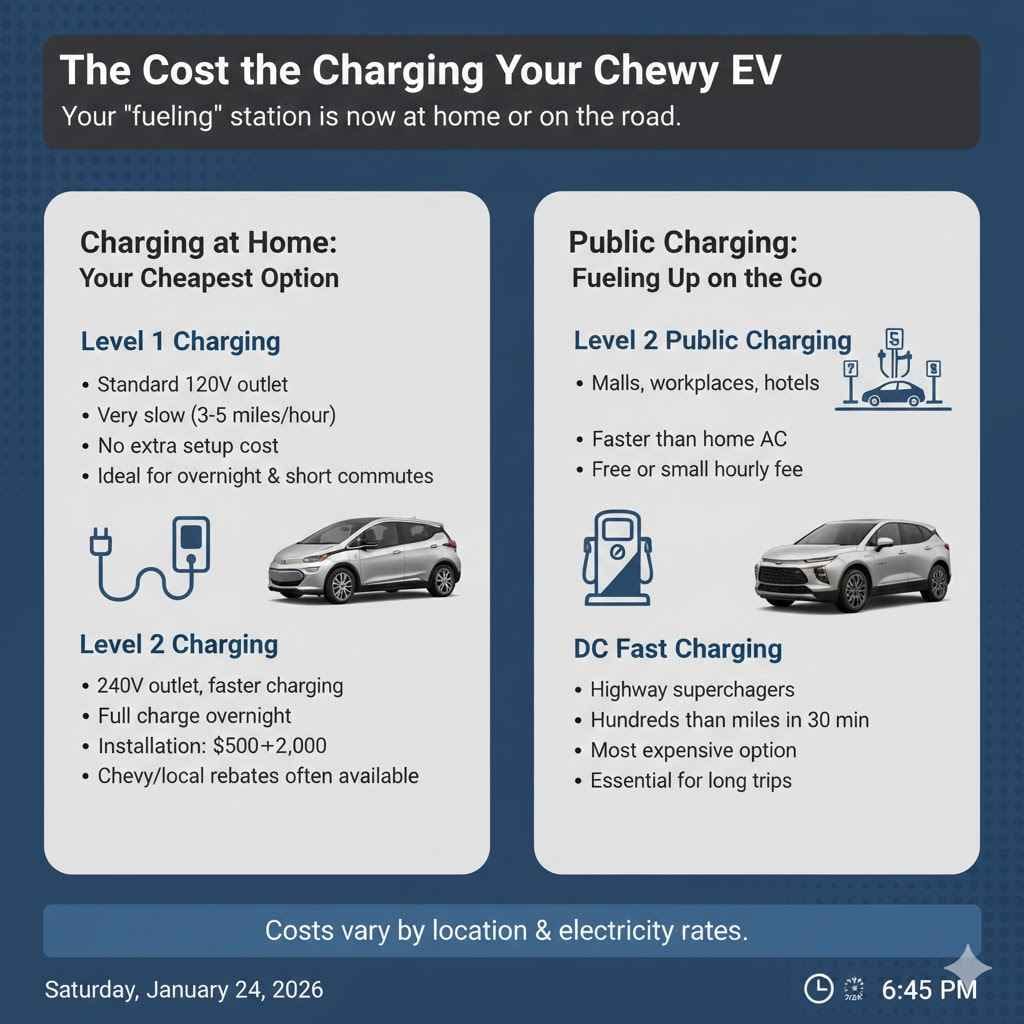
Your “fueling” station is now at home, but you can also use public chargers when you’re on the road. Here’s what to expect for costs.
Charging at Home: Your Cheapest Option
- Level 1 Charging: This is simply plugging your car into a standard 120-volt wall outlet using the cord that comes with the car. It’s very slow (adding 3-5 miles of range per hour) but costs nothing extra to set up. It’s perfect for overnight charging if you have a short commute.
- Level 2 Charging: This is the most common home charging solution. It uses a 240-volt outlet (like an electric dryer) and can fully charge your Chevy EV overnight. A Level 2 charger installation can cost between $500 and $2,000, depending on your home’s wiring. However, Chevy often offers programs to help cover this cost for new buyers, and there are sometimes local rebates available.
Public Charging: Fueling Up on the Go
- Level 2 Public Charging: You’ll find these at shopping centers, workplaces, and hotels. They are faster than home charging and can be free or have a small hourly fee.
- DC Fast Charging: These are the superchargers you see along highways. They can add hundreds of miles of range in as little as 30 minutes. This is the most expensive way to charge, but it’s essential for long road trips. The cost is often similar to buying a tank of gas, but you’ll only use it occasionally.
Frequently Asked Questions (FAQ)
Which Chevy EV is the cheapest?
The upcoming Chevy Equinox EV is designed to be the most affordable option, with a starting MSRP of around $34,995 before any tax credits. This makes it one of the most budget-friendly electric SUVs available.
Do all Chevy EVs qualify for the full federal tax credit?
Not always. The rules for the tax credit depend on where the battery materials are sourced and where the vehicle is assembled. Models like the Blazer EV and Equinox EV are designed to qualify, but it’s crucial to check the latest government guidelines and confirm with your dealer, as the rules can change.
Is it expensive to install a home charger for a Chevy EV?
It can range from a few hundred to a couple of thousand dollars. However, Chevrolet often provides promotional offers to new buyers that can help cover or reduce the cost of a standard Level 2 charger installation. This makes it much more affordable for most people.
How much does it cost to replace a Chevy EV battery?
This is a common worry, but it shouldn’t be a major concern. Chevy EV batteries come with an excellent warranty, typically covering them for 8 years or 100,000 miles. Battery failures are very rare, and they are designed to last the life of the vehicle.
Are electric cars really cheaper to maintain than gas cars?
Absolutely. With no oil changes, spark plugs, timing belts, or exhaust systems to worry about, the routine maintenance costs for an EV are significantly lower. Your main costs will be tires, brakes (which last longer), and cabin air filters.
Can I use a Tesla charger for my Chevy EV?
Soon, yes! General Motors, Chevy’s parent company, has adopted Tesla’s charging standard (NACS). Starting in 2024, Chevy EV owners will be able to use thousands of Tesla Superchargers with an adapter. Future Chevy EVs will have the NACS port built-in, making charging even easier.
How does cold weather affect the cost of running a Chevy EV?
Cold weather can reduce an EV’s range by 10-30% because the battery has to work harder to stay warm and heat the cabin. This means you’ll need to charge a bit more often in the winter, which can slightly increase your electricity costs. However, modern Chevy EVs have advanced systems to manage battery temperature and minimize this effect.
Conclusion: Is a Chevy Electric Car a Smart Financial Choice?
So, how much does a Chevy electric car cost? The answer is more than just a single number. While the initial sticker price might seem higher than a comparable gas car, the story changes quickly when you factor in all the savings.
When you combine the powerful federal and state incentives that can slash thousands off the price, the daily savings on fuel, and the drastically lower maintenance costs, a Chevy EV often becomes the more affordable choice over the long run. You’re not just buying a car; you’re investing in a smarter, cleaner, and more cost-effective way to get around.
By understanding the true cost—from the showroom floor to your garage and beyond—you can feel confident that choosing an electric vehicle from Chevrolet is a great decision for both your wallet and the road ahead. Happy driving!