
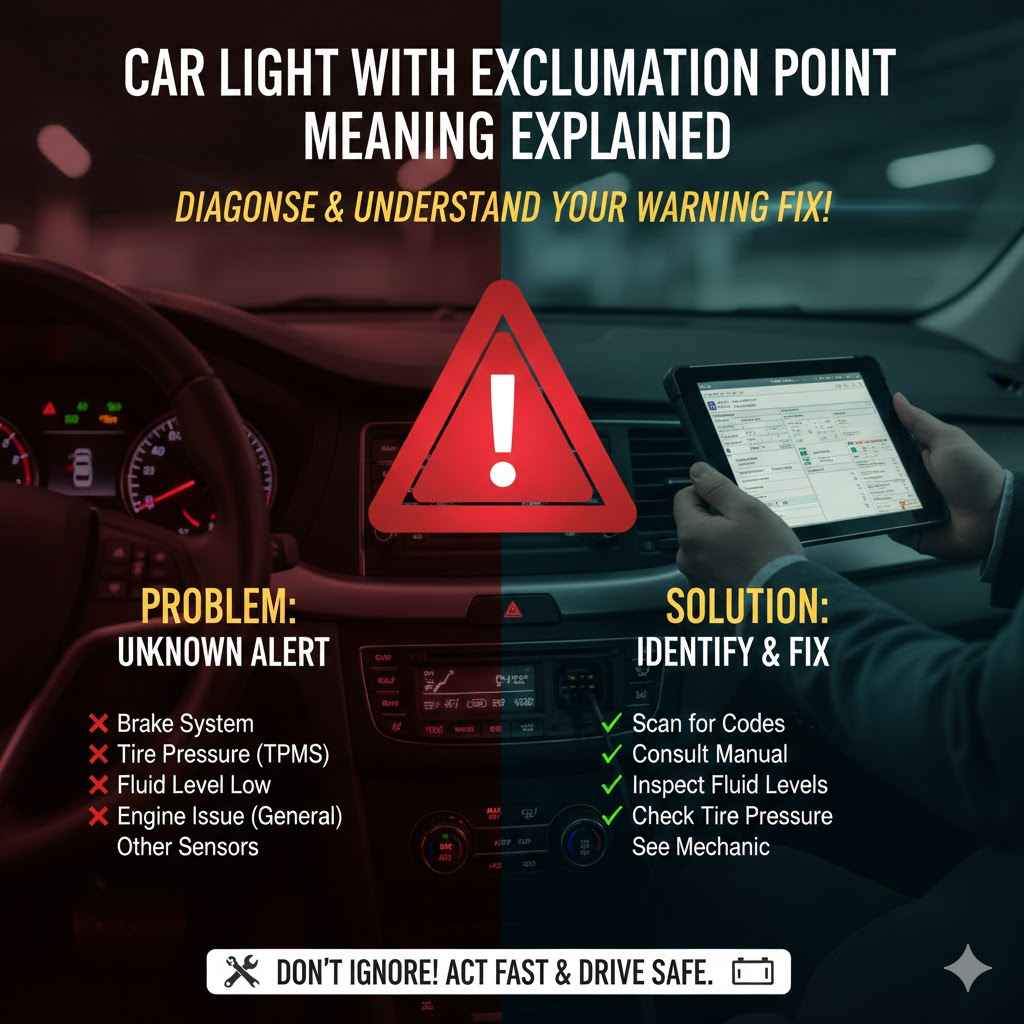
Many drivers see a light on their dashboard with an exclamation point inside a circle and wonder what it means. This symbol can pop up for various reasons, and for new drivers, it can be a bit confusing. But don’t worry, figuring out what this light means is simpler than you might think.
We’re going to walk through it step by step so you know exactly what to do. Get ready to learn about the Car Light With Exclamation Point: Meaning Explained.
Understanding Your Car’s Warning Lights
Your car’s dashboard is like a communication panel, showing you important information about your vehicle’s health and performance. When a warning light appears, it’s your car telling you something needs attention. These lights are designed to be a quick alert, and the one with an exclamation point is particularly common.
It often signals a general issue rather than a specific system failure, making it a bit of a mystery for many.
This light can appear in a few different forms, such as an exclamation point inside a triangle, or a circle with an exclamation point. Each variation might hint at a slightly different problem, but they all point to something you should check. Ignoring these lights can lead to bigger, more expensive problems down the road, so knowing what they mean is key to keeping your car running smoothly and safely.
The Exclamation Point Symbol What It Means
The exclamation point symbol on your dashboard is a universal indicator for caution. It’s not specific to one particular part of your car but rather serves as a general warning that something is not quite right. Think of it like a universal “check this out” signal.
Its purpose is to grab your attention and prompt you to investigate further.
When this light illuminates, it’s often linked to systems that are vital for safe driving but don’t have their own dedicated, more specific warning symbol. This includes things like tire pressure, braking systems, or even just a door being ajar. Because it’s so general, the first step in understanding what this light means is to look for other clues around your car or in your car’s manual.
One common cause for this light to appear is related to your tires. Low tire pressure is a frequent culprit. Your car has sensors that monitor how much air is in each tire.
If one or more tires are significantly underinflated, the system will activate this warning light to let you know that your tires might not be safe for driving. Driving on underinflated tires can affect handling, braking, and fuel efficiency, and can even lead to a blowout.
Another system this light might be alerting you to is your braking system. While a red brake light usually indicates a more serious brake issue, the exclamation point can sometimes signal a problem with the brake fluid level or the brake assist system. It’s essential to check your brake fluid and consult your car’s manual to understand the specific implication for your vehicle.
Some vehicles also use this light to indicate that the electronic stability control (ESC) or traction control system is activated. If you’re driving on slippery surfaces like snow or ice, these systems engage to help you maintain control. The exclamation point light might flash to show that the system is working.
In this case, it’s not a malfunction but a notification that the system is active.
Tire Pressure Monitoring System TPMS
The Tire Pressure Monitoring System, or TPMS, is a critical safety feature in modern vehicles. It uses sensors to continuously check the air pressure in each tire. When the pressure in any tire drops below a safe level, the TPMS warning light, often showing an exclamation point, illuminates on your dashboard.
This system is crucial because underinflated tires can be dangerous. They can lead to poor handling, increased braking distances, reduced fuel economy, and a higher risk of tire failure or blowouts. The TPMS alert ensures you are aware of low tire pressure promptly, allowing you to address the issue before it becomes a safety hazard.
How TPMS Works
Your car is equipped with sensors inside each tire. These sensors measure the air pressure and temperature within the tire. They then transmit this data wirelessly to a central computer in your car.
If the pressure in any tire falls below a predetermined threshold, typically about 25% below the recommended pressure, the TPMS warning light will turn on.
Some TPMS systems also alert you if the pressure in a tire is too high, though this is less common. The system is designed to be highly sensitive to changes in tire pressure, providing an early warning before the issue becomes critical. The specific pressure threshold that triggers the light can vary depending on the vehicle manufacturer.
Common Causes of Low Tire Pressure
Several factors can cause your tire pressure to drop. The most common is simply the natural leakage of air over time, which is normal for all tires. Temperature changes also play a significant role; as the temperature drops, the air inside your tires contracts, leading to lower pressure.
Punctures from nails, screws, or other sharp objects are another major cause of sudden or gradual air loss. Even small punctures can lead to significant pressure loss over hours or days. Additionally, damage to the tire valve stem or the wheel rim can also result in air leaks.
Regular visual inspections of your tires can sometimes reveal these issues before the TPMS light comes on.
What to Do When the TPMS Light Comes On
When the TPMS light appears, your first action should be to safely pull over and inspect your tires visually. Check if any tire looks noticeably flatter than the others. If you can safely do so, use a tire pressure gauge to check the pressure in each tire.
The recommended tire pressure is usually found on a sticker inside the driver’s side door jamb or in your car’s owner’s manual.
Once you identify the underinflated tire(s), you should add air until the recommended pressure is reached. If the light stays on after adding air, it might indicate a slow leak or a faulty sensor. In such cases, it’s best to visit a mechanic or tire shop to have the system checked and repaired.
Driving on properly inflated tires is crucial for safety and efficiency.
Brake System Warning Lights
Your car’s braking system is one of its most important safety features. Any issue with your brakes needs immediate attention. The exclamation point symbol can sometimes be related to your brake system, though it’s usually not the primary brake warning light.
A red brake light is typically a direct indicator of a serious problem, such as low brake fluid, a problem with the anti-lock braking system (ABS), or a parking brake issue. However, the exclamation point can be a secondary alert or related to a specific component within the braking system.
Brake Fluid Level
The exclamation point symbol, particularly when accompanied by other brake indicators or a specific message on your dashboard, can signal low brake fluid. Brake fluid is essential for transmitting the force from your brake pedal to the brake pads, allowing your car to stop. If the fluid level is too low, your braking power can be significantly reduced.
Low brake fluid can be caused by a leak in the brake lines or a worn brake pad that requires more fluid to function. It’s crucial to check your brake fluid reservoir regularly. If it’s low, you should have the system inspected for leaks and then topped up by a professional.
Never ignore a warning related to your brakes.
Anti-Lock Braking System ABS Alert
The Anti-lock Braking System (ABS) prevents your wheels from locking up during hard braking, allowing you to maintain steering control. While ABS has its own warning light (often “ABS” in a circle), the general exclamation point might illuminate in conjunction with it or if there’s a related issue. This could mean the ABS system is not functioning correctly.
If the ABS light comes on, it doesn’t necessarily mean your regular brakes have failed, but it does mean the ABS feature is disabled. This can be due to a faulty wheel speed sensor, a problem with the ABS hydraulic unit, or a control module issue. You should get your ABS system checked by a qualified mechanic as soon as possible to ensure optimal braking performance, especially in emergency situations.
Electronic Stability Control ESC and Traction Control TC
Modern cars are equipped with sophisticated systems designed to enhance safety and control, such as Electronic Stability Control (ESC) and Traction Control (TC). These systems help prevent skids and maintain stability, particularly in adverse driving conditions. The exclamation point light on your dashboard can sometimes indicate the status of these systems.
When you’re driving on slippery surfaces like rain, snow, or ice, or if you make a sudden maneuver, these systems may activate automatically. The exclamation point light might flash to let you know that ESC or TC is actively working to help you regain control of your vehicle. This is not a sign of a problem but rather an indication that the system is doing its job.
How ESC and TC Work
Traction Control (TC) prevents your drive wheels from spinning when you accelerate. If it detects a wheel spinning faster than it should, it will reduce engine power or apply the brakes to that wheel, restoring traction. Electronic Stability Control (ESC) goes a step further.
It helps you steer through a skid or loss of control.
ESC uses sensors to detect when your car is about to lose traction or is sliding off its intended path. If this happens, it can automatically apply individual brakes to specific wheels and reduce engine power to help you steer back into control. Both systems are vital for maintaining safe handling in challenging driving situations.
When the Light Flashes or Stays On
If the exclamation point light flashes while you are driving, especially during acceleration or when turning on a slippery road, it usually means that your Traction Control or ESC system is actively engaged. This is normal behavior and indicates the system is helping to prevent a loss of control. Once the road conditions improve or you correct your steering, the light should stop flashing.
However, if the light stays illuminated continuously after you start your car, or if it comes on and stays on during normal driving, it often indicates that there is a problem with the ESC or TC system. This could be due to a faulty sensor, a wiring issue, or a problem with the control module. In such cases, the system may not be able to provide its safety assistance, and it’s recommended to have your vehicle inspected by a mechanic.
Other Potential Causes
While tire pressure, brakes, and stability control are the most common culprits behind the exclamation point warning light, there are a few other less frequent possibilities to consider. Your car’s manufacturer may assign this symbol to other functions to alert you to potential issues.
It’s always a good idea to refer to your car’s owner’s manual. This document is specifically written for your make and model and will provide the most accurate explanation of every warning light on your dashboard. It’s the ultimate guide for understanding what your car is trying to tell you.
Door Ajar Warning
In some vehicle models, the exclamation point symbol, sometimes within a circle or triangle, can indicate that one or more of your car’s doors are not properly closed. This is a simple but important safety reminder. If a door is not shut securely, it can open unexpectedly while you are driving, which is extremely dangerous.
When this light comes on, you should immediately check all your doors, including the trunk and hood. Make sure they are firmly latched. If the light doesn’t turn off after ensuring all doors are closed, there might be an issue with the door sensor itself, and you should have it inspected.
General System Malfunction
Occasionally, the exclamation point light can serve as a general alert for a variety of less specific system malfunctions. It might be linked to the transmission, the engine control unit, or other onboard computer systems. If this light appears alongside other warning lights, or if you notice unusual behavior from your car, it’s a sign that a more thorough diagnostic check is needed.
These types of general malfunctions require professional attention. A mechanic will use diagnostic tools to read error codes from your car’s computer, which will help pinpoint the exact source of the problem. Addressing these issues promptly can prevent minor problems from escalating into major repairs.
Trailer Towing Issues
For vehicles equipped for towing, the exclamation point warning light can sometimes be related to the trailer’s lighting system or the trailer’s brake controller. If you are towing a trailer and this light appears, it means there might be a problem with the electrical connection between your vehicle and the trailer, or with the trailer’s own braking components.
This is a critical safety alert, especially if you are towing. It suggests that the trailer’s lights may not be functioning correctly, or its brakes are not working as they should. You should pull over safely, inspect the trailer’s connections and lights, and ensure the trailer itself is functioning properly before continuing your journey.
Failure to do so could compromise safety for yourself and others on the road.
Real-Life Examples and Scenarios
Understanding abstract symbols is one thing, but seeing them in action helps solidify what they mean. Real-life situations can illustrate how these warning lights guide drivers and prevent potential problems. These examples show how a simple light can lead to important actions.
Consider Sarah, a busy mom who was rushing to drop her kids at school. As she started her car, she noticed the exclamation point light on her dashboard. She’d recently driven over some rough potholes and figured it might be related to that.
Instead of ignoring it, she remembered reading about this light and decided to check her tires.
Scenario 1 Tire Pressure Alert
Sarah pulled into a gas station and used the air pump to check her tires. The front passenger tire was significantly underinflated. She added air until it reached the recommended pressure, which she found on the sticker inside her driver’s door.
As soon as the tire pressure was correct, the exclamation point light turned off. She realized if she hadn’t checked, she could have risked a tire blowout or poor handling, making her commute unsafe.
Scenario 2 ESC Traction Control Activation
Mark was driving on a snowy mountain road. As he took a turn, his car started to slide slightly. Suddenly, the exclamation point light on his dashboard began to flash rapidly.
He immediately eased off the accelerator and made small steering corrections. The flashing light reassured him that his car’s Electronic Stability Control system was actively working to help him regain traction and control.
Once he reached a less slippery section of the road and straightened his wheels, the flashing light turned off. Mark understood that the light wasn’t indicating a problem but was confirming the system was doing its job to keep him safe on the challenging road conditions. This experience highlighted the importance of these safety features.
Scenario 3 Brake System Concern
Maria had her car serviced recently. A few days later, while driving, she noticed the exclamation point light appear on her dashboard, accompanied by a faint grinding sound when she applied the brakes. She immediately felt concerned because she knew brake issues were serious.
She decided not to drive further and instead called for a tow truck to take her car to the mechanic.
The mechanic discovered that one of her brake pads was worn down much further than the others, causing the issue. The exclamation point light was an early warning that her braking system was compromised. Thanks to her quick action, a potentially dangerous brake failure was avoided, and the repair was managed before it caused further damage to her braking system.
Preventative Maintenance and Best Practices
Taking care of your car is about more than just fixing things when they break. Regular maintenance and following some simple best practices can help prevent warning lights from appearing in the first place and ensure your vehicle runs smoothly for years to come. This proactive approach saves you time, money, and stress.
Think of preventative maintenance as giving your car regular check-ups. Just like humans need to see a doctor to stay healthy, cars need routine inspections to catch potential issues early. This means following the recommended service schedule outlined in your owner’s manual.
Regular Tire Checks
As we’ve discussed, tire pressure is a common trigger for the exclamation point light. Making it a habit to check your tire pressure at least once a month, and before any long road trips, is a simple yet effective practice. You can also visually inspect your tires for any signs of wear, damage, or foreign objects.
Ensuring your tires are properly inflated not only helps prevent the TPMS warning light from coming on but also improves fuel efficiency, enhances handling and braking, and prolongs the life of your tires. Many gas stations have air pumps available, and tire pressure gauges are inexpensive and easy to use.
Following Scheduled Maintenance
Your car’s owner’s manual contains a maintenance schedule recommended by the manufacturer. This schedule outlines when certain services should be performed, such as oil changes, fluid checks, brake inspections, and tire rotations. Adhering to this schedule is crucial for keeping all of your car’s systems in good working order.
For example, regular brake inspections will ensure that your brake pads and fluid levels are always optimal. Similarly, timely fluid checks can prevent issues with systems that rely on those fluids, potentially avoiding warning lights related to brakes, power steering, or other vital components. Don’t skip these important appointments.
Understanding Your Owner’s Manual
The owner’s manual is your car’s instruction book. It contains detailed information about all the features, functions, and warning lights specific to your vehicle. Take some time to read through it, especially the section on dashboard symbols and warning lights.
This knowledge will empower you to react appropriately when a light comes on.
Knowing what each symbol means can help you distinguish between a minor issue that can wait a day or two and a critical problem that requires immediate attention. It’s a valuable resource that often gets overlooked, but it can be your best friend when troubleshooting dashboard alerts.
Frequently Asked Questions
Question: What is the most common reason for the car light with an exclamation point
Answer: The most common reason for a car light with an exclamation point is low tire pressure. Your Tire Pressure Monitoring System (TPMS) will alert you when one or more tires are significantly underinflated.
Question: Should I be worried if my car light with an exclamation point comes on
Answer: You should pay attention to it, but not necessarily panic. It’s a warning to check something. Most often, it’s a simple fix like adding air to your tires, but it’s important to investigate the cause.
Question: Can the exclamation point light mean there’s a problem with my brakes
Answer: Yes, it can sometimes be related to the brake system, often indicating low brake fluid or an issue with the anti-lock braking system (ABS). Always check your brake fluid level if this light appears.
Question: What should I do if the exclamation point light is flashing
Answer: If the light is flashing, it often means your Traction Control or Electronic Stability Control system is active due to slippery conditions. Once the conditions improve, the flashing should stop. If it stays on, there may be a system issue.
Question: Where can I find the specific meaning of my car’s exclamation point light
Answer: The best place to find the specific meaning for your vehicle is in your car’s owner’s manual. It provides detailed explanations for all dashboard symbols and warning lights unique to your make and model.
Summary
The car light with an exclamation point is a helpful signal. It alerts you to issues like low tire pressure, brake system concerns, or stability control activation. Checking your tires, brake fluid, and consulting your owner’s manual are key steps.
Addressing these warnings promptly ensures your safety and keeps your car in good condition.