

Bolded Quick Summary (Top of Article)
Yes, you can technically jump-start another car using a Chevy Volt, but it requires caution. Because the Volt is a hybrid-electric vehicle (HEV) with a specialized 12-volt system, you must follow specific procedures to avoid damaging its sensitive electronics or the vehicle itself. Always use the designated jump points, not the battery directly.
We’ve all been there: you walk out to the parking lot, turn the key, and hear nothing but a sad clicking sound. Your car battery is dead! If you happen to drive a fantastic Chevy Volt, you might wonder if this versatile plug-in hybrid can come to the rescue. It’s a natural question. Hybrids are different, and you worry about messing up those fancy systems.
Don’t stress! The good news is that your Volt has a standard 12-volt battery it uses to run interior lights, computers, and the vital systems that start the high-voltage battery contactors. This means it can assist another car. However, the process is slightly different than with a traditional gasoline car. We are going to walk through every safe step together, ensuring you boost your friend’s car (or get your Volt boosted) without any headaches. Let’s jump right in and see how simple it is!
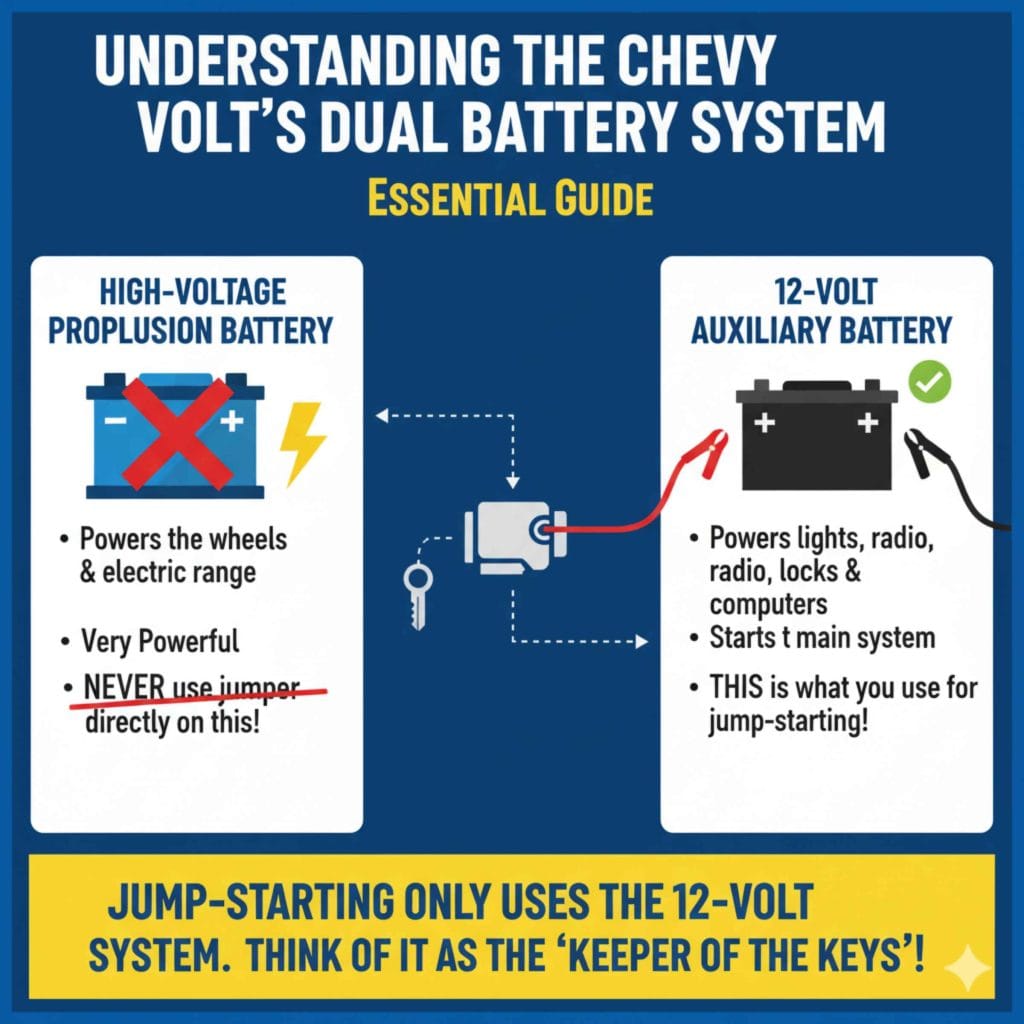
Understanding the Chevy Volt’s Dual Battery System
To safely jump-start anything, you first need to understand what you are working with. The Chevy Volt isn’t just a gas car or just an electric car; it’s a sophisticated Plug-in Hybrid Electric Vehicle (PHEV). This means it has two main electrical components you need to know about:
- The High-Voltage (HV) Propulsion Battery: This is the big battery pack that helps power the wheels and gives you electric range. This battery is powerful and should never be directly connected to jumper cables.
- The 12-Volt Auxiliary Battery: This acts just like the battery in a standard car. It powers the headlights, the radio, the door locks, and, most importantly, the computers that wake up the high-voltage system. This is the battery we use for jump-starting.
When you jump-start a Volt or use a Volt to jump another car, you are only dealing with the 12-volt system. Think of the 12-volt battery as the keeper of the keys—it needs enough juice to unlock the main system before the big battery takes over.
Can a Chevy Volt Jump-Start Another Car?
Yes, a Chevy Volt absolutely can jump-start another vehicle, provided its own 12-volt battery has sufficient charge. Since the Volt’s primary purpose is to save energy, its 12-volt battery is constantly maintained by the high-voltage system while the car is operating normally. However, if the Volt has been sitting for a very long time without being driven or plugged in (which keeps the 12V battery topped up), its 12V battery might be too weak to help.
When using a Volt to jump another car, remember two main rules:
- The Volt Must Be “On”: To ensure the 12-volt system is active and ready to send current, the Volt needs to be in a ready state. For many Volts, this means having the ignition on (as if you were about to drive), but the engine might not need (or be able to) run.
- Use Designated Jump Points: Never connect jumper cables directly to the negative terminal of the 12V battery located in the rear of the Volt. Connect to the designated ground point under the hood to protect vehicle electronics, as recommended by General Motors.
The Tools You Need for the Job
Before you start clipping cables, gather your equipment. Having the right gear makes the process safer and quicker. Here is what you need:
| Required Item | Why You Need It |
|---|---|
| Quality Jumper Cables | Ensure they are heavy-gauge (low gauge number) for better power transfer. |
| Safety Glasses | Protects your eyes from any potential sparks or battery acid splash (though rare with modern systems). |
| Gloves | For basic hand protection. |
| The Owner’s Manual | Always the final confirmation point for specific procedures for your Volt model year. |
Step-by-Step Guide: Using Your Volt to Jump Another Car
This section covers how to use your healthy Volt to wake up a friend’s dead battery. Remember: safety first! Keep the cars close enough for the cables to reach but ensure they are not touching each other.
Phase 1: Preparation and Positioning
- Park Safely: Turn off both vehicles completely. Put both cars in Park (or Neutral if manual) and engage the parking brakes firmly.
- Locate the Volt’s Jump Points: Open the hood of your Chevy Volt. Look for the positive (+) and negative (-) jump connection points. These are usually clearly labeled or have red/black caps and are often integrated into the fuse box area or near the shock towers. Consulting your Volt’s owner’s manual is crucial to find these exact points for your model year.
- Prepare the Dead Car: Locate the designated jump points on the disabled vehicle as well.
- Turn on the Volt: Unlike traditional cars, you generally need to put the Volt into “Ready” mode, which powers up its electrical systems, but you typically keep the gas engine off unless the 12V battery is so low it can’t enter Ready mode (in which case, you might need to start the engine first if possible). Check your manual, but usually, having the main ignition/power on is sufficient.
Phase 2: Connecting the Cables (The Golden Rule Order)
This order is important to prevent dangerous sparking near the battery terminals. Follow this sequence exactly:
- Connect RED (+) to Dead Car: Attach one red (positive) clamp to the positive (+) terminal or jump post of the DEAD car.
- Connect RED (+) to Volt: Attach the other red (positive) clamp to the positive (+) terminal or jump post of the working Chevy Volt.
- Connect BLACK (-) to Volt: Attach one black (negative) clamp to the negative (-) terminal or jump post of the working Chevy Volt.
- Connect BLACK (-) to Ground on Dead Car: Attach the final black (negative) clamp to an unpainted, heavy metal surface (a bracket or engine hoist point) on the DEAD car, far away from its battery. This provides a solid ground reference without risking a spark near the battery gasses.
Phase 3: The Start Sequence
- Wait Briefly: Let the vehicles sit connected for about five minutes. This allows the Volt’s strong 12V system to send a little charge into the dead battery.
- Attempt the Start: Have the driver of the dead car try to start their engine. If it cranks, great! If not, wait another 3–5 minutes and try again.
- Disconnect (Reverse Order): Once the dead car is running, DO NOT immediately turn off the Volt. Keep both running for a few minutes to stabilize the charging systems. Disconnect the cables in the exact reverse order you connected them:
- Black from the ground of the now-running car.
- Black from the negative post of the Volt.
- Red from the positive post of the Volt.
- Red from the positive post of the now-running car.
How to Jump-Start Your Chevy Volt (When It’s Dead)
If your Volt’s 12-volt battery dies, you need another working vehicle to help it. Because of the Volt’s sensitive electronics, using the correct connection points is even more critical here.
Crucial Note: If the Volt is completely dead—meaning it won’t even turn on the dashboard lights—you might not be able to get it into the “Ready” state needed to start its gas engine generator. In this scenario, you must wait for the donor car to deliver enough charge to power the Volt’s computer system first.
Connecting the Cables to the Dead Volt
Use the same connection order as above, but the Volt is receiving the power this time:
- Connect RED (+) to Donor Car: Connect the red clamp to the positive post of the donor vehicle.
- Connect RED (+) to Volt Post: Connect the other red clamp to the positive (+) jump post under the Volt’s hood.
- Connect BLACK (-) to Donor Car Ground: Connect one black clamp to a solid ground point on the donor car.
- Connect BLACK (-) to Volt Ground: Connect the final black clamp to the designated negative ground point under the Volt’s hood—the one that mirrors the positive jump post location.
Starting the Volt After Connecting
- Wait Patiently: Let the Volt sit connected for 10 to 15 minutes, especially if it was completely unresponsive. This allows the donor car to pump enough energy into the 12V battery to wake up the systems.
- Attempt Power-Up: After waiting, attempt to press the Power button on your Volt. If the dashboard lights up, you have successfully restored enough power.
- Start the Gas Engine (If Needed): Once the car is powered on, the Volt may automatically start the gasoline engine to recharge its 12V battery system if it senses extreme low voltage, or you may need to press the accelerator slightly if it’s in EV mode but needs engine assistance.
- Disconnect: Once running, disconnect the cables in reverse order (Black from Volt ground, Black from Donor ground, Red from Volt post, Red from Donor post).
Why You Must Use Designated Jump Points (Not the Battery Terminal)
This distinction is the most important takeaway when dealing with any modern hybrid or complex GM vehicle. Why go through the trouble of finding the posts under the fuse box instead of just connecting to the 12V battery (usually found in the trunk)?
The answer is protection for your delicate electronics. The connection points under the hood are intentionally placed upstream of major protective relays and fuses. Connecting directly to the battery can sometimes cause a harsh surge of current or create a larger spark right next to the battery itself, which could be dangerous given the battery chemistry used in modern vehicles.
| Connection Method | Risk Level | Why It’s Risky on a Volt |
|---|---|---|
| Designated Under-Hood Posts | Low | Safely routes current through protective relays; standard procedure for GM hybrids. |
| 12V Battery Terminal (In Trunk) | High | Can potentially bypass safety electronics or cause a large spark near the battery. |
Always trust the manufacturer’s engineering. For the Chevy Volt, the under-hood posts are the designated “safe zone” for external electrical intervention.
Common Mistakes to Avoid with Your Chevy Volt
Because the Volt is different, beginners often make mistakes that can turn a simple jump into an expensive headache. Here are the top pitfalls to avoid:
- Using the Volt for Too Long: A Volt’s 12V battery is smaller than a truck’s. If the other car has a severely dead battery, trying to jump it for more than 15 minutes can seriously drain the Volt’s 12V system, leaving you stranded too!
- Letting Cables Touch: Never let the two red clamps touch each other, and never let the two black clamps touch each other once they are both connected to a car. This causes a short circuit which can blow fuses or damage electronics.
- Hooking up in the Wrong Order: Remember the rule: Positive first, Negative last. Disconnect in reverse order. Getting this wrong significantly increases the risk of dangerous sparking.
- Mixing Voltages: Only use the Volt to jump a standard 12-volt vehicle. Never attempt to jump a larger system like a heavy-duty truck or a different type of electric vehicle with a different battery architecture.
Maintaining Your Volt’s 12-Volt Health
The best way to deal with a dead battery is to prevent it! The Volt’s 12-volt battery is routinely charged by the hybrid system, but certain habits can shorten its life. Keeping the 12V battery healthy ensures you can always jump others or start your own car reliably.
Tips for 12V Longevity:
- Drive Regularly: The gasoline engine in the Volt automatically runs occasionally (even in EV mode) to charge the 12V system. Driving the car weekly helps keep it topped up.
- Avoid Long Storage Unplugged: If you plan to store your Volt for months, plug it into a charger. Long periods of complete electrical inactivity can drain the small 12V battery faster than the car can recover it.
- Monitor Accessories: Don’t leave the headlights, radio, or interior dome lights on with the car completely off for extended periods. Even though some systems shut down automatically, leaving heavy loads on when the car is “off” drains that small 12V battery quickly.

FAQ: Beginner Questions About Jumping the Volt
Q1: Do I need to turn the gas engine on in my Volt to jump another car?
A: Usually, only powering the Volt to “Ready” mode (pushing the power button without touching the brake) is enough. This activates the 12V system. Only if the 12V battery is extremely flat might you need to start the gas engine to ensure the 12V charger is active.
Q2: Where is the 12-volt battery actually located in a Chevy Volt?
A: In most generations of the Chevy Volt (Gen 1 and Gen 2), the 12-volt auxiliary battery is located in the rear cargo area, often accessible by lifting a panel or accessing the spare tire well area.
Q3: Can I use a portable jump starter on my Chevy Volt?
A: Yes, portable jump starters are often the safest option, as they let you connect directly to the designated under-hood jump points without needing another running vehicle. Make sure your jump pack outputs 12 volts.
Q4: What happens if I accidentally connect the cables to the high-voltage battery?
A: You should never connect directly to the high-voltage system. Connecting to the designated 12V points prevents this. If you confuse connections, you risk severe damage to the vehicle’s complex power management control unit, leading to very expensive repairs. Always double-check the labels.
Q5: How long should I let the Volt run after successfully jump-starting another car?
A: After successfully starting the recipient car, let both vehicles run for at least five minutes before disconnecting the cables. This gives the donor car (your Volt) time to recover its own 12V charge level and ensures the newly started car’s alternator has time to begin working.
Q6: Is it bad for my Volt’s main battery if I jump another car frequently?
A: No, using the 12V system occasionally is fine. However, if you find yourself needing to jump other cars often, it suggests your Volt’s 12V battery might be nearing the end of its lifespan and should be tested by a service center soon.
Conclusion
You now have the confidence and the know-how to handle a dead battery situation, whether you need a jump or you are providing one with your reliable Chevy Volt. Remember the key takeaways: always use the designated under-hood jump points to protect the Volt’s sophisticated electronics, and always connect the cables in the correct positive-then-negative sequence. By following these simple, safe steps, your versatile Volt can be a helpful road companion. Taking the time to learn these basic automotive skills saves time, stress, and money. Keep your battery healthy by driving it regularly, and you’ll rarely need to worry about being stranded!