
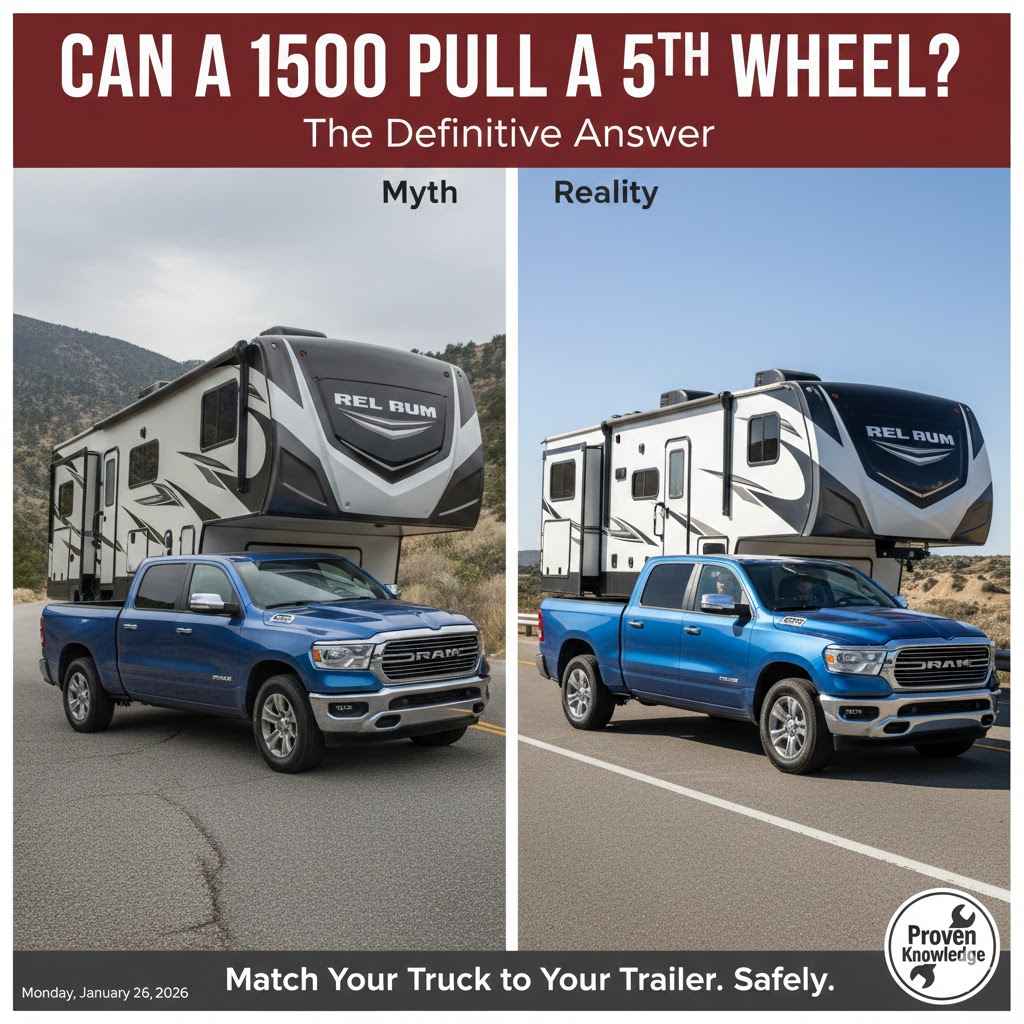
Yes, some 1500-series trucks can technically pull certain lightweight 5th wheel trailers. However, the most critical factor is the truck’s payload capacity—the amount of weight it can carry in its bed—which is often exceeded before you reach the maximum towing limit. Always verify your specific truck’s payload rating to ensure a safe match.
Thinking about buying a 5th wheel camper? It’s an exciting step! You imagine hooking it up to your trusty 1500 truck and hitting the open road. But then a nagging question pops up: can my truck actually handle it? It’s a common and very important question. Many people get confused by big towing numbers and end up with a dangerous combination.
Don’t worry, you’re in the right place. We’re going to break it all down in simple, easy-to-understand steps. I’ll show you exactly how to know for sure if your 1500 is up to the task. We’ll look at the real numbers that matter and skip the confusing jargon. Let’s get you ready for your adventure safely.
The Short Answer vs. The Safe Answer
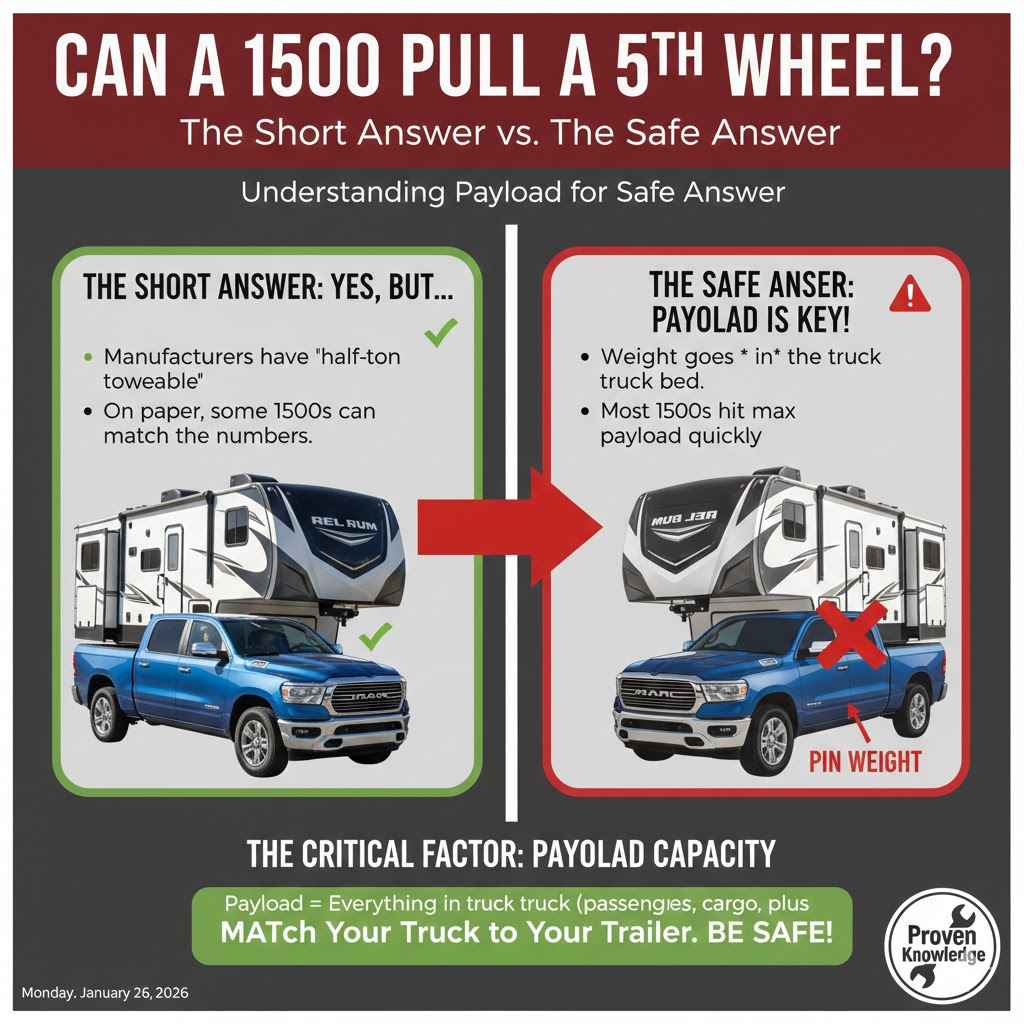
Let’s get this out of the way first. The short answer is: yes, it’s possible. Truck manufacturers and RV dealers have developed lighter 5th wheel models specifically marketed as “half-ton towable.” So, on paper, certain combinations work.
But the safe answer is much more nuanced. It’s not about if you can, but if you should. Towing a 5th wheel puts a unique kind of stress on a truck. Unlike a regular trailer that hitches to the bumper, a 5th wheel places hundreds (or thousands) of pounds of weight directly in the truck’s bed. This is where most 1500 trucks run into trouble.
The single most important number you need to know is payload capacity. We’re going to dive deep into this, because it’s the number that keeps you and your family safe on the road.
Understanding the Numbers: Your Truck’s Most Important Ratings
To tow safely, you need to become familiar with a few key terms. It might seem like a lot at first, but I promise it’s straightforward once you know what to look for. Think of these as your truck’s vital signs.
The King of 5th Wheel Towing: Payload Capacity
If you remember only one thing from this article, let it be this. Payload capacity is the total weight your truck can safely carry in its cab and bed. This includes:
- You and all your passengers
- Cargo and gear in the cab and bed (coolers, firewood, tools)
- The weight of the 5th wheel hitch itself (they can weigh 100-200 lbs!)
- The downward force from the 5th wheel trailer, known as the Pin Weight.
Payload is almost always the limiting factor for towing a 5th wheel with a 1500 truck. You will likely run out of payload capacity long before you hit the maximum towing capacity.
What About Towing Capacity?
Towing capacity is the big, flashy number dealers love to advertise. It’s the total weight of the trailer your truck is rated to pull. While important, it can be misleading. That number is often calculated with only a 150-pound driver in the truck and nothing else. Once you add your family, gear, and the heavy pin weight of a 5th wheel, the reality changes fast.
Key Towing Terms Explained Simply
Here’s a quick-reference table to help you keep these terms straight.
| Term | What It Means in Simple Language |
|---|---|
| Payload Capacity | The maximum weight your truck’s bed and cab can hold. This is the most critical number for 5th wheel towing. |
| Pin Weight | The downward weight the 5th wheel pushes onto the hitch in your truck bed. It counts 100% against your payload. |
| Towing Capacity | The maximum weight of a trailer your truck can pull. Often less important than payload for 5th wheels. |
| GVWR (Gross Vehicle Weight Rating) | The maximum safe weight of your truck, fully loaded with passengers, cargo, and pin weight. You should never exceed this. |
| GCWR (Gross Combined Weight Rating) | The maximum safe weight of your fully loaded truck and fully loaded trailer combined. |
How to Find Your Truck’s Real-World Towing Numbers
Okay, it’s time to do a little detective work on your own truck. This is the most important step! You need to find the numbers for your specific truck, not a generic number from a brochure. Here’s how.
Find the Sticker in Your Door JambOpen your driver’s side door. Look for one or two stickers on the door frame. You are looking for the “Tire and Loading Information” sticker. It’s usually yellow and white.
Find Your Payload CapacityOn that sticker, you will see a sentence that says: “The combined weight of occupants and cargo should never exceed XXXX lbs or XXXX kg.” That number is your truck’s payload capacity. It was calculated when your truck left the factory. Take a picture of this sticker with your phone! This is your golden number.
Consult Your Owner’s ManualYour owner’s manual has a section on towing. It will contain detailed charts that list the maximum towing capacity and GCWR based on your truck’s engine, axle ratio, and whether it’s 2WD or 4WD. This helps you find the other pieces of the puzzle.
Use an Online Tool (Optional)For extra information, you can use the NHTSA’s VIN Decoder tool. By entering your Vehicle Identification Number (VIN), you can get specific details about your truck’s factory build, which can help confirm its specifications.
The Math: Can Your 1500 Handle the Load?
Now we put it all together. Let’s walk through a real-world example. We need to make sure the weight you plan to add to your truck does not exceed its payload capacity.
Step 1: Calculate Your Truck’s Cargo Weight
First, add up the weight of everything you’ll put in your truck. Be honest and overestimate a little to be safe.
- Weight of Passengers: You + your spouse + kids + friends. Let’s say that’s 400 lbs.
- Weight of Gear: Coolers, tools, firewood, luggage in the cab or bed. Let’s estimate 100 lbs.
- Weight of the Hitch: A 5th wheel hitch is heavy! They range from 75 to 200 lbs. Let’s use 150 lbs for our example.
Total Cargo Weight: 400 + 100 + 150 = 650 lbs.
Step 2: Find the 5th Wheel’s Pin Weight
The pin weight is usually 15% to 25% of the trailer’s total weight. CRITICAL TIP: Do not use the “Dry Weight” or “Unloaded Vehicle Weight (UVW)” listed in the brochure. That number is for an empty trailer with no water, no propane, no batteries, and no camping gear. It’s totally unrealistic.
Instead, use the trailer’s Gross Vehicle Weight Rating (GVWR). This is the maximum weight the trailer can be when fully loaded. This is the safest number to use for your calculations. Let’s say you’re looking at a lightweight 5th wheel with a GVWR of 9,000 lbs.
Calculate the estimated pin weight using 20% (a good, safe average):
Estimated Pin Weight: 9,000 lbs x 0.20 = 1,800 lbs.
Step 3: Do the Final Payload Math
Now, let’s add your cargo weight and the trailer’s pin weight together to see the total demand on your truck’s payload.
Total Payload Demand: 650 lbs (Cargo) + 1,800 lbs (Pin Weight) = 2,450 lbs.
Now compare this number to the payload capacity you found on your door sticker. Let’s say your 1500 truck has a payload capacity of 1,850 lbs.
| Calculation | Example Value |
|---|---|
| Your Truck’s Payload Capacity (from sticker) | 1,850 lbs |
| Your Total Payload Demand (Cargo + Pin Weight) | 2,450 lbs |
| Remaining Payload (Payload Capacity – Total Demand) | -600 lbs |
The result is negative 600 pounds. This means this truck and trailer combination is 600 pounds overloaded. It is unsafe and should not be attempted. As you can see, even with a truck that might have a “10,000 lb towing capacity,” the payload limit was reached very quickly.
What About “Half-Ton Towable” 5th Wheels?
The RV industry saw a huge market for people who own 1500-series trucks and want a 5th wheel. So, they created a class of lighter trailers called “half-ton towable” or “lightweight” 5th wheels.
While these models are a step in the right direction, the name can be very misleading. It is a marketing term, not a technical guarantee. It does not mean that any half-ton truck can pull it. You still have to do the math for your specific truck. Many of these trailers, once loaded with gear for a real camping trip, will still exceed the payload capacity of a typical 1500 truck.
Always use the trailer’s GVWR, not its advertised “dry weight,” to calculate pin weight and make your decision.
Beyond the Numbers: Other Important Factors
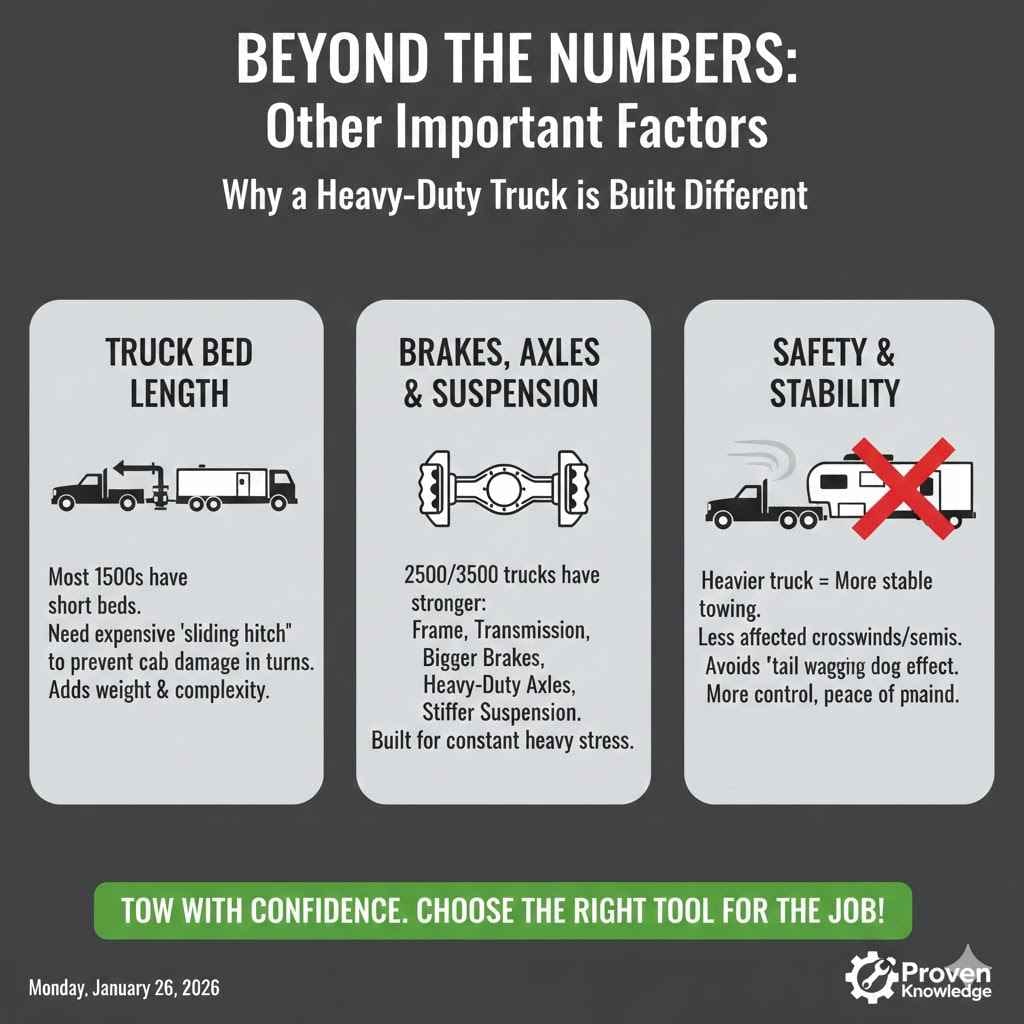
Weight isn’t the only thing to consider. A heavy-duty truck (a 2500/3500 series) is built differently from the ground up.
Truck Bed Length
Most 1500 trucks have short beds (around 5.5 to 6.5 feet). To tow a 5th wheel with a short bed, you often need a special, expensive “sliding hitch.” This hitch slides backward during tight turns to prevent the front corner of the trailer from smashing into the back of your truck’s cab. This adds more weight, cost, and complexity.
Brakes, Axles, and Suspension
A 2500 (3/4-ton) or 3500 (1-ton) truck has a stronger frame, a more robust transmission, bigger brakes, heavy-duty axles, and stiffer suspension. These components are all designed to handle the immense stress of towing heavy loads day in and day out. A 1500 is built more for passenger comfort and light-duty work. Towing at its absolute maximum limit will cause significant wear and tear over time.
Safety and Stability
A heavier truck provides a more stable towing experience. It’s less likely to be pushed around by crosswinds or passing semi-trucks. When you’re towing a trailer that weighs more than your truck, it can create a “tail wagging the dog” effect, which is incredibly dangerous. Having a heavier tow vehicle gives you more control and peace of mind.
FAQs: Your 1500 & 5th Wheel Questions Answered
1. What’s the biggest mistake people make when towing a 5th wheel with a 1500?
The biggest mistake is ignoring payload capacity. People get fixated on the maximum towing capacity and forget that the weight in the truck bed is the real limiting factor. Always check the payload sticker in your driver’s side door.
2. Can I add airbags or helper springs to my 1500 to increase its payload?
No. Aftermarket suspension aids like airbags can help level out your truck’s rear end and improve the ride, but they do not legally or safely increase your payload capacity or GVWR. The frame, axles, and brakes are still the original limiting factors.
3. Is a “half-ton” truck the same as a 1500?
Yes, “half-ton” is a common nickname for the 1500-series class of trucks (like a Ford F-150, Ram 1500, Chevy Silverado 1500). Similarly, “three-quarter-ton” refers to 2500-series trucks and “one-ton” refers to 3500-series trucks.
4. Why is pin weight so much more important for 5th wheels than for travel trailers?
A conventional travel trailer places about 10-15% of its weight on the bumper hitch (tongue weight). A 5th wheel places 15-25% of its weight directly over the truck’s rear axle (pin weight). This much heavier load uses up your truck’s payload capacity much faster.
5. Where is the best place to find my truck’s exact payload capacity?
The single most accurate place is the yellow-and-white “Tire and Loading Information” sticker located inside your driver’s side door jamb. This number is specific to your vehicle as it was built at the factory, including all its options.
6. Is it better to be well under my truck’s towing limits?
Absolutely. For maximum safety, stability, and reduced wear on your vehicle, it’s wise to stay well below your maximum ratings. A good rule of thumb is to use only 80% of your payload and towing capacities. This gives you a comfortable safety margin for emergencies, steep grades, and windy conditions.
The Bottom Line: Should You Tow a 5th Wheel with a 1500?
So, we come back to our original question. While it is technically possible for a properly equipped 1500 truck to pull a very specific, lightweight 5th wheel, you will almost always be operating at the absolute edge of your truck’s capabilities.
This leaves no room for error. No extra firewood, no bringing a couple of friends along, no extra water in the tanks. Towing at your maximum limit is stressful for you and your truck. It leads to more wear and tear, worse handling, and a less enjoyable experience.
For the vast majority of 5th wheel trailers, the safe and correct answer is to use a three-quarter-ton (2500) or one-ton (3500) truck. They are designed for this kind of work. They have the payload, the brakes, and the stability to handle the load with confidence. Choosing the right tool for the job is not just about power—it’s about safety and peace of mind.
By taking the time to understand the numbers on your door sticker, you are taking the most important step toward being a safe and responsible tower. Make the smart choice, stay within your vehicle’s limits, and you’ll be on your way to making wonderful memories on the road.