

Quick Summary: Not all Honda CR-Vs are All-Wheel Drive (AWD). Most modern CR-V models feature a choice between Front-Wheel Drive (FWD) and an optional Real Time AWD system. To know for sure, always check the specific trim level and model year of the vehicle you are looking at.
Ever been stuck looking at a used car listing, wondering if that Honda CR-V has the extra traction you need for snowy winters or light trails? You are not alone! The question, “Are all Honda CR-Vs All-Wheel Drive?” comes up constantly among new and seasoned drivers alike. It can be confusing because Honda offers different drivetrain options across their popular lineup.
The CR-V is famous for being reliable and practical, but knowing exactly what powers the wheels is key to long-term satisfaction and safety. Don’t worry about sounding like a beginner; everyone deserves clear answers. We are going to break down Honda’s clever system in plain English, show you exactly how to check your specific CR-V, and help you understand the benefits of each setup. Let’s clear up the confusion today!
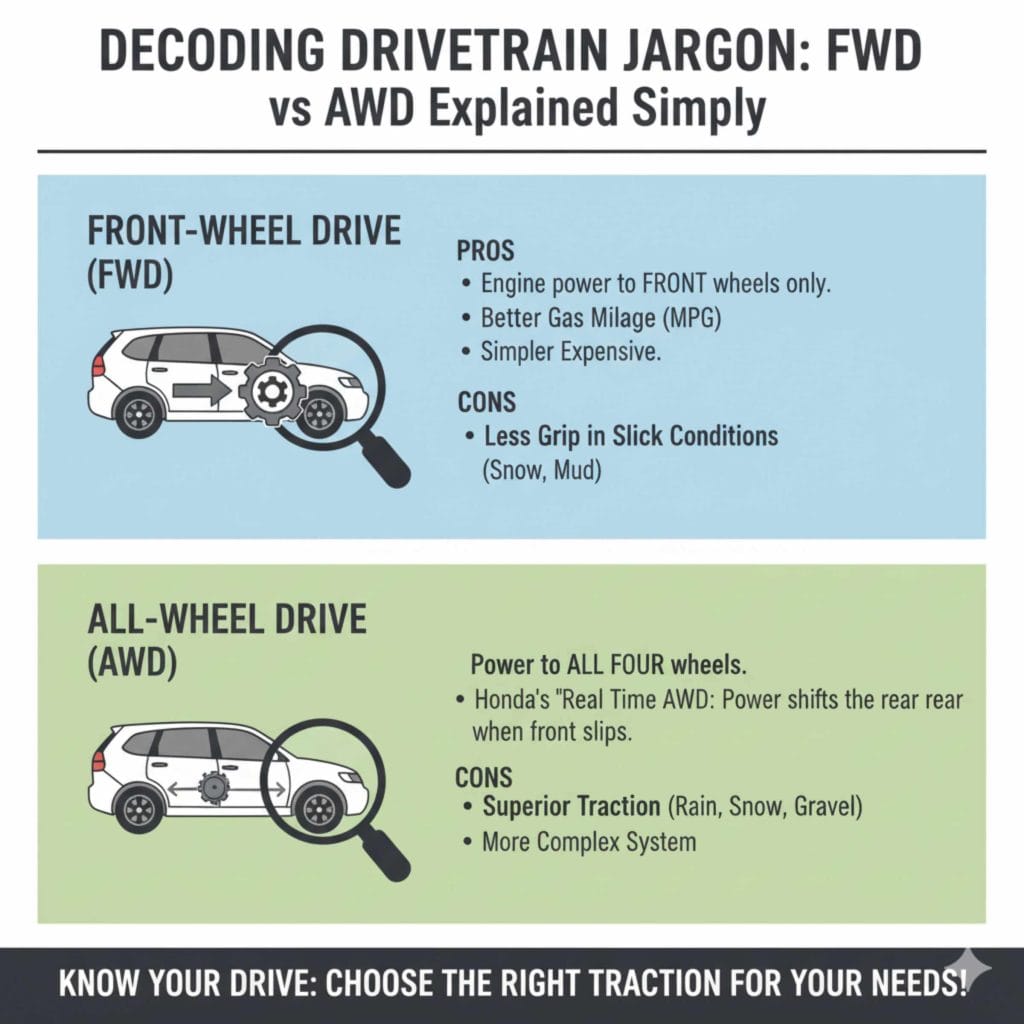
Decoding Drivetrain Jargon: FWD vs AWD Explained Simply
Before we dive into what specific CR-V models offer, it helps to know what we are even talking about. Drivetrain simply means which wheels are getting power from the engine. This decision drastically affects how your car handles in different weather.
Front-Wheel Drive (FWD)
Think of FWD as the standard setup for most everyday cars and crossovers, including many base model CR-Vs. In an FWD vehicle, the engine sends power only to the front wheels. This is great for city driving and fuel efficiency.
- Pros: Generally better gas mileage (MPG), simpler design, often less expensive upfront.
- Cons: Less grip in very slick conditions (deep snow, mud) because those wheels can spin easily.
All-Wheel Drive (AWD)
AWD means power can be sent to all four wheels—sometimes simultaneously, sometimes automatically when needed. Honda calls their system “Real Time AWD,” and it is designed to sense when the front wheels start slipping and instantly send power to the rear wheels for added traction.
- Pros: Superior traction in poor weather (rain, snow, light gravel).
- Cons: Slightly lower fuel economy than FWD, slightly more complex system.
The Definitive Answer: Are All Honda CR-Vs AWD?
To put it plainly: No, not all Honda CR-Vs are All-Wheel Drive.
Honda typically offers almost every generation of the CR-V with a choice between two core drivetrains:
- Front-Wheel Drive (FWD) – Usually standard on the base trims.
- Real Time All-Wheel Drive (AWD) – Usually available as an upgrade or standard on higher trims.
The key takeaway here is that you must look closely at the specific trim level and options package when buying, whether new or pre-owned. If the vehicle listing does not explicitly state “AWD” or “4WD,” it is almost certainly FWD (unless it’s a specialized trim designed for off-road capability, which the CR-V generally is not). Honda’s system is not a traditional 4WD meant for heavy rock crawling, but rather a highly capable AWD system for on-road safety and light adventure.
Understanding Honda’s Famous Real Time AWD System
Honda’s AWD is more sophisticated than just sending power everywhere constantly. It is designed to be efficient until you actually need that extra grip. It operates primarily as an FWD vehicle until it detects a slip, which is where the “Real Time” nature comes in.
How Honda Real Time AWD Works (The Simple Version)
Imagine the CR-V is cruising happily on dry pavement. In this state, the vehicle acts just like a FWD car, saving you gas. Inside the system, there is a sophisticated multi-plate clutch system connected to the rear differential.
If the front wheels begin to spin even slightly faster than the rear wheels (indicating slippage on ice or wet pavement), the system automatically engages the rear wheels. This happens in just a fraction of a second! It pushes torque (turning force) to the rear axle, helping you regain control and forward momentum.
This system is excellent for boosting safety during sudden heavy rain or when accelerating on snowy roads. For more serious off-roading or deep mud, a dedicated 4WD system might be needed, but for the average driver facing varied road conditions, Honda’s AWD is more than capable. For more technical insights into how modern vehicle traction control systems work, reputable sources like the National Highway Traffic Safety Administration (NHTSA) provide useful safety standards documentation.
How to Determine if Your CR-V is FWD or AWD
If you are standing next to a CR-V right now and need to know its drivetrain, there are several easy ways to check without needing a mechanic.
Method 1: Check the Exterior Badging
This is the easiest method, but sometimes badges fall off or are removed. Look on the rear hatch or tailgate of the vehicle.
- If you see an emblem that says “AWD” or “Real Time AWD,” you have the four-wheel system.
- If there is no AWD badging, it is typically FWD. Some trims might have the trim name (like EX or LX) but no drivetrain indicator.
Method 2: Look at the Vehicle Identification Number (VIN) Tag
The VIN holds the key to the car’s original configuration. This is the most reliable method, especially if the badges are missing.
- Locate the VIN sticker. It is usually visible through the driver’s side windshield near the dashboard, or sometimes on the driver’s side door jamb sticker.
- Find the Eighth Digit of the VIN number.
- Consult a VIN decoder chart for that specific model year (you can find free ones online by searching “[Year] Honda CR-V VIN decoder”).
Pro Tip: Often, the letter or number in the eighth position signifies the drivetrain code. For example, on a recent model, a ‘D’ might indicate FWD, while a ‘C’ might indicate AWD, though this varies significantly by Honda’s manufacturing code for that specific year and region. Searching a general VIN decoder online for your specific model year is the simplest approach.
Method 3: Inspect the Center Console/Shifter Area (For Older Models)
While modern CR-Vs manage AWD engagement automatically, some older models (especially pre-2012/2014) had a manual engagement button.
- Look near the gear selector or on the dashboard for a button labeled “LOCK” or “AWD.”
- If you find a button that allows you to manually engage the rear wheels (usually only functional at low speeds, under 25 mph), you definitely have the AWD system. If there is no such button, it is likely FWD.
Method 4: Simple Drive Test (When Safe)
If you are testing a vehicle in a safe, controlled area (like an empty parking lot during light rain, if available:
- Slowly accelerate onto a slightly slippery patch of pavement (like wet grass or damp pavement).
- If the front wheels “dig in” and pull you forward without excessive spinning while the rear end feels stable, you likely have AWD engaging.
- If the front wheels spin freely before the car reluctantly moves, you are likely FWD.
CR-V Generation Breakdown: Which Years Offered AWD?
The availability of All-Wheel Drive has evolved greatly over the CR-V’s lifespan. Knowing which generation you are looking at helps set expectations. Here is a general look at how drivetrain options have been distributed.
CR-V Generations and Drivetrain Availability
The table below gives you a snapshot. Remember, AWD was almost always an option on mid-to-higher trims, not standard across the board until very recently in some markets.
| Generation/Years Approx. | Base Drivetrain | AWD Availability | Key Notes |
|---|---|---|---|
| First Gen (1997–2001) | FWD (Rare) | Very Common Option | Early AWD systems were robust for the time. |
| Second Gen (2002–2006) | FWD | Standard on EX trims | Real Time AWD introduced; widely available. |
| Third Gen (2007–2011) | FWD | Standard on EX-L, Optional on LX/EX | System refinement began here. |
| Fourth Gen (2012–2016) | FWD | Optional on most trims | Very popular years for FWD/AWD choice. |
| Fifth Gen (2017–2022) | FWD | Standard on Touring, Optional on others | Refined Real Time AWD system. |
| Sixth Gen (2023–Present) | FWD | Standard on Sport Touring, Optional on others | Focus remains on excellent hybrid efficiency with FWD or AWD options. |
As you can see, if you are buying a CR-V made anytime since the early 2000s, the probability is high that it came in both FWD and AWD configurations. It is never safe to assume AWD is present just because it is a CR-V.
Why Choosing FWD vs. AWD Matters for You
Deciding between FWD and the optional AWD isn’t just about bragging rights; it genuinely impacts your driving experience, running costs, and confidence.
When FWD is Perfectly Fine (Or Better)
If you live in an area that rarely sees snow—think consistently warm climates like Southern California or Florida—FWD is usually the smarter choice because:
- Fuel Economy: Less weight and less mechanical drag mean you burn less fuel. Over thousands of miles, those savings add up.
- Cost of Ownership: FWD vehicles have fewer components in the drivetrain, leading to potentially lower maintenance costs down the road compared to AWD models.
- Maneuverability: In dry conditions, FWD cars are typically lighter up front and can feel slightly more nimble during tight turns.
When You Absolutely Need AWD
If your daily routine involves any of the following, investing in the AWD version is a wise decision for safety and peace of mind:
- Heavy Snow/Ice: The ability to put power down when two wheels are slipping is invaluable for getting up hills or out of driveways.
- Slippery Surfaces: Driving onto wet, grassy fields for camping or navigating gravel roads requires constant power management.
- Towing Light Loads: While the CR-V is not a heavy tow rig, having AWD helps maintain stability when pulling a small utility trailer on uneven pavement.
Remember, AWD won’t help you stop faster; that is the job of your tires and brakes. However, it will certainly help you start moving and maintain control when traction is low, which is critical for safe driving on slick roads. Always ensure you have good all-season or winter tires installed, as even the best AWD system can’t fix bad tires!
Maintenance Checks Specific to AWD CR-Vs
If you own or buy an AWD CR-V, there is one critical maintenance item that FWD owners never have to worry about: the rear differential fluid.
The rear differential houses the gears that send power to those occasionally-used rear wheels. Honda recommends regular fluid changes here to keep that clutch pack happy. Skipping this service is the number one cause of expensive repairs on older AWD systems.
The Simple AWD Fluid Check Schedule
Consult your owner’s manual for the exact schedule for your year, but here are general guidelines for the rear differential fluid service:
| Driving Condition | Recommended Service Interval |
|---|---|
| Normal Driving (Dry climate, fair weather) | Every 60,000 to 100,000 miles |
| Severe or Heavy Use (Frequent snow, towing, constant heavy rain) | Every 30,000 to 45,000 miles |
When you take your CR-V in for its regular oil change, just mention to the technician, “I have the Real Time AWD; can you check when the rear differential fluid was last changed?” This small step keeps your AWD system healthy for years to come. If you are planning to tackle maintenance yourself, you can often find detailed tutorials on safe fluid draining procedures. Always use gear oil specifically recommended by Honda for the CR-V’s rear differential to protect those vital internal components.
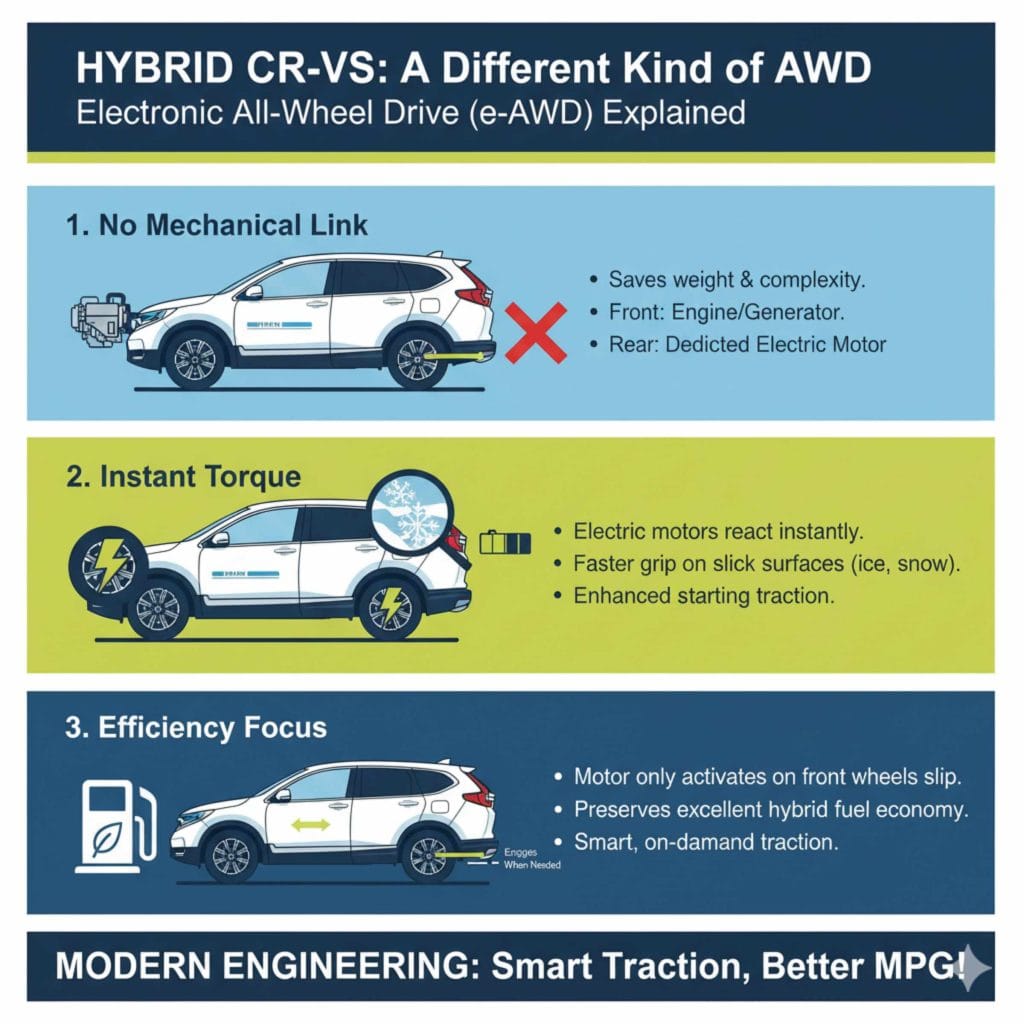
Hybrid CR-Vs All Wheel Drive : A Different Kind of AWD
If you are looking at the more recent Hybrid models (typically 2020 and newer), the setup is slightly different, but the outcome is similar: great traction when you need it.
Honda Hybrid CR-Vs often use an Electronic All-Wheel Drive system (e-AWD). This means there is no physical driveshaft connecting the front engine/transmission to the rear wheels. Instead, the rear wheels are powered by a dedicated electric motor.
Three Key Points About Hybrid e-AWD:
- No Mechanical Link: This saves weight and complexity compared to a traditional mechanical AWD system found on pure gasoline models.
- Instant Torque: Electric motors provide instant torque, meaning the rear wheels can engage almost faster than a gas-powered system, often providing better initial grip when starting on slick ice.
- Efficiency Focus: The electric motor only kicks in when the system deems it necessary, preserving the excellent fuel economy hybrids are known for.
So, yes, Hybrid CR-Vs can be AWD, but they achieve it electronically, which is a neat piece of modern automotive engineering!
Frequently Asked Questions about CR-V Drivetrains (FAQ)
1. Is the base model Honda CR-V AWD?
No. The base trim level for most recent Honda CR-V models is Front-Wheel Drive (FWD). AWD is typically an available upgrade or comes standard on higher trim levels like the EX-L or Touring.
2. Can I add AWD to a CR-V that is only FWD?
No, this is not practical or recommended. The AWD system is built into the core chassis, transmission, and rear axle from the factory. Converting a FWD vehicle to AWD would require completely replacing the entire drivetrain, making it extremely expensive and usually impossible outside of the Honda factory.
3. Does AWD make the CR-V a good off-road vehicle?
The AWD CR-V is excellent for slippery roads, light trails, gravel, and poor weather conditions. It is not designed for serious off-roading, rock crawling, or deep mud. For true rugged adventure, you would typically need a truck or a dedicated SUV with low-range gearing and higher ground clearance.
4. How badly does AWD hurt fuel economy in a CR-V?
Historically, the penalty for AWD was significant, but Honda has minimized the gap. Typically, an AWD CR-V gets about 1 to 2 miles per gallon less than its FWD counterpart. The penalty is smaller on hybrid models.
5. What is the best way to check if my used CR-V already has AWD?
The quickest way is to look for the “AWD” badge on the rear tailgate. If the badge is missing, check the driver’s side door jamb sticker for the manufacturing code, or use the vehicle’s VIN (Vehicle Identification Number) and look up the eighth digit online to decode the original vehicle configuration.
6. Do I need AWD if I only drive in heavy rain?
While not strictly necessary, AWD provides a noticeable safety benefit in very heavy, continuous rain or standing water, as it helps balance the torque distribution and reduces the chance of hydroplaning or losing grip during quick acceleration.
Conclusion: Confidence Starts with Knowing Your Drive
So, are all Honda CR-Vs All-Wheel Drive? No—and now you know exactly why that matters. Honda has intentionally offered the CR-V in both Front-Wheel Drive (FWD) and All-Wheel Drive (AWD) configurations across most generations, giving drivers the flexibility to choose what best fits their climate, driving habits, and budget.
If you live in a mild-weather area and prioritize fuel efficiency and lower maintenance costs, a FWD CR-V is often more than enough. On the other hand, if you regularly face snow, heavy rain, gravel roads, or slippery conditions, Honda’s Real Time AWD or hybrid e-AWD systems can provide valuable traction, confidence, and peace of mind.
The most important takeaway is this: never assume a CR-V is AWD just by its name or appearance. Always check the trim level, VIN, or exterior badging before buying—especially when shopping used. That one detail can make a big difference in safety, performance, and long-term satisfaction.
By understanding how Honda’s drivetrain options work and what your specific needs are, you can choose the right CR-V with confidence and enjoy the reliability the model is known for—no surprises, no confusion, just smarter driving!