
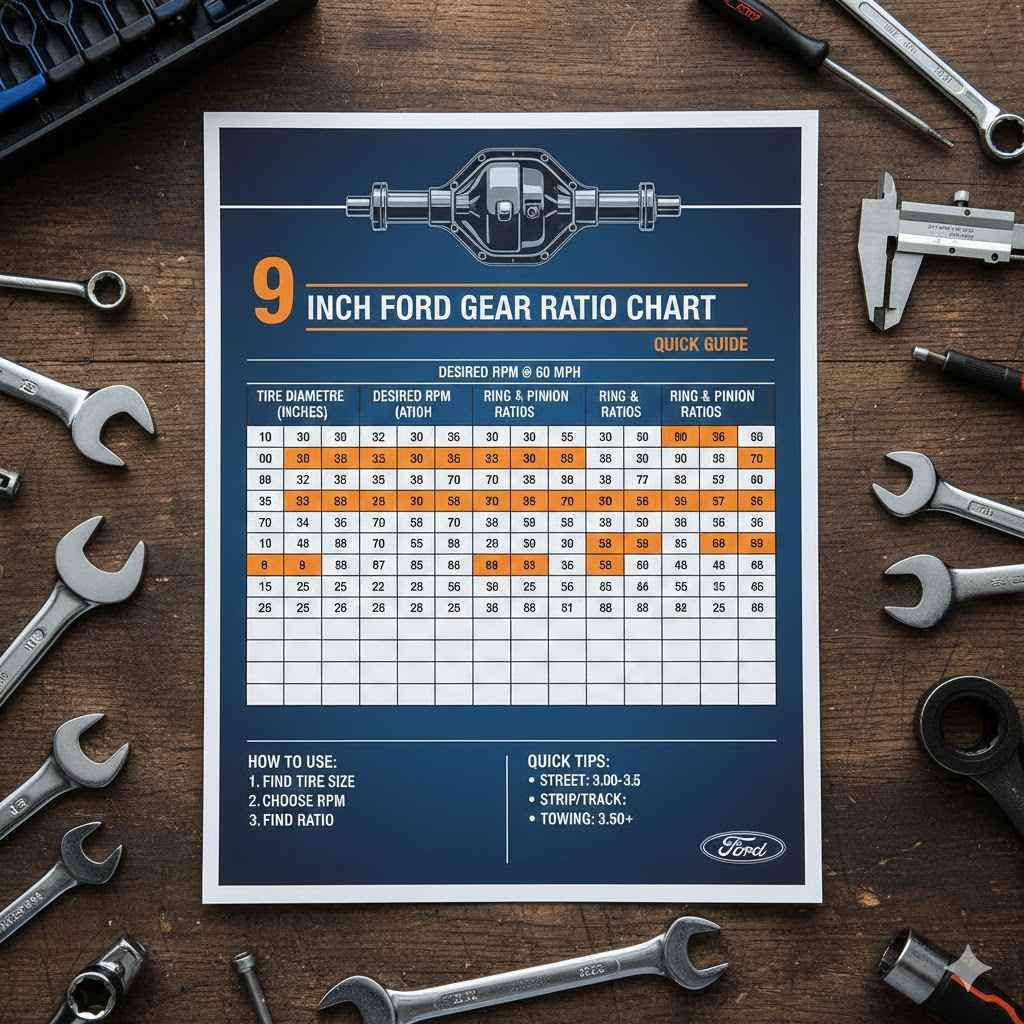
Figuring out the right gear ratio for a 9-inch Ford can seem tricky at first, especially if you’re new to it. So many numbers and what they mean! But don’t worry, it’s much simpler than it looks.
We’re here to break down the 9-Inch Ford Gear Ratio Chart & Quick Guide step-by-step. You’ll quickly get the hang of it and find the perfect ratio for your needs.
Understanding 9 Inch Ford Gear Ratios
This section helps you learn why gear ratios matter so much for your vehicle. It’s all about how your engine’s power gets to the wheels. A good gear ratio makes your car feel right, whether you want quick acceleration or good gas mileage on the highway.
We will look at what these numbers mean and why picking the right one is a big deal for how your car performs.
What is a Gear Ratio?
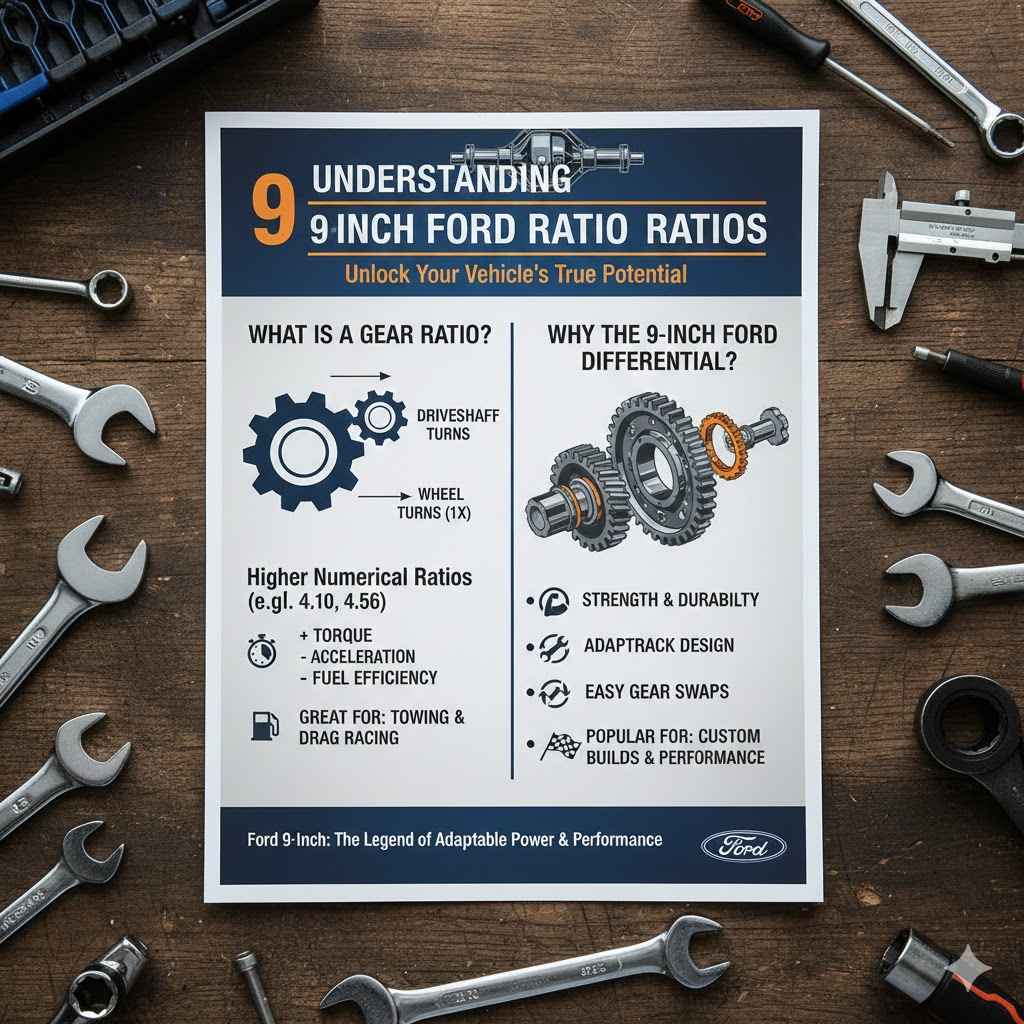
A gear ratio is a simple comparison between two gears. In your car’s differential, it tells you how many times the driveshaft turns for one full turn of the wheel. For example, a 4.10 gear ratio means the driveshaft spins 4.10 times for every single time the wheel turns once.
This ratio directly affects your vehicle’s torque and speed.
Higher numerical gear ratios, like 4.10 or 4.56, give you more torque. This means your car will accelerate faster from a stop. It’s great for towing or for drag racing.
Think of it like the gears on a bicycle; a low gear lets you pedal easily up a hill, giving you more power. This is similar to how a higher numerical gear ratio gives your vehicle more “push” off the line.
Lower numerical gear ratios, like 3.00 or 3.25, give you more speed on the highway. Your engine doesn’t have to work as hard when you’re cruising. This can lead to better fuel efficiency.
Imagine riding your bike on a flat road; you’d use a higher gear to go faster without pedaling as much. This is like having a lower numerical gear ratio for highway driving.
Why the 9-Inch Ford Differential?
The Ford 9-inch rear end has been a favorite for decades among car builders and enthusiasts. It’s known for its strength and durability, making it a solid choice for many different types of vehicles. It’s also very adaptable, meaning you can easily swap out different gear sets to change how your car drives.
This makes it a popular option for custom builds, hot rods, and performance cars.
Because it’s so common and adaptable, many people need to understand its gear ratios. Whether you’re restoring a classic Ford or building a custom vehicle, knowing the right gear ratio is key to getting the performance you want. The 9-inch housing itself is a marvel of engineering for its time, and its widespread use means there’s a huge amount of information and support available.
The modular design of the 9-inch third member, which houses the ring and pinion gears, allows for easy changes. This is a major reason it’s so popular. Mechanics and hobbyists can often swap out the entire third member assembly in a short amount of time.
This flexibility makes it easy to experiment with different gear ratios to find the perfect match for a specific engine and driving style.
The 9 Inch Ford Gear Ratio Chart Explained
Here, we’ll break down what you see on a typical 9-inch Ford gear ratio chart. You’ll learn to read the numbers and understand what they mean for your car’s speed and power. We’ll make it easy to see how different ratios will change your driving experience.
This is the core of our guide to help you choose wisely.
Reading the Gear Ratio Numbers
Gear ratio charts usually list two numbers, like 410 or 456. These numbers represent the ratio of teeth on the ring gear to the teeth on the pinion gear. The first number is the ring gear teeth, and the second is the pinion gear teeth.
So, a 4.10 ratio means the ring gear has 41 teeth, and the pinion gear has 10 teeth.
When you see a ratio listed as “4.10,” it means for every 4.10 rotations of the pinion gear, the ring gear rotates once. This is often simplified to “41:10”. Similarly, a “4.56” ratio means 4.56 turns of the pinion for one turn of the ring gear, or “45:10”.
The higher the first number or the lower the second number (which is less common in charts), the higher the numerical gear ratio.
It’s important to note that some charts might simplify this. You might see “410” to represent 4.10 or “456” for 4.56. Always look at the context or check the chart’s key if you’re unsure.
The numerical value of the ratio is what tells you about the torque and speed trade-off.
Common Gear Ratios and Their Uses
Different gear ratios are best suited for different driving situations. For example, a 3.00 ratio is good for fuel economy on the highway. A 4.10 ratio is a popular choice for a balance of street performance and highway driving.
Ratios like 4.56 or 5.13 are for maximum acceleration, often used in race cars or vehicles with very large tires.
Consider a vehicle that’s primarily used for street driving with occasional highway trips. A 3.73 or 4.10 ratio might be ideal. It offers good off-the-line acceleration for everyday driving and doesn’t make the engine scream at highway speeds.
If the vehicle is mainly for racing, a much steeper ratio like 5.13 would be preferred for quicker times down the strip.
Here’s a quick look at some common ratios and what they’re often used for:
- 3.00 – 3.25: Best for fuel economy on the highway. Ideal for daily drivers that see a lot of highway miles and need to save gas.
- 3.50 – 3.73: A good all-around choice for street use, offering a nice balance between acceleration and highway cruising. Popular for street rods and muscle cars.
- 4.10 – 4.30: Excellent for strong acceleration and towing. A very popular choice for performance street cars where off-the-line power is important.
- 4.56 – 5.13: For maximum acceleration. Primarily for drag racing, off-roading, or vehicles with very large tires that need extra torque to move.
Matching Ratio to Tire Size
The size of your tires plays a huge role in choosing the right gear ratio. Larger tires make your effective gear ratio “shorter” (lower numerically) because the tire has to rotate fewer times to cover the same distance. This means if you have large tires, you might need a numerically higher gear ratio to get back the acceleration you lost.
For instance, if you swap from a 26-inch tire to a 30-inch tire with the same gear ratio, your car will feel like it has a lower gear ratio. It will accelerate slower. To compensate for that larger tire, you might want to go from a 3.73 to a 4.10 ratio.
The new, higher ratio brings back that punchy acceleration.
Let’s look at an example. Someone with 28-inch tall tires might find a 4.10 gear ratio works great for their street car. Now, imagine they decide to put on 33-inch tall tires.
Without changing the gears, their car will feel sluggish. To get a similar feel to their old setup, they might need to switch to a 4.56 gear ratio. This brings the effective gearing back into a more desirable range for performance.
The 9-Inch Ford Gear Ratio Chart & Quick Guide To Choosing
This part of our guide focuses on helping you make the best choice. We’ll walk you through the factors you need to consider, from your car’s engine to how you plan to use it. We want to give you the tools to confidently pick the perfect gear ratio from the 9-Inch Ford Gear Ratio Chart & Quick Guide.
Consider Your Engine’s Powerband
Your engine’s powerband is the range of RPMs where it makes its best power. If your engine makes its peak horsepower at lower RPMs, you might want a gear ratio that keeps it in that range more often, especially when accelerating. If your engine likes to rev high, a gear ratio that allows it to reach those higher RPMs quickly can be beneficial.
A common mistake is to pair a high-revving engine with a very short (numerically low) gear ratio. This can lead to the engine hitting its redline too quickly and not making the most of its power. Conversely, a torquey engine with a very steep (numerically high) gear ratio might not need to rev as high to get moving.
For example, a small-block V8 with a focus on high RPM performance might pair well with a 4.10 or 4.56 gear set. This allows the engine to quickly climb into its happy RPM range for strong acceleration. A large-displacement, low-RPM torque monster, like a big-block Ford or a diesel engine, might be perfectly happy with a 3.50 or 3.73 ratio, as it already has plenty of low-end grunt.
Driving Style and Vehicle Use
How you use your vehicle is a major factor. Are you building a car for drag racing, autocross, daily driving, or cruising? Each of these uses calls for different gear ratios.
A drag car needs to get up to speed as fast as possible, so steep gears are king. A daily driver needs to be comfortable and efficient on the highway, favoring milder gears.
If your car is your daily driver, you’ll likely want a gear ratio that provides a good balance. You want decent acceleration for getting around town, but you also don’t want your engine to be at very high RPMs when you’re on the freeway. This can lead to poor fuel economy and increased engine noise.
A ratio in the 3.50 to 4.10 range is often a good compromise.
For a dedicated weekend cruiser or a show car, you might lean towards slightly steeper gears for better acceleration, even if it means sacrificing a little highway efficiency. If the car is primarily for track use like road racing or autocross, the gear ratio choice becomes more about keeping the engine in its optimal power band through various corners and straights.
Calculating Your Ideal Ratio
To help you figure out the best ratio, you can use online calculators or do some basic math. You’ll need your engine’s RPM at cruising speed, your transmission’s gear ratio (in the gear you typically cruise in, usually fourth or fifth), your tire’s rolling diameter, and the final drive ratio (which is the 9-inch Ford gear ratio you’re considering).
The basic formula to estimate RPM at a given speed is:
RPM = (Speed × Gear Ratio × 336) / Tire Diameter
Where:
- Speed is in miles per hour (MPH).
- Gear Ratio is the overall ratio (transmission gear x differential gear).
- 336 is a constant factor.
- Tire Diameter is in inches.
Let’s say you want to cruise at 70 MPH and want your engine to be around 2500 RPM. You have a transmission with a 1:1 final gear, 28-inch tires, and you’re considering a 3.73 differential gear. Your overall ratio is 1 x 3.73 = 3.73.
So, RPM = (70 × 3.73 × 336) / 28 ≈ 3130 RPM. This might be a bit high for comfortable cruising.
If you tried a 3.50 gear ratio instead: RPM = (70 × 3.50 × 336) / 28 ≈ 2940 RPM. This is a bit closer. If you found a 3.25 gear ratio: RPM = (70 × 3.25 × 336) / 28 ≈ 2730 RPM.
This is getting very close to your target. This calculation helps you see which gear ratio will put your engine at the desired RPM for highway cruising.
Sample Scenarios
Here are a couple of common scenarios to illustrate gear ratio choices:
- Scenario 1: The Classic Muscle Car Restoration
A restorer is bringing back a 1969 Ford Mustang with a 351 Windsor engine. It will be driven mostly on weekends for cruising and occasional trips to car shows. They want good acceleration off the line but also don’t want the engine to be screaming at 70 mph on the highway. They have 255/60R15 tires, which are about 28 inches in diameter. With a C6 automatic transmission (which has a 1:1 final drive ratio), a 3.73 gear ratio in the 9-inch Ford rear end would be a popular choice. This offers a nice balance of acceleration for city driving and manageable RPMs on the highway, likely around 2700-2900 RPM at 70 mph. - Scenario 2: The Pro-Street Build
A builder is creating a pro-street car with a powerful big-block engine and a manual transmission. The goal is maximum acceleration for drag racing, with occasional street use. They plan to run very large rear tires, perhaps 31 inches in diameter. For this setup, a much steeper gear ratio is needed. A 4.56 or even a 5.13 gear ratio in the 9-inch Ford would be suitable. This would give incredible acceleration from a standstill. However, highway cruising would be very limited and noisy, with RPMs likely well over 4000 at 70 mph. Many such cars are fitted with a transmission that offers a lower overdrive gear (e.g., 0.70 or 0.65) to make highway driving possible, or they might swap rear ends for highway trips.
Common Gear Ratio Combinations
When you start looking at 9-inch Ford differentials, you’ll notice that certain gear ratios are more commonly found or recommended for specific applications. This section highlights some of these popular pairings and explains why they work well. It’s like getting insider tips on what has proven successful over time.
The “Streetable” Ratio Sweet Spot
For most street-driven cars, especially those with a V8 engine and automatic transmission, a gear ratio in the 3.50 to 4.10 range is often considered the “sweet spot.” This range provides enough torque for satisfying acceleration without making highway cruising unbearable. It offers a good compromise that keeps most drivers happy.
For example, a 3.73 ratio is often seen as a great all-around choice. It’s a noticeable improvement in acceleration over stock gears (which were often in the 2.79-3.25 range for economy) but still allows for reasonable highway RPMs. A 4.10 ratio gives an extra kick in acceleration, making it ideal if you prioritize a more aggressive feel off the line.
Many people find that with a 3.73 or 4.10 gear set and a tire diameter around 27-29 inches, they can achieve RPMs between 2500 and 3000 at 70 mph. This is a comfortable range for many V8 engines, balancing performance and noise levels. It’s also a range where many performance camshafts and torque converters are designed to operate efficiently.
Performance and Drag Racing Ratios
When performance and straight-line speed are the main goals, the gear ratios get steeper. Racers often look for ratios that will help them achieve the quickest elapsed times (ETs) down the drag strip. This means maximizing acceleration at the expense of highway drivability.
Ratios like 4.56, 4.88, and even 5.13 are common in drag racing applications. These steep ratios force the engine to reach higher RPMs more quickly, which, when paired with the right engine powerband and tire, translates to faster acceleration. The trick is to match the gear ratio to the car’s overall setup so that the car crosses the finish line at the top of its engine’s powerband.
Consider a car running a quarter-mile track. If the engine peaks at 6500 RPM and the desired trap speed is 120 mph, a specific gear ratio will be needed to achieve that. A numerically higher ratio will help the car get to that speed faster.
However, if the ratio is too steep, the engine might hit its rev limiter before the finish line.
Economical Highway Cruising Ratios
If your priority is fuel economy and quiet highway cruising, you’ll want a numerically lower gear ratio. These ratios allow your engine to spin slower at highway speeds, which reduces fuel consumption and cabin noise. These are often the original ratios found in cars designed for long-distance travel or fuel efficiency.
Common economical ratios include 2.79, 3.00, and 3.25. These ratios provide a more relaxed driving experience on the open road. However, they will result in noticeably slower acceleration from a stop compared to steeper ratios.
This is the trade-off for better fuel economy and a quieter ride.
For a classic car that sees regular highway use, swapping to a numerically lower ratio could significantly improve the driving experience. For instance, going from an original 3.50 ratio to a 3.00 ratio might drop engine RPMs by several hundred at 70 mph, making for a much more pleasant and fuel-efficient journey.
Tools and Resources for Your 9 Inch Ford
To make choosing and changing gears easier, there are many helpful tools and resources available. This section points you towards useful items and information that can simplify the process. Whether you’re doing it yourself or working with a mechanic, these can be big helps.
Gear Ratio Calculators Online
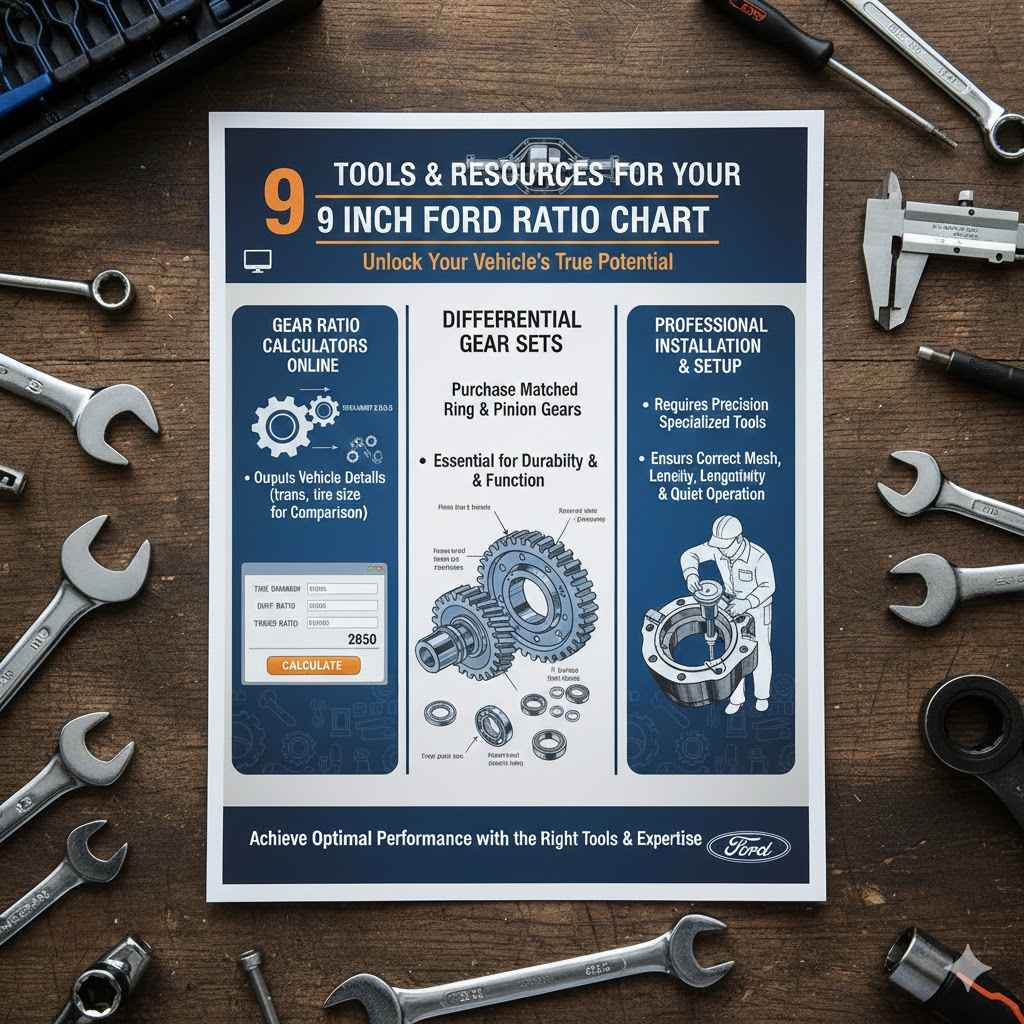
There are many free online gear ratio calculators that can take the guesswork out of choosing the right ratio. You input your vehicle’s details, and they tell you the estimated RPMs at different speeds. These are invaluable tools for comparing different gear ratios and tire sizes to see how they will affect your car’s performance and cruising RPMs.
These calculators usually ask for your transmission’s gear ratios (including overdrive if applicable), your differential gear ratio, your tire’s diameter or circumference, and your desired cruising speed. They then output the estimated engine RPM at that speed. Some even allow you to compare multiple scenarios side-by-side, making it easy to see the differences.
Using one of these calculators is highly recommended before making any purchase decisions. It helps prevent costly mistakes and ensures you choose a gear ratio that aligns with your driving goals. You can find them by searching for “tire to gear ratio calculator” or “RPM calculator” online.
Differential Gear Sets
When you decide on a new gear ratio, you’ll need to purchase a gear set for your 9-inch Ford differential. These sets include the ring gear and the pinion gear. It’s important to buy a quality set from a reputable manufacturer to ensure durability and proper function.
Many companies specialize in Ford rear-end parts.
When buying a gear set, make sure it’s specifically designed for the 9-inch Ford differential. They come in various ratios, so you can select the exact one you need. You might also need additional installation kits, which often include bearings, seals, and shims, depending on whether you’re doing a full rebuild or just changing the gears.
The process of installing new gears is called “setting up” the differential. This requires special tools and knowledge to ensure the gears mesh correctly and have the proper backlash. If you’re not experienced with this, it’s best to have a professional mechanic or a differential specialist do the installation.
Professional Installation and Setup
While it’s possible to learn how to set up gears yourself, it’s a task that demands precision. Incorrect gear setup can lead to premature wear, noise, and even catastrophic failure of the differential. For most people, especially those new to this kind of work, professional installation is the safest and most reliable option.
A qualified mechanic specializing in rear ends can ensure the gears are installed correctly. They have the specialized tools, such as dial indicators and pattern checking compound, to set the pinion depth, ring gear backlash, and gear pattern accurately. This ensures smooth operation and maximum lifespan for your new gears.
Many shops offer a complete package where they will install your chosen gear ratio. You provide them with the desired ratio, and they will source the parts and perform the installation. This can give you peace of mind knowing the job is done right.
Frequently Asked Questions
Question: What is the most common gear ratio for a 9-inch Ford?
Answer: For general street use, a 3.73 or 4.10 gear ratio is very common and offers a good balance of acceleration and highway drivability. Performance and race applications will use steeper ratios like 4.56 or higher.
Question: Can I change my gear ratio myself?
Answer: Changing gears requires specialized tools and knowledge of differential setup. While possible for experienced DIYers, it’s often best left to a professional mechanic for accurate installation and to avoid damage.
Question: How does tire size affect gear ratio choice?
Answer: Larger tires effectively make your gear ratio “shorter” (numerically lower). To compensate for larger tires and maintain acceleration, you’ll typically need a numerically higher gear ratio.
Question: What RPM should I aim for on the highway?
Answer: For most V8 engines, an RPM range of 2500-3000 at cruising speeds (like 70 mph) is often considered comfortable and efficient. This can vary based on your specific engine and transmission.
Question: Where can I find a 9-inch Ford gear ratio chart?
Answer: You can find these charts on automotive parts websites, forums dedicated to Ford vehicles, and through manufacturers of differential components. Many online gear ratio calculators also provide chart-like information.
Summary
Choosing the right 9-inch Ford gear ratio is key to how your vehicle performs. Our guide covers everything from understanding gear ratios to picking the best one for your engine, tires, and driving style. Use our quick guide and charts to find the perfect fit for your car.