

If you often find yourself typing “car” when you meant to type “cat” into search engines or documents, it’s usually due to simple keyboard proximity, autocorrect bias, or muscle memory errors related to common search terms. The fixes involve simple awareness adjustments, changing device settings, or cleaning up your device’s predictive text history.
Hello there! I’m Dustin Hall, and if your keyboard seems to have a mind of its own—consistently offering you a mode of transportation when you wanted a furry friend—you are definitely not alone. This little confusion between typing “car” instead of “cat” is super common! It happens because our fingers are naturally drawn to similar keys, or because our devices have “learned” that we search for vehicles more often. It can be frustrating when you are trying to look up pictures of kittens but end up looking at sedans. The good news is that this is rarely a serious issue. We can fix this with a few simple tweaks. Let’s explore exactly why your keyboard defaults to “car” and how we can gently guide it back to “cat.”
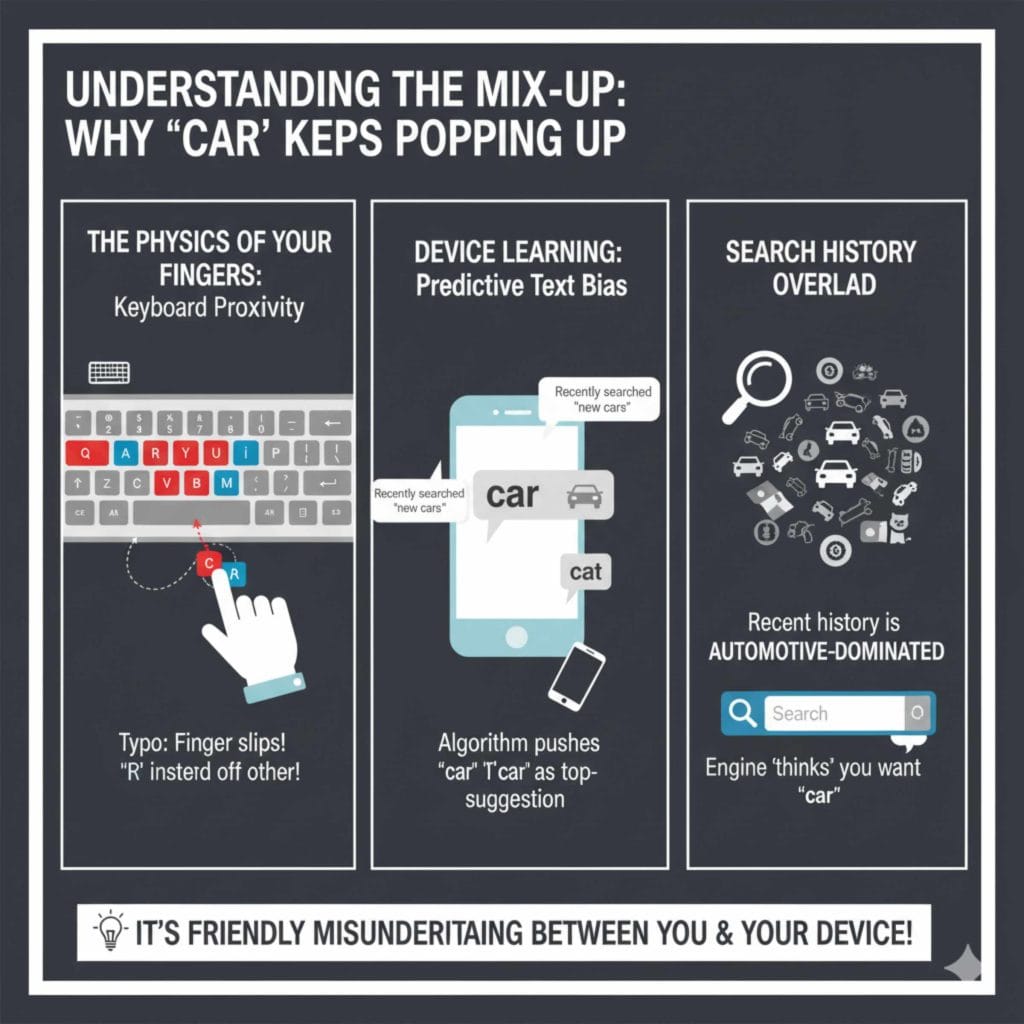
Understanding the Mix-Up: Why “Car” Keeps Popping Up
Before we jump into the fixes, let’s understand the root of the problem. It’s a combination of how our hands move, how spelling works, and how technology anticipates our needs. Think of it as a friendly little misunderstanding between you and your device.
The Physics of Your Fingers: Keyboard Proximity
When we type quickly, our fingers rely on muscle memory. The letters ‘C’, ‘A’, and ‘R’ are very close to ‘C’, ‘A’, and ‘T’ on both standard QWERTY keyboards and phone screens.
Check out the standard QWERTY layout similarities:
- The ‘R’ key is directly next to the ‘T’ key.
- When speed typing, a slight slip or overreach can easily land the finger on ‘R’ instead of ‘T’.
- This is a very common type of typographical error, known as a transposition error, which happens almost unconsciously.
Device Learning: Predictive Text Bias
This is often the biggest culprit. Modern phones and computers use sophisticated algorithms to guess the next word you want to type. If you have recently searched for anything related to vehicles—like directions, repairs, or car reviews—your device learns that “car” is a high-probability word for you right now.
When you type “ca,” the predictor sees this pattern: You recently searched for “Best new cars of 2024,” so it pushes “car” to the top suggestion, even if you are currently trying to type “cat.” It’s trying to be helpful but gets the context wrong.
Search History Overload
Search engines like Google are incredibly smart about remembering what you look up. If your recent search history is dominated by automotive topics—maybe you were researching buying a used vehicle or looking up tire prices—the search engine itself will subconsciously prioritize “car” results, even if you type “c a t.” The engine fills in what it thinks you should be searching for based on your past behavior.
Essential Fixes: Getting Your Device to Say “Cat” Again
Now for the practical part. We need to retrain your device and adjust your habits slightly. These steps are easy, safe, and designed for everyday drivers and users, not master mechanics.
Fix 1: Clearing the Predictive Text Dictionary (The Reset Button)
If your phone or computer has learned “car” too well, the quickest way to break the habit is to clear that specific learned word. The method varies slightly by operating system.
For Smartphones (iOS and Android):
Most smartphone keyboards let you selectively delete learned words or completely reset the dictionary.
- Navigate to Settings: Go to your device’s main Settings app.
- Find Keyboard Settings: Look for “General” (iOS) or “System” (Android), then find “Keyboard” or “Language & Input.”
- Reset Dictionary: Search for an option like “Reset Keyboard Dictionary” or “Clear Learned Words/History.” Be aware: This will erase other slang or non-standard words you may have taught your phone, but it usually fixes the immediate confusion.
- Test It: After the reset, type “c a” a few times. Your device should now offer neutral suggestions or wait for you to complete the word.
For Desktop Computers (Windows and Mac):
Desktop prediction is usually less aggressive, but if you use specialized word processors, you might need to address custom dictionaries.
- Word Processors: If you are typing in Microsoft Word or Google Docs, go to the Spelling & Grammar check settings and look for “Custom Dictionaries.” You can often remove recently added or frequently misspelled words there.
- Browser Autocomplete: For web searches, clearing browser history and cache (specifically targeting form data) often clears targeted autocomplete suggestions.
Pro Tip from Dustin: If you are using an Android device, check the settings for your specific keyboard app (like Gboard or Samsung Keyboard). Sometimes, you can find a setting labeled “Delete learned words” which is more targeted than a full dictionary reset.
Fix 2: Adjusting Search Engine Behavior
If the problem only happens when you are typing into Google, Bing, or another search bar, the issue is likely your search history influencing the results.
Here is how you can encourage Google to stop assuming you want automotive content:
| Action | Why It Works | Where to Look |
|---|---|---|
| Review Recent Activity | Identifying and deleting specific searches related to cars stops the algorithm from prioritizing that topic. | Google My Activity (myactivity.google.com) |
| Use Incognito/Private Mode | This creates a clean slate, forcing the search engine to rely only on the input, not your history. | The browser’s main menu (usually three dots or lines). |
| Sign Out (Temporarily) | If you are signed into your Google account on your browser, signing out temporarily removes personalized history influence. | Top right corner of the search page or browser. |
Fix 3: Improving Typing Technique for Accuracy
Since keyboard touch is a major factor, sometimes a small adjustment in how you position your hands can solve the ‘R’ for ‘T’ slip-up.
- Slow Down Slightly: When typing words where you know errors occur (like ‘cat’), consciously slow down for those two or three letters. Speed builds bad habits.
- Focus on the ‘T’: Ensure the pad of your index finger is hitting the ‘T’ key squarely, rather than the outer edge hitting the neighbor ‘R’.
- Check Posture (For Desktops): If you are sitting too low or too high, your wrist angle might be forcing an unnatural reach to the top row keys, increasing error rates on ‘T’ and ‘Y’. Ensure your wrists are relatively straight when typing.
Fix 4: Customizing Autocorrect Rules (If Available)
Some third-party keyboard apps or specialized software allow you to add specific “exceptions” or “replacement rules.” While rare for simple words, if you find yourself constantly replacing “car” with “cat,” you can sometimes input a rule that says: “When I type C-A-R, suggest C-A-T instead,” but this is usually an advanced step.
For most users, focusing intently on typing the letter sequence correctly until the predictive text recalibrates is simpler. Persistence matters here; use the correct word intentionally a few times.
The Reliability Factor: When Does This Matter Most?
In casual texting, typing “car” instead of “cat” is annoying but harmless. However, as a responsible driver and car owner, accuracy matters when you are dealing with official information.
Scenarios Where Accuracy is Crucial:
- VIN Lookups: If you are searching for vehicle history reports or recall information, ensure you are typing “Car” or the specific model name accurately. A misplaced letter could lead you to the wrong vehicle identification number (VIN) lookup page, wasting time.
- Insurance Documents: When filling out forms or searching insurance portals, accuracy is non-negotiable. Ensure your context is right before hitting submit.
- Safety Information: Looking up technical service bulletins (TSBs) or safety recalls (like those tracked by the National Highway Traffic Safety Administration—check their resources at nhtsa.gov) requires precision. Mistyping a model name could mean missing crucial safety updates for your actual vehicle!
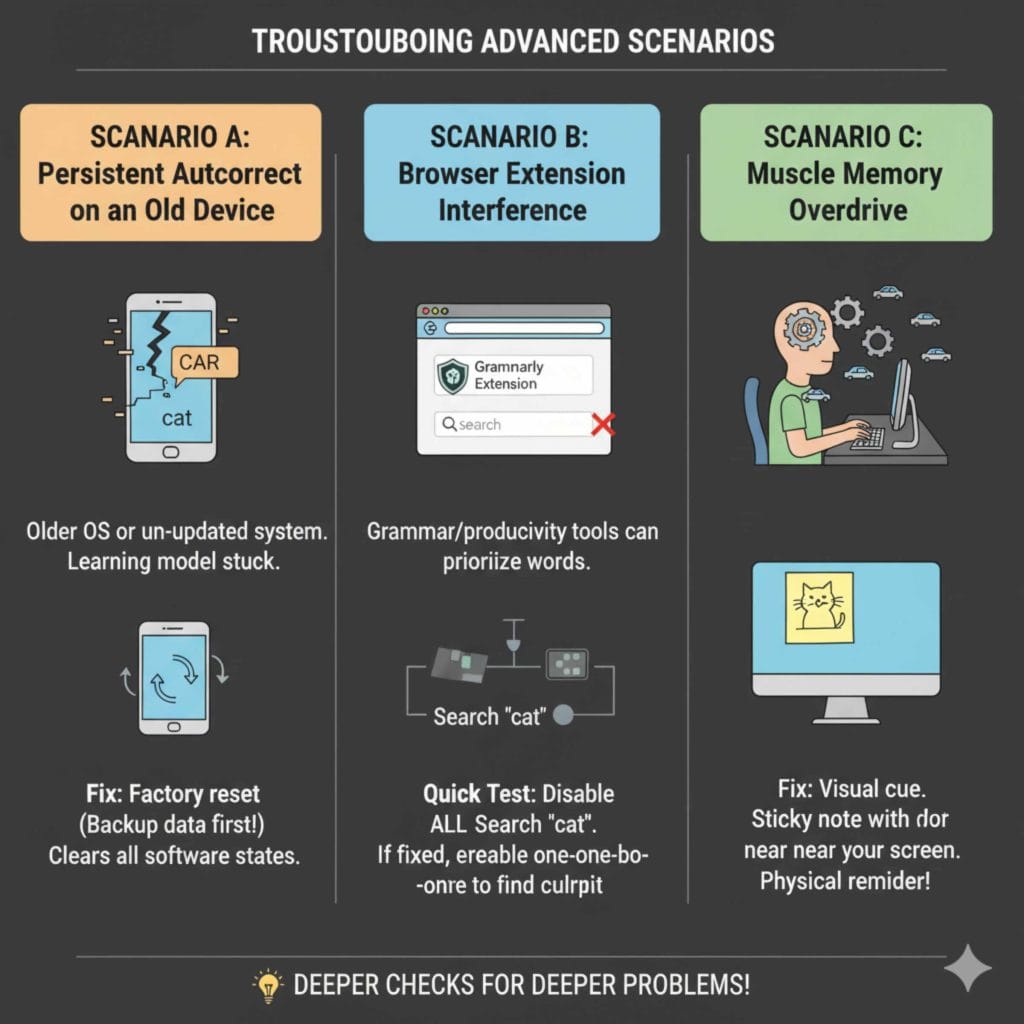
Troubleshooting Advanced Scenarios
What if you’ve done all the simple fixes, and the problem persists? Here are a few deeper checks you can run.
Scenario A: Persistent Autocorrect on an Old Device
If you are using an older phone or an operating system that hasn’t been updated recently, its learning model might be stuck in an older loop. Sometimes, the only fix is to back up your data and perform a factory reset, clearing all software states, including deeply embedded typing errors.
Scenario B: Browser Extension Interference
If you use browser extensions dedicated to grammar checking (like Grammarly) or productivity tools, sometimes these extensions interfere with standard text inputs, inadvertently prioritizing common capitalized words (like “Car” in a title) over your intended word (“cat”).
Quick Test: Disable all third-party browser extensions and try searching for “cat” again. If the prediction is gone, re-enable them one by one to find the culprit.
Scenario C: Muscle Memory Overdrive
If you spend hours every day researching cars for work, a hobby, or a big purchase, your brain might be hardwired to type “car” in specific professional contexts. The fix here isn’t technical; it’s psychological.
Keep a visual cue nearby, like a sticky note with a picture of a cat, taped above your monitor or near your phone stand, as a physical reminder when you type in that specific environment.
Summary of Common Causes and Quick Fixes
To give you a quick reference map for solving your typing trouble:
| Primary Cause | Best Fix Strategy | Where to Apply |
|---|---|---|
| Finger slips (‘R’ vs ‘T’) | Slow down and focus on touch accuracy. | Your typing habit. |
| Device learned “car” too often. | Reset Keyboard Dictionary. | Phone/Tablet Settings. |
| Search history bias. | Clear specific search history entries or use Incognito mode. | Google/Browser Settings. |
| Software conflict. | Disable third-party grammar/productivity extensions. | Browser Settings. |
Frequently Asked Questions (FAQ)
Q1: Is it bad for my phone if I clear the keyboard dictionary?
A: No, it is completely safe. Clearing the dictionary only removes learned word patterns; it does not affect any personal data like contacts, photos, or apps. It just removes slang or frequently mistyped words the system learned.
Q2: Why does my phone always suggest “CAR” in all caps?
A: If your phone suggests the word in all capital letters, it usually means the device thinks you are typing the beginning of a proper noun (like a brand name) or the first word of a sentence. This is a context clue based on your previous typing structure.
Q3: How long until my device stops suggesting “car” if I just start typing “cat” correctly?
A: Usually, within 5 to 10 accurate attempts, especially after a dictionary purge, the device will start prioritizing the new, correct input over the old, frequent input. Consistency is key!
Q4: Can my keyboard settings be saved if I get a new phone?
A: Often, yes. Cloud backup services for iOS (iCloud) and Android (Google Backup) frequently save keyboard settings, including learned words. However, if you switch ecosystems (e.g., moving from iPhone to a Samsung device), you will likely have to retrain the new keyboard from scratch.
Q5: Do car forums or automotive websites cause this problem?
A: If you spend a lot of time on sites specifically focused on cars and type “car” repeatedly in their internal search bars, yes, those specific domains might train their localized autocomplete features to favor “car.” This is separate from your phone’s general learning.
Q6: What is the difference between setting ‘R’ and ‘T’ on the keyboard?
A: On a standard QWERTY layout, ‘R’ and ‘T’ are separated by one key position on the top row. Humans often struggle with this small gap when typing fast, leading to accidental key presses that easily swap ‘R’ and ‘T’ when they are close together in a word like C-A-R vs C-A-T.
Conclusion: Driving Forward with Confidence
Dealing with the “car instead of cat” phenomenon is really just a small hurdle in our digital lives. It shows just how smart (and sometimes overly eager) our technology is to guess what we need. Remember, the issue is almost always rooted in simple finger placement or your recent search history telling your software you are interested in automotive topics. Take a moment to reset your keyboard dictionary, clean up any overzealous personalized search results, and consciously focus on your touch accuracy. By applying these straightforward fixes, you’ll regain full control over your typing, ensuring that when you need a picture of your feline friend, you get exactly that—not a four-wheeled distraction. You’ve got this, and happy typing!