
A hard brake pedal is most often caused by a failing brake booster, which uses engine vacuum to make braking easier. A leak in the vacuum hose, a bad check valve, or a faulty booster itself can prevent this power assist, forcing you to use much more leg strength to stop your car. This is a serious safety issue that needs immediate attention.
Hitting the brakes and feeling a rock-solid pedal push back is a scary experience. One moment, your car stops smoothly. The next, you’re stomping with all your might just to slow down. If this has happened to you, you’re not alone. It’s a surprisingly common issue, but it’s also one you absolutely cannot ignore.
My name is Dustin, and I’m here to help you understand what’s going on under the hood without any confusing mechanic talk. We’ll walk through the reasons why your brake pedal is hard to push. I’ll show you what to look for and what steps to take. You can handle this. Let’s figure this out together and get you back on the road safely.
When you press your brake pedal, you’re not just using your own muscle. Modern cars have a system called a power brake booster that multiplies the force from your foot, making it easy to stop a two-ton vehicle. When that pedal suddenly feels like a brick, it usually means this power assist system has failed. Your brakes might still work, but you’ll have to use a huge amount of physical effort to engage them, which is extremely dangerous in an emergency.
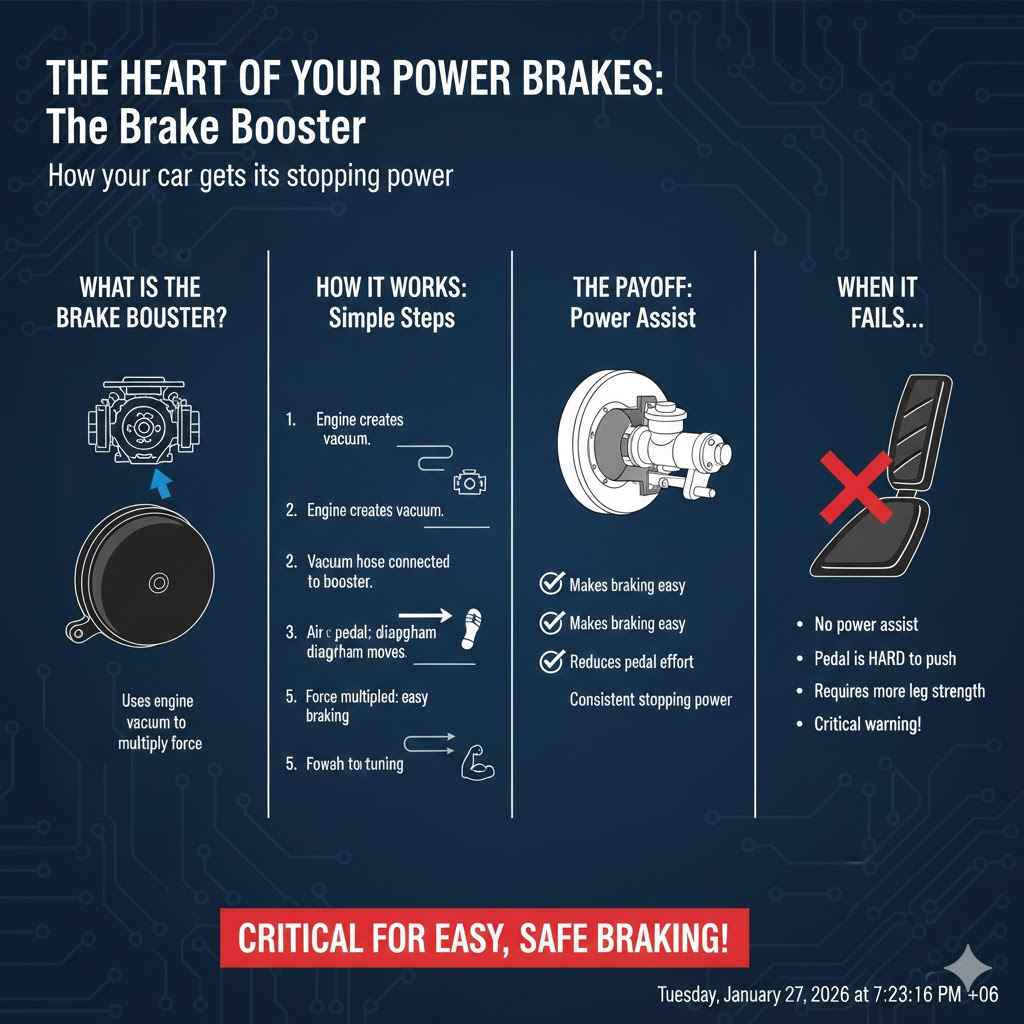
The Heart of Your Power Brakes: The Brake Booster
Think of the brake booster as power steering for your brakes. It’s a round, black, can-like object located on the driver’s side of the engine bay, right behind the brake master cylinder. It uses engine vacuum to create a pressure difference that helps push the master cylinder piston when you press the brake pedal.
Here’s how it works in simple terms:
- Your engine creates a vacuum as it runs.
- A hose connects this vacuum source to the brake booster.
- Inside the booster, a flexible diaphragm separates two chambers.
- When you press the brake pedal, a valve opens, letting atmospheric pressure into the chamber behind the diaphragm.
- The vacuum on the other side then pulls the diaphragm forward, multiplying the force you applied and making braking feel easy.
When this system fails, that power assist is gone. You are left with purely mechanical braking, which requires a lot more leg power. Let’s dive into the most common reasons this system can fail.
Top 3 Reasons for a Hard Brake Pedal
While a few different things can cause a hard brake pedal, three culprits are responsible for the vast majority of cases. We’ll start with the most common one: the brake booster itself.
1. Brake Booster Failure
The brake booster is the most likely reason for a stiff brake pedal. Over time, the internal diaphragm can tear or the seals can wear out. When this happens, it can no longer hold a vacuum, and the power assist feature is lost. It’s like trying to open a heavy door without the handle—you can still do it, but it takes a lot more work.
Symptoms of a Failing Brake Booster:
- Extremely Hard Brake Pedal: This is the number one sign. The pedal requires significantly more effort to push down.
- Hissing Noise: You might hear a hissing sound from under the dashboard when you press or release the brake pedal. This is air leaking past the failed diaphragm.
- Longer Stopping Distances: Because you can’t apply as much force as easily, your car will take longer to stop.
- Stalling Engine: A large vacuum leak from the booster can sometimes affect the engine’s air-fuel mixture, causing it to run rough or even stall at low speeds.
2. Vacuum Leak from a Hose or Connection
The brake booster needs a steady supply of vacuum from the engine to work. This vacuum is delivered through a thick rubber hose. If this hose cracks, splits, or becomes disconnected, the booster will lose its power source.
Think of it like trying to drink from a straw with a hole in it. You can suck as hard as you want, but you won’t get much liquid. Similarly, if the vacuum hose is leaking, the booster can’t build the pressure difference it needs to help you brake.
Symptoms of a Vacuum Hose Leak:
- Hard Brake Pedal: Just like a failed booster, a lack of vacuum will make the pedal stiff.
- Loud Hissing Sound from the Engine Bay: A significant leak will often create an audible hissing or sucking noise near the booster.
- Rough Engine Idle: A vacuum leak can disrupt the engine’s performance, leading to a rough or fluctuating idle.
- Check Engine Light: A large vacuum leak can trigger the check engine light with codes related to the air-fuel mixture (e.g., P0171 or P0174).
3. Faulty Brake Booster Check Valve
The check valve is a small, simple, but crucial part. It’s usually located where the vacuum hose connects to the brake booster. Its job is to act as a one-way door, allowing air to be pulled out of the booster but not letting it back in. This ensures the booster maintains vacuum even when the engine isn’t producing much, like during hard acceleration.
If this valve gets stuck closed, no vacuum can get into the booster. If it gets stuck open, the vacuum can escape, especially when you need it most. In either case, your power assist will be gone.
Symptoms of a Faulty Check Valve:
- Brake Pedal is Hard Immediately: The pedal might feel hard right after starting the car or during certain driving conditions.
- Power Assist Fades: You might have power assist for one or two pumps of the pedal after shutting off the engine, but it disappears quickly.
- Symptoms Similar to a Vacuum Leak: Because it’s part of the vacuum system, a bad check valve can mimic the symptoms of a leaky hose.
How to Diagnose a Hard Brake Pedal at Home (A Simple Test)
You can perform a simple test in your driveway to help pinpoint the problem. It requires no tools and only takes a minute. Safety first: make sure your car is in Park (or Neutral with the parking brake on) and in a safe, level location.
- Pump the Brakes with the Engine Off: With the car turned off, pump the brake pedal four or five times. It should get progressively harder to push. This is normal, as you are using up any residual vacuum stored in the booster.
- Hold the Pedal Down: After the last pump, press the brake pedal down firmly and hold it there. It should feel very stiff.
- Start the Engine: While still holding the pedal down, start the engine.
What to Expect:
- Good Result: If the brake booster and its vacuum supply are working correctly, you will feel the brake pedal sink slightly toward the floor as soon as the engine starts. This is the vacuum assist kicking in.
- Bad Result: If the pedal does not sink at all and remains hard, it confirms there is a problem with the power brake assist system. This points directly to a failed booster, a major vacuum leak, or a bad check valve.
Next Steps: Visual Inspection
After the test, you can do a quick visual check. Open the hood and locate the large, round brake booster. Follow the thick rubber hose from the booster to the engine. Look for any obvious cracks, splits, or loose connections in the hose. With the engine running, you can sometimes hear a hissing sound coming from a leak. Be very careful around a running engine!
Other, Less Common Causes of a Hard Brake Pedal
While the power assist system is the culprit over 90% of the time, a few other mechanical issues can sometimes lead to a stiff pedal.
Seized Brake Caliper or Wheel Cylinder
Brake calipers (on disc brakes) or wheel cylinders (on drum brakes) are the hydraulic components that squeeze the brake pads against the rotors or push the shoes against the drums. They can become corroded and seize up, especially in areas with road salt. If a caliper piston is stuck, it can prevent the brake pads from moving freely, making the pedal feel hard because you are pushing against a component that won’t move.
Symptoms: Usually, a seized caliper is accompanied by other signs, such as the car pulling to one side when braking, a burning smell from the affected wheel, or one wheel being noticeably hotter than the others after a drive.
Contaminated Brake Fluid or Clogged Lines
Brake fluid is hygroscopic, meaning it absorbs moisture from the air over time. This moisture can cause corrosion inside the brake lines, master cylinder, and calipers. Debris from this corrosion can clog the system, creating a restriction that makes the pedal hard to push. The U.S. National Highway Traffic Safety Administration (NHTSA) emphasizes using the correct, clean brake fluid for your vehicle to prevent such issues.
Symptoms: This is less common and usually happens on older, poorly maintained vehicles. The pedal feel may be inconsistent, and braking performance will be poor overall.
Summary of Causes and Potential Costs
Dealing with car repairs can be stressful, especially when it comes to cost. This table gives you a general idea of what to expect for each potential problem. Keep in mind that prices vary widely based on your vehicle, location, and whether you choose a dealership or an independent mechanic.
| Problem | Common Symptoms | Average DIY Cost | Average Professional Repair Cost |
|---|---|---|---|
| Brake Booster Failure | Very hard pedal, hissing under dash, longer stopping distance. | $150 – $300 (Part only) | $400 – $800+ |
| Vacuum Hose Leak | Hard pedal, hissing from engine bay, rough idle. | $10 – $50 | $100 – $250 |
| Faulty Check Valve | Hard pedal, especially after engine starts. | $5 – $20 | $75 – $150 |
| Seized Brake Caliper | Hard pedal, car pulls to one side, burning smell. | $50 – $150 (Per caliper) | $250 – $500 (Per caliper) |
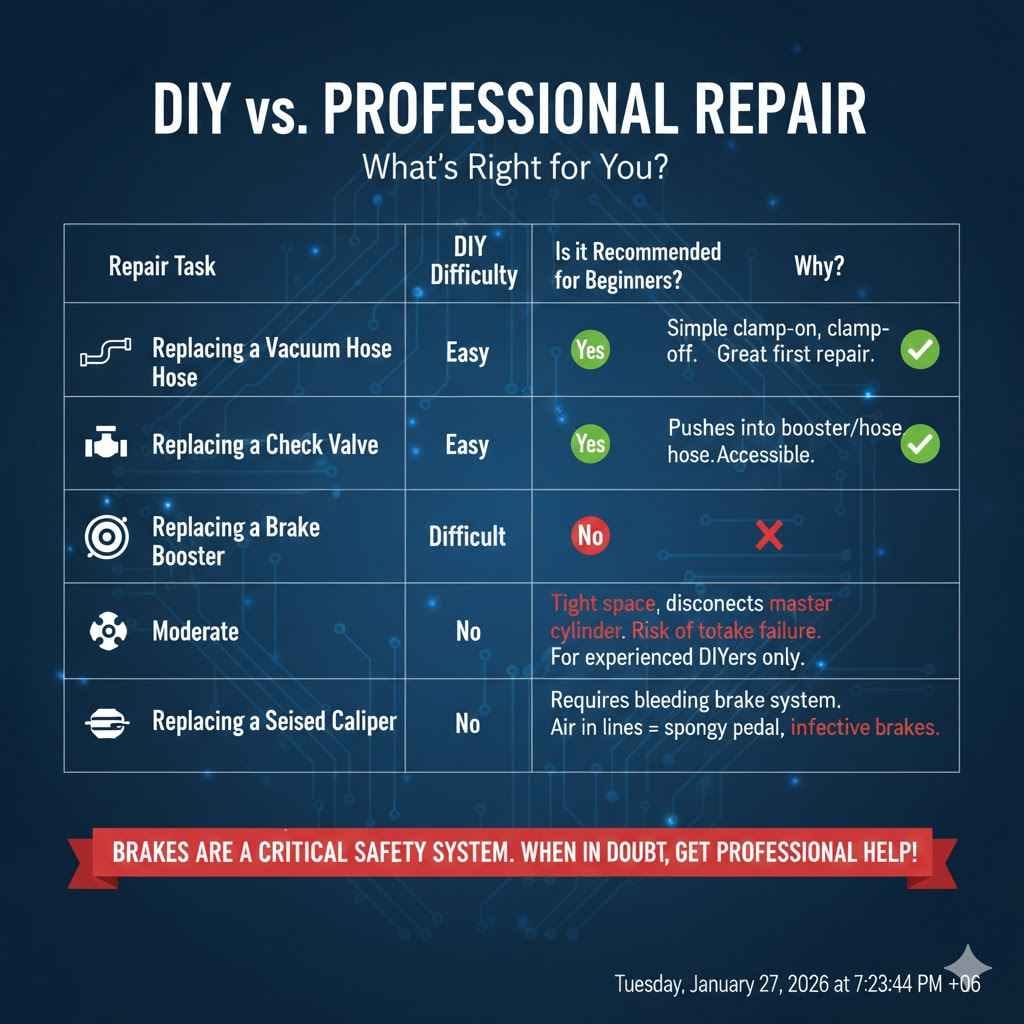
DIY vs. Professional Repair: What’s Right for You?
Now for the big question: can you fix this yourself? Some of these repairs are quite simple, while others are best left to a professional, especially because they involve your car’s most important safety system.
| Repair Task | DIY Difficulty | Is it Recommended for Beginners? | Why? |
|---|---|---|---|
| Replacing a Vacuum Hose | Easy | Yes | This is often a simple clamp-on, clamp-off part. It’s a great first-time repair. |
| Replacing a Check Valve | Easy | Yes | The valve usually just pushes into the booster and hose. It’s very accessible and quick to replace. |
| Replacing a Brake Booster | Difficult | No | This involves working under the dashboard in a tight space and disconnecting the brake master cylinder. A mistake can lead to total brake failure. This is for experienced DIYers only. |
| Replacing a Seized Caliper | Moderate | No | This requires bleeding the brake system, which must be done correctly to ensure there is no air in the lines. Air in the brake lines will cause the pedal to feel spongy and ineffective. |
Frequently Asked Questions (FAQ)
1. Can I drive my car with a hard brake pedal?
It is extremely dangerous and not recommended. While the brakes may still technically function, your stopping distance will be much longer, and you may not be able to apply enough force to stop in an emergency. You should have the vehicle towed to a repair shop immediately.
2. How much does it cost to fix a brake booster?
The cost to replace a brake booster typically ranges from $400 to $800, including parts and labor. The part itself can cost between $150 and $300, but the labor can be intensive as the mechanic often needs to work in a cramped area under the dashboard.
3. Is a hard brake pedal always the brake booster?
Not always, but it is the most common cause. A simple vacuum leak from a cracked hose or a faulty check valve are also very common and much cheaper to fix. It’s important to diagnose the problem correctly before replacing expensive parts.
4. What does a failing brake booster sound like?
A failing brake booster often makes a distinct hissing sound. You might hear it when you press the brake pedal, or it might be a constant hiss that changes pitch when you press the pedal. The sound is air leaking past the internal diaphragm.
5. How long does a brake booster last?
A brake booster is designed to last the life of the vehicle, but like any component, it can fail prematurely. Most boosters will easily last over 100,000 miles, but factors like moisture and wear and tear can cause them to fail sooner.
6. Can bad brake fluid cause a hard pedal?
Yes, but it’s less common. Old, contaminated brake fluid can lead to corrosion and debris clogging the brake lines or master cylinder. This restriction can make the pedal feel hard, though it often leads to other symptoms first, like a spongy pedal or poor braking performance.
7. What’s the difference between a hard pedal and a spongy pedal?
A hard pedal feels like you’re pressing against a wall and requires a lot of force. It’s usually caused by a loss of power assist. A spongy or soft pedal feels mushy, sinks too far to the floor, and is typically caused by air in the brake lines or a failing master cylinder.
Conclusion: Don’t Wait on Brake Repairs
A hard brake pedal isn’t just an inconvenience; it’s a serious red flag from your car’s most critical safety system. It’s your car’s way of screaming for help. While the fix might be as simple as replacing a ten-dollar vacuum hose, ignoring the warning can have devastating consequences.
By using the simple diagnostic test we covered, you can get a better idea of where the problem lies. For easy fixes like a vacuum hose or check valve, you might feel confident tackling the job yourself and saving some money. For a more complex job like replacing the brake booster, there is no shame in letting a trusted professional handle it. Your safety, and the safety of others on the road, is always the top priority.
Take this warning seriously. Investigate the cause, get it fixed promptly, and you’ll be back to driving with the confidence and peace of mind that comes from knowing your brakes will be there for you when you need them most.