
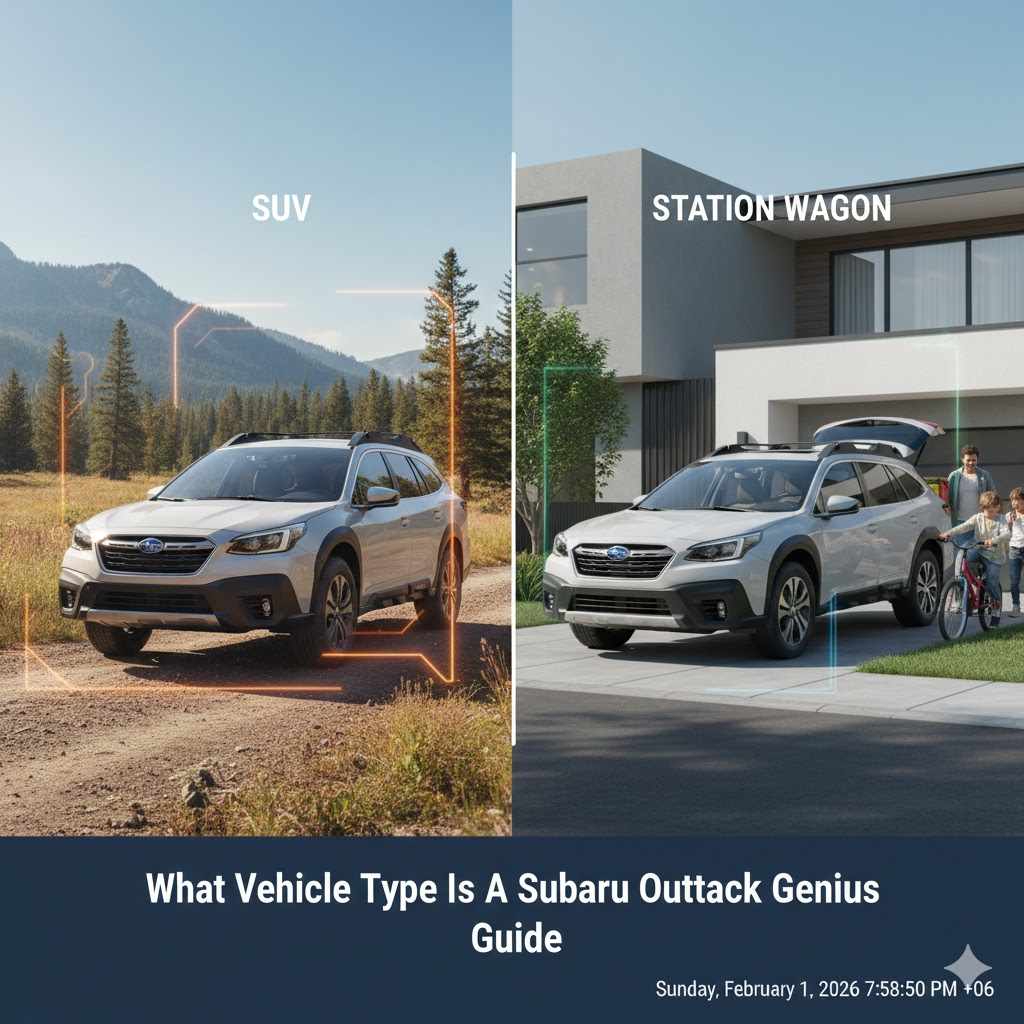
The Subaru Outback is officially classified as a crossover SUV. It brilliantly combines the spacious, comfortable ride of a station wagon with the higher ground clearance, rugged capability, and standard Symmetrical All-Wheel Drive of an SUV. This unique blend makes it one of the most versatile vehicles on the road today.
Have you ever looked at a Subaru Outback and wondered, “What exactly is that?” You’re not alone! It has the long body of a station wagon but sits high off the ground like an SUV. This can be confusing for many car owners. It’s one of the most common questions I hear from drivers trying to understand what makes this vehicle so popular.
Don’t worry, because you’ve come to the right place. In this guide, I’ll break it all down for you in simple, easy-to-understand terms. We will clear up all the confusion and show you exactly what vehicle type the Subaru Outback is. By the end, you’ll be a genius on the topic and will understand why it’s a favorite for so many different people.
The Great Debate: Is the Outback a Wagon or an SUV?
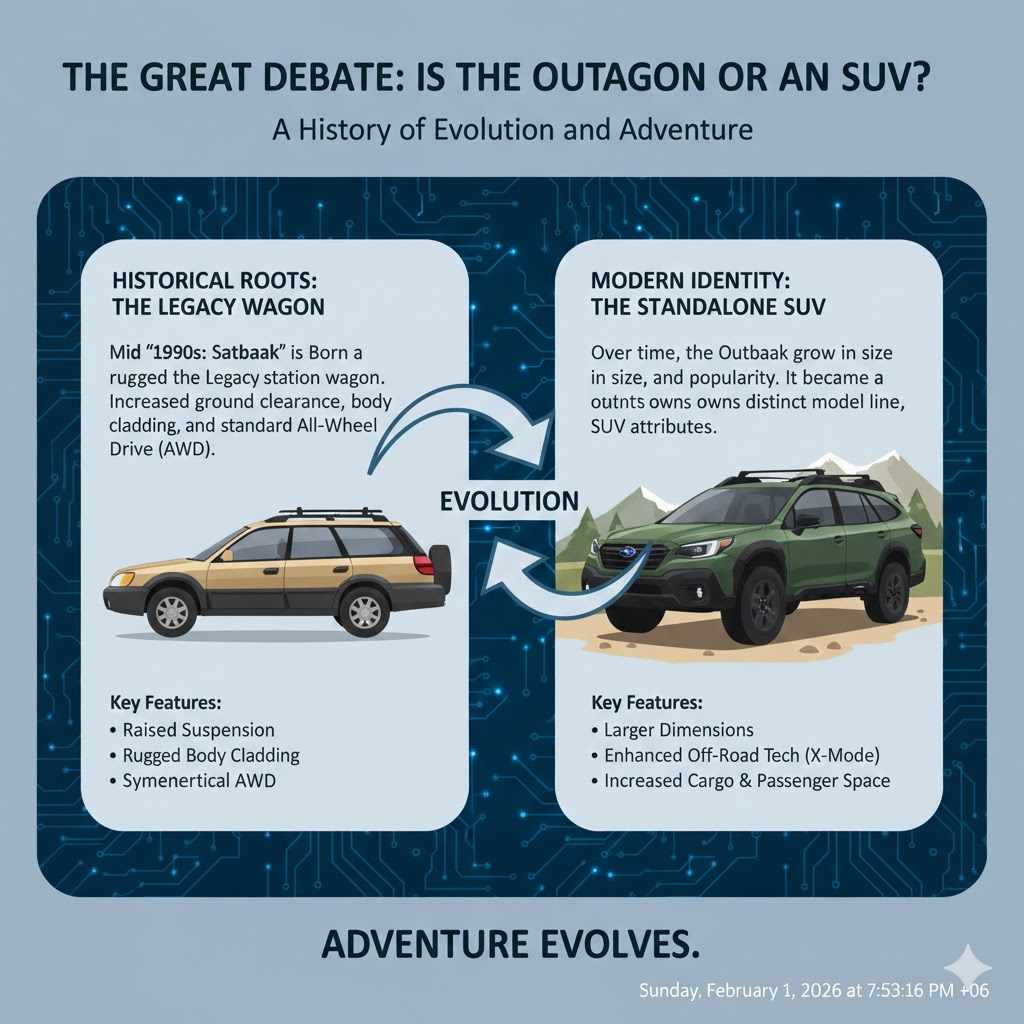
The biggest reason for confusion about the Subaru Outback is its history. When it first appeared in the mid-1990s, it was actually a version of the Subaru Legacy station wagon. It was called the “Legacy Outback.” The idea was simple: take a practical station wagon, raise the suspension for more ground clearance, add some rugged body protection, and give it a capable all-wheel-drive system. It was marketed as a car that could handle adventure without being a big, clumsy truck.
Over the years, the Outback became incredibly popular. It grew in size and capability with each new generation. Eventually, it became so distinct that Subaru dropped the “Legacy” name, and it became its own model line. While it still shares its core platform with the Legacy sedan, its features now lean much more heavily into SUV territory. This evolution is why people still see the wagon in its shape, but its performance and features shout SUV.
Unpacking the “Crossover” Label: What It Really Means
So, what do you call a vehicle that’s part wagon and part SUV? The auto industry came up with the perfect term: a “crossover.” This is the key to understanding the Subaru Outback. A crossover, or Crossover Utility Vehicle (CUV), is a vehicle built on a car’s platform that has features from a sport utility vehicle (SUV).
The most important part of this definition is the “car’s platform.” This means a crossover uses a “unibody” construction, where the body and frame are one single piece. This is just like a regular sedan or station wagon. Traditional, old-school SUVs were built using a “body-on-frame” method, where the body is mounted on top of a separate, heavy steel frame, just like a pickup truck.
Benefits of a Crossover Design
Using a unibody car platform gives crossovers like the Outback some major advantages that drivers love. Here’s what you get:
- A Smoother, More Comfortable Ride: Since it’s built like a car, it drives like one. It handles bumps and turns with ease, making it great for daily commuting and long road trips.
- Better Fuel Economy: Unibody construction is much lighter than a heavy truck frame. Less weight means the engine doesn’t have to work as hard, which saves you money on gas.
- Easier Handling and Parking: Crossovers are typically more responsive and nimble than truck-based SUVs. They are easier to steer, maneuver in traffic, and fit into tight parking spaces.
- Improved Safety: Modern unibody designs have built-in crumple zones that are engineered to absorb the force of an impact, protecting everyone inside.
How the Outback Fits the Crossover Mold
The Subaru Outback is the textbook definition of a crossover. It perfectly blends the two worlds. It has the unibody platform for that smooth, car-like ride, but it also has the key SUV features that people want, like higher ground clearance to drive over obstacles and standard all-wheel drive for amazing traction in bad weather.
Key Features That Define the Subaru Outback
Let’s look closer at the special ingredients that make the Outback a unique and capable crossover. These are the core features that have made it a legend among loyal owners.
Symmetrical All-Wheel Drive (AWD)
This is Subaru’s signature technology and a huge reason for the Outback’s success. Unlike some systems that only send power to the other wheels when slipping is detected, Subaru’s Symmetrical AWD is always on, constantly sending power to all four wheels. This provides a balanced and stable grip on the road at all times. Whether you’re driving on dry pavement, in a rainstorm, or through a few inches of snow, the system gives you incredible confidence and control.
Higher Ground Clearance
Ground clearance is the distance between the lowest point of the car’s underbody and the ground. A typical sedan might have about 5 inches of ground clearance. The Subaru Outback, however, boasts an impressive 8.7 inches (and even 9.5 inches on the rugged Wilderness model). This extra height allows it to easily clear snow, navigate bumpy dirt roads, and handle rougher terrain without scraping the bottom of the vehicle. It’s one of the main features that separates it from a standard station wagon.
The Boxer Engine
Under the hood of every Subaru is a unique engine called a “Boxer” engine. Instead of pistons moving up and down like in most cars, the Boxer’s pistons move side-to-side, like a boxer punching. This flat design allows the engine to be mounted lower in the vehicle. A lower center of gravity means the car is more stable and balanced, especially when cornering. It reduces that “tipping” feeling you might get in taller SUVs and contributes to the Outback’s secure, planted feel on the road.
Station Wagon Roots and Cargo Space
The Outback has never forgotten its wagon heritage. Its long, rectangular body shape creates an enormous and practical cargo area. With the rear seats up, you have plenty of room for groceries, luggage, and sports gear.
But when you fold the rear seats down, the Outback transforms into a cargo-hauling machine. It offers more usable space than many larger, bulkier SUVs, making it perfect for trips to the hardware store, moving furniture, or packing up for a camping trip.
How the Outback Compares to Other Vehicle Types
Seeing how the Outback stacks up against other types of vehicles is the best way to truly appreciate its unique place in the automotive world. It takes the best qualities from several categories and combines them into one practical package.
A Traditional SUV (like a Ford Explorer or Chevrolet Tahoe) is often built on a truck frame, making it heavy and rugged, with excellent towing capacity but a rougher ride and worse fuel economy. A Station Wagon (like a Volvo V60) is built on a car platform and offers huge cargo space and a comfortable ride, but typically has low ground clearance, limiting its all-weather and all-terrain ability.
A Sedan (like a Honda Accord) is great for commuting with good fuel economy and handling, but it lacks the cargo space and go-anywhere capability of the Outback.
This table gives a simple breakdown:
| Feature | Subaru Outback (Crossover) | Traditional SUV | Station Wagon | Sedan |
|---|---|---|---|---|
| Platform | Car-based (Unibody) | Truck-based (Body-on-frame) | Car-based (Unibody) | Car-based (Unibody) |
| Ground Clearance | High | Very High | Low | Low |
| Driving Feel | Smooth and Car-like | Sturdy and Truck-like | Smooth and Car-like | Agile and Car-like |
| Fuel Economy | Good | Fair to Poor | Good to Excellent | Excellent |
| Cargo Space | Excellent | Excellent (often taller) | Excellent | Limited |
| Off-Road Ability | Very Capable | Excellent | Limited | Very Limited |
Who is the Subaru Outback For? The Ideal Driver Profile
The Outback’s jack-of-all-trades nature makes it a perfect fit for a wide range of people. Do you see yourself in one of these groups? If so, the Outback might be the perfect vehicle for you.
- The Outdoor Adventurer: If you love hiking, kayaking, skiing, or camping, the Outback is your best friend. Its standard roof rails are ready for your gear racks, the massive cargo bay can hold all your equipment, and the AWD and ground clearance will get you to the trailhead with confidence.
- The Safety-Conscious Family: Subaru is known for its focus on safety. The Outback consistently earns top safety ratings from organizations like the Insurance Institute for Highway Safety (IIHS). Its spacious back seat is perfect for car seats, and the huge cargo area easily swallows strollers, groceries, and everything else a busy family needs.
- The All-Weather Commuter: If you live in a place with real seasons—snow, ice, and heavy rain—the Outback provides peace of mind. The Symmetrical AWD system is legendary for its performance in slick conditions, ensuring you can get to work or school safely when other cars are stuck at home.
- The Practical Pet Owner: Dog lovers adore the Outback. The low cargo floor makes it easy for dogs of all ages to hop in and out. The wide opening and durable interior materials make it a comfortable and easy-to-clean space for your furry companions.
A Quick Look at the Outback’s History and Evolution
Understanding the Outback’s journey helps explain why it is what it is today. It didn’t just appear overnight; it was crafted over decades in response to what drivers really wanted.
The Early Days (1990s)
As we mentioned, the first Outback debuted in 1994 as a trim level of the Legacy wagon. It featured a raised suspension and two-tone paint with rugged body cladding. It was a novel idea that combined the practicality of a wagon with the adventurous spirit of an SUV. The famous commercials featuring “Crocodile Dundee” actor Paul Hogan helped cement its image as a tough, capable vehicle ready for anything.
Becoming Its Own Model
The concept was a massive hit. People loved that they could get SUV-like capability without the poor gas mileage and clumsy handling of a traditional SUV. By its second generation in 2000, the Outback had officially become its own distinct model, separating from the Legacy nameplate. It grew larger, more powerful, and more refined, solidifying its place as Subaru’s flagship vehicle.
The Modern Outback
Today’s Outback is the most capable and advanced version yet. It’s larger, safer, and more packed with technology than ever before. While its wagon-like profile remains, it is now taller and more robust, leaning even more into its SUV identity. The introduction of the even more rugged Outback Wilderness trim, with higher ground clearance and all-terrain tires, shows that Subaru continues to push the model’s adventurous capabilities further than ever.
Common Misconceptions About the Subaru Outback
Because the Outback carves its own path, a few myths and misunderstandings have popped up over the years. Let’s clear the air on some of the most common ones.
Myth 1: “It’s just a station wagon.”
This is the most common mistake people make. While it evolved from a wagon, its standard high ground clearance, robust AWD system, and official classification firmly place it in the crossover SUV category. A standard station wagon simply cannot handle the same level of rough roads or snowy conditions as an Outback.
Myth 2: “It’s a serious off-roading truck.”
On the flip side, it’s important to understand the Outback’s limits. Its capability on dirt roads, forest trails, and in deep snow is incredible for a crossover. However, it is not a dedicated rock-crawler like a Jeep Wrangler or a Ford Bronco. It lacks the heavy-duty frame, low-range gearing, and advanced suspension needed for extreme off-roading. Always practice safe driving on public lands, as advised by resources like the U.S. Forest Service.
Myth 3: “All Subarus are the same.”
Subaru offers a full lineup of capable crossovers and SUVs, and each one is different. The Forester has a more traditional, upright SUV shape with a focus on maximum visibility. The Crosstrek is a smaller, more city-friendly compact crossover. The Ascent is a large, three-row family SUV. The Outback stands out with its unique wagon-like profile, offering a different balance of cargo space, comfort, and style.
What Does the EPA Classify the Subaru Outback As?
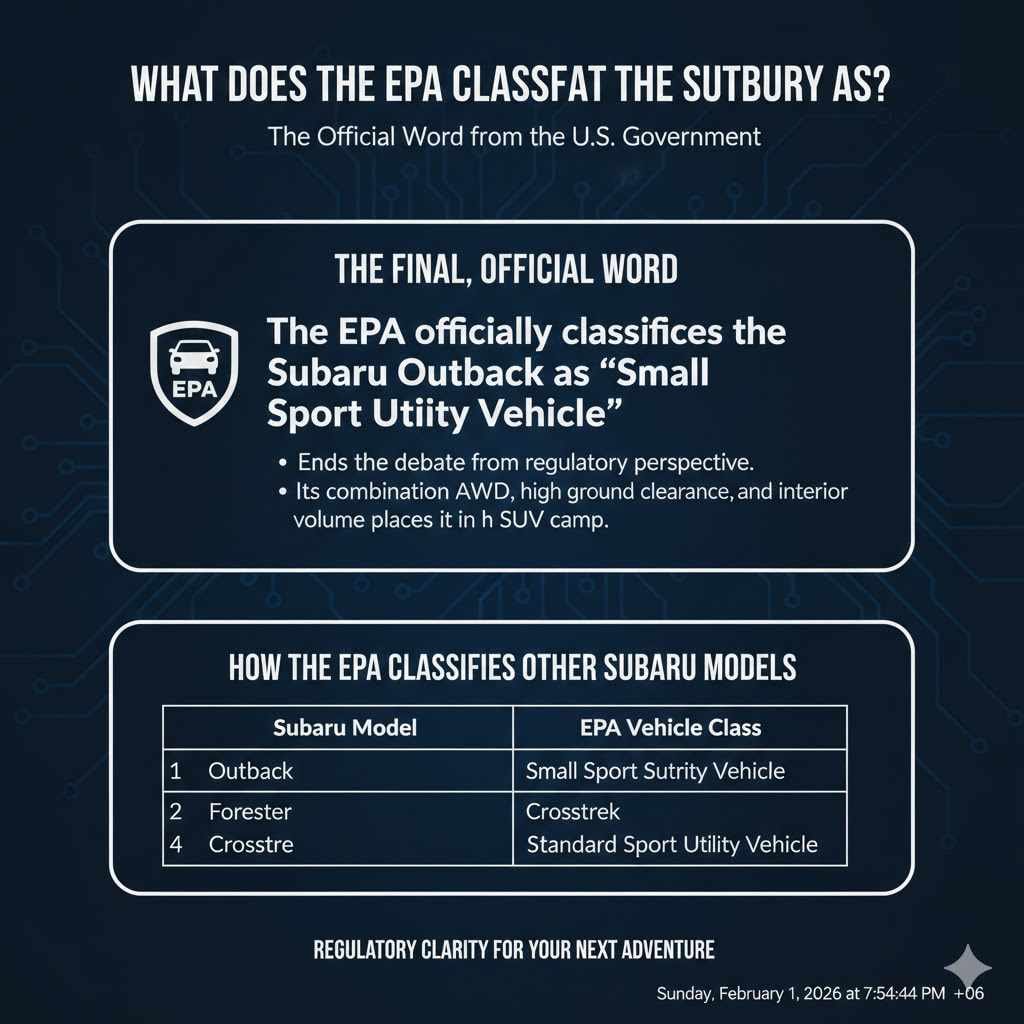
If you’re looking for the final, official word, look no further than the U.S. government. The Environmental Protection Agency (EPA) is responsible for classifying vehicles to determine fuel economy standards and provide information to consumers. They don’t have a “crossover” category, so they place vehicles in the category they fit best.
For many years, the EPA has officially classified the Subaru Outback as a “Small Sport Utility Vehicle.” This ends the debate from a regulatory perspective. Despite its wagon-like shape, its combination of an AWD drivetrain, high ground clearance, and interior volume puts it squarely in the SUV camp in the eyes of the government.
Here’s how the EPA classifies some of Subaru’s other popular models:
| Subaru Model | EPA Vehicle Class |
|---|---|
| Outback | Small Sport Utility Vehicle |
| Forester | Small Sport Utility Vehicle |
| Crosstrek | Small Sport Utility Vehicle |
| Ascent | Standard Sport Utility Vehicle |
Frequently Asked Questions (FAQ)
What is the main difference between a Subaru Outback and a Forester?
The biggest difference is their shape. The Forester has a taller, more traditional boxy SUV design, which gives it a more upright seating position and great visibility. The Outback has a longer, wagon-like design, which gives it a smoother, more car-like ride and a longer cargo area.
Is a Subaru Outback considered a luxury vehicle?
No, the Outback is not a luxury vehicle. It is a mainstream brand known for practicality, safety, and reliability. However, its top-level trim packages, like the Touring and Touring XT, offer many luxury features like Nappa leather seats, a premium sound system, and advanced technology.
How much cargo space does a Subaru Outback have?
The Subaru Outback is a leader in its class for cargo space. It typically offers around 32.5 cubic feet of space behind the rear seats and a massive 75.7 cubic feet with the rear seats folded down, making it incredibly versatile for hauling gear.
Is the Subaru Outback good in the snow?
Yes, the Outback is famous for being one of the best vehicles for driving in the snow. The combination of its standard Symmetrical All-Wheel Drive, high ground clearance, and stable handling makes it extremely sure-footed and reliable in winter conditions.
Does the Subaru Outback get good gas mileage?
For a vehicle of its size and capability, the Outback gets very good gas mileage. Newer models can achieve up to 33 miles per gallon on the highway, thanks to its efficient Boxer engine and car-based platform. This is much better than most traditional SUVs.
Why do they call it a “crossover”?
It’s called a “crossover” because its design “crosses over” between two different vehicle types. It takes the unibody platform and comfortable ride of a car and combines it with the high ground clearance, all-wheel drive, and versatility of an SUV.
Is an Outback expensive to maintain?
The Subaru Outback is generally not expensive to maintain. Its maintenance costs are on par with other mainstream brands like Honda and Toyota. They are known for their reliability and durability, which helps keep long-term repair costs down.
Conclusion: The Best of Both Worlds
So, what vehicle type is a Subaru Outback? The final, simple answer is that it’s a crossover SUV. It masterfully blends the best features of a spacious station wagon with the rugged, go-anywhere spirit of a modern SUV. It refuses to be put in a single box, and that is precisely its greatest strength.
The Outback offers the smooth ride, easy handling, and good fuel economy of a car, while also giving you the all-weather confidence of Symmetrical All-Wheel Drive, the obstacle-clearing ability of high ground clearance, and the massive cargo capacity to fuel your adventures. It is a practical, safe, and incredibly versatile machine built for people who need one vehicle that can do it all.
Now, the next time someone asks you if the Outback is a wagon or an SUV, you can smile and answer with confidence. You can tell them it’s a crossover—the brilliant combination of the best of both worlds. You’re not just a driver; you’re an informed owner who truly understands what makes your vehicle special.