
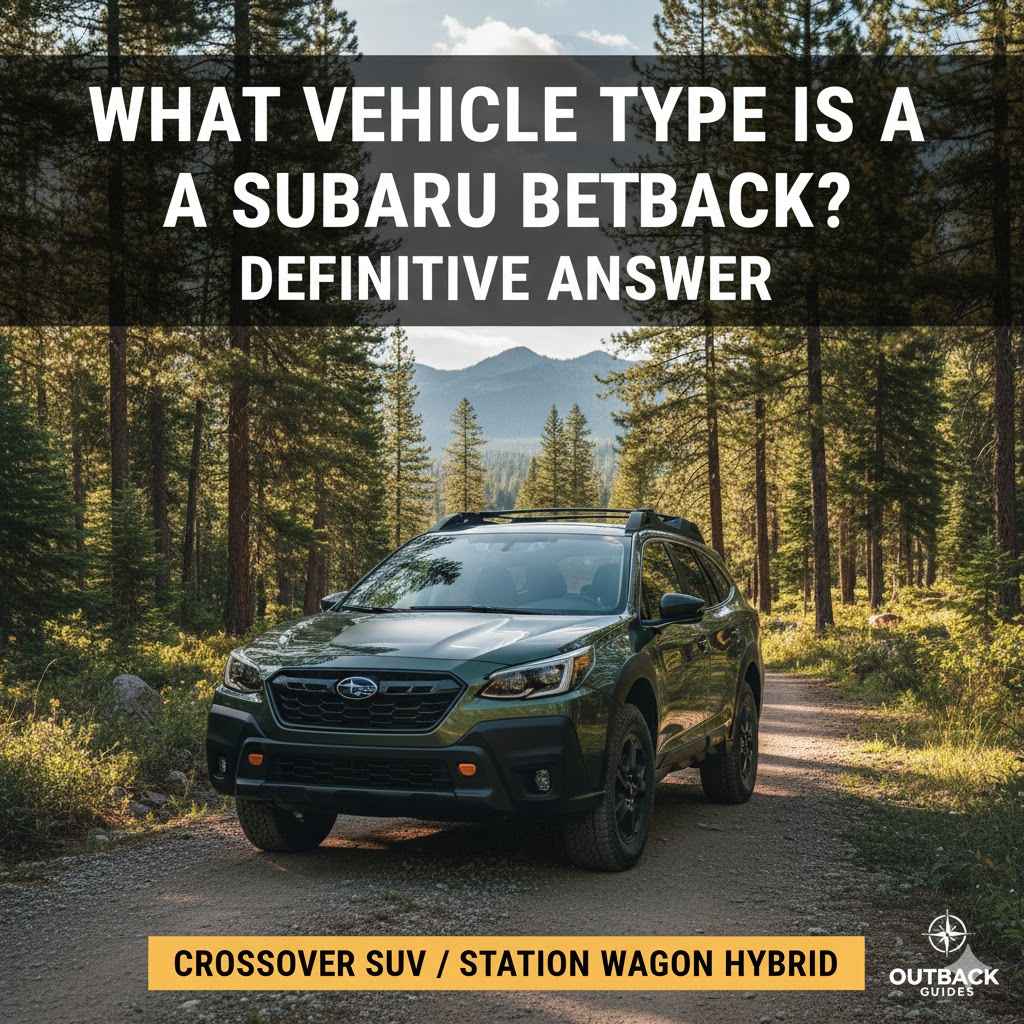
The Subaru Outback is officially classified as a crossover SUV. While it began as a rugged station wagon, its high ground clearance, standard all-wheel drive, and spacious interior firmly place it in the modern crossover category, blending the best features of an SUV with the comfort and handling of a car.
Have you ever looked at a Subaru Outback and wondered, “Is that a wagon or an SUV?” You are not alone. This is one of the most common questions in the car world. The Outback has a unique shape that doesn’t quite fit into one single box. It can feel confusing when you’re trying to compare it to other vehicles.
Don’t worry, I’m here to clear things up for you. My name is Dustin Hall, and I love making car topics simple and easy to understand. We are going to break down exactly what a Subaru Outback is, where it came from, and how it compares to other cars on the road. By the end, you’ll have a clear, definitive answer and feel confident in your knowledge.
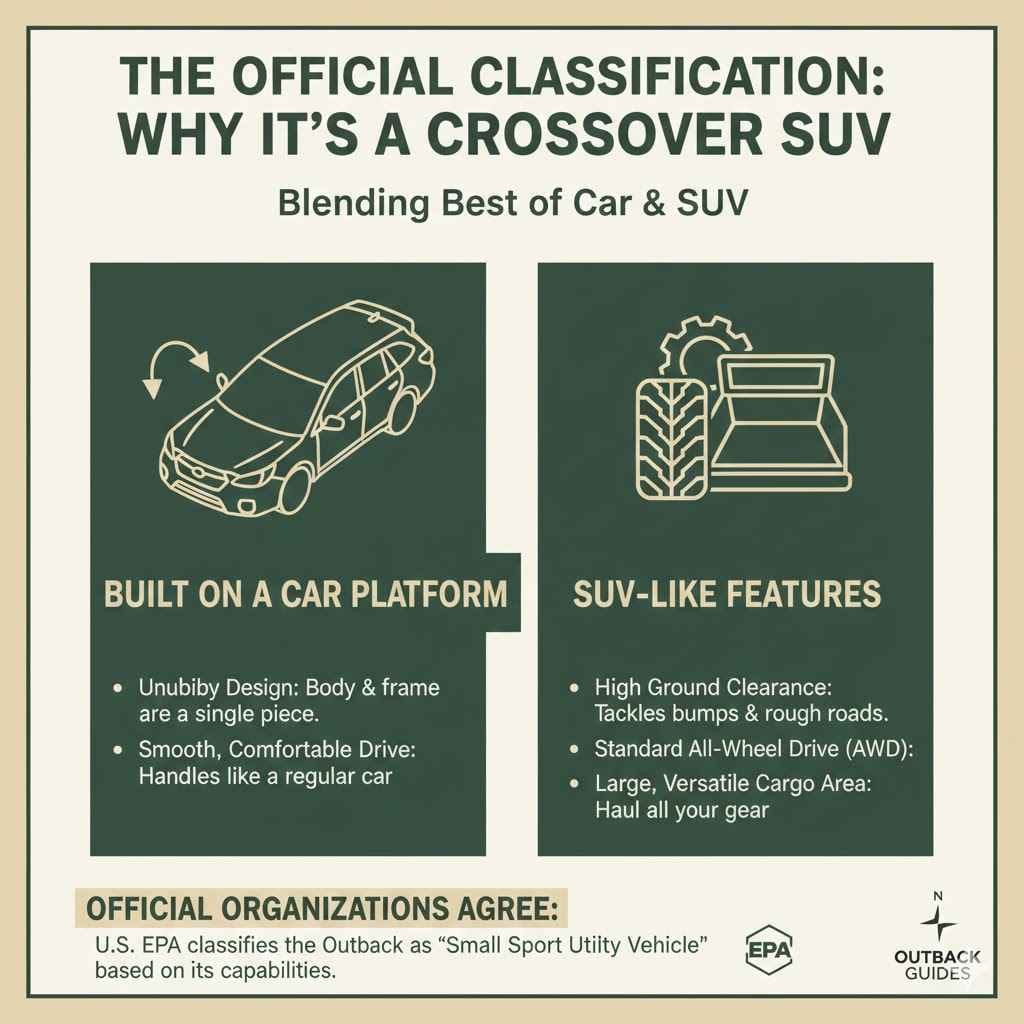
The Official Classification: Why It’s a Crossover SUV
Let’s get straight to the point. Today, the Subaru Outback is officially classified as a crossover SUV. This isn’t just an opinion; it’s how automakers, government agencies, and the auto industry see it. But what does “crossover SUV” actually mean?
Think of a crossover as a vehicle that mixes the best parts of a car with the best parts of an SUV. Here’s how the Outback fits that description perfectly:
- Built on a Car Platform: Unlike traditional, truck-like SUVs that are built on a heavy steel frame (called body-on-frame), the Outback is built like a car. It uses a “unibody” design, where the body and frame are one single piece. This is a key reason why it feels so smooth and comfortable to drive, just like a regular car.
- SUV-Like Features: While it drives like a car, it has all the key features you’d expect from an SUV. This includes high ground clearance to go over bumps and rough roads, standard All-Wheel Drive (AWD) for great traction, and a large, versatile cargo area for hauling your gear.
Even official organizations agree. The U.S. Environmental Protection Agency (EPA), which handles fuel economy ratings, categorizes the Outback as a “Small Sport Utility Vehicle.” This classification is based on its capabilities, like its AWD system and ground clearance, which allow it to handle a variety of road conditions, just like an SUV.
A Look Back in Time: The Outback’s Wagon Roots
So, if it’s a crossover now, why do so many people still think of it as a station wagon? The answer lies in its history. The Outback wasn’t born an SUV; it evolved into one.
Back in the mid-1990s, Subaru saw that people loved the space and practicality of their Legacy station wagon but wanted something that could handle more adventure. They wanted a vehicle that could tackle snowy roads and dirt trails without needing a big, bulky SUV. Subaru’s brilliant solution was to take their popular Legacy wagon and give it a rugged makeover.
The Birth of a Legend
The very first Subaru Outback, launched in 1994, was essentially a Subaru Legacy wagon with a few key upgrades:
- A Lifted Suspension: They raised the car higher off the ground, giving it more clearance to avoid scraping on rocks or getting stuck in deep snow.
- Rugged Body Cladding: They added tough plastic panels around the bottom of the car to protect it from dings and scratches on rough trails.
- All-Wheel Drive as Standard: This gave it fantastic grip and stability in all kinds of weather.
It was an instant hit! Subaru had created a new kind of vehicle that offered the easy-driving nature of a wagon with the go-anywhere spirit of an SUV. Many experts say the original Outback was the car that truly kicked off the crossover craze we see today. It proved that you didn’t need a giant truck to have adventure-ready capability.
Over the years, the Outback has grown in size and capability. Each new generation has moved it further into the SUV camp, but it has never forgotten its wagon roots. That long roofline and practical shape are a direct link to its past.
Outback Evolution: Then vs. Now
Seeing the changes side-by-side makes it easy to understand the Outback’s journey from a lifted wagon to a full-fledged crossover SUV.
| Feature | First Generation Outback (circa 1995) | Current Generation Outback |
|---|---|---|
| Vehicle Base | Subaru Legacy Wagon | Subaru Global Platform (shared with other Subaru SUVs) |
| Ground Clearance | Around 7.5 inches | 8.7 inches (9.5 inches on Wilderness model) |
| Overall Size | Clearly a station wagon size | Mid-size crossover SUV size |
| Technology | Basic features like cassette player and cruise control | Large touchscreen, advanced driver-assist safety systems (EyeSight) |
| Off-Road Capability | Good for its time with AWD | Advanced X-MODE for snow, dirt, and mud; Hill Descent Control |
Outback vs. The World: How It Compares to Other Vehicle Types
To really understand what the Outback is, it helps to see how it stacks up against other types of vehicles. Let’s compare it directly to traditional SUVs, station wagons, and other crossovers.
Subaru Outback vs. Traditional SUVs
A traditional SUV, like a Toyota 4Runner or Jeep Wrangler, is built like a truck. They use a body-on-frame design, which is extremely tough and great for heavy-duty work.
The Key Differences:
- Ride Comfort: The Outback’s unibody (car-like) construction gives it a much smoother and quieter ride on paved roads. Traditional SUVs can feel more bouncy and rugged in daily driving.
- Handling: The Outback handles more like a car. It feels stable and composed around corners, whereas a tall, body-on-frame SUV can feel top-heavy.
- Towing & Off-Roading: This is where traditional SUVs shine. Their strong frames allow them to tow much heavier loads and handle extreme off-road rock crawling. The Outback is very capable on dirt trails and in bad weather, but it’s not designed for the same level of hardcore off-roading.
Subaru Outback vs. Station Wagons
This is where the lines get blurry for many people. A modern station wagon, like a Volvo V60 or Audi A4 allroad, shares a similar long-roof shape with the Outback.
The Key Differences:
- Ground Clearance: This is the biggest giveaway. The Outback sits much higher off the ground. A typical station wagon has a ride height similar to a sedan, making it less suitable for rough roads.
- Rugged Styling: The Outback has prominent black body cladding and beefy roof rails that signal its adventurous intent. Most wagons have a sleeker, more street-focused design.
- Purpose: Station wagons are primarily designed for on-road comfort and cargo space, sometimes with a sporty feel. The Outback is designed from the ground up to be a balance of on-road comfort and off-road readiness.
Subaru Outback vs. Other Crossovers
When you compare the Outback to popular crossovers like the Honda CR-V, Toyota RAV4, or Hyundai Santa Fe, you start to see its unique place in the market.
The Key Differences:
- Standard All-Wheel Drive: Nearly every other competitor offers front-wheel drive (FWD) as the standard setup and makes you pay extra for all-wheel drive (AWD). With the Outback, Subaru’s excellent Symmetrical AWD is standard on every single trim level. This is a huge value and a core part of its identity.
- Wagon-Like Profile: While it’s taller than a wagon, the Outback still has a lower roofline and a longer, more stretched-out look than many of its boxier crossover rivals. This gives it a unique style and can contribute to better aerodynamics.
- Ground Clearance: With 8.7 inches of standard ground clearance (and an amazing 9.5 inches on the Wilderness trim), the Outback often sits higher than many of its direct competitors, giving it a real advantage on snowy or uneven roads.
| Vehicle Type | Best For | Outback’s Advantage | Outback’s Disadvantage |
|---|---|---|---|
| Traditional SUV | Heavy towing, extreme off-roading | Much better on-road comfort, fuel efficiency, and handling | Lower towing capacity, not built for rock crawling |
| Station Wagon | On-road performance, car-like handling with more cargo room | Far superior off-road and bad weather capability, higher view | Less sporty handling than a performance-oriented wagon |
| Other Crossovers | Well-rounded family transportation | Standard AWD, typically more ground clearance, unique rugged style | Can have less third-row options compared to some larger crossovers |
Key Features That Define the Subaru Outback
Certain features are at the very heart of the Outback’s identity as a crossover. These are the things that give it that special “best of both worlds” character.
Standard Symmetrical All-Wheel Drive (AWD)
This is Subaru’s signature technology. In simple terms, Symmetrical AWD constantly sends power to all four wheels simultaneously. This balanced approach gives you incredible grip and stability. Whether you’re driving in a downpour, on a snowy street, or on a gravel road, the system works to keep you in control. Unlike some “on-demand” systems that wait for a wheel to slip before sending power, Subaru’s system is always on, ready to react.
High Ground Clearance
Ground clearance is the space between the bottom of the car and the road. A regular car might have 5-6 inches of clearance. The Subaru Outback has a generous 8.7 inches. Why does this matter?
- It lets you drive through deeper snow without getting stuck.
- It allows you to clear rocks, ruts, and other obstacles on trails.
- It helps you avoid scraping the bottom of your car on steep driveways or large speed bumps.
The even more rugged Outback Wilderness model pushes this to an incredible 9.5 inches, which is more than many “true” SUVs.
Crossover Utility and Space
The Outback is brilliantly practical. Its long shape gives it a huge amount of cargo space. With the rear seats up, you have plenty of room for groceries, luggage, and sports gear. Fold the rear seats down, and you open up a cavernous area that can hold bikes, camping equipment, or large items from the hardware store. Plus, most Outback models come with sturdy roof rails that have clever, built-in crossbars, making it super easy to attach a roof box, bike rack, or kayak carrier.
Car-Like Comfort and Handling
This is the secret to the Outback’s success. Despite its rugged looks and capabilities, it’s incredibly comfortable for daily driving. The unibody frame and four-wheel independent suspension soak up bumps in the road, giving you a smooth and quiet ride. It feels planted and secure on the highway and is easy to park and maneuver in the city. You get the commanding view of an SUV without the harsh, truck-like ride.
Who Is the Subaru Outback For?
The Outback’s unique blend of features makes it a perfect fit for many different kinds of people. Do you see yourself in any of these groups?
- The Outdoor Adventurer: If your weekends are filled with hiking, camping, kayaking, or skiing, the Outback is your perfect partner. Its AWD and ground clearance will get you to the trailhead, and its massive cargo area will hold all your gear.
- The Safety-Conscious Family: Subaru is known for safety. The Outback consistently earns top safety ratings from organizations like the Insurance Institute for Highway Safety (IIHS). Its standard AWD provides peace of mind in bad weather, and its EyeSight Driver Assist Technology acts as an extra set of eyes on the road.
- The Daily Commuter Who Wants Versatility: The Outback is comfortable and efficient enough for the daily grind, but it’s always ready for a spontaneous weekend trip. It’s the one car that can handle a trip to the grocery store and a trip to the mountains with equal ease.
- The Pet Owner: The spacious cargo area is perfect for dog crates, and the durable interior materials are easy to clean. The low load floor also makes it easier for older dogs to jump in and out compared to taller SUVs.
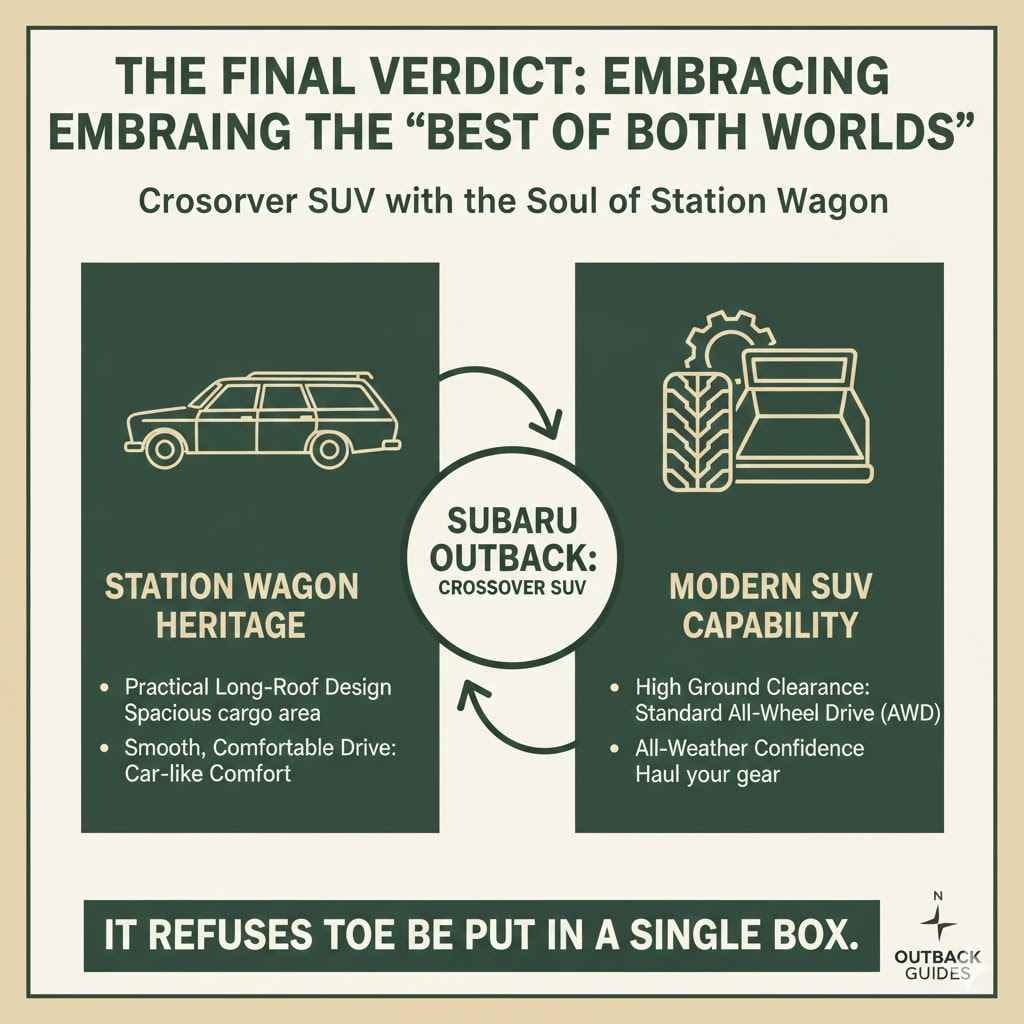
The Final Verdict: Embracing the “Best of Both Worlds”
So, what vehicle type is a Subaru Outback? The definitive answer is that it’s a crossover SUV.
However, simply calling it a crossover doesn’t tell the whole story. It’s a crossover with the soul of a station wagon. It honors its heritage with a practical, long-roof design while embracing the modern demands for SUV capability, ground clearance, and all-weather confidence. This unique blend is not a point of confusion; it’s the Outback’s greatest strength. It refuses to be put in a single box, and that’s why so many people love it.
Frequently Asked Questions (FAQ)
Is the Subaru Outback considered an SUV for insurance purposes?
Yes, most insurance companies classify the Subaru Outback as a small SUV or a crossover. This is based on its weight, price, and features like standard All-Wheel Drive. Your insurance rates will be similar to other vehicles in this popular category.
Is a Subaru Outback good in the snow?
Absolutely. The Outback is one of the best vehicles you can buy for driving in the snow. Its combination of standard Symmetrical All-Wheel Drive, high ground clearance, and available X-MODE for slippery conditions gives it outstanding traction and stability.
What’s the difference between a Subaru Forester and an Outback?
Think of it this way: the Forester has a more traditional, upright SUV shape with a taller roof and a shorter length. The Outback is longer, lower, and more wagon-like in its profile. The Forester often feels more spacious vertically (more headroom), while the Outback offers more horizontal cargo length, especially with the seats folded down.
Can a Subaru Outback go off-road?
Yes, the Outback is very capable of light-to-moderate off-roading. It’s perfect for dirt roads, gravel trails, and getting to remote campsites. Its AWD system and ground clearance can handle much more than a typical car. However, it’s not designed for extreme rock crawling or the most difficult 4×4 trails.
Is the Outback a reliable car?
Subaru has a strong reputation for reliability and durability. Outbacks are known for lasting a long time, and it’s common to see older models still on the road. Like any car, regular maintenance is key to ensuring a long and trouble-free life.
How is the Outback different from a classic station wagon?
The main differences are ride height and capability. The Outback sits several inches higher off the ground than a station wagon. It also comes standard with a more advanced all-wheel-drive system and rugged design features built for handling rougher conditions.
Does the Outback have a third row of seats?
No, the Subaru Outback is a two-row vehicle that seats up to five passengers. If you need a three-row Subaru, you would look at the Subaru Ascent, which is a larger SUV designed to carry up to eight people.
Conclusion
The next time someone asks you what kind of car the Subaru Outback is, you can answer with confidence. It’s a crossover SUV that masterfully combines the best attributes of a comfortable, easy-to-drive car with the rugged, go-anywhere capability of an SUV. It carved out its own unique space in the automotive world by blending practicality with adventure.
Understanding your vehicle, or one you’re thinking about buying, is empowering. It helps you make smarter decisions and feel more connected to the machine that gets you where you need to go. The Outback’s story is a perfect example of how a vehicle can be more than just one thing—it can be the perfect solution for whatever your journey holds.