
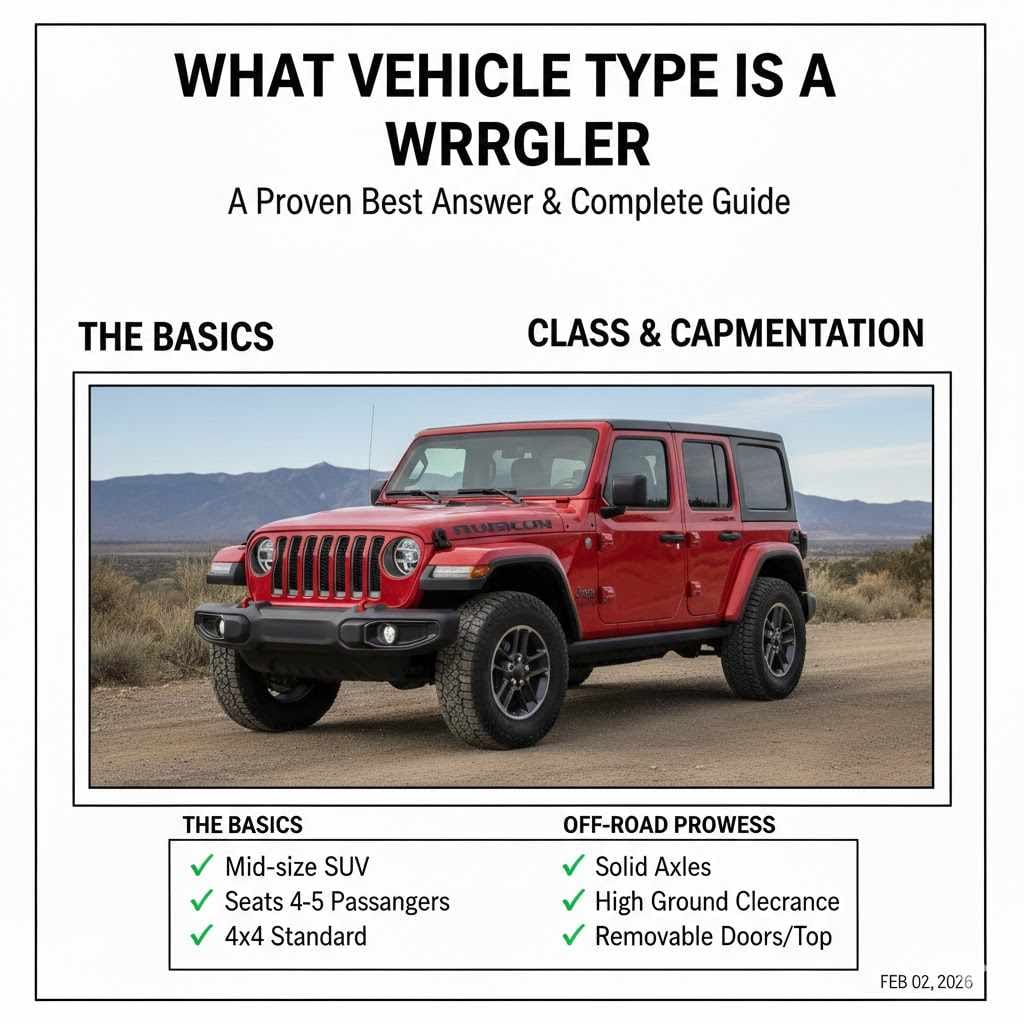
The Jeep Wrangler is best classified as a purpose-built off-road SUV (Sport Utility Vehicle). While it has unique convertible features and a ruggedness similar to a truck, its core design—a body-on-frame build, standard 4×4 system, and focus on all-terrain capability—firmly places it in the off-road SUV category, engineered for adventure.
Have you ever looked at a Jeep Wrangler and wondered, “What exactly is that?” It looks tough like a truck, but you can take the top off like a convertible. It can carry people like a car, but it seems most at home on a dirt trail. It’s a common question, and the answer is not as simple as one word.
Don’t worry, you’re not alone in asking! Many people get confused by the Wrangler’s unique style. We are here to clear things up for you. In this guide, we will break down exactly what type of vehicle the Jeep Wrangler is. We will look at its design, its history, and what makes it so special. Let’s solve this mystery together.
The Official Classification: Why It’s an SUV
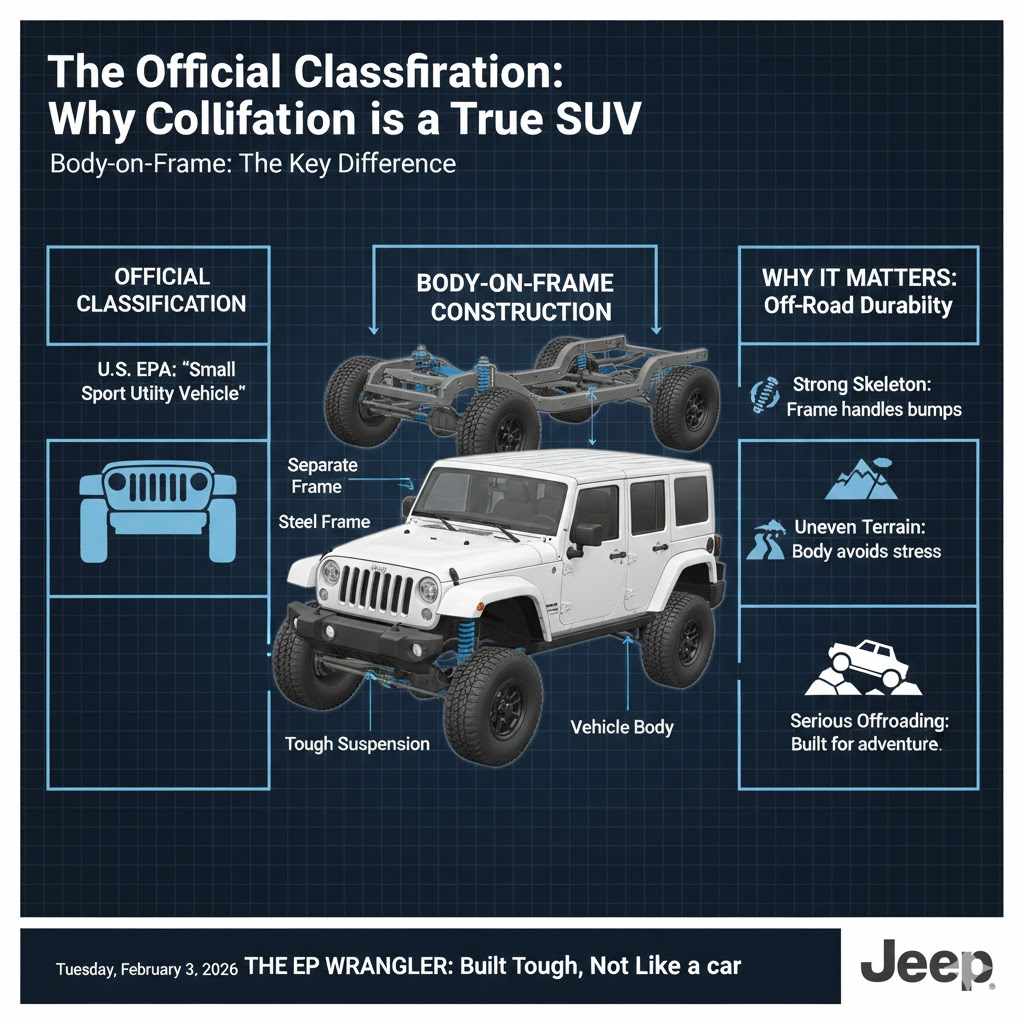
At its core, the Jeep Wrangler is classified as a Sport Utility Vehicle, or SUV. Government agencies and the auto industry agree on this. For example, the U.S. Environmental Protection Agency (EPA) categorizes the Wrangler as a “Small Sport Utility Vehicle.” This classification is based on specific design features that separate it from cars or trucks.
The biggest reason for this classification is its construction. Most cars today use what is called a “unibody” design, where the frame and the body of the car are one single piece. This is great for smooth road handling and comfort. The Jeep Wrangler, however, uses a “body-on-frame” design. This means the body of the Jeep is mounted onto a separate, strong steel frame, much like a traditional pickup truck. This heavy-duty frame is what gives the Wrangler its incredible strength and durability, especially on rough, uneven terrain.
This tough frame allows the suspension to twist and flex without putting stress on the vehicle’s body. Think of it like having a strong skeleton. It can handle bumps, rocks, and dips in the trail that would damage a normal car. This design is essential for serious off-roading, which is the “Sport” and “Utility” the Wrangler was built for.
But Isn’t It Like a Truck? Wrangler vs. Pickup Truck
It’s easy to see why someone might think the Wrangler is a type of truck. It has that rugged look, a tough frame, and a powerful presence on the road. However, there is one key difference that separates an SUV like the Wrangler from a pickup truck.
A pickup truck is defined by its separate, open-air cargo bed. The passenger cab and the cargo bed are two distinct parts of the vehicle. The Jeep Wrangler has an enclosed space where the passenger area and the cargo area are connected inside one body. While you can fold down the seats to create more cargo space, it is not the same as having a dedicated, open bed for hauling things like dirt, lumber, or large equipment.
To make this even clearer, Jeep created the Gladiator. The Jeep Gladiator is essentially a Wrangler that has been stretched and given a separate, open pickup bed. Seeing a Gladiator and a Wrangler side-by-side makes the difference obvious. The Gladiator is Jeep’s truck, while the Wrangler is their iconic off-road SUV.
| Feature | Jeep Wrangler (SUV) | Typical Pickup Truck |
|---|---|---|
| Cargo Area | Enclosed cargo space connected to the passenger cabin. | Separate, open-air cargo bed. |
| Main Purpose | Transporting passengers and gear over difficult terrain. | Hauling and towing heavy loads. |
| Structure | Single enclosed body for passengers and cargo. | Separate cab for passengers and bed for cargo. |
| Versatility | Focuses on go-anywhere adventure and passenger comfort. | Focuses on utility and work-related tasks. |
The Convertible Fun Factor: A Unique SUV Trait
One of the most beloved features of the Jeep Wrangler is something few other SUVs offer: the ability to feel the open air. The Wrangler is one of the only true convertible SUVs you can buy today. You can remove the doors and take off the roof, which transforms your driving experience. This is a huge part of the Jeep culture and what makes owning one so much fun.
This convertible nature doesn’t change its classification as an SUV, but it certainly makes it a special one. Whether you are cruising on the beach or enjoying a sunny day, the open-air freedom is unmatched. Wranglers come with several roof options, allowing you to choose how you want to enjoy the outdoors.
- Soft Top: This is the classic, foldable fabric top. It’s the easiest to take down and put up on the go, making it perfect for sudden changes in weather. Modern soft tops are much quieter and more durable than older versions.
- Hard Top: A solid, fiberglass top that comes in multiple pieces. It offers better insulation from weather and road noise, making it a great choice for daily driving. You can often remove just the front panels over the driver and passenger for a sunroof-like experience.
- Sky One-Touch Power Top: This option gives you the best of both worlds. It works like a giant cloth sunroof that retracts with the push of a button, opening up nearly the entire roof area. The rear side windows are still removable for an even more open feel.
Digging Deeper: The Core DNA of an Off-Road Vehicle
So, we’ve established the Wrangler is an SUV. But to be even more precise, it is an off-road SUV. This is the “proven best answer” because it speaks to the vehicle’s true purpose. It wasn’t just designed to look tough; every part of it was engineered to perform in challenging conditions where pavement ends. Several key features make up this off-road DNA.
Key Off-Road Features of the Jeep Wrangler
- Body-on-Frame Construction: As we mentioned, this strong and separate frame is the backbone of the Wrangler. On a rocky trail, the frame can twist and flex, allowing the wheels to stay in contact with the ground. A normal unibody car would become rigid and stiff, potentially damaging the body or getting stuck.
- Solid Axles: This is a feature found on very few modern vehicles, but it is critical for serious off-roading. Most SUVs use an independent suspension, where each wheel can move up and down on its own. The Wrangler uses solid axles in the front and rear. This means the left and right wheels are connected by a solid steel tube. When one wheel is pushed up by a rock, it pushes the other wheel down, helping it maintain traction. This simple, rugged design is incredibly effective on uneven surfaces.
- True Four-Wheel Drive (4×4) Systems: All Jeep Wranglers come with a 4×4 system, but not just any system. They use part-time 4×4 systems with a dedicated transfer case. This allows the driver to manually select between 2-wheel drive (for normal roads), 4-wheel drive high (for slippery conditions like snow or dirt roads), and 4-wheel drive low (for extreme off-road situations like rock crawling). The “low range” gearing multiplies the engine’s torque, allowing the Wrangler to crawl over obstacles slowly and with great control.
- Impressive Ground Clearance & Angles: To go off-road, you need to be able to drive over things without getting stuck. The Wrangler is designed with this in mind.
- Ground Clearance: This is the distance from the lowest point of the vehicle to the ground. The Wrangler sits high, allowing it to clear rocks, logs, and other obstacles.
- Approach Angle: This is the maximum angle of a ramp the Wrangler can climb without its front bumper hitting it. A short front overhang gives it a fantastic approach angle.
- Departure Angle: This is the same idea but for the rear. It allows the Wrangler to come down off an obstacle without scraping its rear bumper.
A Quick Look at the Wrangler’s History
Understanding the Wrangler’s history helps explain why it is the way it is. The Wrangler’s family tree starts in World War II with the Willys-Overland MB, the famous military “Jeep” that served soldiers on every front. It was designed to be simple, tough, and capable of handling any terrain. That purpose-built spirit is still alive in the Wrangler today.
After the war, Willys-Overland began selling a civilian version called the “CJ” (for Civilian Jeep). For decades, the CJ series brought off-road adventure to the masses. In 1987, the Jeep brand introduced the first vehicle to carry the “Wrangler” name, the YJ model. While it was more comfortable and modern than the old CJs, it kept the same core principles of off-road mastery.
The Wrangler has evolved through several generations, but each one has stayed true to its heritage. This history is why the Wrangler isn’t just another SUV; it’s a direct descendant of one of the most important vehicles ever made.
| Generation | Model Years | Key Feature |
|---|---|---|
| Wrangler YJ | 1987–1995 | First “Wrangler,” known for its controversial square headlights. |
| Wrangler TJ | 1997–2006 | Returned to classic round headlights and introduced coil spring suspension. |
| Wrangler JK | 2007–2018 | Introduced the first four-door “Unlimited” model, which became hugely popular. |
| Wrangler JL | 2018–Present | The current model, with modern technology, improved comfort, and even more capability. |
So, Is a Wrangler the Right Type of Vehicle for You?
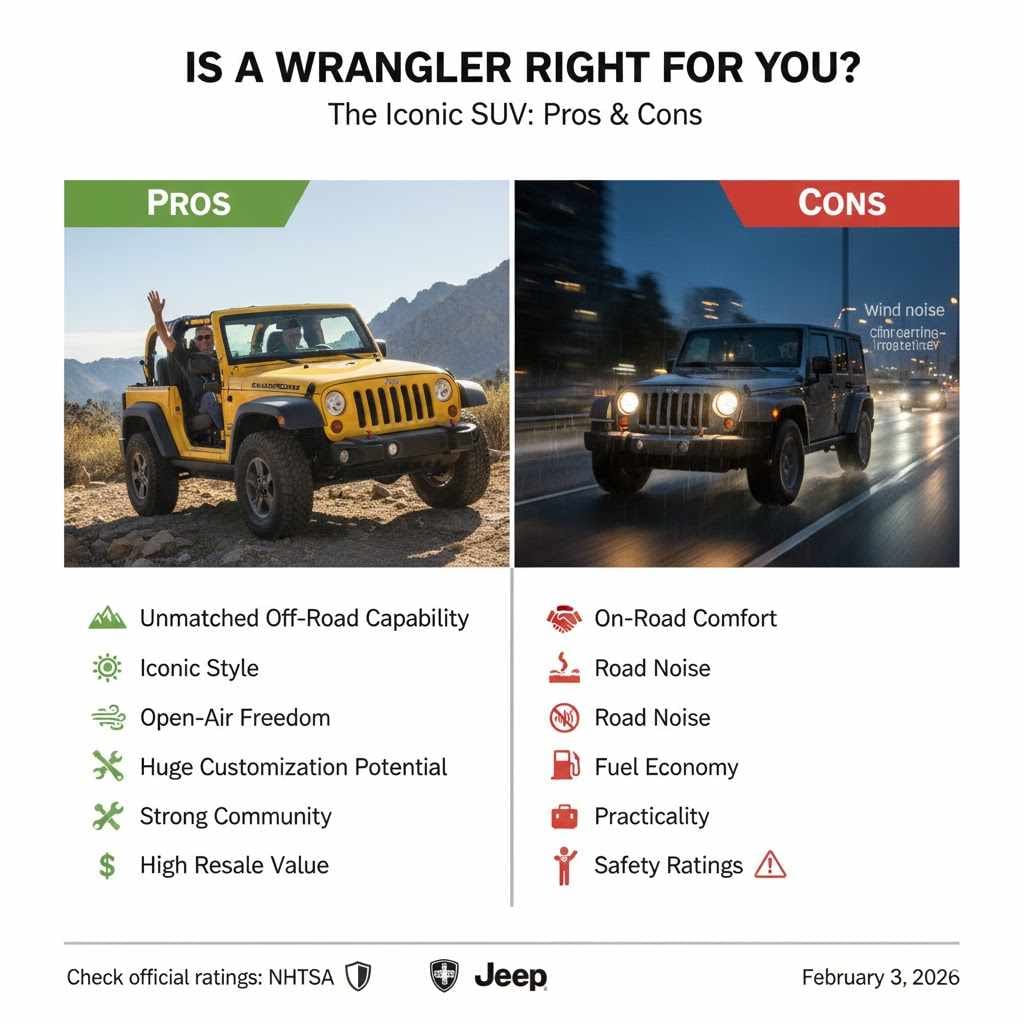
Now that you know exactly what a Jeep Wrangler is—an iconic, convertible, off-road SUV—you might be wondering if it’s the right vehicle for you. It offers an experience unlike any other, but it does come with some unique trade-offs. Thinking about the pros and cons can help you decide.
Pros of Owning a Jeep Wrangler
- Unmatched Off-Road Capability: Straight from the factory, a Wrangler can tackle trails that would stop most other SUVs in their tracks.
- Iconic Style: The look is timeless and recognized everywhere. It’s a vehicle that makes a statement.
- Open-Air Freedom: The ability to remove the roof and doors is a major selling point and a source of endless fun.
- Huge Customization Potential: The aftermarket for Jeep parts is massive. You can build a Wrangler to be exactly what you want it to be.
- Strong Community: Wrangler owners are passionate. The “Jeep Wave” is a real thing, and there are clubs and events all over the country.
- High Resale Value: Wranglers hold their value incredibly well, better than almost any other vehicle on the road.
Cons to Consider
- On-Road Comfort: The same features that make it great off-road (like solid axles) can lead to a bumpier, less refined ride on the highway compared to other modern SUVs.
- Road Noise: Especially with a soft top, you will hear more wind and road noise than in a typical enclosed vehicle.
- Fuel Economy: Its boxy shape and heavy-duty parts mean it is not the most fuel-efficient vehicle.
- Practicality: While the four-door model is much more practical, cargo space and interior refinement can be less than what you find in a more family-focused SUV.
- Safety Ratings: While they have modern safety features, their unique design can sometimes lead to lower scores in certain crash tests compared to mainstream SUVs. You can always check official ratings from sources like the National Highway Traffic Safety Administration (NHTSA).
Frequently Asked Questions (FAQ)
What is the official vehicle class of a Jeep Wrangler?
The Jeep Wrangler is officially classified as a small Sport Utility Vehicle (SUV) with four-wheel drive. This classification is used by government agencies like the EPA and is based on its body-on-frame construction and off-road design.
Is a Jeep Wrangler considered a truck?
No, a Jeep Wrangler is not a truck. While it shares a tough, body-on-frame design with many trucks, it lacks a separate, open cargo bed. Jeep’s truck model, which is based on the Wrangler, is called the Gladiator.
Can a Jeep Wrangler be a good family car?
The four-door Wrangler Unlimited can work as a family car. It has seating for five and modern safety features. However, it may have less cargo space and a rougher ride than a traditional family SUV, so it’s a trade-off between daily comfort and adventure capability.
Are all Jeep Wranglers 4×4?
Yes, every Jeep Wrangler made comes standard with a 4×4 system. This is a core part of its identity as a go-anywhere vehicle. They feature a transfer case with both high- and low-range gearing for serious off-road use.
What’s the difference between a “Jeep” and a “Wrangler”?
“Jeep” is the brand name of the company that makes many different vehicles, such as the Grand Cherokee, Compass, and Renegade. The “Wrangler” is a specific model made by Jeep, and it is their most famous and iconic off-road vehicle.
Why is the Jeep Wrangler so popular?
The Wrangler’s popularity comes from its unique combination of rugged capability, iconic design, and the sense of freedom it offers. It represents adventure, and the ability to customize it and join a passionate community makes it more than just a vehicle—it’s a lifestyle.
Conclusion: More Than Just an SUV
So, what vehicle type is a Jeep Wrangler? The simplest and most accurate answer is an off-road SUV. It perfectly blends the utility of an SUV with the fun of a convertible and the toughness of a truck, all built upon a foundation of legendary off-road capability.
But the Wrangler is also something more. It’s a piece of history, a symbol of freedom, and an invitation to adventure. It’s not designed to be the smoothest or quietest ride on the highway because that’s not its purpose. It was built to take you to places other vehicles can’t, to let you take the top off and feel the sun, and to put a smile on your face. Whether you see it as an SUV, a convertible, or just a “Jeep,” you now know exactly what makes the Wrangler a class all its own.