
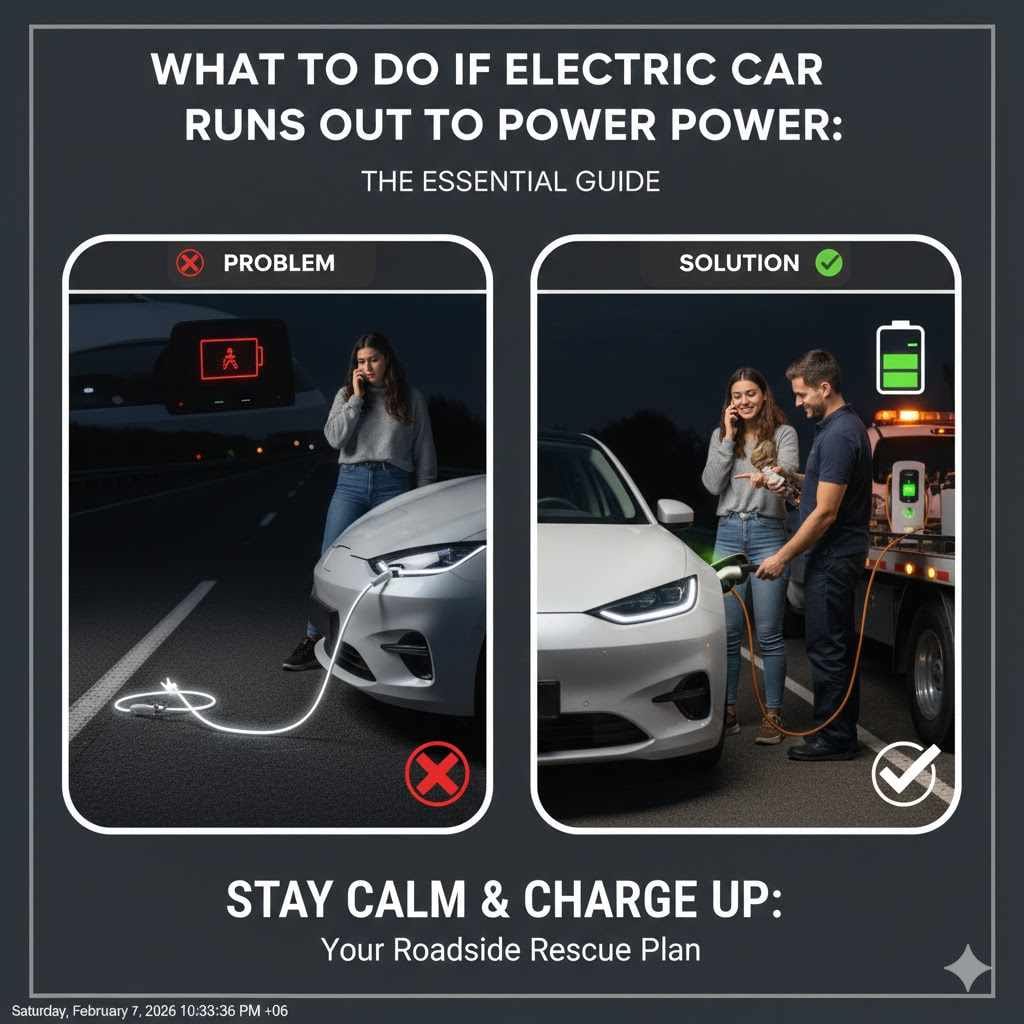
If your electric car runs out of power, stay calm. Pull over to a safe location, turn on your hazard lights, and contact your vehicle’s roadside assistance service or a third-party provider like AAA. They can either send a mobile charging unit to give you enough range to reach a station or tow your vehicle on a flatbed truck.
The thought of your electric car running out of power can be stressful. This fear, often called “range anxiety,” is a common concern for many EV drivers. But what really happens if your battery hits zero? Is it a disaster? The good news is, it’s not. It’s a situation that is both rare and manageable.
Running out of power in an EV is similar to running out of gas. It’s an inconvenience, but there is a clear plan to get you back on the road safely. In this guide, I’ll walk you through the exact steps to take, your options for getting a charge, and how to prevent it from ever happening. Let’s make sure you feel confident and prepared for any situation.
First, What Really Happens When Your EV Battery Hits Zero?
Your electric car is smart. It’s designed to prevent you from being suddenly stranded. Long before the battery is completely empty, your car will give you a series of clear warnings. It won’t just shut off without notice while you’re driving.
Your Car Gives You Plenty of Warning
Modern EVs are packed with systems to alert you when your battery is getting low. Here’s what you can expect:
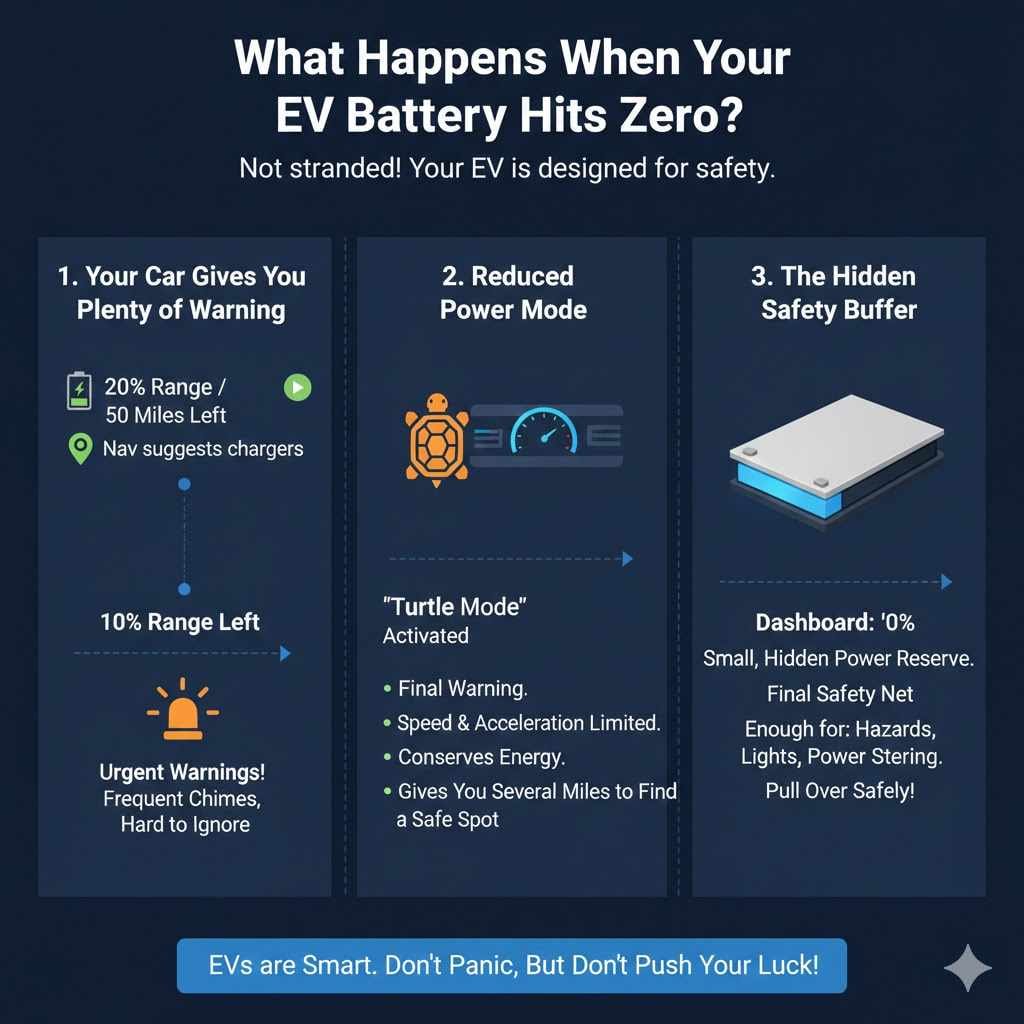
- Initial Warnings: Your first alert might appear when you have around 20% or 50 miles of range left. You’ll see a notification on your dashboard and hear a chime. The car’s navigation system may even automatically suggest nearby charging stations.
- Urgent Warnings: As the battery level drops further, usually around 10%, the warnings become more serious. The alerts will be more frequent and harder to ignore.
- Reduced Power Mode (“Turtle Mode”): This is the final and most important warning. When the battery is critically low, the car enters a low-power mode. You’ll often see a turtle icon on the dash. In this mode, the car limits your speed and acceleration to conserve every last bit of energy. This gives you several miles to find a safe place to pull over.
The Hidden Safety Buffer
Even when your dashboard reads “0%,” there’s usually a small, hidden power reserve left in the battery. Automakers build this in as a final safety net. This buffer isn’t meant for driving long distances. It’s designed to give you just enough power to keep your lights, hazards, and power steering working while you pull safely to the side of the road.
The Immediate Action Plan: A Step-by-Step Guide
If you find yourself running out of power, the most important thing is to act calmly and safely. Your car has already given you the warnings and the tools you need. Here is your simple, step-by-step plan.
- Don’t Panic, Stay Calm: The car is slowing down on purpose. This is normal. Take a deep breath. You have time to react and get to safety. Panicking can lead to poor decisions.
- Find a Safe Place to Stop: As soon as the car enters turtle mode, your priority is to stop safely. Look for the nearest highway shoulder, emergency pull-off area, or a quiet side street. A parking lot is even better. Avoid stopping in a traffic lane or on a blind curve.
- Make Your Vehicle Visible: Once you’ve stopped, turn on your hazard lights immediately. This makes you visible to other drivers. If it’s dark or foggy, or if you have them, place reflective safety triangles or flares behind your vehicle for extra visibility. Your safety is the top priority.
- Assess Your Location and Stay in the Car: Determine where you are. Are you on a busy highway or a quiet residential street? This will help you decide the best rescue option. For safety, it’s generally best to remain in your vehicle with your seatbelt on, especially on a busy road. The National Highway Traffic Safety Administration (NHTSA) advises staying in your vehicle as the safest course of action.
Your Rescue Options: Getting Your EV Moving Again
Once you are safely off the road, you have a few excellent options to get charged and on your way. Unlike a gas car, you can’t just walk to a station with a can. But the solutions for EVs are just as effective.
Option 1: Contact Roadside Assistance
This is often the easiest and most reliable solution. Most EV manufacturers include roadside assistance with a new vehicle purchase for a certain period.
- Manufacturer-Provided Assistance: Companies like Tesla, Ford, Chevrolet, and Hyundai have dedicated programs. They understand the specific needs of their EVs. Simply use your car’s mobile app or call the number in your owner’s manual.
- Third-Party Services: If you have a membership with a service like AAA, you’re in good hands. AAA has invested heavily in EV-specific training and equipment. They can provide either a mobile charge or a proper tow.
- Insurance Providers: Many auto insurance policies include roadside assistance as an add-on. Check your policy to see if you are covered.
Option 2: Mobile EV Charging Services
This is becoming a more common solution. A service van, equipped with a powerful battery pack or generator, comes to your location to give you a charge.
- How It Works: The technician connects their mobile charger to your car, giving you about 10-20 miles of range in 30-60 minutes.
- The Goal: The purpose of a mobile charge is not to fill your battery. It’s to provide just enough power to safely drive to the nearest public charging station to fully recharge.
- Who Offers It: Services like AAA and dedicated startups like SparkCharge are expanding mobile charging networks across the country.
Option 3: Towing to a Charging Station
If mobile charging isn’t available, towing is a perfectly safe option, but it must be done correctly.
IMPORTANT: Your EV Must Be Towed on a Flatbed Truck.
This is the most critical rule. An electric car’s wheels are connected to electric motors. If the wheels turn while being towed (as with a traditional dolly tow), the motors can generate electricity, potentially damaging the drivetrain and battery system. A flatbed truck lifts the entire car off the ground, ensuring no parts are moving or at risk of damage.
When you call for a tow, you must specify that you have an electric vehicle and require a flatbed. Any reputable tow service will know this, but it is always best to confirm.
Table: Comparing Your Rescue Options
| Feature | Mobile Charging | Flatbed Towing |
|---|---|---|
| Best For | When you are relatively close to a charging station and just need a small boost. | When you are far from a station or if mobile charging is unavailable. |
| Convenience | Very convenient. You can stay with your car and drive away once charged. | Less convenient. You have to ride with the tow truck to the charging station. |
| Time Taken | Typically 30-60 minutes for the charge, plus wait time for the truck. | Load time plus travel time to the station. Can be faster or slower depending on distance. |
| Cost | Often covered by roadside assistance. Can be more expensive if paid out-of-pocket. | Often covered by roadside assistance. Costs can be high without coverage, especially for long distances. |
| Key Requirement | Service must be available in your area. | You must specifically request and ensure a flatbed tow truck is sent. |
What NOT to Do When Your EV Runs Out of Power
Knowing what not to do is just as important as knowing what to do. Avoid these common mistakes to prevent damage to your car or yourself.
- Don’t Try to Push It Far: Electric cars are extremely heavy due to their large batteries. Pushing one for any significant distance is difficult and can be dangerous, especially near traffic.
- Don’t Accept the Wrong Kind of Tow: Never let anyone tow your EV with its drive wheels on the ground. Politely refuse a dolly tow and insist on a flatbed. The risk of costly damage is too high.
- Don’t “Jump-Start” the High-Voltage Battery: You cannot jump-start the main traction battery like you would a gas car’s engine. The systems are completely different. (We’ll discuss the separate 12-volt battery later).
- Don’t Panic and Leave Your Car: Do not abandon your vehicle in a dangerous spot like a lane of traffic. Your priority is to get it to the shoulder or another safe location.
How to Prevent Running Out of Power in the First Place
The best strategy is to avoid running out of power altogether. With a little planning, you can drive with complete peace of mind.
Tip 1: Know Your Car’s Real-World Range
The range advertised by the manufacturer (EPA estimate) is a good starting point, but your actual range will vary. Factors like weather, your driving style, and the terrain all have an impact. Pay attention to your car’s range estimator and learn how your driving habits affect it.
Tip 2: Plan Ahead for Long Trips
For trips that go beyond your car’s single-charge range, planning is key. Use apps like PlugShare, A Better Routeplanner (ABRP), or your car’s built-in navigation to map out charging stops before you leave. These tools show you where stations are, if they are available, and how fast they charge.
Tip 3: The 20% Rule
A great habit to adopt is to treat 20% battery as your new “empty.” Start looking for a charger when you get down to this level. This gives you a huge buffer for unexpected detours or finding that a charger is out of service.
Tip 4: Be Mindful of the Weather
Cold weather is the biggest enemy of EV range. Batteries are less efficient in the cold, and running the cabin heater uses a lot of energy. In winter, expect your range to be 20-40% lower. If possible, precondition your car’s battery and cabin while it’s still plugged in at home to save energy on the road.
Table: Key Factors That Affect Your EV’s Range
| Factor | Impact on Range | How to Manage It |
|---|---|---|
| Cold Weather | High Impact (Can reduce range by up to 40%) | Precondition your car before driving. Use heated seats/steering wheel instead of blasting the cabin heat. |
| High Speeds | High Impact (Driving at 75 mph uses much more energy than 65 mph) | Drive at or slightly below the speed limit. Use cruise control on highways. |
| Aggressive Driving | Medium Impact (Hard acceleration uses a lot of power) | Accelerate smoothly and anticipate stops to maximize regenerative braking. |
| Hilly Terrain | Medium Impact (Going uphill uses more energy) | While you can’t avoid hills, you can regain some energy through regenerative braking on the way down. |
| Heavy Loads | Low-to-Medium Impact (Extra weight or roof racks increase energy use) | Remove unnecessary weight or cargo carriers when not in use. |
A Quick Note on the 12-Volt Battery
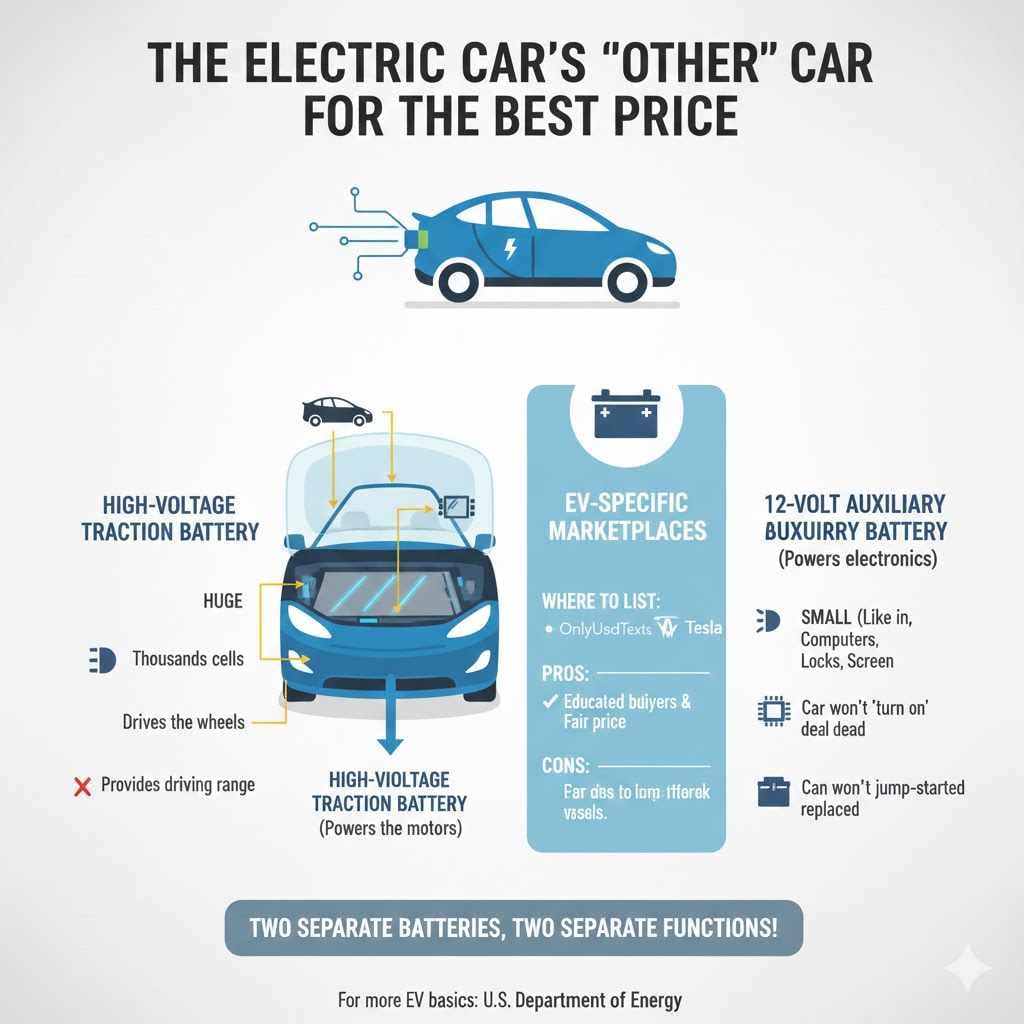
It’s important to understand that your EV actually has two batteries. There’s the huge high-voltage (HV) traction battery that powers the motors, and a small 12-volt battery, just like the one in a gas car.
The 12-volt battery powers your car’s lights, computers, door locks, and infotainment screen. If this small battery dies, your car won’t “turn on,” even if the main HV battery is fully charged. This can be confusing! A dead 12-volt battery is a separate issue from running out of driving range. The good news is that you can jump-start or replace a 12-volt battery just like you would in any other car. For more basics on how EVs work, the U.S. Department of Energy is a great resource.
Frequently Asked Questions (FAQs)
1. Does running an EV battery to zero damage it?
Occasionaly running it to zero is not likely to cause significant harm because of the built-in safety buffers. However, repeatedly draining the battery completely or letting it sit at 0% for a long time can degrade its long-term health. It’s best to avoid it whenever possible.
2. How much does a mobile EV charge cost?
If you have roadside assistance through your car’s manufacturer or a provider like AAA, the service is often free. If you pay out-of-pocket, costs can vary but typically range from $100 to $300, depending on the provider and your location.
3. Can I charge my EV with a portable power station or generator?
Technically, yes, but it is extremely slow. A standard portable power station would take many hours to add just a few miles of range. It is not a practical solution for a roadside emergency. A mobile charging service uses much more powerful equipment.
4. What is “turtle mode” in an electric car?
Turtle mode is a reduced power mode that your car automatically enters when the battery is critically low. It limits speed and acceleration to conserve the final bit of energy, giving you enough time and range to pull over to a safe location. It is usually indicated by a turtle icon on the dashboard.
5. How long does it take for a mobile charger to give me enough range?
A typical mobile charging service will spend about 30 to 60 minutes connected to your vehicle. This is usually enough to add 10-20 miles of range, which should be sufficient to get you to the nearest public charging station.
6. Is it bad to always charge my EV to 100%?
For daily driving, most manufacturers recommend charging your battery to 80% or 90% to maximize its lifespan. Charging to 100% is perfectly fine when you need the full range for a long trip, but doing it every single day can accelerate battery degradation over time.
7. Does my car insurance cover running out of power?
Many comprehensive insurance policies offer roadside assistance as an optional add-on. If you have this coverage, it will likely cover a tow or mobile charge just like any other roadside event. Check with your insurance provider to confirm your specific coverage details.
Conclusion: Driving with Confidence
Running out of power in your electric car is not the catastrophe it may seem. Your car is designed to give you ample warning, and a clear, safe system of solutions is in place to help you. The key is to remember the plan: stay calm, pull over safely, turn on your hazards, and call for help. Whether you get a mobile charge or a flatbed tow, you’ll be back on your way in no time.
By understanding how your car works and planning your trips, you can practically eliminate the risk of ever running out of charge. Embrace the journey, enjoy the quiet ride, and drive with the confidence that you are prepared for anything the road throws your way.