
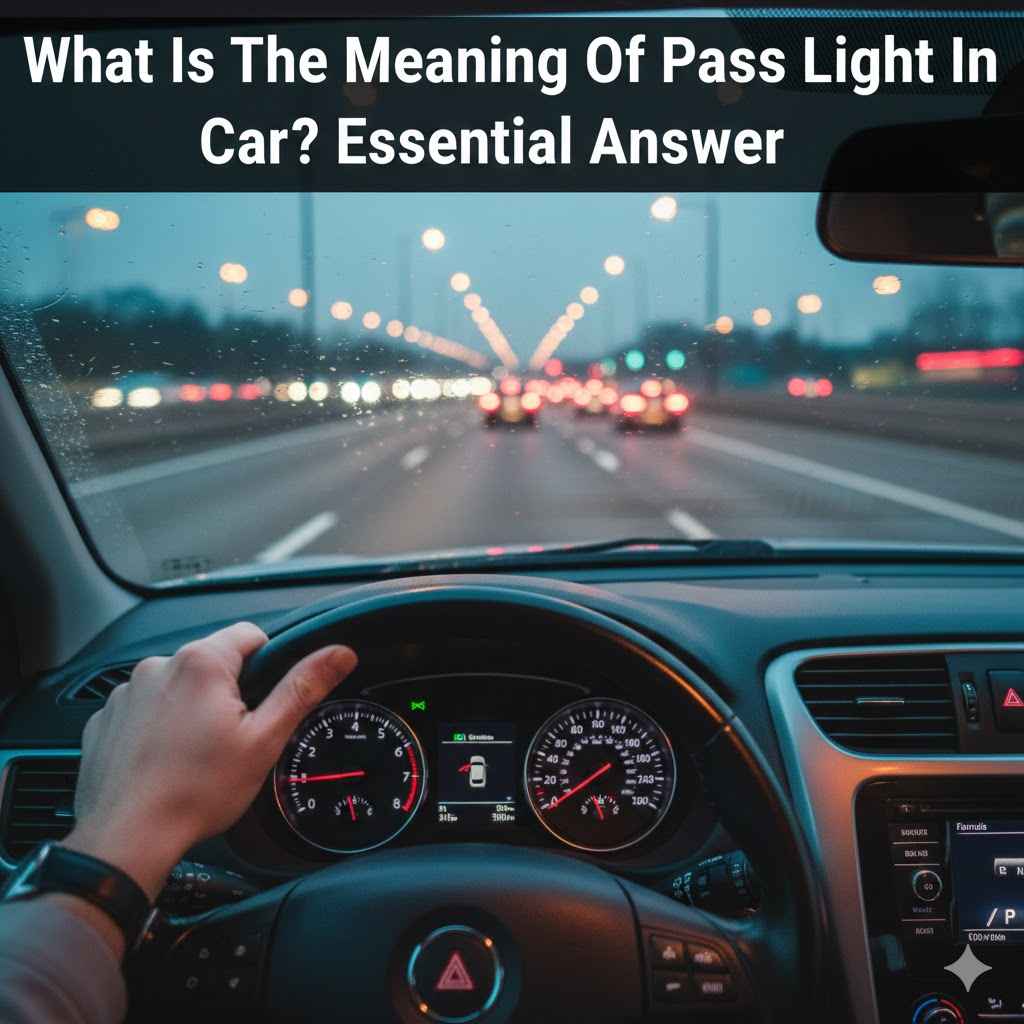
The “pass light” in a car is not a separate bulb but a function that briefly flashes your high-beam headlights. You activate it by gently pulling the headlight stalk toward you. Its primary meaning is to communicate with other drivers—to signal that you intend to pass, warn of a hazard, or acknowledge another driver’s courtesy.
Have you ever been driving and wondered about all the levers and switches around your steering wheel? One of the most common but often misunderstood features is the “pass light.” Maybe you’ve pulled a lever by accident and seen your lights flash, or perhaps you’ve seen other drivers do it and wondered what they were trying to say. It can feel like a secret language on the road.
Don’t worry, you’re not alone in feeling this way! Many drivers are unsure about this simple tool. The good news is that it’s incredibly easy to understand and use. In this guide, I’ll walk you through exactly what the pass light is, why it’s there, and how you can use it safely and effectively. By the end, you’ll feel more confident and connected to your vehicle. Let’s unlock this simple feature together.
Demystifying the “Pass Light”: What It Really Is
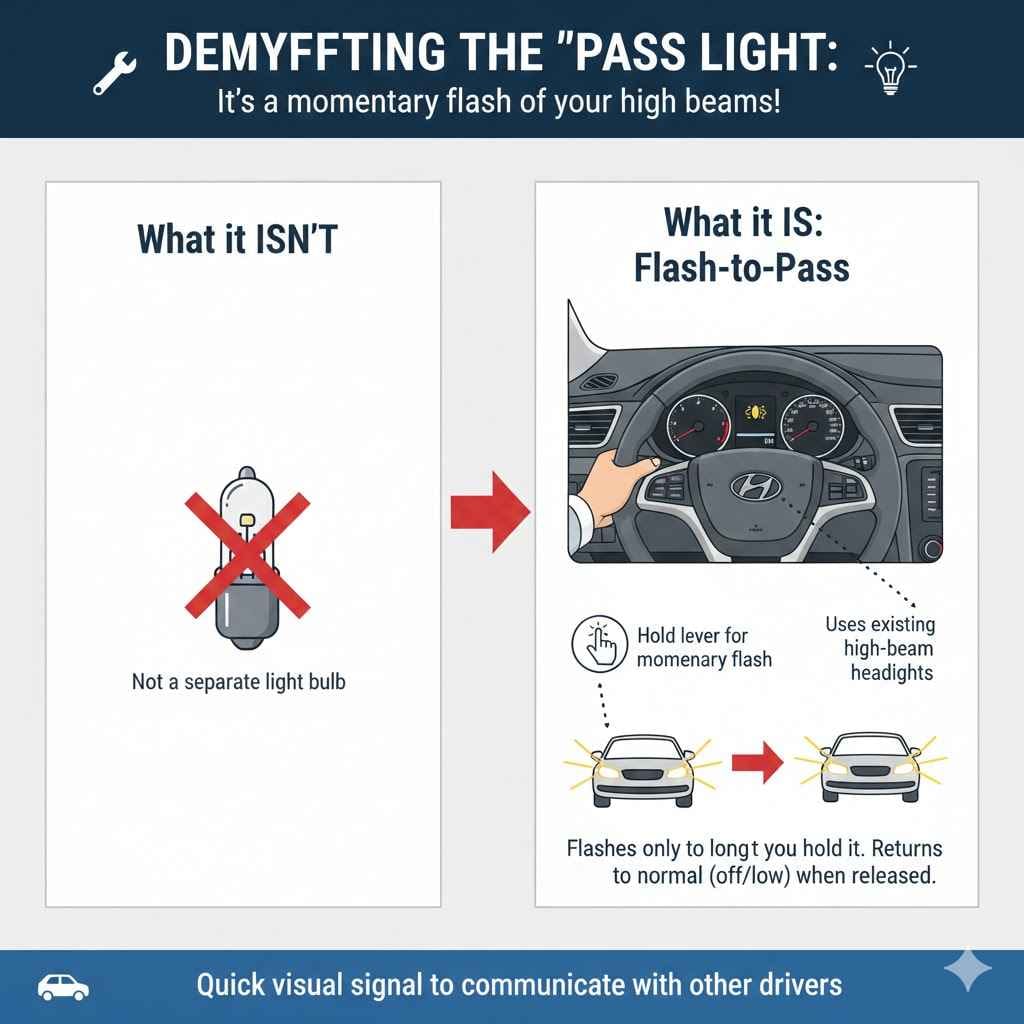
First things first, let’s clear up a common point of confusion. The “pass light” isn’t a separate, dedicated light bulb on your car. Instead, it’s a function that uses your existing high-beam headlights. When you activate the pass light, you are essentially flashing your high beams for a very short moment.
Think of it as a quick “hello” or “look out!” using your lights. Unlike turning on your high beams to stay on for night driving, the pass light is designed for a momentary flash. You control it, and the flash lasts only as long as you hold the lever. As soon as you let go, your headlights return to their normal setting (either off or on low beams).
This feature is also commonly known as “flash-to-pass.” The name itself gives a big clue about its main purpose, which has its roots in helping drivers communicate safely on highways and two-lane roads.
The Main Purpose: Why Your Car Has a Pass Light Feature
So, why did car manufacturers include this feature? The core reason is communication. Your car horn is great for urgent warnings, but it can be loud, aggressive, and startling in many situations. The pass light offers a silent, visual alternative to get another driver’s attention without causing alarm.
It’s a universal, non-verbal way to send a quick message on the road. Here are the most common reasons you would use the pass light:
- Signaling to Pass: This is the classic use. On a highway, if you are behind a slower vehicle in the left lane, a quick flash can politely let them know you would like to overtake. It’s often seen as a gentler nudge than tailgating or honking.
- Warning of Hazards Ahead: If you’ve just passed a danger on the road—like a deer, a stalled vehicle, or debris—you can flash your lights at oncoming traffic to give them a heads-up. This simple act of courtesy can prevent accidents.
- Acknowledging Other Drivers: Did a truck driver move over to give you more room? Did another car let you merge into traffic? A quick double-flash is a common way to say “thank you.” It’s the visual equivalent of a friendly wave.
- Alerting an Unaware Driver: Sometimes you’ll see a driver at night who forgot to turn on their headlights. A quick flash is a gentle way to alert them to the problem without startling them. It can also be used to signal a driver that their high beams are on and dazzling you.
How to Use the Pass Light: A Simple Step-by-Step Guide
Using the pass light is one of the easiest things you can do in your car. It’s designed to be done without taking your hands off the steering wheel or your eyes off the road. Here’s how to do it:
- Locate the Stalk: Find the lever or stalk on the side of your steering column. In most cars, this is the same stalk that controls your turn signals. It’s usually on the left side in left-hand-drive cars (like in the US) and on the right side in right-hand-drive cars (like in the UK or Australia).
- Identify the Motion: This stalk typically has two main motions for headlights. Pushing it away from you will lock the high beams on. To use the pass light, you do the opposite.
- Pull Gently Toward You: To activate the flash-to-pass feature, gently pull the stalk toward your chest. You’ll feel a slight spring-loaded resistance. Your high beams will flash on and the blue high-beam indicator will light up on your dashboard.
- Release to Stop: The flash only lasts as long as you are pulling the lever. As soon as you release it, the stalk will spring back to its neutral position, and your high beams will turn off. You can give a single long flash or a few quick, short flashes depending on the message you want to send.
That’s it! It’s an intuitive motion designed for quick, easy access. Practice it once or twice while your car is parked so you can get a feel for it without any pressure.
The Unwritten Rules: Pass Light Etiquette and Safety
Just because you can flash your lights doesn’t mean you always should. Like any form of communication, there’s a certain etiquette to using the pass light. Using it correctly can make you a safer and more courteous driver. Using it improperly can confuse or even anger other drivers.
Here’s a helpful table to guide you on the do’s and don’ts of using the pass light.
| Situation | What to Do (The “Do’s”) | What to Avoid (The “Don’ts”) |
|---|---|---|
| Overtaking a Slower Vehicle | Give one or two quick flashes from a safe distance to signal your intent to pass. | Don’t flash repeatedly or aggressively right behind them. This can be seen as hostile and is known as tailgating. |
| Warning of a Road Hazard | Flash your lights at oncoming traffic to alert them to something dangerous ahead (e.g., an accident, debris, or animal). | Don’t flash for minor things. Overuse can make other drivers ignore the signal when it’s truly important. |
| Saying “Thank You” | A quick double-flash is a common and polite way to thank a driver who let you in or moved over for you. | Avoid a long, sustained flash, which can be confusing or seem like a warning instead of a thank you. |
| Alerting a Driver at Night | If a driver has their high beams on or no lights at all, a single, quick flash can be a helpful reminder. | Don’t flash your high beams repeatedly into their eyes. This is dangerous as it can temporarily blind them. |
| Approaching a Blind Corner or Hill | On a narrow rural road, a quick flash before entering a blind corner can alert a potential oncoming car of your presence. | Don’t rely on this in heavy traffic or urban areas, where it will likely be misinterpreted. |
Is Using the Pass Light Legal? A Look at the Rules
This is a question many drivers have. The short answer is: it depends on where you live and how you use it. In most places, using the pass light for its intended purpose—signaling to pass or warning of a hazard—is perfectly legal. However, the laws can be nuanced.
For example, in some U.S. states, flashing your headlights to warn other drivers of a police speed trap ahead has been a legal gray area. While courts have often upheld it as a form of free speech, some local ordinances may still prohibit it. According to the National Highway Traffic Safety Administration (NHTSA), proper use of headlights is crucial for safety, but specific signaling laws are typically managed at the state level.
The key takeaway is intent. If you are using the flash-to-pass feature to enhance safety and communicate clearly, you are generally within the law. However, if you use it to harass, intimidate, or dazzle other drivers, you could be cited for aggressive driving or improper headlight use. Always prioritize safety and courtesy. When in doubt, check your local Department of Motor Vehicles (DMV) handbook for specific regulations in your area.
Pass Light vs. High Beams: What’s the Difference?
While the pass light uses the high-beam bulbs, its function and purpose are very different from using your regular high beams. Understanding this distinction is key to being a safe night driver. New drivers often get these two functions confused.
Here’s a simple breakdown in a table to make the differences crystal clear:
| Feature | Pass Light (Flash-to-Pass) | Constant High Beams |
|---|---|---|
| Activation | Pulling the stalk toward you (momentary). | Pushing the stalk away from you (locks in place). |
| Duration | Temporary, only while you hold the stalk. | Continuous, stays on until you switch it off. |
| Primary Purpose | Communication: Signaling, warning, or acknowledging. | Illumination: Seeing further down dark roads. |
| When to Use | Day or night for quick signals to other drivers when a horn is not appropriate. | Only at night on unlit roads with no other cars in front of you or coming toward you. |
| Effect on Other Drivers | A brief, attention-getting flash that is not meant to blind. | Can cause dangerous glare and temporarily blind other drivers if used improperly. |
What to Do When Your Pass Light Stops Working
Like any component in your car, the pass light function can sometimes fail. If you pull the stalk and nothing happens, don’t panic. It’s usually a simple fix you can troubleshoot yourself. Here are the most common causes and the steps you can take, starting with the easiest.
Check the Headlight Bulbs
The most obvious reason for a failed flash is a burnt-out bulb. Since the pass light uses your high-beam filaments, check if your regular high beams work. Turn your headlights on and push the stalk forward to lock the high beams. Get out of the car and check if both high beams are lit. If one or both are out, you’ve found your problem. Replacing a headlight bulb is a common DIY task for many vehicles.
Inspect the Fuse
Your car’s electrical systems are protected by fuses. If there was a small power surge, the fuse for the headlights may have blown to protect the circuit. Your owner’s manual is your best friend here—it will show you where the fuse boxes are located (there’s usually one in the engine bay and one inside the cabin) and which fuse corresponds to the high beams. You can visually inspect the fuse to see if the small metal wire inside is broken. If it is, replacing it with a new fuse of the exact same amperage is a very cheap and easy fix.
Examine the Headlight Stalk (Multifunction Switch)
The stalk on your steering column is officially called a multifunction switch because it controls many things (turn signals, headlights, wipers, etc.). Over time, the electrical contacts inside can wear out. If your bulbs and fuses are fine, the switch itself might be the culprit. This is a more complex repair that often involves removing the steering wheel covers. If you suspect the switch is the problem, it might be best to consult a trusted mechanic. But for most cases, the issue will be a simple bulb or fuse.
The History Behind the Flash: Where Did the Pass Light Come From?
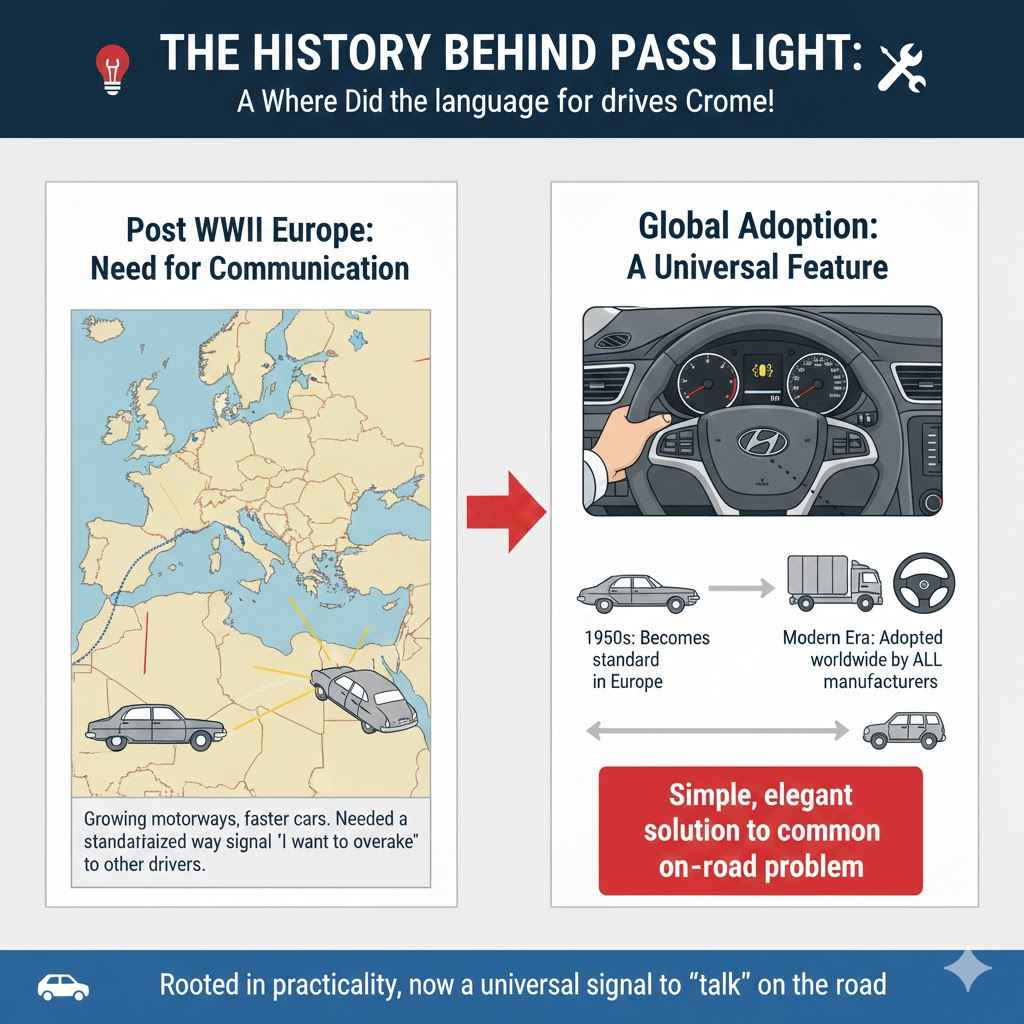
The concept of flashing lights to communicate isn’t new. It became particularly popular in Europe after World War II. On the continent’s growing network of motorways and rural roads, a standardized system of communication was needed. The “flash-to-pass” became an established and widely understood signal, especially in countries like Italy and France, to indicate an intention to overtake.
As automotive design became more global, this handy feature was adopted by manufacturers all over the world. While its use is more frequent and standardized in Europe, it has become a universal feature in virtually every modern car, from a compact sedan to a large truck. It’s a simple, elegant solution to a common on-road communication problem, and its history is rooted in the very practical need for drivers to “talk” to each other without words.
Frequently Asked Questions (FAQ)
Is the pass light the same as daytime running lights (DRLs)?
No, they are completely different. Daytime running lights are low-wattage lights that are on automatically whenever the car is running to make you more visible to others. The pass light is a manual function that flashes your bright, high-beam headlights.
Can I use the pass light to signal that police are ahead?
This is a common but legally tricky use. In many places, this is considered a form of free speech and is legal. However, some local jurisdictions may have laws against it, sometimes calling it “obstructing police.” It’s best to be aware of your local laws and use the feature primarily for direct safety warnings.
Will flashing my lights drain my car battery?
No, not at all. The flash is momentary and uses a tiny amount of electricity. Your car’s alternator produces more than enough power to handle it while the engine is running. You would have to flash your lights for an extremely long time with the engine off to have any noticeable effect on the battery.
Do all cars have a pass light feature?
Nearly all modern cars and trucks built in the last few decades have this feature. It is a standard function of the multifunction switch on the steering column. Very old or classic cars might not have it, but if your car was made after 1980, it almost certainly does.
Is it rude to flash your lights at someone?
It all depends on the context. A quick, polite flash to say “thank you” or “you can go ahead” is considered courteous. However, flashing your lights repeatedly and aggressively right behind someone is very rude and dangerous. Intent is everything.
What is the symbol for the pass light?
When you flash your lights, you will see the standard high-beam indicator symbol light up on your dashboard for a moment. This symbol looks like a blue letter “D” with several horizontal lines coming out of its flat side.
Conclusion: Driving with Confidence
And there you have it! The pass light, or flash-to-pass feature, is no longer a mystery. It’s not some complicated piece of equipment but a simple, effective communication tool built right into your car. By understanding what it is—a quick flash of your high beams—and how to use it, you’ve added another layer of skill to your driving.
From politely signaling an overtake to warning others of danger, this feature helps make the roads a safer and more cooperative place. Remember the simple etiquette: use it for clear communication, not for aggression. Now that you know how to use it and what it means, you can feel more confident and in control behind the wheel. Happy and safe driving!