
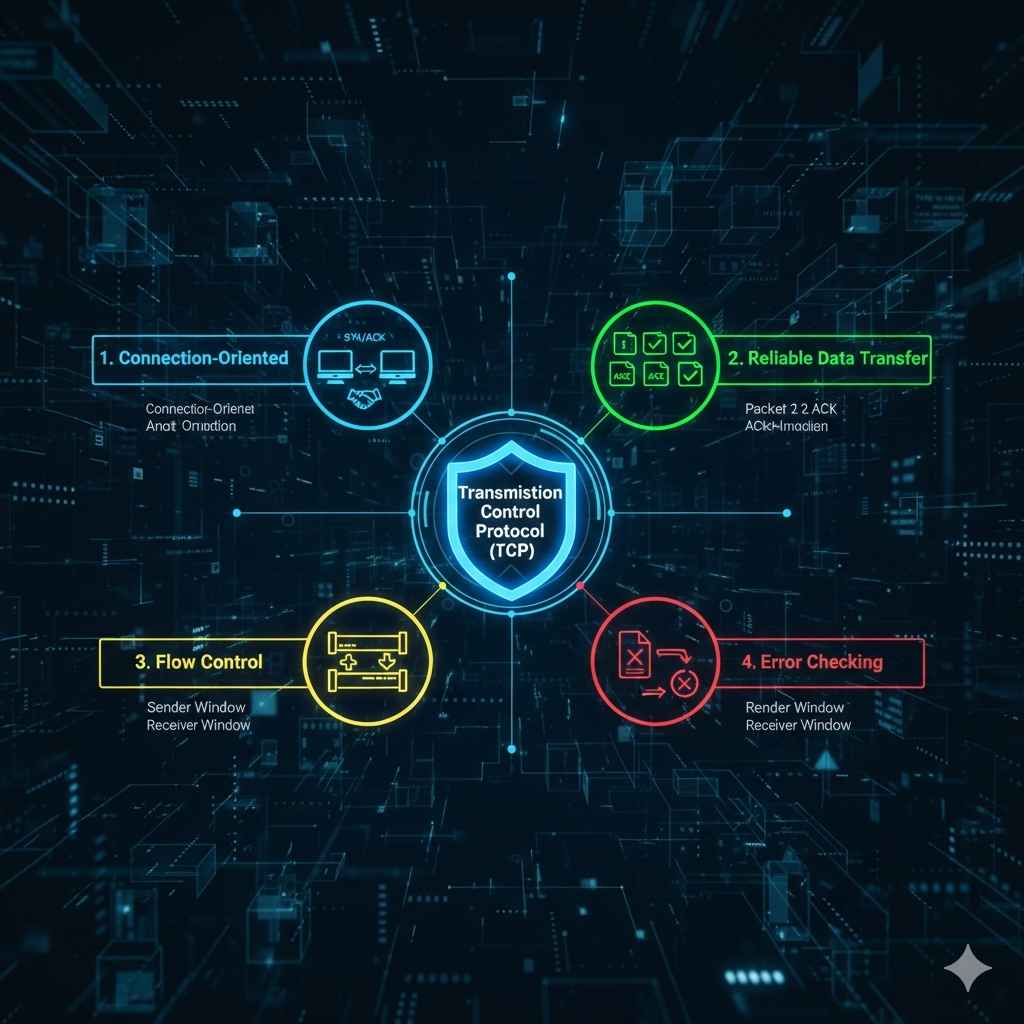
If you’re wondering, What Is the Function of Transmission Control Protocol? it’s a common question, especially for those new to computers and the internet. It might seem tricky at first because it involves technical details about how data travels. But don’t worry! We’ll break it down step-by-step using easy-to-understand language. We’ll show you how TCP works, and its importance to online activities. Get ready to discover the magic behind your favorite online experiences!
Data Movement and Its Role
Data transmission across the internet might seem like magic. When you send an email or stream a video, information needs to get from one computer to another, flawlessly. This is where TCP shines. Think of TCP as a reliable delivery service for your digital information. It manages how data is broken down, sent, and reassembled, ensuring it arrives correctly at its destination. By understanding the core aspects of TCP, you gain insights into how the internet facilitates communication.
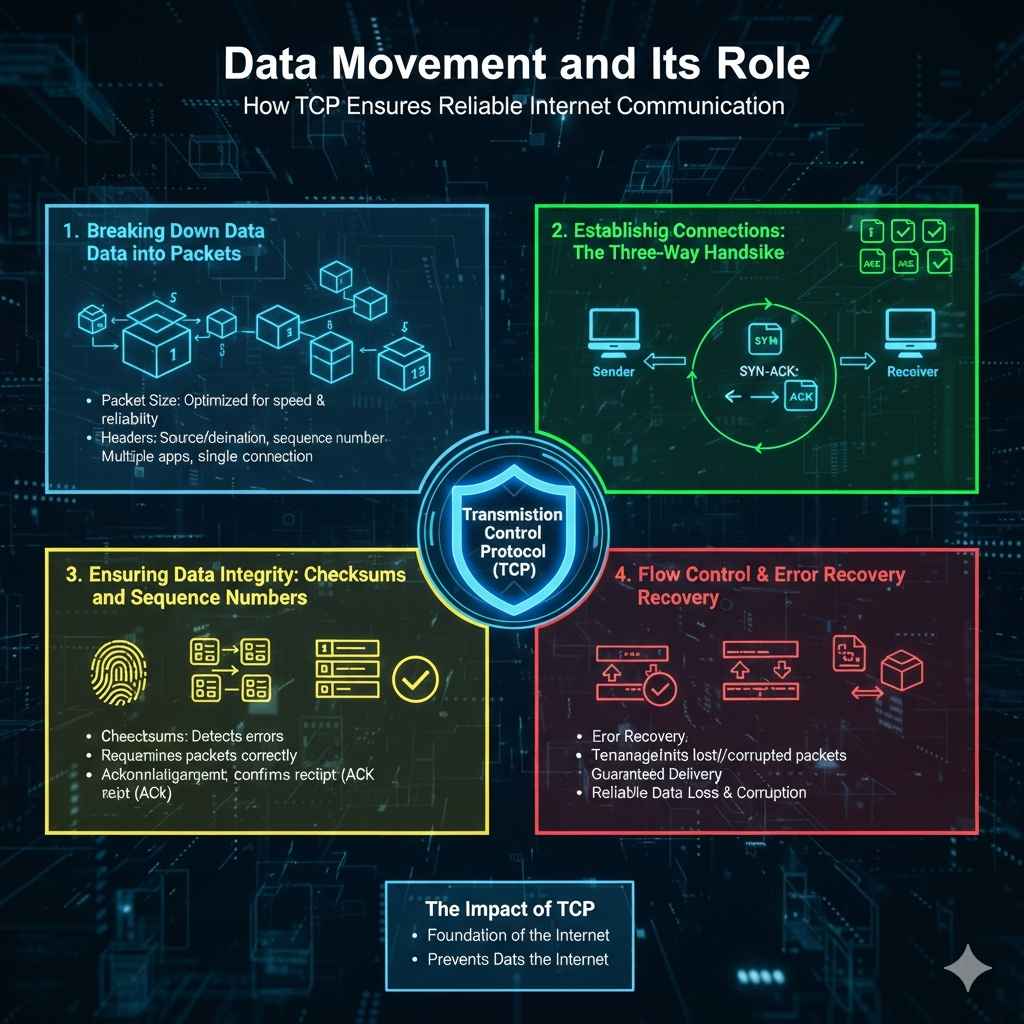
Breaking Down Data into Packets
When you send data, it doesn’t travel as one big chunk. Instead, TCP breaks it down into smaller pieces called packets. Imagine it like a package that is split up into multiple boxes. Each packet gets a header with information about the sender, the receiver, and its place in the overall message. This process makes the data easier to manage and helps it find its way across the network more efficiently. This method is important for fast data transfer.
- Packet Size: TCP determines the size of these packets, optimizing for speed and reliability. If the packets are too big, they can be more likely to be lost or corrupted. If they are too small, it adds overhead and slows the overall process.
- Headers: Each packet includes a header containing vital information such as the source and destination IP addresses, port numbers, sequence numbers, and checksums.
- Segmentation: This method improves data flow. It allows multiple applications to communicate over a single connection simultaneously. This is similar to how a highway allows many cars to travel at the same time.
This approach has a big impact on how data flows. This method is used so that data transfer can be more efficient, especially over congested networks. This is similar to how a train system uses cars, each carrying a different load, all traveling to different destinations at the same time.
Establishing Connections: The Three-Way Handshake
Before any data is sent, TCP sets up a connection. This setup is known as the “three-way handshake”. This process ensures that both the sender and receiver are ready to communicate. It starts with the sender sending a “SYN” (synchronize) packet to the receiver. The receiver responds with a “SYN-ACK” (synchronize-acknowledge) packet. Finally, the sender sends an “ACK” (acknowledge) packet. This confirms the connection and allows data transfer to begin. This is a lot like when you say “Hello” to someone, then they say “Hi” and then you acknowledge them.
- SYN: The sender initiates the connection by sending a SYN packet to the receiver. This is the first step of establishing a connection.
- SYN-ACK: The receiver responds to the SYN packet with a SYN-ACK, acknowledging the initial request and also requesting to establish its own connection.
- ACK: The sender responds to the SYN-ACK packet with an ACK packet, confirming the connection and signaling that data transfer can begin.
This process guarantees that both ends are ready. This process is important because it is like getting a confirmation for a package being sent. Without it, messages may be lost or arrive in the wrong order. This confirmation is also necessary for fast data transfer.
Ensuring Data Integrity: Checksums and Sequence Numbers
During data transfer, TCP ensures the information arrives correctly using checksums and sequence numbers. Checksums act like a digital fingerprint. They’re calculated for each packet to detect any corruption that might occur during transit. Sequence numbers keep track of the order of packets, ensuring they are reassembled correctly at the destination. These safeguards guarantee that the data you receive is exactly what was sent, without any errors or missing parts. Without these the internet would not be useful.
- Checksums: These are calculations performed on the data in each packet to detect errors during transmission.
- Sequence Numbers: Each packet is assigned a unique sequence number. This helps the receiver put the packets back together in the correct order.
- Acknowledgment: The receiver sends acknowledgments (ACKs) back to the sender for each packet received. If a packet is lost or corrupted, the sender will retransmit it.
This helps in a variety of ways. Consider a book being sent to you. The checksum is like checking each page to make sure it is not damaged. The sequence number makes sure the pages are in the correct order. The acknowledgements are like checking in with you to make sure you got the book. This guarantees a smooth delivery.
The Function of TCP in Practical Applications
TCP plays a vital part in many of our everyday online activities. You interact with it constantly, even if you don’t realize it. When you browse the web, send emails, or stream videos, TCP is quietly working in the background. Understanding its role will give you a greater appreciation for the technology that drives the digital experiences we rely on daily.
Web Browsing
When you type a website address into your browser, TCP kicks into action. It establishes a connection with the website’s server, breaking down your request into packets. These packets are then sent over the internet. The server receives these packets, processes the request, and sends the website’s content back to you. TCP ensures that the website’s text, images, and videos arrive intact and in the correct order, allowing you to view the webpage as it was designed. This process is usually very fast.
- HTTP and HTTPS: These protocols build on top of TCP to enable web browsing. HTTPS adds an extra layer of security, encrypting the data transmitted between your browser and the server.
- Connection Establishment: When you type a website address, your computer uses TCP to send a request to the server. The server responds, and a connection is established.
- Data Transmission: The website’s content is then broken down into packets, and sent over the internet using TCP.
This is like ordering a meal at a restaurant. Your web browser is the customer, the website server is the cook, and TCP is the waiter. You tell the waiter what you want (request), the waiter then takes that order to the cook (the server) and then the cook sends the order back, using the waiter (TCP) to deliver it to you. The waiter makes sure that your meal (website content) arrives in order and that everything is correct.
Email Communication
Email relies on TCP for sending and receiving messages. When you send an email, your email client uses TCP to connect to your email server. The email is then broken down into packets and transmitted over the internet to the recipient’s email server. The recipient’s server then uses TCP to deliver the email to their inbox. TCP handles all the behind-the-scenes work, guaranteeing your messages are delivered accurately, even with attachments. It’s a key part of how this process works.
- SMTP, POP3, and IMAP: These are protocols that work with TCP to send and retrieve email. SMTP is used for sending, while POP3 and IMAP are used for receiving.
- Message Segmentation: Your email is broken into packets. These packets are sent across the network.
- Reliable Delivery: TCP guarantees that your email arrives at its destination without loss or corruption.
Think of it like using the postal service to send a letter. The email client is the sender. The recipient’s email server is the destination. TCP is the postal service, ensuring that the letter (email) arrives safely. TCP helps messages arrive safely to the destination.
File Transfer
File transfer is another area where TCP is essential. When you download a file or upload a document, TCP manages the process. It ensures the file is broken down into packets, transmitted reliably, and reassembled correctly at the receiving end. This guarantees the file’s integrity and prevents corruption. Regardless of the size of the file, or how far it must travel, TCP makes sure it arrives intact. Without this, important files could be corrupted.
- FTP and SFTP: These protocols use TCP to transfer files between computers. They provide methods for secure file transfer over a network.
- Large Files: TCP is specifically designed to handle large file transfers efficiently. The process is optimized for speed.
- Error Checking: TCP’s error checking ensures that the file is not corrupted during the transfer process. This protects the file and the data being sent.
Imagine you’re sending a large package. TCP breaks the package into smaller boxes (packets). It ensures all boxes get to the destination in order (sequence numbers) and that none are damaged (checksums). Once at the destination, the packets are reassembled. This allows for safe transfer.
Advanced TCP Features and Concepts
While the basic function of TCP is straightforward, it also has several advanced features that make the internet more efficient and reliable. These capabilities provide additional functionality. Understanding these aspects will help provide a fuller image of TCP and its role in modern data communication.
Congestion Control
Congestion control is a feature that stops networks from being overloaded, leading to delays and data loss. TCP monitors network conditions and adjusts the rate at which data is sent to avoid congestion. If the network becomes busy, TCP reduces the sending rate. This helps prevent network slowdowns and ensures fair use of network resources. This improves overall performance for everyone using the network. Without it, the network would be slow.
- Slow Start: At the beginning of a connection, TCP starts slowly. It gradually increases the sending rate.
- Congestion Avoidance: TCP uses different methods. If it detects congestion, the sending rate is decreased.
- Fast Retransmit: If a packet is lost, TCP quickly retransmits it. This helps reduce delays.
Think of it like a highway during rush hour. TCP is like a traffic controller. When the highway gets busy, the traffic controller slows down the traffic flow to prevent gridlock. This ensures that traffic keeps moving. This makes the roads safer for everyone.
Flow Control
Flow control prevents a fast sender from overwhelming a slower receiver. TCP uses flow control mechanisms to manage the rate at which data is sent. The receiver informs the sender how much data it can handle at a time. This keeps the receiver from being overwhelmed. This method avoids data loss and ensures a smooth data flow. It guarantees both parties can operate without issues.
- Windowing: The receiver tells the sender how much data it can accept at once.
- Sliding Window: The sender can send multiple packets. The receiver can process them before it acknowledges them.
- Dynamic Adjustment: The window size is adjusted based on the receiver’s processing capabilities.
Imagine two people: a fast runner and a slow walker. Flow control is like the fast runner slowing down to match the pace of the walker. The fast runner (the sender) sends data at a rate the walker (the receiver) can handle. This ensures a balanced exchange.
Port Numbers and Sockets
Port numbers and sockets are key to how TCP works, helping identify the right application. A port number is a unique number that identifies a specific process or application on a computer. Sockets combine an IP address and a port number to create a connection endpoint. This allows many applications to communicate simultaneously. These features are critical for managing multiple network applications on a single device, like a computer. This system allows different applications to run smoothly.
- Well-Known Ports: These ports are reserved for common services. These services include HTTP (port 80) and HTTPS (port 443).
- Ephemeral Ports: These ports are used by clients to establish connections to server applications.
- Sockets: Sockets are software endpoints that allow applications to communicate. These help establish communication.
This is like having different mailboxes for different types of mail. The IP address is the building’s address. The port number is the mailbox number of a specific resident (application). This ensures that mail (data) is delivered to the right person (application).
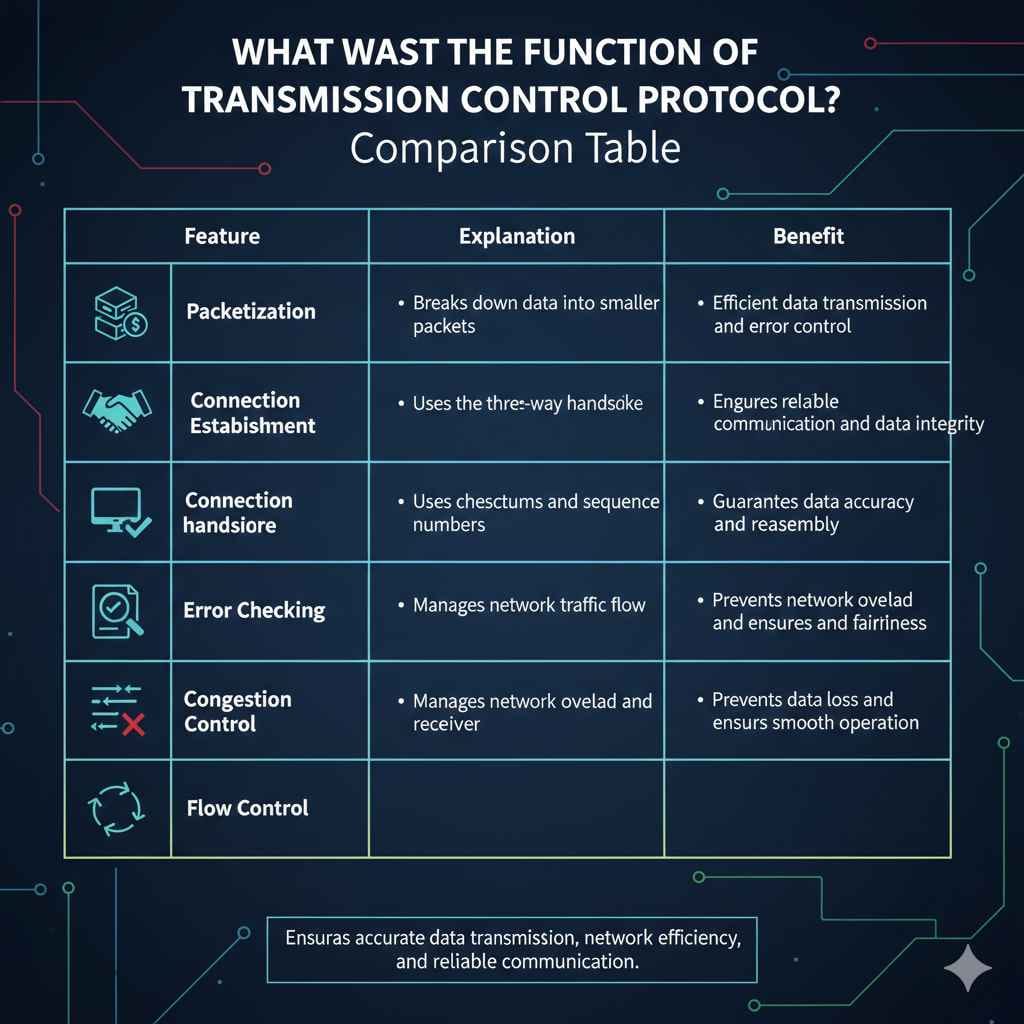
What Is the Function of Transmission Control Protocol? Comparison Table
| Feature | Explanation | Benefit |
|---|---|---|
| Packetization | Breaks down data into smaller packets | Efficient data transmission and error control |
| Connection Establishment | Uses the three-way handshake | Ensures reliable communication and data integrity |
| Error Checking | Uses checksums and sequence numbers | Guarantees data accuracy and reassembly |
| Congestion Control | Manages network traffic flow | Prevents network overload and ensures fairness |
| Flow Control | Regulates data flow between sender and receiver | Prevents data loss and ensures smooth operation |
This table offers a clear overview of the key features of TCP. It compares various functions and emphasizes their roles in ensuring accurate data transmission, network efficiency, and reliable communication.
Frequently Asked Questions
Question: What is TCP and how does it work?
Answer: TCP, or Transmission Control Protocol, is a set of rules that governs how data is sent across the internet. It works by breaking data into packets, ensuring they arrive in order, and guaranteeing error-free transmission through techniques like checksums and sequence numbers.
Question: What’s the difference between TCP and UDP?
Answer: TCP is connection-oriented, meaning it establishes a connection before transmitting data, guaranteeing delivery. UDP is connectionless, sending data without a connection, which is faster but less reliable. TCP is used for applications like web browsing, while UDP is often used for streaming video.
Question: How does TCP handle lost data packets?
Answer: TCP uses sequence numbers and acknowledgments (ACKs) to handle lost packets. If a packet is lost during transmission, the receiver won’t send an ACK, and the sender will retransmit the lost packet to ensure complete and correct data delivery.
Question: Why is TCP important for web browsing?
Answer: TCP is important for web browsing because it guarantees that the web pages, images, and other resources you request are delivered to your browser in the correct order and without any errors. It’s vital for a reliable user experience.
Question: Can I use TCP without knowing the technical details?
Answer: Yes! You use TCP every day when you browse the web, send emails, or stream videos. All the technical details are handled automatically. You don’t need to understand everything to enjoy the benefits of a reliable internet connection.
Final Thoughts
You now have a solid grip on What Is the Function of Transmission Control Protocol? It acts as the backbone of reliable internet communication, managing data transfer, ensuring its integrity, and guaranteeing smooth connections. TCP is a core technology, playing a crucial role in daily internet activities, from web browsing to sending emails. Understanding how TCP works gives you a deeper appreciation for the technology that makes it all possible. Keep exploring. Keep asking questions. Your journey into the digital world is just beginning.