
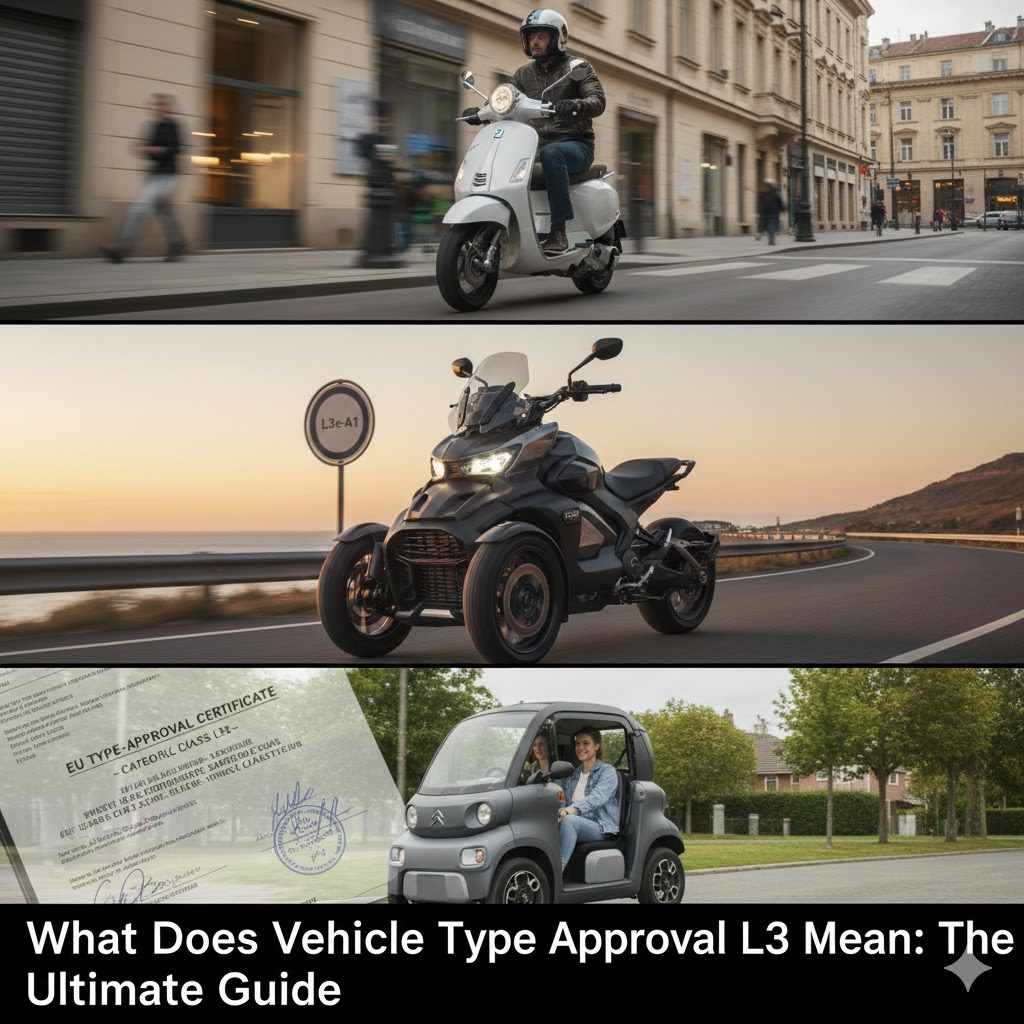
Vehicle Type Approval L3 is a European classification for two-wheeled motorcycles with an engine size over 50cc and a top speed exceeding 45 km/h (28 mph). This certification ensures the motorcycle meets strict safety, environmental, and performance standards, making it legal for road use across the EU and other adopting countries.
Have you ever looked at your vehicle’s paperwork and seen strange codes like ‘L3’? It can feel like you’re trying to read a secret language. But don’t worry, it’s not as complicated as it looks. Understanding these codes is key to knowing your vehicle is safe, legal, and ready for the road. This guide is here to help you feel confident about what your vehicle’s approval means. We will break down exactly what Vehicle Type Approval L3 is, why it matters so much, and how it affects you as a rider. Let’s dive in and make sense of it all together.
What is Vehicle Type Approval in Simple Terms?
Before we get into the specifics of ‘L3’, let’s talk about the big picture: vehicle type approval. Think of it like a passport for a vehicle model. Before a manufacturer, like Honda or Yamaha, can sell a new model of motorcycle, they have to prove that it meets a long list of rules. These rules cover everything from safety to environmental impact.
An independent authority tests a sample vehicle from that model line. They check the brakes, the lights, the engine emissions, the noise level, and dozens of other things. If the vehicle passes all the tests, the entire “type” or model is approved. This means the manufacturer can now produce and sell that model across a whole region, like the European Union.
Every single vehicle they build of that model then gets its own copy of this “passport,” which is called a Certificate of Conformity (CoC). This certificate is your proof that your specific bike was built to the approved, safe, and legal standard. Without this approval, a vehicle cannot be legally registered or used on public roads.
Understanding the “L” Category of Vehicles
So where does the ‘L’ in L3 come from? In the world of vehicle regulations, different types of vehicles are sorted into categories. Passenger cars are typically in Category M, and goods vehicles are in Category N. Category L is specifically for two- and three-wheeled vehicles, as well as light four-wheeled vehicles known as quadricycles.
This category system helps create specific rules for specific types of vehicles. After all, you wouldn’t test a small scooter with the same crash standards as a large truck. The L category has several sub-categories, from L1 up to L7, each defining a different kind of light vehicle.
Here is a simple table to give you an idea of what some of these categories mean:
| Category Code | Vehicle Type | Simple Description |
|---|---|---|
| L1 | Light two-wheel vehicle | Mopeds with a top speed up to 45 km/h. |
| L2 | Three-wheel moped | Three-wheeled vehicles with the same limits as a moped. |
| L3 | Two-wheel motorcycle | The focus of our guide! Motorcycles faster than 45 km/h. |
| L4 | Two-wheel motorcycle with sidecar | A standard motorcycle with a sidecar attached. |
| L5 | Motor tricycle | Three-wheeled vehicles with performance greater than a moped. |
| L6 | Light quadricycle | Small, light four-wheeled vehicles with limited speed and power. |
| L7 | Heavy quadricycle | More powerful four-wheeled vehicles, like ATVs. |
As you can see, L3 is the classification for what most of us simply call a motorcycle. It separates them from slower mopeds (L1) and vehicles with more wheels (L2, L4, L5).
A Deep Dive into the L3 Category
Now let’s zoom in on L3. For a vehicle to be classified as L3, it must meet two main criteria:
- It must have two wheels.
- Its performance must be higher than a moped. This is defined by either:
- An engine size larger than 50 cubic centimeters (cc) if it has a combustion engine.
- A maximum design speed of more than 45 kilometers per hour (about 28 miles per hour).
Basically, if it has two wheels and goes faster than a moped, it’s an L3 vehicle. This category covers a huge range of motorcycles, from beginner-friendly bikes like a Kawasaki Ninja 400 to powerful superbikes like a Ducati Panigale or touring bikes like a Harley-Davidson Street Glide.
This classification is the starting point. As motorcycle technology and licensing rules have evolved, the L3 category has been further broken down to be more specific. This brings us to a very important modern term: L3e.
What Does the “e” Mean in L3e?
You will almost always see the L3 category written as L3e today. The “e” was added as part of updated European regulations, most notably the EU Regulation 168/2013. This regulation set new, stricter standards for safety and emissions for all L-category vehicles.
The “e” essentially signifies that the vehicle conforms to these modern standards. Within the L3e category, there are three crucial sub-categories that are directly tied to motorcycle licensing levels in Europe and the UK. Understanding these will help you see how type approval connects directly to the bike you are legally allowed to ride.
The L3e Sub-Categories Explained
These sub-categories are based on performance, mainly power output and power-to-weight ratio. This ensures that new riders start on less powerful machines and progress safely.
| Sub-Category | Performance Level | Maximum Power | Maximum Engine Size | Maximum Power-to-Weight Ratio | Typical Rider/License |
|---|---|---|---|---|---|
| L3e-A1 | Low Performance | 11 kW (about 14.7 hp) | 125 cc | 0.1 kW per kg | Beginner / Learner (e.g., A1 license in Europe) |
| L3e-A2 | Medium Performance | 35 kW (about 47 hp) | No limit | 0.2 kW per kg | Intermediate (e.g., A2 license in Europe) |
| L3e-A3 | High Performance | No limit | No limit | No limit | Unrestricted / Full License (e.g., A license in Europe) |
Let’s break these down a bit more:
- L3e-A1: These are the perfect starter bikes. They are light, easy to handle, and have enough power to keep up with traffic without being overwhelming. Think of bikes like the Honda CB125R or Yamaha MT-125.
- L3e-A2: This is the next step up. These bikes have more power, making them suitable for longer journeys and highway riding. Some bikes are designed specifically for this class, like the KTM 390 Duke. Others are more powerful models that have been restricted to meet the 35 kW limit, like a Suzuki SV650. A rider can have the restriction removed once they get their full license.
- L3e-A3: This is the category for all unrestricted, full-power motorcycles. From adventure bikes to cruisers to superbikes, if it makes more than 35 kW, it falls into the L3e-A3 category.
Why Does L3 Type Approval Matter to You?
Okay, so we’ve covered the technical definitions. But why should you, the rider, care about all these codes and regulations? It’s actually incredibly important for several very practical reasons.
1. Your Safety is Guaranteed
This is the number one reason type approval exists. When a motorcycle is L3e approved, it means it has been rigorously tested to meet high safety standards. These standards cover critical components, including:
- Brakes: The regulations mandate specific braking performance. For almost all new L3e motorcycles, this means having an Anti-lock Braking System (ABS) as standard. ABS prevents wheels from locking up during hard braking, which is a major cause of accidents.
- Lighting and Signals: Headlights, tail lights, and turn signals must meet standards for brightness, visibility, and durability. This ensures other drivers can see you, and you can see the road ahead.
- Tires: The tires fitted to the bike must be approved for its weight and speed capabilities.
- Structural Integrity: The frame and other major components are designed and tested to withstand the stresses of normal riding.
Riding a type-approved motorcycle gives you peace of mind, knowing that it’s not just thrown together but is built to a verified, safe design.
2. Protecting the Environment
Modern type approval includes strict environmental standards. The “Euro” emissions standards (like Euro 4, Euro 5, and the upcoming Euro 5+) set limits on the harmful pollutants a vehicle’s engine can produce, such as carbon monoxide (CO) and nitrogen oxides (NOx).
When you ride an L3e-approved bike, you know it’s running as cleanly as possible with modern technology. This helps reduce air pollution, which is good for everyone. The regulations also cover noise levels, ensuring that motorcycles are not excessively loud, which helps reduce noise pollution in our communities.
3. It’s a Legal Requirement
This is a big one. You simply cannot register and use a vehicle on public roads if it does not have type approval for your region. When you buy a new motorcycle from a dealership, all of this is taken care of for you. The bike comes with its Certificate of Conformity (CoC), and the dealer uses this to register the vehicle in your name.
If you were to import a motorcycle from another part of the world (like the US or Japan) that doesn’t use the same EU type approval system, you would face a long, complicated, and expensive process to get it tested and approved. Often, it’s not even possible. So, L3e approval is your ticket to legally riding on the road.
4. Getting the Right Insurance
Insurance companies will not provide coverage for a vehicle that is not legally approved for road use. The type approval is proof to them that the vehicle is a standard, known quantity that meets all safety rules. When you ask for an insurance quote, they will use your vehicle’s registration number, which is tied directly to its type approval. No approval means no insurance, and riding without insurance is illegal and carries severe penalties.
5. Maintaining Your Bike’s Value
A motorcycle with valid type approval and all its correct documentation is a valuable asset. When it’s time to sell, the buyer will want to know that the bike is legal and safe. The Certificate of Conformity is an important document that proves this.
A bike without this approval, perhaps a grey import or a heavily modified vehicle, will have a much lower resale value. For road use, it’s practically worthless because the new owner won’t be able to register or insure it legally. Keeping your paperwork in order helps protect your investment.
How to Find Your Motorcycle’s Type Approval Category
Curious about where to find this information for your own bike? It’s usually in a few key places. Here’s a simple step-by-step guide to finding it:
- Check the Certificate of Conformity (CoC): This is the most important document. It’s a formal certificate issued by the manufacturer. If you bought your bike new, you should have received it with your paperwork. It will clearly state the vehicle category, often in section ‘0.4’. Look for ‘L3e’ or one of its sub-categories.
- Look at the Statutory Plate (VIN Plate): Every motorcycle has a small metal plate or sticker fixed to the frame, usually on the headstock (the part of the frame behind the headlight). This plate contains essential information like the Vehicle Identification Number (VIN), weights, and the type approval number. The category ‘L3e’ may be explicitly written here.
- Consult Your Vehicle Registration Document: Your official registration document (often called the V5C in the UK) contains all the key details about your vehicle. The vehicle category is listed here. In the UK V5C, for example, you can find it in section ‘J’.
If you’re ever in doubt, your local dealership or a qualified mechanic can help you identify the information. Knowing your bike’s exact sub-category (A1, A2, or A3) is also vital for ensuring you hold the correct license to ride it legally.
Conclusion: Your Confidence on Two Wheels
So, what does vehicle type approval L3 mean? It’s much more than just a code on a piece of paper. It’s a comprehensive system designed to ensure every motorcycle on the road is safe, environmentally friendly, and legal. It’s a promise from the manufacturer, verified by experts, that your bike is fit for purpose.
From the ABS that might save you in an emergency stop, to the emissions controls that protect the air we breathe, to the simple fact that you can register and insure your ride without any hassle, L3e approval is working behind the scenes to make motorcycling better for everyone.
The next time you see ‘L3e’ on your vehicle’s documents, you can feel confident and informed. You know it represents a standard of quality and safety you can trust, allowing you to focus on what really matters: enjoying the freedom and joy of the open road.
Frequently Asked Questions (FAQ)
What is the main difference between an L1e and an L3e vehicle?
The main difference is performance. An L1e vehicle is a moped, defined by a top speed of no more than 45 km/h (28 mph) and an engine size of 50cc or less. An L3e vehicle is a motorcycle, defined as having a top speed over 45 km/h or an engine size larger than 50cc.
Does an electric motorcycle fall into the L3e category?
Yes, absolutely. The regulations are technology-neutral. For electric motorcycles, the classification is based on maximum speed and power output instead of engine size. An electric bike with a top speed over 45 km/h would be an L3e vehicle, and it would be further classified as A1, A2, or A3 based on its continuous power output.
Is type approval the same thing as an MOT or annual inspection?
No, they are different things. Type approval is a one-time process done by the manufacturer before a vehicle model is sold to the public. It certifies the model’s design. An MOT (or other annual inspection) is a regular check-up throughout the vehicle’s life to ensure it is still in a roadworthy condition and continues to meet key safety and environmental standards.
Can I modify my L3e motorcycle?
You can modify your motorcycle, but you must be careful. Modifications must not take the vehicle outside of its approved specifications. For example, changing the exhaust system is common, but the new exhaust must be approved for road use and not exceed legal noise or emissions limits. Major changes, like engine tuning that increases power significantly, could void your insurance and make the bike illegal to ride on your current license if it pushes it into a higher category (e.g., from A2 to A3).
Where is the type approval number on my motorcycle?
The full type approval number is found on the statutory plate (VIN plate) on the motorcycle’s frame and on the Certificate of Conformity (CoC). It’s a long string of characters, usually starting with ‘e*’ followed by numbers, indicating the country of approval and the specific regulation it meets.
What happens if I import a motorcycle without European type approval?
Importing a non-approved motorcycle for road use is very difficult. You would need to put the vehicle through a process called Individual Vehicle Approval (IVA). An authorized testing center will inspect the vehicle to see if it meets the necessary standards. This can be very expensive, and the vehicle may need significant modifications to pass. It is often not practical for most individuals.
Does the L3e approval expire?
No, the type approval for your specific vehicle does not expire. It certifies that the vehicle was built to the standards in force at the time of its manufacture. However, the standards themselves (like the Euro emissions levels) are updated over time, and new vehicles must meet the latest standards to receive type approval.