
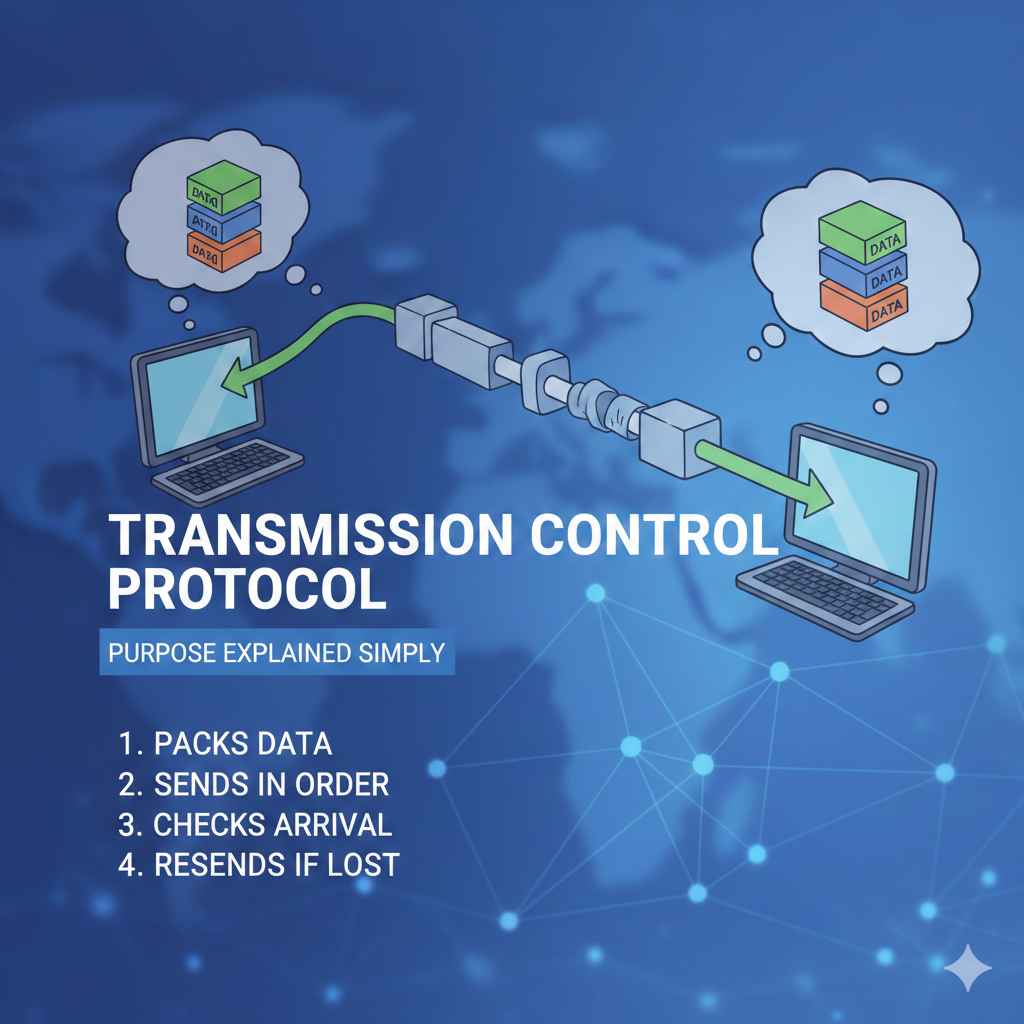
It’s common to find discussions about the Purpose of Transmission Control Protocol Explained a bit tricky at first. Don’t worry, many people feel the same! It involves technical stuff that can sound complicated. But we’re here to make it super easy. We’ll break down the concepts step-by-step so you can easily grasp what TCP is and what it does. You’ll learn how it helps move information around the internet. Let’s start with the basics!
What Exactly Is the Purpose of Transmission Control Protocol?
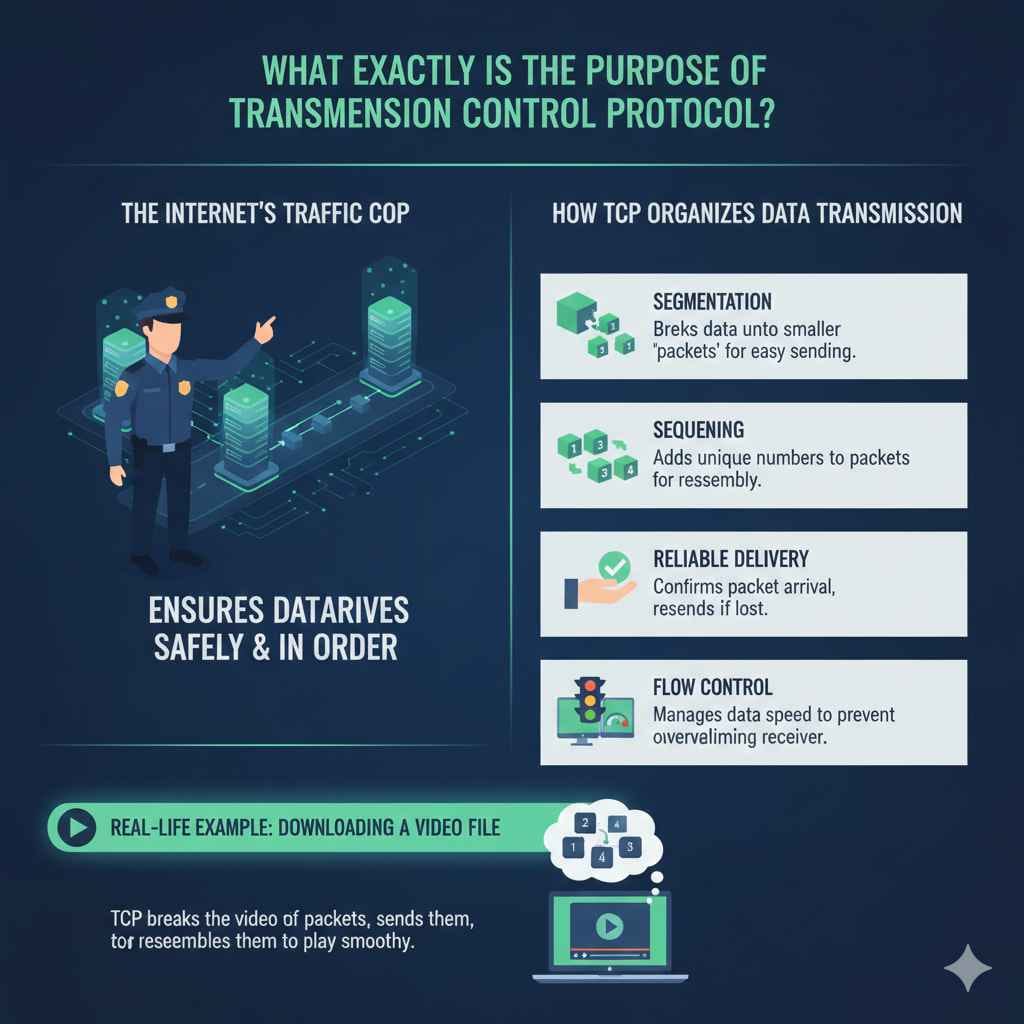
The internet is like a massive network of roads carrying information instead of cars. Transmission Control Protocol (TCP) is like the traffic cop and postal service of the internet, ensuring everything gets to its destination safely and in the correct order. It’s one of the main sets of rules that devices on the internet use to communicate with each other.
Without TCP, sending data across the internet would be a chaotic mess, like a package delivery service with no tracking or sorting. It handles everything from websites to email, making sure your data arrives where it needs to go.
How TCP Organizes Data Transmission
TCP’s main job is to guarantee reliable data transfer. Imagine sending a large book through the mail. TCP breaks up this “book” into smaller, manageable chunks called “packets.” These packets are then sent across the internet independently. At the receiving end, TCP reassembles these packets in the correct order to recreate the original “book.”
This involves several key processes like segmentation, sequencing, and reassembly. If any packet goes missing or gets damaged, TCP is smart enough to detect this and request a retransmission. This ensures that the complete data arrives accurately.
- Segmentation: TCP divides the data into smaller parts, making it easier to send over the network. These parts are packets. This process is important because it prevents large chunks of data from clogging up the network. The size of each packet is carefully chosen to optimize transfer speed.
- Sequencing: Each packet receives a unique number so the receiving computer can put them back in the correct order. Think of it like numbering the pages of your book. This is a key function, as packets can take different routes across the internet and arrive out of order.
- Reliable Delivery: TCP ensures the data arrives reliably through a process of acknowledgements. The receiving computer sends a message back to the sender confirming it received each packet correctly. If a packet is lost or damaged, the sender will retransmit it. This guarantees that all data arrives and is correct.
- Flow Control: TCP regulates the rate at which data is sent to prevent overwhelming the receiver. It’s like a traffic light, ensuring the receiver can handle the incoming traffic. This prevents dropped packets and optimizes the overall data transfer.
Real-Life Example of TCP in Action
Consider downloading a large video file.
The video file is broken down into numerous packets by TCP.
These packets travel across the internet.
TCP at the destination device ensures each packet arrives, and it puts them back together in the correct sequence, so you get a smooth video.
The Essential Functions of TCP Explained
TCP’s roles go beyond just transporting data; it’s also responsible for establishing and managing connections. It acts as the gatekeeper, ensuring reliable communication from start to finish. It manages the connection between two devices, making sure they can send and receive information effectively. TCP also deals with error checking, data integrity, and flow control. The protocol constantly monitors the network to ensure a smooth flow of data.
Connection Establishment and Termination
Before any data can be transferred, TCP establishes a connection. This is often described as the “three-way handshake.” The sender sends a request to connect, the receiver acknowledges this request, and then the sender confirms the acknowledgment. Once this handshake is done, the connection is ready. When the data transfer is complete, TCP also handles the termination of the connection, ensuring all resources are properly released. This ensures everything is done in an organized way.
- Three-Way Handshake: This is a key process to initiate a reliable connection. First, the sending device sends a SYN (synchronize) packet to the receiver. The receiver responds with a SYN-ACK (synchronize-acknowledge) packet. Finally, the sending device sends an ACK (acknowledge) packet. This confirms the connection, allowing data transfer to begin.
- Connection Termination: TCP also handles the closure of the connection. When both parties are done, they send FIN (finish) packets to end the session. This frees up resources on both ends. This is important to ensure that network resources are used efficiently.
- Port Numbers: TCP uses port numbers to identify specific applications or processes on a device. Think of it like having different doors on a building, each leading to a different room. This enables multiple applications to use the internet simultaneously without interfering with each other. For example, HTTP typically uses port 80, while HTTPS uses port 443.
TCP’s Error Checking and Data Integrity
TCP includes built-in mechanisms to verify data accuracy. It uses checksums to detect if any data has been corrupted during transmission. If a problem is found, TCP will automatically request the data be sent again. This ensures that the received data matches the original data. TCP also handles dropped packets and data retransmission requests.
Here’s a breakdown of the functions involved:
- Checksums: TCP calculates a checksum for each packet. This checksum is a numerical value based on the data in the packet. When the packet is received, the receiving device calculates its own checksum and compares it to the original. If they match, the data is likely error-free.
- Sequence Numbers: Sequence numbers help in ordering data correctly. If a packet is missing, the receiving device knows which one and can request a retransmission. This ensures the data is reassembled in the right order.
- Acknowledgements: TCP uses acknowledgements to confirm the successful reception of packets. The receiver sends an acknowledgement (ACK) back to the sender for each packet received correctly. If the sender doesn’t receive an ACK within a certain time, it retransmits the packet.
Comparing TCP and UDP: What Are the Key Differences?
While TCP is designed for reliability, User Datagram Protocol (UDP) focuses on speed. UDP is a connectionless protocol that doesn’t guarantee data delivery or order. It’s like sending postcards – you don’t know if they’ll arrive or in what order, but it’s fast. TCP, on the other hand, is like registered mail, where every step is tracked. Each has its place, and the best choice depends on what you need.
Reliability and Speed Trade-offs
TCP’s strength is reliability. It ensures that data arrives, even if it has to be resent several times. But, this added reliability can make it slower. UDP is faster because it skips all the error-checking and retransmission processes. Because UDP doesn’t guarantee delivery, it is suitable for applications where a little data loss is okay, such as streaming video or online gaming.
| Feature | TCP | UDP |
|---|---|---|
| Connection | Connection-oriented | Connectionless |
| Reliability | High (guaranteed delivery, order) | Low (no guarantees) |
| Speed | Slower | Faster |
| Error Checking | Yes (checksums, sequence numbers, ACKs) | Limited (checksums only) |
| Applications | Web browsing, email, file transfer | Online gaming, video streaming, DNS |
- Connection-Oriented vs. Connectionless: TCP establishes a connection before sending data, while UDP doesn’t. This means TCP can ensure a reliable delivery. UDP sends data without a pre-existing connection, which makes it faster but less reliable.
- Error Correction: TCP has built-in error-checking mechanisms to ensure that all data is delivered correctly. UDP does very minimal error checking. It might be appropriate when you prioritize speed over 100% data accuracy.
- Example Use Cases: TCP is used for applications where reliability is essential, such as transferring financial transactions. UDP works well for streaming video or online games, where minor data loss doesn’t affect user experience too much.
When to Use TCP and UDP
Choosing between TCP and UDP depends on the application’s needs. If accurate and ordered delivery is key, TCP is the better choice. Think about online banking or sending important documents. If speed is more important than perfect delivery, such as for live video streaming or online gaming, UDP is suitable.
- File Transfer (TCP): When downloading a file from a website, the browser uses TCP to ensure all the data is received correctly. TCP breaks the file into packets, sends them, and reassembles them in the correct order.
- Online Gaming (UDP): Games often use UDP to send real-time data, like player movements. Speed is more important than perfect delivery. If a packet is lost, it might cause a brief glitch, but the game continues.
The Purpose of Transmission Control Protocol in Modern Internet Usage
TCP remains the backbone of the internet, powering everyday activities from browsing to email. It makes sure we can safely send and receive data. As technology develops, TCP has adapted to meet new demands. It is central to how we use the internet now.
TCP’s Role in Web Browsing
When you visit a website, your browser uses TCP to communicate with the web server. TCP handles everything from establishing the connection to downloading the website’s content. It assures that all the images, text, and other elements are received correctly and displayed in the right order. This reliability is fundamental to the browsing experience.
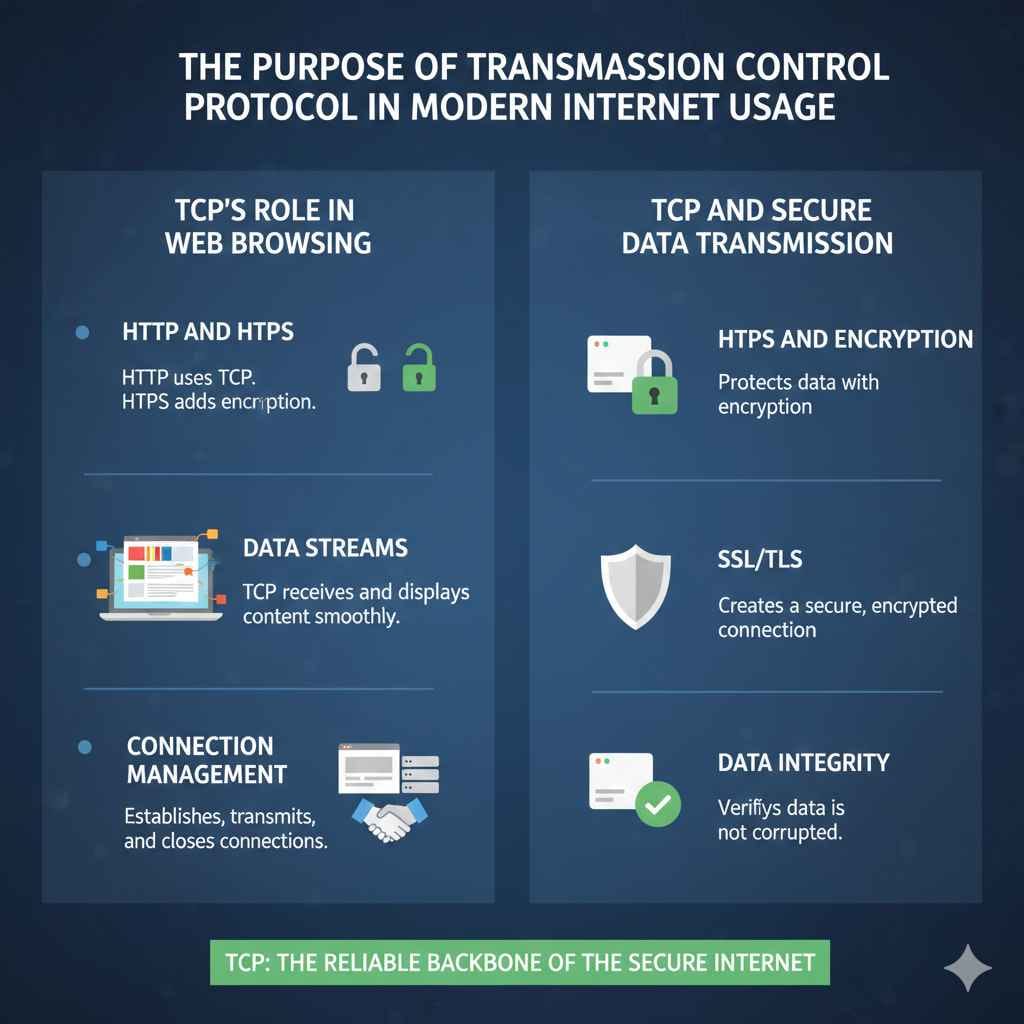
- HTTP and HTTPS: Hypertext Transfer Protocol (HTTP) and Hypertext Transfer Protocol Secure (HTTPS) use TCP to transmit data. HTTP is the underlying protocol for the web, while HTTPS adds a security layer through encryption.
- Data Streams: TCP manages data streams, enabling your browser to receive and display content smoothly. This involves breaking up the web content into packets. The packets are transmitted, reassembled, and displayed.
- Connection Management: TCP manages the connections between your computer and the web server. It establishes a connection (using the three-way handshake), transmits the data, and closes the connection. This ensures an organized data transfer.
TCP and Secure Data Transmission
In secure protocols like HTTPS, TCP plays a key role in ensuring secure communication. The encryption used by HTTPS is built on top of TCP. TCP ensures that the encrypted data packets are delivered reliably. This is key for secure online transactions and other sensitive communications.
- HTTPS and Encryption: HTTPS uses encryption to protect your data as it travels across the internet. The data is encrypted before being sent via TCP, and it’s decrypted at the receiving end.
- Secure Sockets Layer (SSL) and Transport Layer Security (TLS): SSL and TLS are cryptographic protocols that provide a secure connection. These security protocols use TCP to create a secure, encrypted connection between a web server and a web browser.
- Data Integrity: TCP provides a way to verify the integrity of the data being transmitted. This is especially important for secure transactions. TCP detects if any of the data is corrupted, which is essential to prevent fraud or other security breaches.
Frequently Asked Questions
Question: What is a packet?
Answer: A packet is a small piece of data that gets sent over the internet. When you send information, TCP breaks it down into these smaller packets, which are then reassembled at the destination.
Question: How does TCP handle lost packets?
Answer: If a packet doesn’t arrive, TCP notices this by using acknowledgments. The sender will retransmit the lost packet to make sure all data arrives correctly.
Question: What is a port number?
Answer: A port number is like a door number on a building. It’s used to identify specific applications or processes on a device, such as web servers (port 80) or secure web servers (port 443).
Question: Is TCP faster or slower than UDP?
Answer: TCP is generally slower than UDP because it includes error-checking and retransmission to ensure data is delivered correctly. UDP is faster, but it doesn’t guarantee delivery.
Question: What is the three-way handshake?
Answer: The three-way handshake is how TCP establishes a connection. It involves the sender and receiver exchanging SYN, SYN-ACK, and ACK packets before data transfer begins.
Final Thoughts
You’ve now explored the core functions of TCP and why the Purpose of Transmission Control Protocol Explained is important to the internet. From breaking down data into packets to making sure they arrive at the right place, TCP keeps the internet working. It handles connections, checks for errors, and ensures data is transmitted securely. Understanding TCP helps make more sense of how the internet does its work. You’ve also seen how it compares to UDP and the trade-offs between speed and reliability. Keep exploring, and you’ll find there’s always more to discover about the tech around us!