
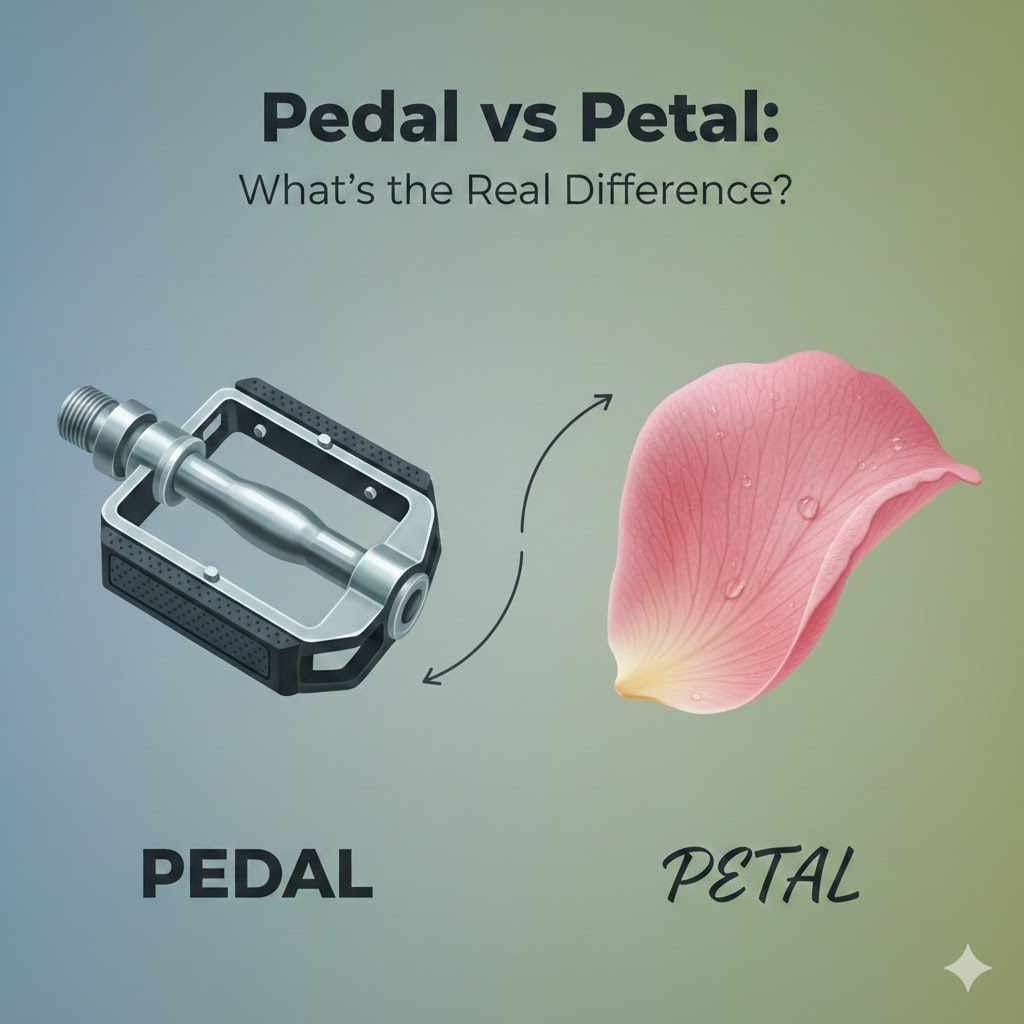
Sometimes words sound alike but mean very different things. That’s what happens with “pedal” and “petal.” It can be tricky for new learners to tell them apart because they’re spelled similarly and sound almost the same. Don’t worry!
We’ll make it super simple to know the difference between Pedal vs Petal: What’s the Real Difference?. Let’s break it down step by step.
Understanding Pedal vs Petal
This section helps clear up the confusion between words that sound very similar but have completely different meanings. Many people get these words mixed up. Learning the specific uses for “pedal” and “petal” will make your writing and speaking much clearer.
We will explore each word individually to see how they are used in everyday language and common phrases.
What Does Pedal Mean
The word “pedal” usually refers to something you push with your foot. Think about riding a bicycle. You use your feet to push down on the pedals to make the bike move.
It’s an action word, a verb, that means to use your feet on a pedal. It can also be a noun, referring to the part you push.
For example, “She loved to pedal her bike through the park.” Here, “pedal” is a verb showing the action of riding. Another example: “The piano has three pedals.” In this case, “pedals” are nouns, the parts of the piano you press with your feet.
The word “pedal” is also used in other contexts. Think about musical instruments like organs or pianos. These often have foot pedals that change the sound or provide bass notes.
In cars, there are also pedals for accelerating, braking, and using the clutch.
A common misunderstanding is using “pedal” when you mean “petal.” This happens because the words sound so much alike. Knowing that “pedal” is about feet and pushing is the key to using it correctly.
Examples of Pedal Use
- The cyclist adjusted her feet on the pedals, ready to begin the race. This sentence shows how pedals are parts of a bicycle that are used for movement. They are the levers you push with your feet to make the wheels turn.
- He used the gas pedal to speed up the car. Here, “pedal” refers to a control in a vehicle that is operated by foot. This pedal increases the engine’s power.
- The musician played a beautiful melody on the organ, using both the keys and the foot pedals. This highlights the use of pedals in musical instruments to create a fuller sound. The pedals can control bass notes or other sonic effects.
Technical Explanation of Pedal
In mechanics, a pedal is a lever operated by the foot. It converts linear foot motion into mechanical work. This is often seen in bicycles, where the pedals are connected to a crank arm and chainring, which drives the rear wheel.
In automobiles, pedals are part of the driver’s control system. The accelerator pedal controls engine speed, the brake pedal applies the brakes, and the clutch pedal (in manual transmissions) disengages the engine from the transmission, allowing gear changes.
For musical instruments like pianos and organs, pedals have different functions. Piano pedals typically affect the sustain or volume of the notes. Organ pedals often play bass notes, acting like a separate keyboard for the feet.
The etymology of “pedal” comes from the Latin word “pedalis,” meaning “of the foot,” which itself comes from “pes,” meaning “foot.” This connection to the foot is a consistent theme across all its uses.
What Does Petal Mean
Now, let’s talk about “petal.” A petal is a part of a flower. Flowers have colorful, often soft parts that surround the center. These are called petals.
They are usually pretty and help attract insects for pollination.
Think about a rose. The red parts you see are the petals. A daisy has white petals.
A tulip has big, colorful petals. It’s always about the flower.
It’s easy to mix up “petal” and “pedal” because they sound so similar. But remember, if you’re talking about flowers and their beautiful parts, you use “petal.” If you’re talking about pushing something with your foot, you use “pedal.”
Here’s a simple way to remember: “Petal” has an “a” like “flower.” “Pedal” has an “e” like “feet.” This little trick can help you choose the right word.
Examples of Petal Use
- The red rose had soft, velvety petals. This sentence describes the delicate outer parts of a rose, which are its petals.
- She picked a wildflower, admiring its bright yellow petals. This shows petals as a key visual feature of a flower that people often notice and appreciate.
- A gentle breeze caused the delicate petals to fall from the cherry blossom tree. This describes the natural shedding of flower petals.
Technical Explanation of Petal
In botany, a petal is one of the often brightly colored, leaf-like structures that make up the corolla of a flower. The corolla is the collective term for all the petals of a flower. Petals are typically located just inside the sepals, which are the outermost whorl of floral leaves, usually green and protective.
The primary function of petals is to attract pollinators, such as insects, birds, and bats. Their color, shape, scent, and sometimes even patterns visible in ultraviolet light serve as visual cues to guide pollinators to the flower’s reproductive parts.
The structure of petals can vary greatly among different plant species. They can be fused together to form a tube or cup shape, or they can be separate and distinct. The number of petals on a flower can also be characteristic of its plant family; for instance, many flowers in the buttercup family have five petals.
The word “petal” comes from the Greek word “petalon,” meaning “leaf,” which is related to “petannai,” meaning “to spread out.” This accurately describes the often flat, spread-out nature of these floral structures.
Pedal vs Petal Comparing Their Uses
Let’s make the difference between these two words super clear by comparing them side-by-side. This will help you see when to use each one without any doubt. We’ll look at how they function in sentences and what they represent.
The most straightforward way to differentiate is by thinking about the context. If the sentence is about movement, machines, or anything involving feet, then “pedal” is the correct word. If the sentence is about flowers, nature, or beauty, then “petal” is the word you need.
There are no situations where “pedal” and “petal” can be used interchangeably. They are not synonyms. Using the wrong word can change the meaning of your sentence entirely, leading to confusion for your listener or reader.
Key Differences Summarized
- Meaning: “Pedal” relates to feet and pushing, often part of a machine. “Petal” refers to a part of a flower.
- Function: Pedals are used for action, like making a bike move or controlling a car. Petals are decorative and attract pollinators to flowers.
- Context: You’ll find “pedal” in discussions about vehicles, musical instruments, and exercise equipment. You’ll find “petal” when talking about gardening, botany, or nature.
The visual distinction is also important. A pedal is typically a hard, mechanical part. A petal is usually soft, thin, and organic.
When to Use Pedal
Use “pedal” when you are talking about anything that involves pushing with your foot. This includes:
- Bicycles: The parts you push with your feet to make the bike go.
- Cars: The accelerator, brake, and clutch controls.
- Musical Instruments: Like pianos and organs, where foot pedals change the sound.
- Exercise Equipment: Such as stationary bikes or elliptical machines, which have pedals you move with your feet.
Remember the “e” in “pedal” connects to “feet” or “move.”
When to Use Petal
Use “petal” when you are talking about flowers. This includes:
- The colorful parts of a flower that surround its center.
- The decorative aspects of a bloom.
- Any discussion related to the anatomy of a flower.
Remember the “a” in “petal” connects to “flower” or “attract.”
Common Mistakes and How to Avoid Them
The most common mistake is spelling or saying “pedal” when you mean “petal,” or vice versa. This usually happens because the words sound so alike.
To avoid this, try to visualize the object you are talking about. Are you picturing a bicycle tire or a rose? This mental image will guide you to the correct word.
Another helpful tip is to say the word out loud and think about its meaning. Does it involve feet? Then it’s “pedal.” Does it involve a flower?
Then it’s “petal.”
Reading more will also help. When you see these words in context, you’ll naturally absorb their correct usage. The more you practice, the easier it becomes.
Real-Life Scenarios for Pedal vs Petal
Seeing how these words are used in everyday situations can really cement the difference in your mind. Let’s look at some common scenarios where you might encounter “pedal” or “petal.”
Imagine you’re telling a friend about your day. You might say, “I rode my bike to the store and had to pedal hard up the hill.” In this case, you are describing the action of using your feet on the bike’s pedals.
On the same day, you might also stop to smell a beautiful flower. You could then say, “The petals of that rose are so vibrant.” Here, you are referring to the soft, colorful parts of the flower.
These two simple sentences, spoken close together, perfectly illustrate the distinct meanings of “pedal” and “petal.”
Scenario 1 A Bike Ride
You’re planning a fun afternoon bike ride. You get your bicycle ready. You check the tires and make sure the chain is on properly.
Then, you get on the bike and put your feet on the pedals. You start pushing your feet down, and the bike begins to move.
As you ride, you might pass a garden. You see bright red flowers. You admire their beautiful petals.
You think about how different these soft parts of the flower are from the hard metal parts of your bike you are pushing.
This scenario highlights the contrast. One involves the mechanical act of cycling, and the other involves the natural beauty of a flower.
Scenario 2 A Flower Arrangement
Someone is making a beautiful flower arrangement for a party. They carefully select different types of flowers. They trim the stems and remove any extra leaves.
They arrange the blooms, making sure the colorful petals are facing outward. They want the arrangement to look its best.
Later, at the party, someone might ask about the music. Perhaps there’s a piano being played. The host might say, “The pianist is so talented; she can even use the pedals to create different sounds.”
Here again, the “petals” are the visual stars of the flower arrangement, while the “pedals” are part of the musical performance.
Scenario 3 Driving a Car
A new driver is learning to operate a car. The driving instructor explains the controls. “This is the accelerator pedal,” the instructor says, pointing to the rightmost pedal.
“You press this gently to make the car go faster.”
“This is the brake pedal,” they continue, pointing to the middle one. “You press this to slow down or stop the car.” They might also explain the clutch pedal for manual cars. These are all “pedals” that the driver uses with their feet.
After the driving lesson, the student might drive past a park filled with blooming flowers. They might notice the lovely “petals” on the flowers. This reinforces the distinction: feet on pedals, flowers have petals.
Common Phrases and Idioms
Sometimes, words appear in phrases that help us understand their meaning. While “petal” is usually used literally, “pedal” appears in a few common phrases.
One well-known phrase is “put the pedal to the metal.” This means to accelerate quickly or to go as fast as possible. It comes from cars where pressing the accelerator pedal down hard makes the vehicle go fast.
There isn’t a common idiom using “petal” that describes an action or a machine. “Petal” is almost always used to refer to the actual part of a flower. This makes “pedal” the word more likely to appear in figurative language.
“Put the Pedal to the Metal”
This idiom is used to tell someone to speed up or to put in their maximum effort. For example, if a team is falling behind in a race, the coach might shout, “Come on, team, put the pedal to the metal!”
The origin comes from car racing. Drivers would press the accelerator pedal down as far as it would go (to the metal floor of the car) to achieve maximum speed. It’s a vivid image of going all out.
This phrase is a clear example of “pedal” being tied to action and speed.
Other Uses of Pedal
Beyond vehicles, “pedal” can describe repetitive actions. For example, “He started to pedal the story, repeating the same old excuses.” This means he kept bringing up the same points over and over, like a cyclist pedaling continuously.
In sports, “pedal” might be used informally to describe continuous effort. “She really had to pedal hard in the last mile of the marathon.” This emphasizes the sustained effort required.
These uses show how the concept of continuous, foot-powered action associated with “pedal” can be extended metaphorically.
The word “petal” simply does not have these kinds of idiomatic uses. Its meaning is firmly rooted in the world of flowers.
Quick Recap and Final Check
We’ve covered a lot to make sure you understand the difference between “pedal” and “petal.” Remember that “pedal” is about feet and action, often related to machines. “Petal” is about flowers.
The next time you’re unsure, ask yourself: Am I talking about pushing something with my foot, or am I talking about a flower? This simple question will guide you to the correct word.
Knowing this difference helps you communicate more clearly and avoid confusing others. It’s a small detail that makes a big impact.
Frequently Asked Questions
Question: Is pedal a noun or a verb
Answer: Pedal can be both a noun and a verb. As a noun, it refers to the part you push with your foot, like on a bike. As a verb, it means to operate a pedal, like when you pedal a bicycle.
Question: Are pedal and petal related in any way
Answer: No, pedal and petal are not related in meaning. They sound alike and are spelled similarly, which can cause confusion, but they refer to completely different things.
Question: Can I use petal to describe a car part
Answer: No, you should not use “petal” to describe a car part. Car parts that are pushed with the foot are called pedals.
Question: What is the main difference between pedal and petal
Answer: The main difference is that a pedal is operated by the foot, often on a machine like a bicycle or car, while a petal is a part of a flower.
Question: How can I easily remember the difference
Answer: Remember that “petal” has an ‘a’ like “flower,” and “pedal” has an ‘e’ like “feet” or “engine.”
Summary
You now know the clear distinction between pedal and petal. Pedal involves your feet and action, often with machines like bikes or cars. Petal refers to the delicate parts of a flower.
Keep this simple rule in mind: feet use pedals, flowers have petals. You’ve got this!