
Resetting your Transmission Control Module (TCM) without an expensive scanner is simpler than you think. The easiest method involves safely disconnecting the car battery’s negative terminal for a specific time. This drains residual power, forcing the TCM to clear learned data and codes, often solving minor shifting quirks quickly and affordably.
If your automatic transmission is acting a little strange—maybe shifting hard, skipping gears, or just feeling “off”—you might see a trouble light on your dash. Often, this points to the Transmission Control Module (TCM). This computer learns your driving habits to make shifting smooth. Sometimes, those learned habits get mixed up, or a temporary glitch happens. Before heading to the mechanic, you can try a quick, free fix at home: resetting the TCM. This guide shows you exactly how to do it safely, without needing a fancy diagnostic scanner. Let’s get your shifting back to normal!
Understanding the TCM: What It Is and Why It Needs a Reset
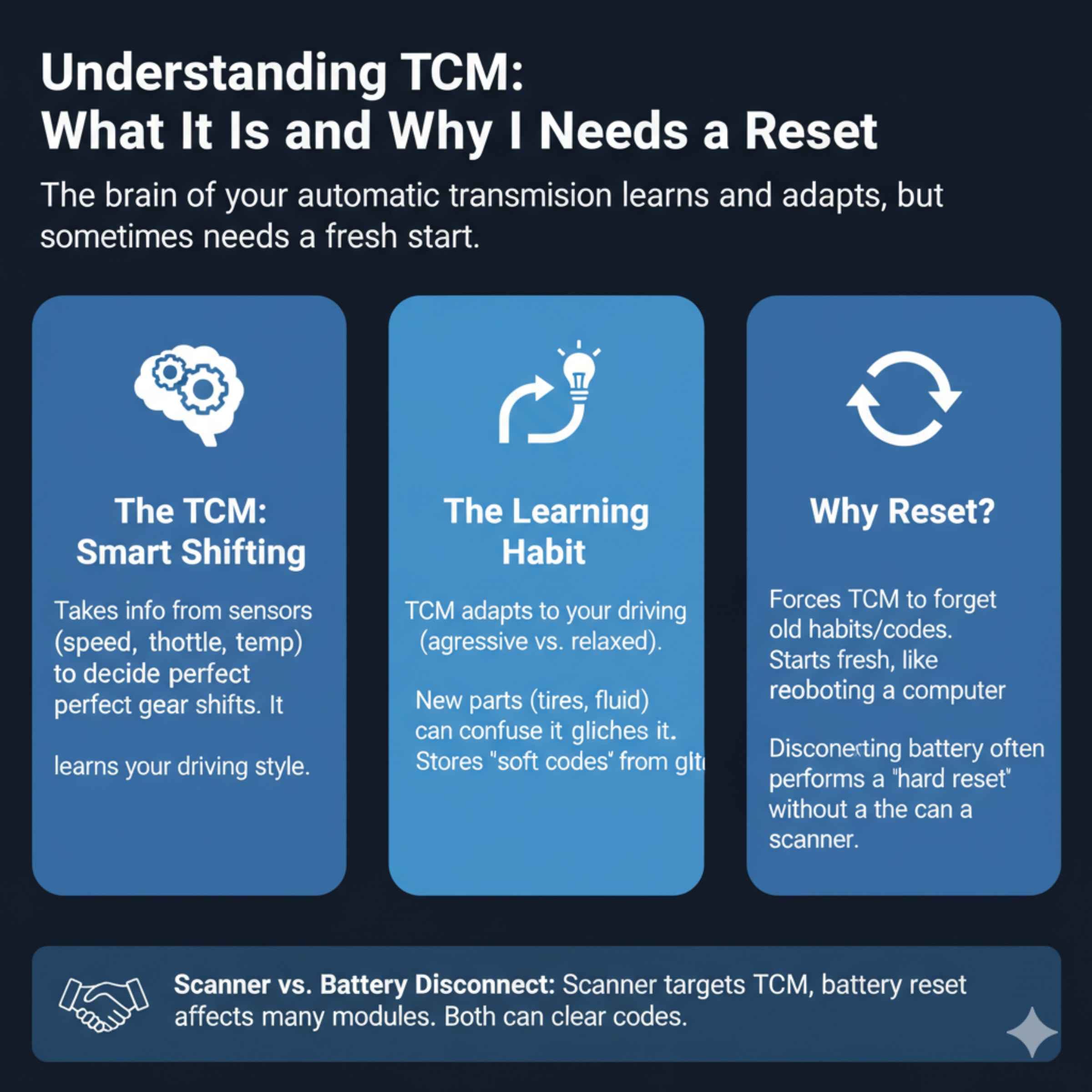
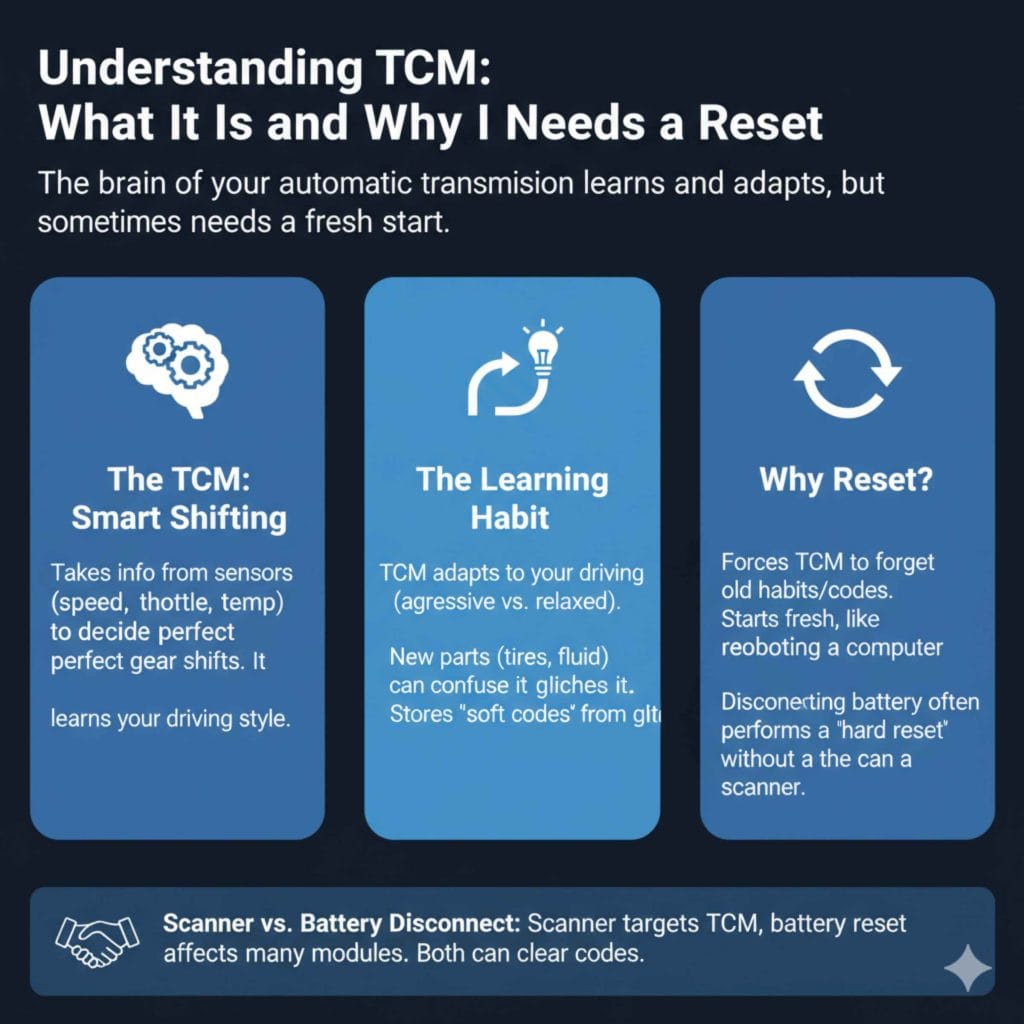
The Transmission Control Module (TCM) is like the brain for your automatic transmission. It takes information from many sensors—like how fast you are going, how hard you press the gas pedal, and the engine temperature—and decides the perfect moment to shift gears.
The TCM’s Learning Habit
Modern cars are smart. The TCM doesn’t just follow pre-set rules; it learns you. If you frequently drive aggressively, the TCM adjusts to hold gears longer for faster acceleration. If you’ve recently installed new tires or changed differential fluid, the TCM might get confusing data, leading to clumsy shifting.
When this learning process goes wrong, or if a minor, temporary electrical hiccup occurs, the TCM stores a “soft code.” This soft code might remain in the memory even after the initial problem clears up. A reset forces the module to forget these old habits and start fresh, much like rebooting a computer.
Why Resetting Versus Scanning?
A professional scanner (or OBD-II tool) can specifically target and erase the TCM codes. However, many drivers don’t own one. The good news is that disconnecting the battery often achieves a similar “hard reset” effect on many vehicle systems, including the TCM, because most modules rely on constant battery power to maintain their volatile memory.
Safety First: Preparing for the Reset Procedure
Before touching any wires, safety is our top priority. Working with the battery, even when turning the car off, requires respecting electricity.
Tools You Will Likely Need
You usually won’t need specialized tools for this simple battery reset.
| Tool | Purpose |
|---|---|
| Wrench or Socket Set | To loosen the battery terminal nuts (usually 10mm or 13mm). |
| Safety Glasses | To protect your eyes from any accidental sparks or corrosion. |
| Gloves (Recommended) | To keep hands clean and offer modest protection. |
| Wire Brush or Battery Terminal Cleaner | To clean connectivity after reconnecting (optional but helpful). |
Step 1: Parking Safely
1. Find a Safe Spot: Park your vehicle on a flat, level surface away from traffic.
2. Engage Parking Brake: Apply the parking brake firmly. If you have an automatic transmission, put the shifter in Park (P). If manual, use first gear.
3. Turn Everything Off: Ensure the ignition is completely off. Turn off the radio, lights, climate control, and any other accessories.
How To Reset Transmission Control Module Without Scanner: Step-by-Step Guide
This method is often referred to as a “hard reset” because it completely cuts power to the vehicle’s computers, forcing them to default back to factory settings upon restart.
Step 2: Locating and Disconnecting the Battery
The battery is typically located under the hood, though in some modern vehicles, it might be under a back seat or in the trunk. Consult your owner’s manual if you can’t find it quickly.
- Open the Hood: Secure the hood latch so it won’t fall while you work.
- Identify Terminals: Locate the battery. You will see two thick cables connected to the posts: one positive (+) usually marked red, and one negative (-) usually marked black.
- Disconnect the Negative First: Using your wrench or socket, loosen the nut holding the black (negative, -) battery cable clamp onto the battery post. Always disconnect the negative cable first. This prevents accidental short-circuiting against the car’s metal frame while you work.
- Secure the Cable: Once the nut is loose, gently twist and pull the negative cable clamp off the battery post. Move it completely away from the battery terminal so it cannot accidentally touch it again. Tape or cover the clamp end with a rag for extra safety.
Step 3: Draining Residual Power (“The Wait”)
This is the most crucial part for resetting modules like the TCM. Even after disconnecting the battery, small capacitors within the various control units (like the TCM and PCM/ECM) can hold a small charge for a time, keeping some memory alive. We need to drain this residual power completely.
- Wait Time: Leave the negative cable disconnected for a minimum of 15 to 30 minutes. For older vehicles, waiting 45 minutes offers extra assurance. This duration ensures that the minute electrical charges in the system bleed out.
- Optional Power Drain (The “Switch Trick”): To speed up the draining of residual power, after disconnecting the negative cable, press and hold the brake pedal or cycle the ignition switch (turning the key to the accessory/on position and back off) a few times without starting the car. This pulls stored energy through the circuits.
Step 4: Reconnecting the Battery
Once the required waiting time has passed, it’s time to put everything back together.
- Clean Contacts (If Needed): If you notice white or blue powdery buildup (corrosion) on the battery posts or cable clamps, use a wire brush to clean them now. Good contact ensures a stable system afterward.
- Reconnect the Positive First: Place the now-free positive (red) cable clamp firmly back onto the positive post. Tighten the nut securely—it should not wiggle.
- Reconnect the Negative Last: Place the black (negative, -) cable clamp back onto the negative post. Tighten this nut securely. A small spark may occur when you make the final connection; this is normal as the system powers up.
Step 5: The Reteaching (Drive Cycle)
When you reconnect the battery, the TCM has been completely wiped clean. It will have zero knowledge of your driving style. It immediately enters a “relearn” or “drive cycle” mode. For the transmission to shift correctly again, you must allow the car to relearn your habits.
- Start the Car: Allow the car to idle for about 5 minutes. This lets the Powertrain Control Module (PCM) initialize all systems.
- Initial Drive: Drive gently. Avoid hard acceleration for the first 10–15 minutes. Focus on smooth starts and stops.
- Vary the Speed: Drive on roads where you can reach cruising speeds (like 45–55 mph) and let the car hold that speed for a few minutes. Then, slow down completely and accelerate again.
- Simulate Normal Life: Complete a routine drive that mimics how you usually use your car (city driving, highway cruising, stopping at lights). The TCM needs specific inputs to map out optimal shift points.
This relearning cycle can take anywhere from a few miles to a full tank of gas, depending on your vehicle make and model. Be patient; smooth shifting should return as the module adapts.
Alternative Resetting: Checking Fuses (For Specific Issues)
While the battery disconnect is the most universal method for a TCM reset, sometimes only the TCM draws power, meaning resetting just that specific circuit might fix the issue without wiping out radio presets or causing the engine ECM to relearn timing. This requires slightly more precision.
When to Try the Fuse Method
This method is best if you strongly suspect the TCM has corrupted data but you want to preserve other electronic memories.
| Pro (Fuse Pull) | Con (Fuse Pull) |
|---|---|
| Only affects the TCM memory, preserving other settings. | Difficult to locate the exact TCM fuse without a manual. |
| Faster wait time usually sufficient (5 minutes). | Not all vehicles separate the TCM fuse distinctly from the PCM/ECM. |
| No tools needed if you have a fuse puller handy. | If you pull the wrong fuse, you might lose power brake assist or power steering temporarily. |
How to Locate and Pull the TCM Fuse
1. Consult the Manual: Open your vehicle owner’s manual and turn to the fuse box diagram section. Look specifically for fuses labeled “TCM,” “Transmission,” or sometimes “AT.”
2. Locate the Fuse Box: Most cars have one fuse box under the hood and often one inside the cabin (like under the dash or by the driver’s left knee).
3. Pull the Fuse: Using needle-nose pliers or a fuse puller, carefully remove the identified fuse.
4. Wait: Wait 10–15 minutes. This is usually enough for the dedicated TCM circuit to lose power and reset.
5. Reinsert: Firmly push the fuse back into its slot.
6. Test Drive: Perform the Reteaching drive cycle described above.
The Bigger Picture: When a Reset Doesn’t Work
It’s encouraging when a simple battery disconnect solves the problem. However, it is important to know when a reset is just a temporary band-aid.
A TCM reset only clears learned data or minor electrical glitches. It will not fix mechanical failures or persistent electronic faults.
Signs You Need More Than a Reset
If you experience these issues after a reset and a full drive cycle, the problem is likely mechanical or a failing sensor:
Check Engine Light Returns Immediately: If the “Check Engine” light flashes or immediately returns after the reset and driving, the underlying issue causing the code is still present.
Mechanical Noises: Grinding, clunking, or whining sounds during shifting never come from electrical memory; they signal physical wear.
Complete Failure to Shift: If the car is stuck in one gear (limp mode) before the reset, and remains there after, the computer might be detecting a critical sensor failure that requires replacement, not just a reboot.
If the issue persists, you will need a professional diagnostic scan. Tools like an OBD-II scanner pull specific trouble codes (like P0700 or P0750), which point exactly to which sensor or solenoid is failing. Understanding these codes is vital for effective repair, which is why professionals use them. For more information on reading standard diagnostic codes, you can reference general guidelines from organizations like the U.S. Department of Transportation’s National Highway Traffic Safety Administration (NHTSA) resources on vehicle diagnostics.
Maximizing Your TCM Reset Success
To give your TCM the best chance to relearn smoothly after a reset, follow these best practices to ensure the process is clean and effective.
Post-Reset Best Practices Checklist
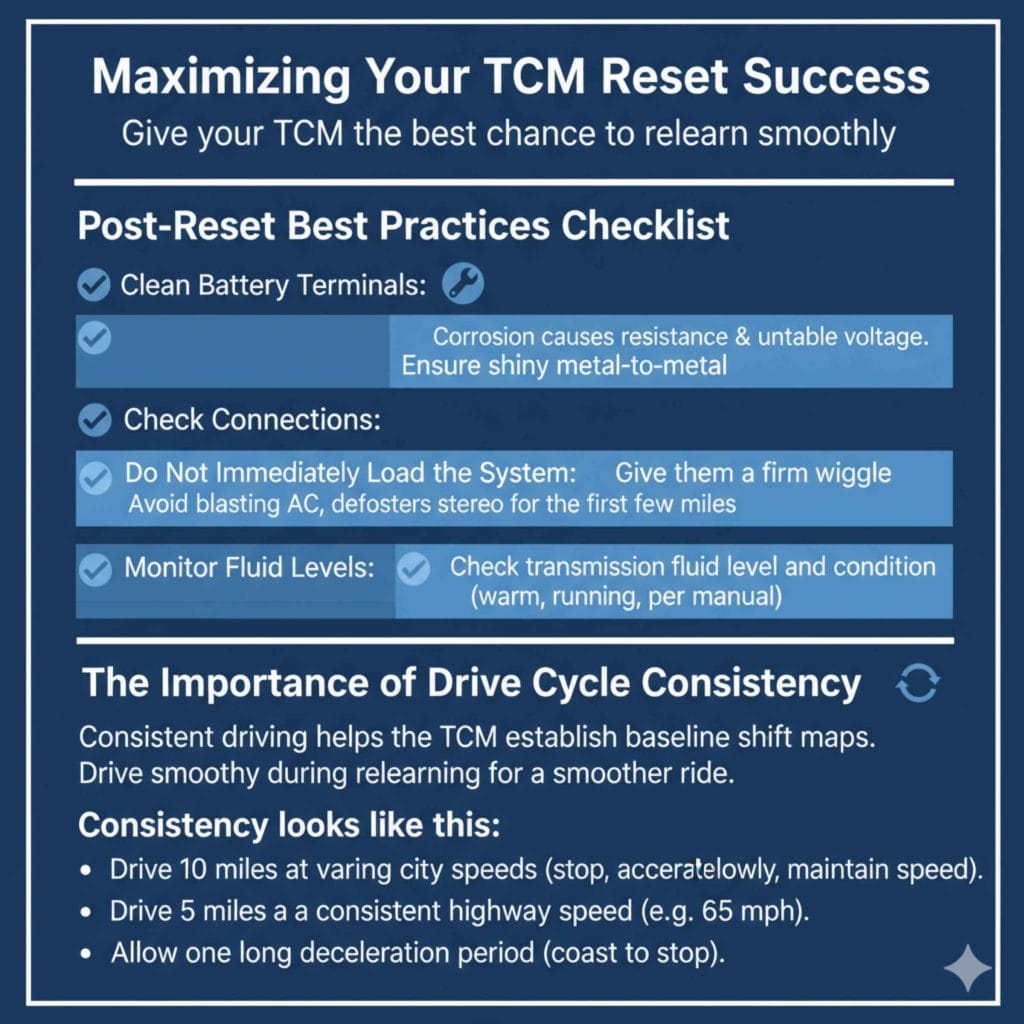
Clean Battery Terminals: Corrosion causes resistance, leading to unstable voltage. Unstable voltage can confuse even a newly reset module. Ensure the connection is shiny metal-to-metal.
Check Connections: Give both battery cables a firm wiggle after tightening the nuts. They must be tight.
Do Not Immediately Load the System: After the initial start-up, avoid blasting the AC, turning on rear defrosters, or maxing out the stereo for the first few miles. Let the core engine and transmission systems stabilize first.
Monitor Fluid Levels: While resetting the computer won’t fix low fluid, low or old transmission fluid is a leading cause of poor shifting. Use this opportunity to check your transmission fluid level and condition (ideally when the car is warm and running, following your manual’s specific instructions).
The Importance of Drive Cycle Consistency
The TCM is programmed to establish baseline shift maps based on consistent driver inputs. If you reset the module and then immediately drive aggressively for five minutes, it will learn an aggressive pattern. To achieve the smoothest possible ride, try to drive consistently during the relearning phase.
Consistency looks like this:
Drive 10 miles at varying city speeds (stop, accelerate slowly, maintain speed).
Drive 5 miles at a consistent highway speed (e.g., 65 mph).
Allow one long deceleration period where you take your foot completely off the accelerator and coast to a stop.
This varied, but controlled, input helps the TCM establish its base parameters correctly across different load conditions.
Frequently Asked Questions About TCM Resets
Q1: How long should I leave the battery disconnected to reset the TCM?
For high confidence in clearing the module memory, wait a minimum of 15 to 30 minutes. This ensures that all capacitors holding residual charge have time to bleed down completely.
Q2: Will disconnecting the battery reset my radio presets and clock?
Yes, almost certainly. Disconnecting the negative battery terminal cuts power to all non-permanent memory. You will need to reset your clock, saved radio stations, and potentially security codes for factory stereos after reconnecting.
Q3: Does the TCM reset fix rough shifting caused by low transmission fluid?
No. A reset only clears computer memory or temporary glitches. If your shifting issues are caused by low fluid, worn clutches, or mechanical failure, the rough shifting will return as soon as heavy load is applied.
Q4: How long does it take for the transmission to “relearn” after the reset?
This varies widely by vehicle manufacturer. It can take anywhere from five miles of normal driving to a full week of varied use before the TCM settles into its optimal, learned shift pattern.
Q5: Is it safe to disconnect the battery on my car if it has a complex alarm system?
It is generally safe, but be prepared. Some factory alarms or security features might require a specific sequence (like locking and unlocking the doors with the key fob) to reactivate after battery power is restored. Always have your key fob handy.
Q6: What if my car has two batteries (like some hybrids or heavy-duty pickups)?
If your vehicle has dual batteries, you must disconnect the negative terminal on both batteries to ensure a complete power cut to all modules. Always check your specific vehicle manual for dual-battery procedures.
Conclusion: Confidence in Your Do-It-Yourself Fix
Learning how to reset your Transmission Control Module without a scanner is a fantastic, confidence-boosting skill for any car owner. By safely disconnecting the negative battery terminal for at least 15 minutes, you effectively reboot the transmission’s brain, clearing out those minor electronic gremlins that cause frustrating shifting issues. Remember that the key to success afterward is patience—giving the car time and varied driving input to relearn your perfect driving style. If the lights come back on and the shifting remains poor after you’ve given the system time to adapt, that’s your cue to seek professional diagnostic help. For now, enjoy the satisfaction of tackling a common automotive puzzle right in your own driveway!