
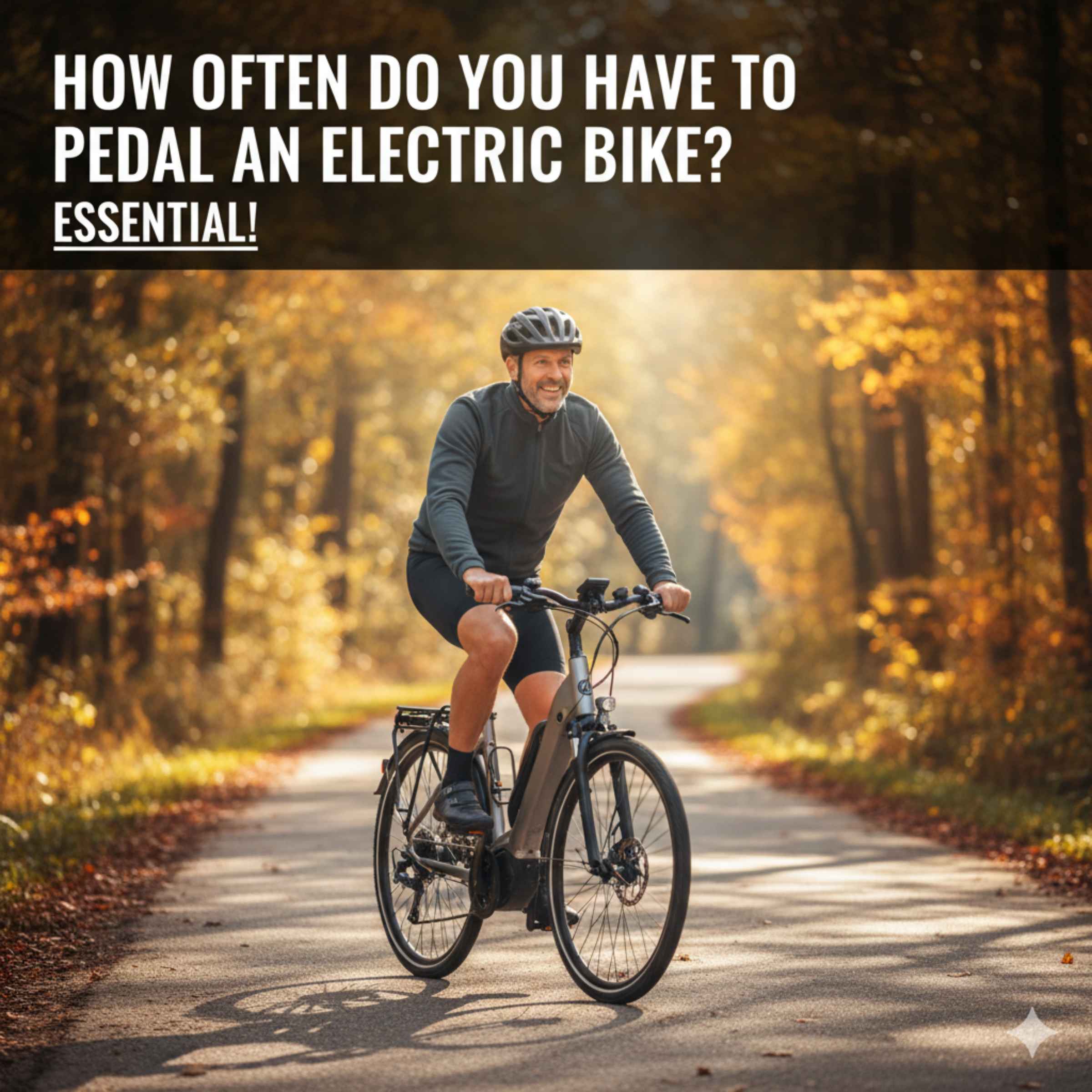
You only need to pedal an e-bike when you want to conserve battery, get a workout, or if the assist level is set low. Many e-bikes allow you to ride using only the throttle, making pedaling completely optional in many situations.
Welcome to the simple world of electric bikes! If you’ve just bought one or are thinking about it, a big question pops up: Do I still have to work? It feels confusing when you have a battery helping you out. You might worry about getting tired or running out of juice too fast. Don’t sweat it! This is a very common feeling for new riders. We are going to clear up exactly when and how much you need to pedal. We’ll show you that you are always in control of how much effort you put in. Ready to learn the simple rules for a great ride? Let’s dive into how e-bikes truly work underneath the hood—or, in this case, the battery!
Understanding the Electric Bike Assist Levels
The core difference between a regular bike and an electric bike (e-bike) is the motor and the assistance. Think of the motor like a friendly helper that kicks in when you ask it to. But how do you ask? Through different “assist levels.”
What is Pedal Assist (PAS)?
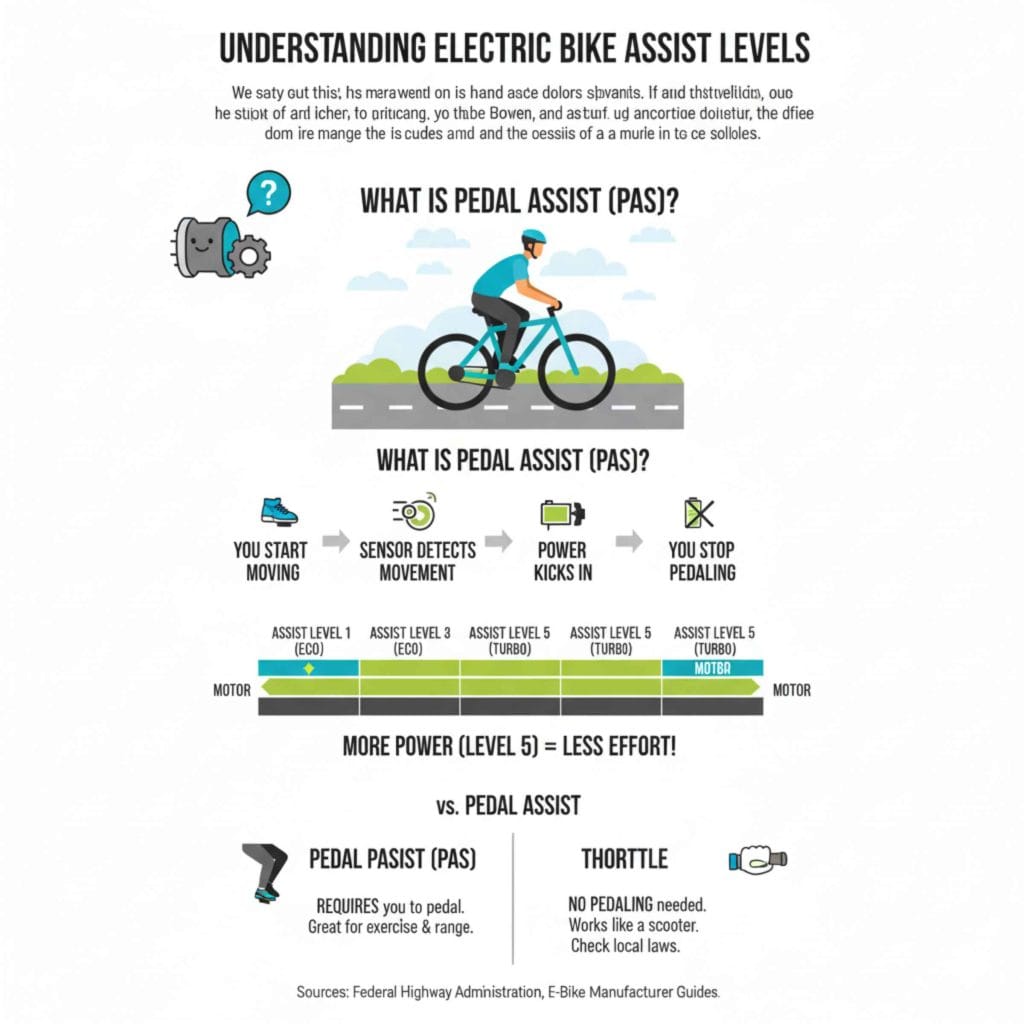
Pedal Assist System, or PAS, is the most common way e-bikes operate. It means the motor only turns on after you start pedaling. It doesn’t spin the wheel by itself just because you’re sitting on it.
Here is the simple breakdown of how PAS works:
- You start moving: You push the pedals, even just a little.
- The sensor detects movement: A sensor (usually near the crank or wheel) feels the motion.
- Power kicks in: The motor activates and adds power to your pedaling based on the level you selected (Eco, Tour, Turbo, etc.).
- You stop pedaling: The motor stops assisting right away.
The more power you select (e.g., Level 5 versus Level 1), the less effort you need to put in. On Level 1, you do most of the work with a little boost. On Level 5, the bike does most of the work!
Throttle vs. Pedal Assist
This is one of the most important distinctions for new riders. Not all e-bikes have both options, but many popular commuter and mountain e-bikes do.
Pedal Assist (PAS): Requires you to pedal for the motor to engage. This is often preferred for exercise or longer range.
Throttle: This works like the gas pedal on a car or a scooter. You twist or push a lever, and the bike moves forward under motor power without you having to pedal at all. These bikes are often classified differently legally, so check your local Federal Highway Administration guidelines on electric bicycles when riding in public areas.
So, How Often Do I Have to Pedal?
The direct answer to “How often do you have to pedal an electric bike?” depends entirely on two things: the bike’s features and your riding preference.
Scenario 1: Your E-Bike Has a Throttle
If your e-bike is equipped with a throttle, the answer is simple: You don’t have to pedal at all, ever, if you don’t want to.
You can use the throttle to get up to speed, cruise along, and even climb gentle hills without your feet moving on the pedals. For riders with knee issues, those carrying heavy loads, or those who just want to cruise, the throttle is a game-changer. You use the battery power exclusively.
Scenario 2: Your E-Bike Only Features Pedal Assist (PAS)
If your bike relies only on PAS, then yes, you must pedal. However, “pedaling” in this context doesn’t mean heavy labor.
Even on the highest assist level:
- You must initiate the pedal motion.
- You will only be providing the minimum input needed to signal the sensors to turn on.
- It often feels like pedaling on a very slight downhill slope.
Think of it less as exercising and more as telling the bike, “Okay, now I’d like a little help engaging.” You are always contributing, but your effort level stays very low.
The Four Main Riding Styles and When You Pedal
To make this clearer, let’s look at the four primary ways people ride electric bikes and how pedaling fits into each.
Style 1: Maximum Assistance (The “Scooter Feel”)
When you pedal: Only when starting from a complete stop or when the battery is completely dead.
How it works: Use the throttle (if available) exclusively. Set the PAS to zero or the lowest setting. This uses the most battery power quickly but requires zero physical effort from you.
Style 2: Balanced Commuting (The “Boosted Ride”)
When you pedal: Constantly, but very lightly.
How it works: This is the sweet spot for most daily riders. Set the PAS to a medium level (like 2 or 3 out of 5). You pedal just enough to keep the motor engaged, letting it handle wind resistance and moderate hills. This offers the best balance between exercise, range, and speed.
Style 3: Range Extension (The “Long Haul”)
When you pedal: Strongly, but using low assistance.
How it works: If you are going very far, you should pedal harder and set the PAS to the lowest level (Level 1). This forces you to do most of the work, turning the motor into a supplemental aid rather than the primary power source. This dramatically extends your battery range.
Style 4: Pure Workout (The “E-Bike as a Regular Bike”)
When you pedal: 100% of the time, with maximum effort possible.
How it works: Turn the entire electric system off, or set the PAS to zero. You are riding it just like a standard, heavy bicycle. You only turn the motor on if you hit a surprise steep hill or are completely exhausted.
Factors That Change How Much You Need to Pedal
Your own input changes minute by minute based on what the road throws at you. Here are the key factors that dictate your pedaling frequency and intensity.
1. Terrain and Hills
This is the biggest factor. If you are riding on pancake-flat ground, you might use lower assist and pedal more to keep your heart rate up without draining power.
When approaching a steep hill, you have two choices:
- Throttle it: If you have one, use the throttle to zoom up without pedaling (high battery drain).
- Crank the PAS: If you only have PAS, immediately switch to the highest assist level (Level 5). You will still have to pedal, but the motor makes the hill feel like low-grade pavement.
2. Battery Level
As your battery power drops, the motor might not deliver the full power it usually does, especially going uphill. If you are running near 10%, you will naturally need to pedal harder to compensate for the motor’s slightly reduced output. Always keep an eye on your battery gauge if you are far from home!
3. Bike Class and Motor Type
E-bikes are sorted into classes, which dictate how they assist you, affecting your pedaling requirements significantly.
Table 1: Comparing E-Bike Classes and Pedaling Requirements
| E-Bike Class | Top Motor Speed | Primary Power Method | Need to Pedal? |
|---|---|---|---|
| Class 1 | 20 mph | Pedal Assist Only (PAS) | Yes, to engage motor. |
| Class 2 | 20 mph | Throttle or PAS | Optional (use throttle to avoid pedaling). |
| Class 3 | 28 mph | PAS Only (No Throttle) | Yes, always required for assistance. |
If you have a Class 3 e-bike, you are guaranteed to have to pedal to get any motor help. Class 2 gives you the freedom to coast using the throttle.
4. Your Fitness Goals
Are you looking to replace your car entirely, or are you using the bike for light exercise?
If you want a workout—even a light one—you should intentionally keep the assist level low (1 or 2). This ensures you are getting cardiovascular benefits while the motor smooths out the hardest parts of the ride.
If your goal is purely transportation and you struggle with hills or distance, set the assist higher (3 to 5) and let the bike do the heavy lifting while you just provide the minimum input to keep the system legally engaged.
Sensor Types: How the Bike Knows You Are Pedaling
If you have a PAS bike, the motor relies on sensors to know when to engage. Understanding these helps you feel the difference in how the bike responds to your effort.
1. Cadence Sensor
This is the simplest and most common type. It simply detects if the pedals are moving.
Experience: It’s an “on/off” feeling. As soon as you start spinning, the motor gives you the power you selected, regardless of how hard you are actually pushing down on the pedals. If you spin them lightly, the bike still kicks in hard.
2. Torque Sensor
This is a more advanced system, common on mid-drive motors and higher-end bikes. It measures the force you are applying to the pedals.
Experience: It feels much smoother and more natural, like riding a regular bike but with superhuman legs. If you push lightly, the assist is light. If you push hard (like going up a hill), the assist ramps up immediately to match your effort.
If you have a torque-sensing e-bike, you will naturally pedal more often and more consistently because the bike rewards your effort instantly and smoothly. If you have a cadence sensor, you might consciously pedal less, relying on bursts of power.
Tips for Maximizing Your Ride (and Minimizing Fatigue)
Knowing how often to pedal is one thing; riding smart is another. Here are practical tips to make your e-biking experience smooth and enjoyable, building your confidence in managing the power assist.
Tip 1: Start Slow and Low
When you first get on your e-bike, especially if you’ve never ridden one before, start with the assist level set to zero or the lowest setting. Get used to the weight and the feel of the bike under your own power first. Then, slowly increase the assist one level at a time until you find the sweet spot that feels comfortable for your first few rides.
Tip 2: Master Feathering the Throttle (If Applicable)
If you have a throttle, don’t just jam it down to its maximum setting! Gentle throttle use extends your range significantly. Use the throttle aggressively only for starting from a dead stop or passing parked cars. For cruising, use very light pressure.
Tip 3: Shift Gears Like a Regular Bike
Many new riders forget they still have gears. The motor assists, but you still need to use your gears to maintain an efficient cadence (pedal rotation speed).
- Climbing: Shift into an easier (smaller) gear before you hit the hill, so you can keep your legs spinning easily while the motor kicks in hard.
- Cruising Speed: Shift into harder (bigger) gears when on flat ground to keep your legs moving at a comfortable, steady pace.
Tip 4: Don’t Coast on PAS-Only Bikes
If you are riding a bike that only has Pedal Assist (no throttle), remember that if you stop pedaling, the assistance stops immediately. If you are flying down a decline and decide to stop assisting, the bike will slow down much more quickly than a regular bike because the motor isn’t contributing any free-rolling coasting friction.
Tip 5: Use PAS for Maintenance and Safety
Even if you enjoy riding throttle-only most of the time, use the lower PAS settings often. Why?
- It keeps your legs gently active, which is better for long-term riding comfort.
- It helps you learn the bike’s handling characteristics when the motor is engaged quietly.
- It saves battery for when you truly need the boost (like climbing that unexpected steep road).
Understanding E-Bike Range and Battery Management
The ultimate limiting factor in how much you can ride without pedaling is your battery. If you over-rely on the throttle or max assist, you will drain the battery much faster than if you integrate pedaling.
How Heavy Effort Affects Range
Think of your battery as having a finite amount of “juice.” Using the throttle or max assist drains that juice very quickly. Pedaling, even lightly, forces the bike to use the battery more efficiently. Bicycle manufacturers often test range benchmarks under specific, repeatable conditions. These official ranges are almost always achieved using a mix of low-to-medium pedal assist (or a specified average rider wattage).
If you ride 100% throttle on challenging terrain, expect to get 40% to 60% of the advertised maximum range.
To get the maximum distance, you often need to treat the e-bike like a regular hybrid bike that occasionally throws you a strong tailwind.
Comparing Battery Draw
This table shows a rough comparison of how effort impacts energy use based on a typical 500Wh battery pack range estimates. These are estimates and vary widely by bike model and rider weight.
Table 2: Estimated Range Based on Riding Style
| Riding Style | Average Rider Input | Motor Usage | Estimated Range (Miles) |
|---|---|---|---|
| Max Throttle Only | Zero | Constant High Draw | 15 – 25 Miles |
| Medium PAS (Balanced) | Constant Light Effort | Moderate/On-Demand Draw | 30 – 50 Miles |
| Low PAS (Range Focus) | Constant Medium-Hard Effort | Low/Supplemental Draw | 50 – 80+ Miles |
If traveling further is important, getting comfortable relying on your own muscles slightly more—even just setting it to Level 1 or 2—will save you from having to stop and recharge halfway through your trip.
Legal Considerations: When Pedaling Matters
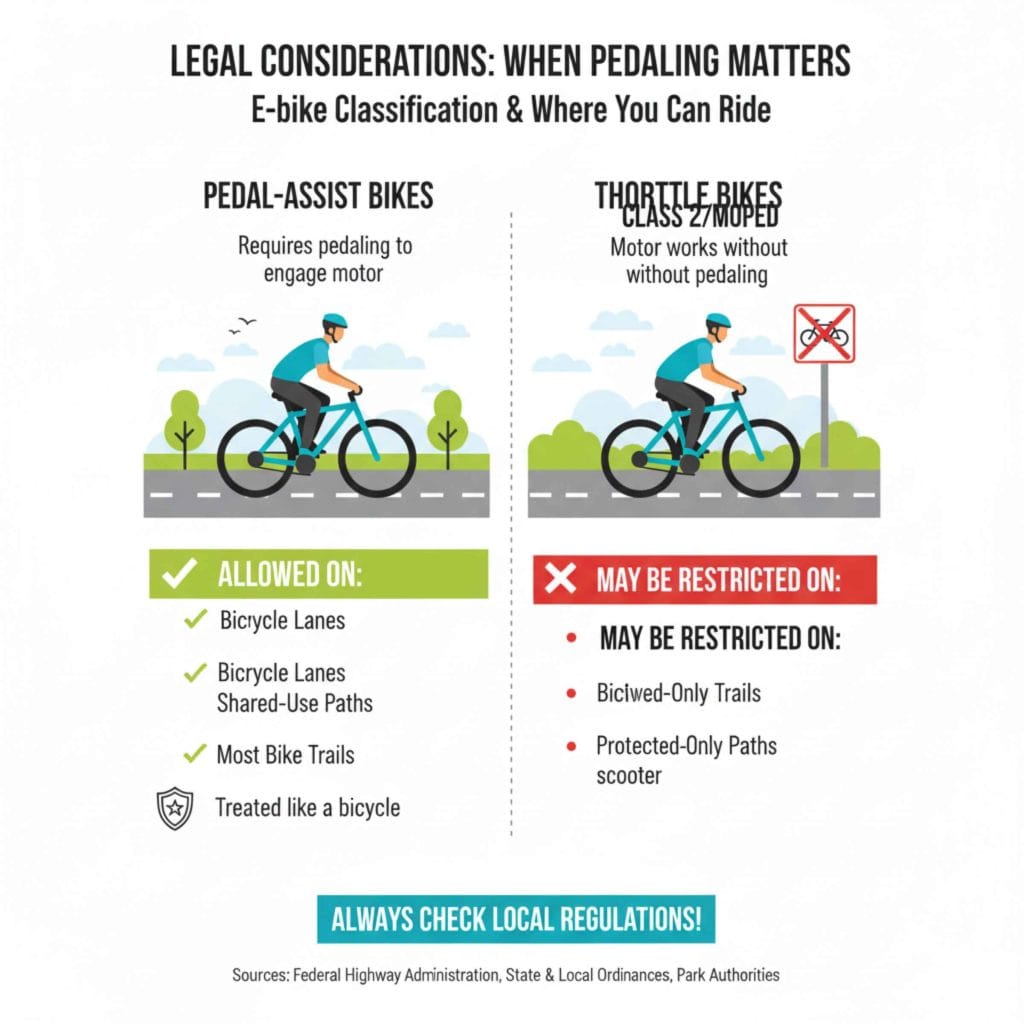
In many regions, the classification of an e-bike (which dictates where you can ride it—paths, roads, or trails) depends on whether it requires pedaling to engage the motor. This is a crucial point for safety and avoiding fines, especially on shared-use paths managed by local parks or state authorities.
For example, according to guidelines in many U.S. states concerning electric bicycles:
- If a bike has a throttle and can move without pedaling, it may be considered a moped or motorized scooter in some jurisdictions, banning it from bicycle-only trails.
- If a bike requires the rider to pedal to engage the motor (Class 1 or Class 3), it is legally treated more like a standard bicycle, granting access to almost all bike lanes and trails.
Always check with your local transportation department or park authority to ensure you meet local regulations. For instance, if you plan to ride on protected bike paths where motorized vehicles are banned, pedaling (even lightly via PAS) is often the only way to legally use the motor assistance.
Frequently Asked Questions (FAQ)
Q1: Can an electric bike run out of battery and still be ridden?
A: Yes, absolutely! If the battery dies, your e-bike simply becomes a heavy regular bicycle. Since e-bike frames and components are built sturdier to handle extra power and speed, they tend to be heavier than standard bikes, so pedaling home will feel like a workout, but it is perfectly safe to ride them manually.
Q2: How fast do I have to pedal for the motor to kick in?
A: This varies by model, but typically, the motor will engage almost immediately—within the first half-rotation of the pedals. With a cadence sensor, you only need to spin them enough to register movement; you don’t need to be pedaling at cycling speed yet.
Q3: If I use the throttle, do I ever need to touch the pedals?
A: Technically, no. On a Class 2 e-bike with a throttle, you can ride without pedaling at all. However, lightly pedaling while using the throttle—especially on hills—reduces battery drain, improves stability, and helps the motor work more efficiently.
Q4: Does pedaling make an e-bike go faster?
A: Not beyond the motor’s speed limit. Pedaling helps the motor reach and maintain its maximum assisted speed more efficiently, but once that limit is reached, extra pedaling only adds physical effort, not additional speed.
Q5: Is pedaling required to charge the battery?
A: No. Most e-bikes do not recharge the battery through pedaling. Pedaling simply reduces how much power the motor draws, helping the battery last longer rather than replenishing it.
Q6: Do you still get exercise if you pedal an electric bike?
A: Yes. Even with pedal assist, you still engage your leg muscles and cardiovascular system. Lower assist levels provide light to moderate exercise, while higher levels reduce strain but keep you active.
Conclusion
How often you have to pedal an electric bike depends entirely on your bike type, assist settings, and personal goals. If your e-bike has a throttle, pedaling can be optional. If it relies on pedal assist, you’ll need to pedal—but usually with minimal effort.
The beauty of an e-bike is flexibility: you can ride it like a scooter, a lightly assisted bicycle, or a full workout machine. Whether you’re conserving battery, climbing hills, commuting comfortably, or exercising, you control how much work you do. Once you understand assist levels and riding styles, pedaling an e-bike becomes less about effort—and more about choice.