
Charging an electric car in the UK can cost as little as £10-£15 for a full charge at home using an off-peak electricity tariff. However, using public rapid chargers can cost £30-£45 or more for the same charge. The key is knowing where and when you charge to get the lowest price.
Thinking about switching to an electric car? That’s great! But you probably have one big question on your mind: how much does it actually cost to charge one? You may have heard scary stories about high prices. It can feel confusing, but I promise it’s simpler than you think.
Many people worry about the cost, but the truth is you have a lot of control over it. It’s not like buying petrol where the price is the price. With an electric car, a little bit of knowledge can save you a lot of money. In this guide, I’ll walk you through everything, step-by-step. We’ll look at charging at home, on the road, and I’ll share simple tips to keep your running costs super low.
Understanding the Basics: Where Can You Charge Your EV?
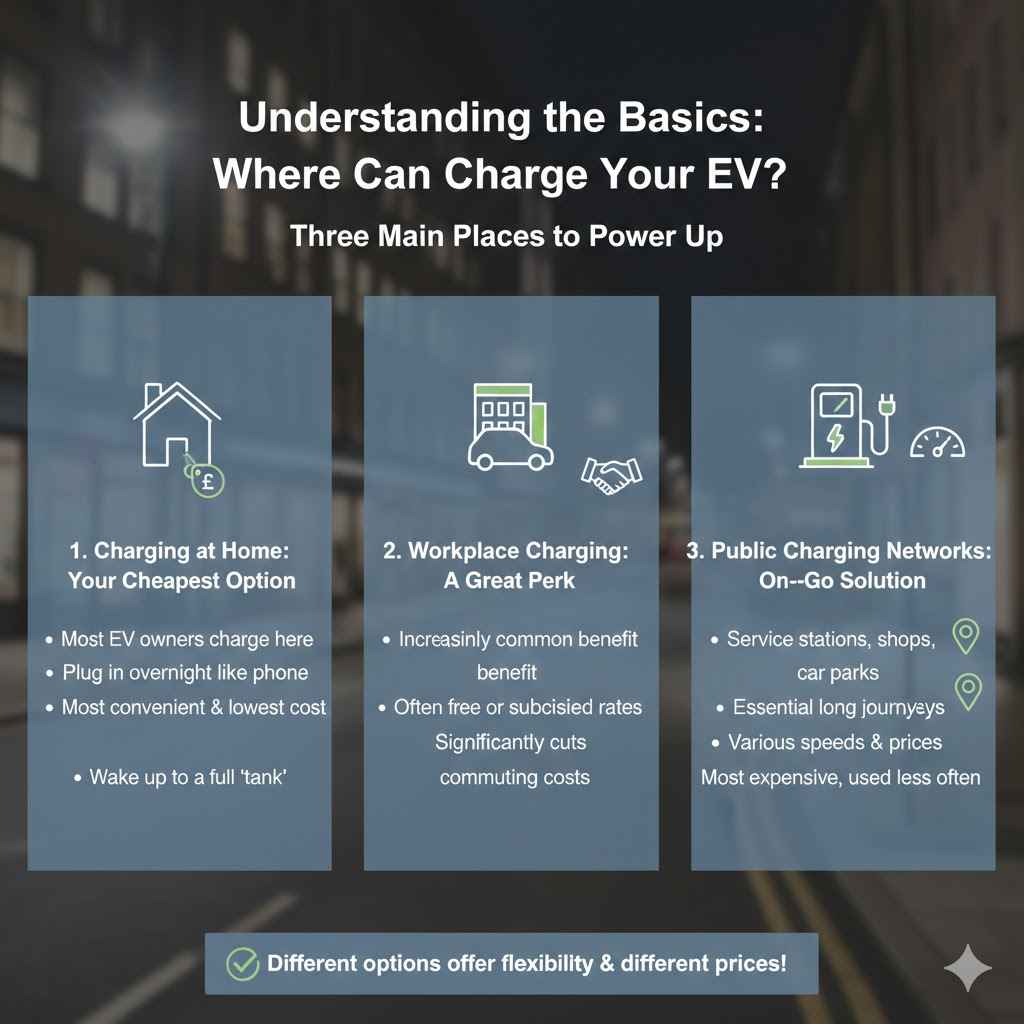
Before we talk about money, let’s look at the three main places you can plug in your electric car. Think of them as different types of fuel stations, each with its own price and convenience.
Charging at Home: Your Cheapest Option
This is where most electric car owners do almost all of their charging. You simply plug your car in overnight, just like your phone. It’s the most convenient and, by far, the cheapest way to charge. Waking up to a “full tank” every morning for just a few pounds is one of the best perks of owning an electric car.
Workplace Charging: A Great Perk
More and more companies are installing chargers for their employees. This can be a fantastic benefit. Sometimes, charging at work is free! Other times, it’s offered at a low, subsidised rate. If your workplace offers this, it can significantly cut your driving costs.
Public Charging Networks: The On-the-Go Solution
These are the chargers you see at service stations, supermarkets, and in public car parks. They are essential for long journeys or for people who can’t charge at home. Public chargers come in different speeds and prices, which we’ll explore in detail. They are the most expensive option, but you’ll likely use them less often than you think.
The Big Question: How Much Does It Actually Cost?
The cost of charging depends on three main things:
- Your Car’s Battery Size: This is measured in kilowatt-hours (kWh). A bigger battery is like a bigger fuel tank—it holds more energy and costs more to fill, but it also gives you a longer range.
- The Price of Electricity: This is measured in pence per kilowatt-hour (p/kWh). This price changes depending on where you charge and what energy plan you have.
- The Type of Charger: Home chargers are the cheapest, while super-fast public chargers cost the most.
The basic formula is simple: Battery Size (kWh) x Electricity Price (p/kWh) = Cost to Full Charge
Breaking Down Home Charging Costs
Charging at home is your secret weapon for saving money. You pay for electricity through your home energy bill. There are two types of plans, or tariffs, to know about.
A Standard Tariff is what most people have. The price per kWh is the same no matter what time of day you use it. An EV Tariff, on the other hand, gives you super-cheap electricity during specific off-peak hours, usually overnight. This is designed for electric car owners.
Let’s see the difference this makes for a few popular cars. We’ll assume the battery is empty and we’re charging it to 100%.
| Car Model (Approx. Battery Size) | Cost on Standard Tariff (Avg. 30p/kWh) | Cost on Off-Peak EV Tariff (Avg. 8p/kWh) | Annual Savings (10,000 miles/year) |
|---|---|---|---|
| Nissan Leaf (40kWh) | £12.00 | £3.20 | Around £650 |
| VW ID.3 (58kWh) | £17.40 | £4.64 | Around £950 |
| Tesla Model 3 Long Range (75kWh) | £22.50 | £6.00 | Around £1200 |
As you can see, switching to an EV tariff makes a huge difference. That overnight charge for a Tesla could cost less than a fancy cup of coffee!
The Reality of Public Charging Costs
Public charging is a different story. It’s more expensive because you’re paying for the convenience and the expensive equipment. Prices vary a lot between different companies and charger speeds.
Here are the main types of public chargers you’ll find:
- Slow (3-7kW): Often found in car parks or on streets. Can take 8-12 hours for a full charge. Good for topping up while at work or shopping.
- Fast (7-22kW): The most common type found at supermarkets, gyms, and cinemas. They can add around 30 miles of range per hour.
- Rapid (50kW+): Found at motorway service stations. Designed for long trips, they can charge a battery to 80% in about 30-45 minutes.
- Ultra-Rapid (100kW+): The fastest chargers available. Can add 100 miles of range in as little as 10-15 minutes, depending on your car.
Here’s a look at what you can expect to pay. Instead of a full charge, let’s look at the cost to add 100 miles of range to a typical EV (which uses about 4 miles per kWh).
| Charger Type | Average Cost per kWh | Cost to Add 100 Miles (25 kWh) |
|---|---|---|
| Fast Charger (e.g., Pod Point at a supermarket) | 40p – 60p | £10.00 – £15.00 |
| Rapid Charger (e.g., BP Pulse, Gridserve) | 65p – 79p | £16.25 – £19.75 |
| Ultra-Rapid Charger (e.g., Ionity) | 74p – 85p | £18.50 – £21.25 |
Note: Prices are estimates and can change. Some networks use subscription models that can lower these costs.
Why Is Public Charging So Much More Expensive?
It can be a shock to see public charging prices that are more than double what you pay at home. It might seem unfair, but there are some good reasons for the higher cost. It’s not just about the electricity.
- Expensive Hardware: Rapid and ultra-rapid chargers are complex, powerful machines that cost tens of thousands of pounds to buy and install.
- Grid Connection: Installing these powerful chargers often requires expensive upgrades to the local electricity grid to handle the high power demand.
- Location Costs: Companies have to pay rent for the prime locations at motorway services or in city centres.
- Maintenance and Support: A team of engineers is needed to keep the network running 24/7 and fix any problems.
- Different VAT Rate: Electricity at home has a 5% VAT rate. But electricity from public chargers is considered a service, so it’s subject to the standard 20% VAT rate. This adds a big chunk to the final price.
While these costs are higher, remember that for most drivers, public charging is only for occasional long trips. The vast majority of your miles will be powered by cheap, overnight electricity at home.
Smart Tips to Save Money on EV Charging
The best thing about EV charging is that you are in control. With a few smart habits, you can make sure you are always paying the lowest possible price to power your car. Here are my top tips for keeping charging costs down.
Tip 1: Get an EV-Friendly Energy Tariff
This is the single biggest money-saving tip. If you can charge at home, switch to an electricity plan designed for electric car owners. These tariffs offer incredibly cheap electricity for a few hours overnight (e.g., from midnight to 5 am). You can set your car or home charger to only charge during these cheap hours. It’s a set-and-forget way to save hundreds of pounds a year.
Tip 2: Charge at Home Whenever Possible
It sounds simple, but it’s true. Every mile you drive using electricity from your home is a mile you powered for just a few pence. Make home charging your default habit. Plan your week so that you leave home with enough charge for your daily needs, and only rely on public chargers when you absolutely have to on longer journeys.
Tip 3: Use Free Chargers (Yes, They Exist!)
Keep an eye out for free charging opportunities. Many supermarkets (like Tesco and Sainsbury’s), shopping centres, and hotels offer free fast charging for customers. While you won’t get a full charge during your weekly shop, an hour of free charging can add 20-30 miles of range. Over a year, these little top-ups really add up!
Tip 4: Understand Public Charging Subscriptions
If you regularly use public chargers from one company (like BP Pulse or Ionity), look into their subscription plans. You pay a small monthly fee, and in return, you get a much lower price per kWh. This can be a great deal if you travel long distances for work or don’t have access to home charging.
Tip 5: Don’t Always Charge to 100%
On a long journey using a rapid charger, you often only need enough charge to get to your next stop or to your destination. Charging an EV battery slows down dramatically after it reaches 80%. So, charging from 20% to 80% is much faster than charging from 80% to 100%. By only taking the charge you need, you save time and get back on the road sooner.
What About the Hidden Costs?
The cost per kWh is the main thing to think about, but there are a few other one-time or occasional costs to be aware of. Let’s make sure there are no surprises.
Home Charger Installation
To get the best charging speeds and safety at home, you’ll want a dedicated home charger, also called a wallbox. The unit and installation typically cost between £800 and £1,200. While this seems like a lot, it’s a one-time investment that unlocks massive savings on your “fuel” costs. For people living in flats or renting, there are government grants available to help with this cost. You can learn more about the EV chargepoint grant on the official UK government website.
Public Charging Cables
Most rapid chargers have cables attached (like a petrol pump). However, many slower fast chargers require you to use your own cable. Your car will come with at least one cable, but you might want to buy a spare or a longer one for more flexibility. This is a small, one-time cost.
Idle Fees
This is an important one to know about! To stop people from leaving their cars plugged in after they’ve finished charging, many networks charge “idle fees.” If your car is fully charged but still occupying the bay, you could be charged a penalty for every minute you overstay. Always use the charging app to monitor your session and move your car as soon as it’s done.
Putting It All Together: A Real-World Example
Let’s compare the annual running costs for an electric car versus a similar petrol car. This shows the true financial benefit of switching.
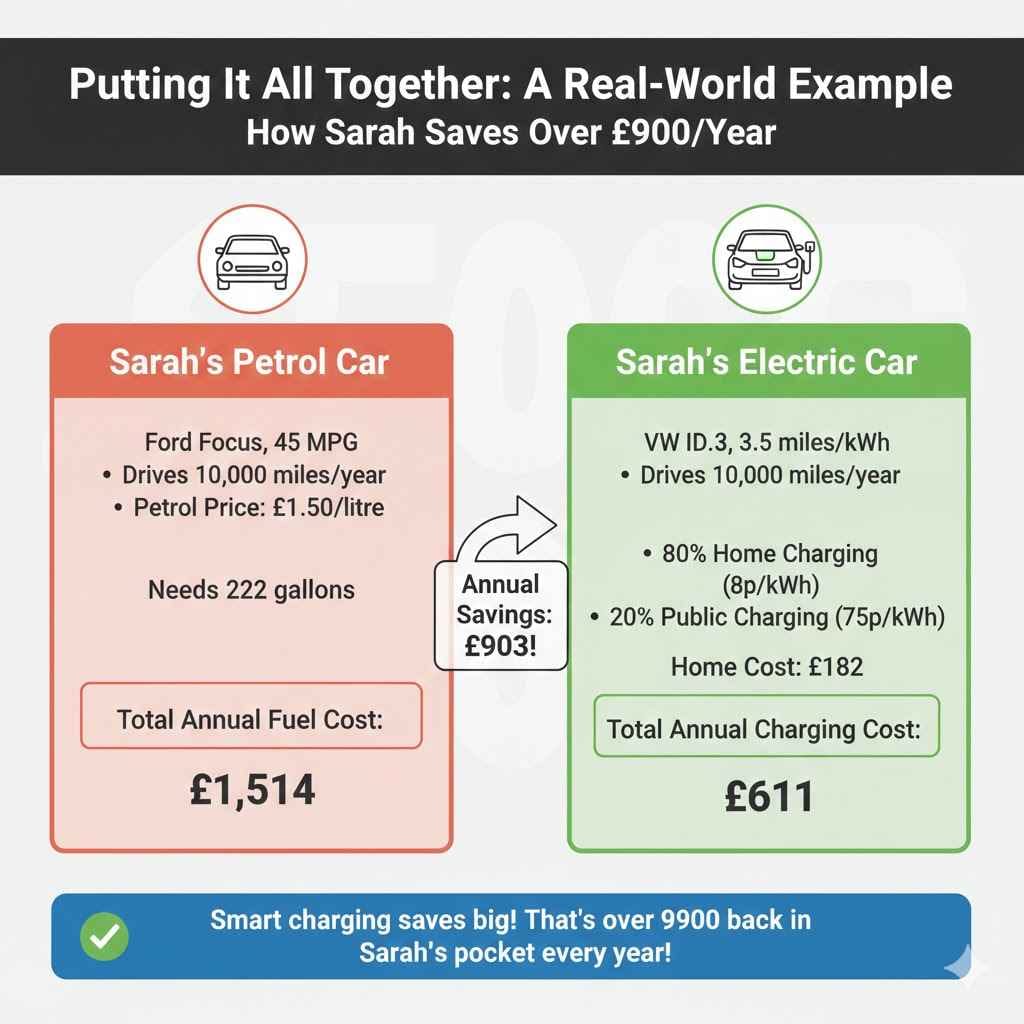
Meet Sarah. She drives 10,000 miles a year.
- Her Petrol Car: A Ford Focus that gets 45 miles per gallon (MPG).
- Her Electric Car: A VW ID.3 that gets 3.5 miles per kWh.
Petrol Car Annual Fuel Cost:
- She needs 222 gallons of petrol (10,000 miles / 45 MPG).
- At an average petrol price of £1.50 per litre (£6.82 per gallon), her annual fuel bill is: £1,514.
Electric Car Annual Charging Cost:
- She needs 2,857 kWh of electricity (10,000 miles / 3.5 miles per kWh).
- She does 80% of her charging at home on an off-peak tariff (8p/kWh).
- She does 20% of her charging on public rapid chargers (average 75p/kWh).
- Home Cost: (2,857 kWh 0.80) £0.08 = £182.85
- Public Cost: (2,857 kWh 0.20) £0.75 = £428.55
- Her total annual charging bill is: £182.85 + £428.55 = £611.
In this real-world scenario, Sarah would save over £900 every single year just on fuel costs by switching to an electric car and charging smartly. That’s a huge saving!
Frequently Asked Questions (FAQ)
Is it cheaper to charge an EV than to buy petrol?
Yes, absolutely. Even if you only used expensive public chargers, the cost per mile is often similar to or slightly less than petrol. But if you can charge at home, the cost is dramatically lower. For most drivers, you will save hundreds, if not thousands, of pounds per year.
How can I find the cheapest public chargers near me?
There are fantastic apps for this! Zap-Map and PlugShare are two of the most popular in the UK. They show you a live map of all public chargers, their availability, speed, and most importantly, their price. You can filter by network or connector type to find exactly what you need.
Do I need a special charger at home?
While you can charge an EV from a regular 3-pin wall socket, it is extremely slow and not recommended for daily use. A dedicated home wallbox charger is much faster, safer, and allows you to take advantage of smart features like scheduled charging for off-peak tariffs.
How long does it take to charge an electric car?
This depends entirely on the charger’s speed and your car’s battery size. A full charge can take anywhere from 12+ hours on a 3-pin plug, 6-8 hours on a home wallbox, to just 30-40 minutes for an 80% charge at a public rapid charger.
Does the weather affect charging costs?
The weather doesn’t directly change the price per kWh, but cold weather does reduce your car’s efficiency. The battery won’t go as far on a single charge in winter. This means you’ll need to charge more often, so your overall monthly cost might be slightly higher in colder months.
Can I use any public charger for my car?
Almost all modern EVs in the UK use the same type of connectors for slow/fast charging (Type 2) and rapid charging (CCS). The main exception is the Nissan Leaf, which uses a different rapid charging connector called CHAdeMO. Apps like Zap-Map will help you find the right chargers for your specific car.
Conclusion: Is the Cost Really “Shocking”?
So, is the cost to charge an electric car in the UK shocking? Yes, but perhaps not in the way you first thought. The truly shocking part is how incredibly cheap it can be to run an electric car when you do most of your charging at home. For just a few pounds, you can wake up every day with a full battery, ready to go.
While it’s true that public rapid chargers cost more, they are not meant for everyday use. They are the equivalent of premium fuel at a motorway service station—you pay more for the speed and convenience when you’re on a long trip. The reality for most drivers is a mix of both, with the vast majority of charging happening at home, keeping average costs very low.
Making the switch to electric puts you in the driver’s seat of your running costs. By understanding the difference between charging types and adopting a few simple habits, you can enjoy the fun of electric driving while saving a significant amount of money year after year. It’s a change that’s good for the planet and even better for your wallet.