
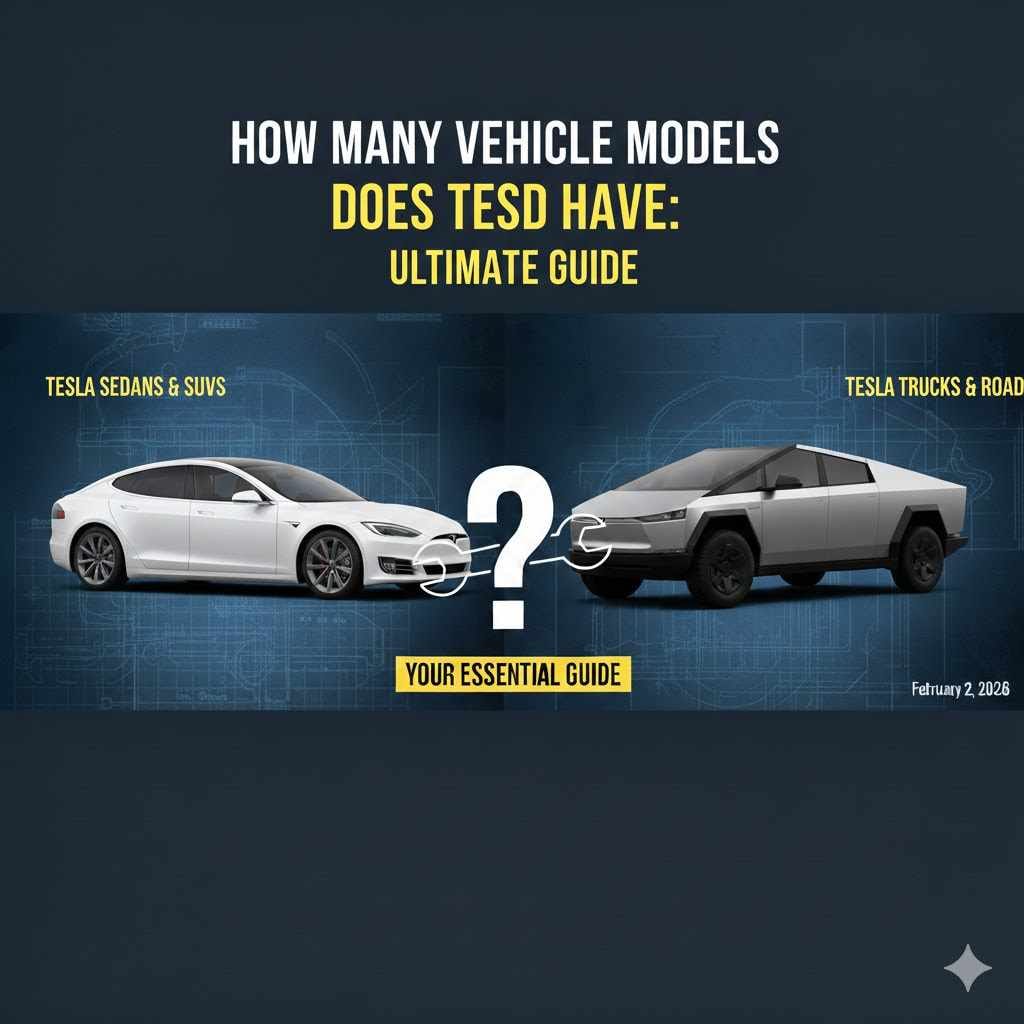
Tesla currently offers five main vehicle models for consumers: the Model S, Model 3, Model X, Model Y, and the Cybertruck. The company also produces the Tesla Semi for commercial transport. This brings the total number of distinct current models to six, with exciting vehicles like the next-generation Roadster on the horizon.
Have you ever tried to figure out exactly how many cars Tesla makes? It can feel a little confusing. You hear names like Model S, Model 3, and the futuristic Cybertruck, but it’s not always clear how they all fit together. You might wonder which one is the sedan, which is the SUV, and where new ones fit in.
Don’t worry, you’re not alone! It’s a common question. We’re going to break it down together in a simple, clear way. This guide will walk you through every single Tesla model, explaining what makes each one special. You’ll soon be able to tell them apart like a pro.
Tesla has become a household name in the automotive world, but their approach to a car lineup is very different from traditional automakers. Instead of dozens of models with confusing trim levels, Tesla focuses on a handful of core vehicles that cover the most popular segments. Let’s dive in and explore each one.
The Core Consumer Lineup: S, 3, X, Y
Tesla’s primary consumer vehicles are the Model S, Model 3, Model X, and Model Y. If you rearrange the letters, they cheekily spell “S3XY.” This was an intentional naming scheme by CEO Elon Musk to make the lineup memorable. Each of these models serves a different purpose and caters to a different type of driver.
The Trailblazer: Tesla Model S
The Model S was the car that put Tesla on the map as a serious luxury automaker. It’s a full-size premium sedan that proved electric cars could be stylish, fast, and have a long range. It set the standard for what a high-end EV could be, combining incredible performance with cutting-edge technology.
From its sleek, aerodynamic design to its massive center touchscreen that controls nearly every function of the car, the Model S feels like a vehicle from the future. It’s perfect for those who want the best of the best in terms of performance, range, and luxury features in an electric sedan.
Key Features of the Model S:
- Incredible Performance: The Plaid version is one of the fastest-accelerating production cars in the world, going from 0 to 60 mph in under two seconds.
- Longest Range: The Model S often boasts the longest EPA-estimated range of any EV on the market, making it ideal for road trips. You can learn more about official range estimates at the U.S. Department of Energy’s FuelEconomy.gov site.
- Yoke Steering: A unique, controversial, and futuristic U-shaped steering wheel that replaces the traditional round wheel (a standard wheel is now also an option).
- Spacious Interior: With a large trunk and a front trunk (frunk), it offers ample storage space for a sedan.
- Premium Comfort: Features like a high-end sound system, ventilated front seats, and a rear-seat screen make for a luxurious ride.
Who is the Model S for?
The Model S is for the driver who wants a top-of-the-line luxury experience without compromise. If you prioritize maximum performance, the longest possible range for long-distance travel, and the latest technology in a sleek sedan package, the Model S is the clear choice.
The People’s EV: Tesla Model 3
The Model 3 was Tesla’s mission to bring electric cars to the masses. It’s a smaller, more affordable compact sedan designed to compete with cars like the BMW 3 Series and Audi A4. Its arrival was a game-changer for the EV industry, making a high-quality electric car accessible to a much wider audience.
The interior of the Model 3 is famous for its minimalist design. There are almost no physical buttons; everything is controlled through a single, horizontal 15-inch touchscreen mounted in the center of the dashboard. This clean, uncluttered approach gives the car a very modern and open feel.
Key Features of the Model 3:
- Affordability: It is Tesla’s entry-level vehicle, making it the most accessible way to join the Tesla family.
- Excellent Efficiency: The Model 3 is one of the most efficient EVs available, meaning it uses less energy to travel each mile, which helps keep running costs low.
- Agile Handling: Its smaller size and lower center of gravity make it feel nimble and fun to drive, especially on winding roads.
- Glass Roof: A standard all-glass roof provides a bright, airy feel to the cabin.
- Multiple Drivetrain Options: Available in a base Rear-Wheel Drive version for maximum efficiency or Dual Motor All-Wheel Drive versions for better traction and performance.
Who is the Model 3 for?
The Model 3 is perfect for daily commuters, small families, or anyone looking for their first electric car. It offers a fantastic blend of performance, range, technology, and value, making it an excellent all-around choice for those who don’t need the massive space of an SUV.
The Family Hauler with Flair: Tesla Model X
If you need more space than a sedan can offer, the Tesla Model X is the answer. It’s a mid-size luxury SUV that combines the utility of a family vehicle with the wild performance Tesla is known for. Its most iconic feature is, without a doubt, the “Falcon Wing” rear doors.
These doors hinge up and out, creating a massive opening that makes it incredibly easy to get in and out of the back seats, even in tight parking spaces. They are not just for show; they are a practical solution for parents trying to buckle children into car seats. The Model X can also be configured with seating for five, six, or seven people, making it highly versatile.
Key Features of the Model X:
- Falcon Wing Doors: Unique, sensor-equipped rear doors that open vertically, providing unparalleled access to the second and third rows.
- Massive Panoramic Windshield: The largest all-glass panoramic windshield in production, offering an incredible, helicopter-like view for the driver and front passenger.
- Towing Capability: It is a capable SUV with the ability to tow up to 5,000 pounds, perfect for pulling a small boat or trailer.
- Flexible Seating: Available in multiple configurations to prioritize passenger capacity or cargo space.
- Top-Tier Performance: Like the Model S, the Model X is available in a Plaid version, making it one of the quickest SUVs on the planet.
Who is the Model X for?
The Model X is designed for larger families or anyone who needs the space and utility of an SUV but still craves a high-tech, high-performance driving experience. If you need to carry more than five people, want to tow, and love making a statement with features like the Falcon Wing doors, this is the Tesla for you.
The All-Rounder: Tesla Model Y
The Tesla Model Y is arguably the company’s most important vehicle right now. It’s a compact SUV that shares about 75% of its parts with the Model 3, which helps keep costs down. It hits the sweet spot for many buyers by offering the practicality of an SUV with a price point that is much closer to the Model 3 than the Model X.
Think of the Model Y as a taller, more spacious version of the Model 3. It has a similar minimalist interior and driving feel but adds a large hatchback for easier cargo loading and an optional third row of seats for small children. This versatility has made it one of the best-selling vehicles in the world.
Key Features of the Model Y:
- Exceptional Cargo Space: With its hatchback design and fold-flat rear seats, the Model Y offers a huge amount of storage room for its size.
- Optional Third Row: A small, forward-facing third row is available, increasing seating capacity to seven—a rare feature in a compact electric SUV.
- High Driving Position: As an SUV, it offers a higher, more commanding view of the road compared to the Model 3 sedan.
- Great Balance of Price and Utility: It provides much of the practicality of the larger Model X for a significantly lower price.
- Heat Pump: It includes a highly efficient heat pump for heating the cabin, which helps preserve driving range in cold weather.
Who is the Model Y for?
The Model Y is for the person or family who needs more space than a sedan but doesn’t need the massive size or expense of the Model X. It is the ultimate practical choice in the Tesla lineup, perfect for hauling gear, groceries, kids, and pets while still being efficient and fun to drive.
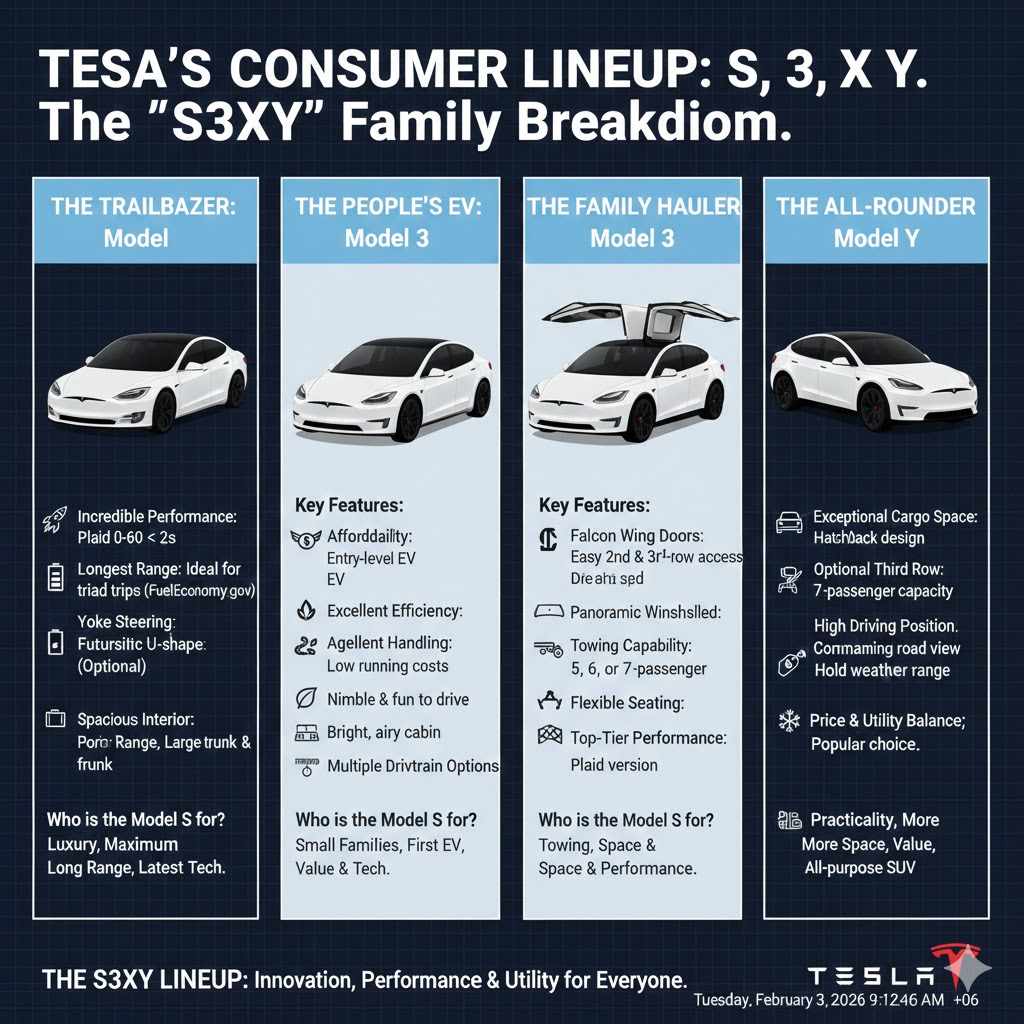
Tesla Model Comparison Table
Seeing the specs side-by-side can make it much easier to understand the differences between Tesla’s core models. Here is a simplified table to help you compare them. Note that prices, range, and performance figures can change based on the specific trim and options selected.
| Feature | Model S | Model 3 | Model X | Model Y |
|---|---|---|---|---|
| Vehicle Type | Full-Size Sedan | Compact Sedan | Mid-Size SUV | Compact SUV |
| Starting Price (Approx.) | ~$74,990 | ~$38,990 | ~$79,990 | ~$43,990 |
| Max Range (EPA Est.) | ~405 miles | ~341 miles | ~348 miles | ~330 miles |
| 0-60 mph (Fastest Trim) | 1.99 seconds | 3.1 seconds | 2.5 seconds | 3.5 seconds |
| Seating Capacity | Up to 5 | Up to 5 | Up to 7 | Up to 7 |
| Key Feature | Extreme performance, longest range | Most affordable, great value | Falcon Wing doors, most space | Versatility, SUV value |
The Newcomers and Specialty Vehicles
Beyond the core S3XY lineup, Tesla has expanded into new and exciting vehicle categories that push the boundaries of design and engineering.
The Futurist’s Ride: Tesla Cybertruck
Perhaps no vehicle in recent history has generated more buzz than the Tesla Cybertruck. With its radical, angular design made of an ultra-hard stainless steel exoskeleton, it looks like nothing else on the road. It’s built to be tough, durable, and incredibly capable.
The Cybertruck isn’t just a design statement; it’s packed with innovative features. The body panels are claimed to be bullet-resistant to small arms fire, the glass is shatter-resistant, and it offers better performance than many sports cars. It combines the utility of a truck with a level of toughness and technology that is completely unique.
Key Features of the Cybertruck:
- Stainless Steel Exoskeleton: The body provides structural integrity and is resistant to dents, damage, and long-term corrosion.
- Adaptive Air Suspension: Offers up to 17 inches of ground clearance, making it highly capable off-road.
- Incredible Towing and Payload: It can tow up to 11,000 pounds and has a payload capacity of 2,500 pounds.
- Powershare Technology: The battery can be used to power your home, tools, or even charge another EV.
- Lockable Vault: The 6-foot truck bed, called the “vault,” comes with a built-in, slidable cover to secure your cargo.
The Big Rig Reimagined: Tesla Semi
The Tesla Semi is not a consumer vehicle but is a crucial part of Tesla’s mission to transition all forms of transport to sustainable energy. It’s a fully electric Class 8 semi-truck designed to revolutionize the logistics industry.
With a claimed range of up to 500 miles on a single charge while fully loaded, the Semi aims to significantly reduce the cost of shipping goods. Its operating costs per mile are projected to be much lower than a traditional diesel truck due to cheaper “fuel” (electricity) and far fewer moving parts to maintain. Its central driver’s seat and advanced Autopilot features are also designed to improve safety and driver comfort.
What’s on the Horizon and in the Past?
Tesla’s lineup is always evolving. While they have a solid set of current models, they are always working on what’s next, and it’s worth remembering where they started.
Upcoming Model: The Next-Generation Roadster
First announced years ago, the second-generation Tesla Roadster is set to be a true “hypercar.” Tesla claims it will be the quickest car in the world, with a 0-60 mph time of 1.9 seconds, a top speed of over 250 mph, and an unprecedented range of 620 miles. It represents the absolute pinnacle of electric vehicle performance. For more details, you can visit the official Tesla Roadster page.
A Look Back: The Original Tesla Roadster
We can’t forget the car that started it all. The original Tesla Roadster (2008-2012) was the company’s first vehicle. Based on a Lotus Elise chassis, this two-seater sports car was the first highway-legal all-electric car to use lithium-ion battery cells. It proved that EVs could be exciting and desirable, paving the way for every model that followed.
Frequently Asked Questions (FAQ)
1. What is the cheapest Tesla model available?
The Tesla Model 3 is the most affordable vehicle in Tesla’s lineup. The base Rear-Wheel Drive version is the entry-level option, designed to make Tesla ownership accessible to more people.
2. Which Tesla is the best for families?
This depends on your family’s size and needs. The Model Y is a fantastic all-around choice for most families, offering a great balance of space, utility, and price. For larger families or those who need to seat up to seven adults comfortably, the Model X is the superior option with its larger cabin and easier third-row access.
3. Which Tesla has the longest driving range?
The Tesla Model S Long Range typically offers the longest EPA-estimated range of any Tesla, often exceeding 400 miles on a full charge. This makes it the best choice for drivers who frequently take long road trips and want to minimize charging stops.
4. What are the Falcon Wing doors, and which model has them?
The Falcon Wing doors are the unique, vertically opening rear doors found exclusively on the Tesla Model X. They are equipped with sensors to avoid hitting objects in garages or tight parking spaces and provide a very large opening for easy access to the rear seats.
5. How is the Cybertruck different from a normal pickup truck?
The Cybertruck is different in almost every way. Instead of a body-on-frame design, it has a stainless steel exoskeleton for durability. It is electric, offering sports-car-like acceleration. It also includes features not found on traditional trucks, like an integrated bed cover (vault), adaptive air suspension, and the ability to output power for external use (Powershare).
6. Are all Tesla models all-wheel drive (AWD)?
No, not all of them. The Model 3 offers a base version that is Rear-Wheel Drive (RWD). However, all other consumer models (Model S, Model X, Model Y, and Cybertruck) come standard with Dual Motor All-Wheel Drive for enhanced traction and performance.
7. How often does Tesla release new models?
Tesla does not follow the traditional annual model-year update cycle of other automakers. Instead, they introduce improvements and new features to their vehicles as they are developed via over-the-air software updates or mid-production hardware changes. Entirely new models, like the Cybertruck, are released much less frequently, often with several years between major new vehicle launches.
Conclusion: A Focused and Powerful Lineup
So, how many vehicle models does Tesla have? The answer is a focused and powerful six: the Model S, Model 3, Model X, Model Y, the Cybertruck, and the commercial Semi. This streamlined approach allows Tesla to perfect a few key platforms that cover the most important segments of the market—from affordable sedans and versatile SUVs to game-changing trucks.
Understanding this lineup is the first step to figuring out which EV might be right for you. Whether you need a practical daily driver like the Model 3, a family-hauling SUV like the Model Y, or the mind-bending performance of a Model S Plaid, Tesla offers a compelling option. By keeping things simple, they’ve made it easier than ever to find an electric car that fits your life. You are now equipped with the knowledge to confidently navigate the world of Tesla.