
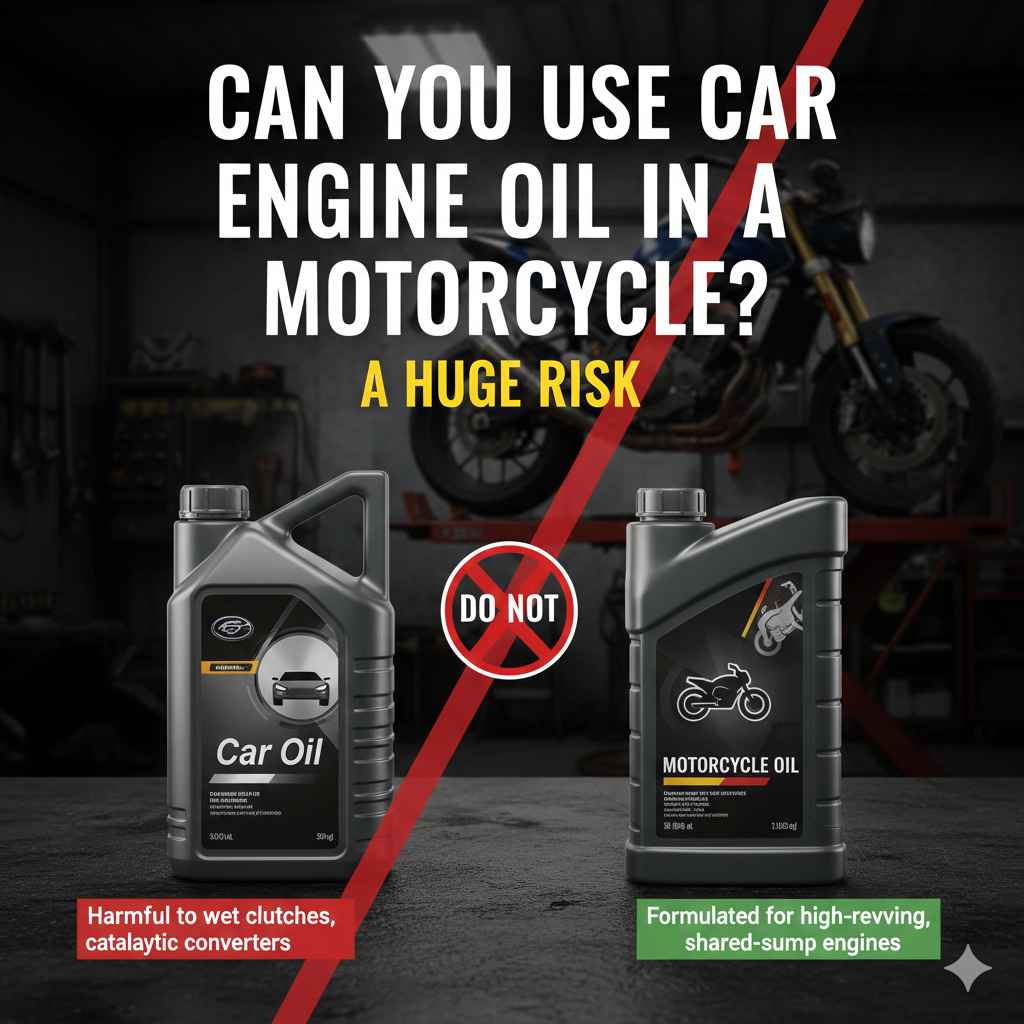
Using car engine oil in a motorcycle is a huge risk and is not recommended. Car oils contain friction modifiers that can cause your motorcycle’s wet clutch to slip, leading to severe damage and unsafe riding conditions. Always use oil specifically designed for motorcycles to protect the engine, transmission, and clutch.
Hey there, Dustin Hall here. If you own both a car and a motorcycle, you’ve probably stood in your garage, looked at a bottle of car oil, and wondered, “Can I just use this in my bike?” It seems convenient and might even save you a few bucks. It’s a super common question, and I’m glad you’re looking for the right answer before pouring.
The truth is, while they both lubricate engines, car oil and motorcycle oil are worlds apart. Using the wrong one can cause some serious headaches and expensive repairs down the road. But don’t worry, I’m here to break it all down for you. In this guide, we’ll walk through exactly why your motorcycle needs its own special oil, what could happen if you use car oil, and how to choose the right product every time. Let’s get you confident about what goes into your bike!
Why It’s Tempting to Use Car Oil in a Motorcycle
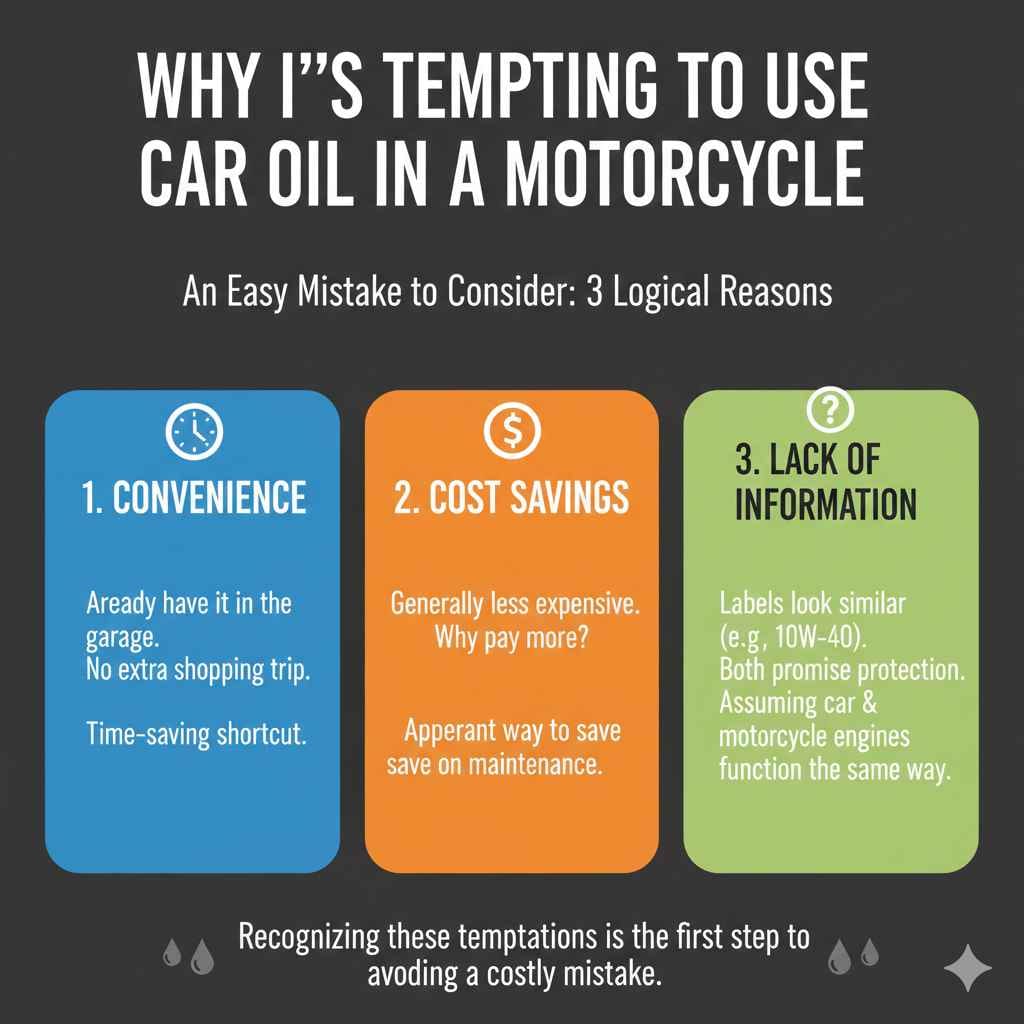
Let’s be honest, the thought of using car oil in your motorcycle crosses many minds. It’s an easy mistake to consider, especially if you’re new to riding or doing your own maintenance. There are a few logical reasons why it seems like a good idea at first glance.
First, there’s the convenience factor. You likely already have a bottle of car engine oil sitting on a shelf in your garage. If you’ve just finished changing the oil in your car, you might have some left over. Using that instead of making a separate trip to the auto parts store for motorcycle-specific oil feels like a simple, time-saving shortcut. No extra shopping, no extra clutter—just one bottle for both vehicles.
Then there’s the cost. Generally, standard car engine oil is less expensive than its motorcycle counterpart. When you see two bottles on the shelf and one is significantly cheaper, it’s natural to question if the extra cost for the motorcycle oil is truly necessary. We all want to save money on maintenance, and it’s easy to think, “Oil is oil, right? Why pay more?”
Finally, a lack of information can play a big role. To the untrained eye, the labels look similar. They both have viscosity ratings like 10W-40, and they both promise to protect your engine. Without a clear understanding of what happens inside a motorcycle engine versus a car engine, it’s easy to assume they function the same way. This assumption is where the trouble begins. But recognizing these temptations is the first step to avoiding a costly mistake.
The Big Difference: Why Motorcycles Need Special Oil
So, why can’t we just pour that 5W-30 from your sedan into your cruiser? The answer lies in how differently cars and motorcycles are designed. A motorcycle is not just a two-wheeled car; its engine, clutch, and transmission are a tightly integrated system with unique demands.
1. The Wet Clutch System: The Deal Breaker
This is the most critical difference. The vast majority of modern motorcycles use a “wet clutch.” This means the clutch—the part that engages and disengages the power from the engine to the transmission—is located inside the engine casing and is bathed in the same oil that lubricates the engine.
Here’s the problem: To improve fuel economy, car oils are packed with special additives called “friction modifiers.” These additives are designed to make engine parts as slippery as possible to reduce friction. While that’s great for a car engine, it’s a disaster for a wet clutch. A motorcycle clutch needs a certain amount of friction to grip properly. When friction-modified car oil coats the clutch plates, they can’t grab onto each other effectively. This leads to clutch slippage, especially when you accelerate hard. It feels like the engine is revving up, but the bike isn’t accelerating as it should. Continuous slippage will quickly burn out the clutch, leading to a very expensive repair.
2. Shared Sump for Engine, Gearbox, and Clutch
In most cars, the engine and the transmission are separate units, each with its own dedicated fluid. Your car uses engine oil for the engine and transmission fluid for the gearbox.
In most motorcycles, it’s a “one-pot” system. The same oil that lubricates the engine’s pistons and bearings also has to protect the transmission gears and cool the clutch. This is called a shared sump or integrated transmission. A motorcycle’s transmission puts immense pressure and shearing force on oil. The meshing gears try to tear the oil molecules apart. Motorcycle oils contain special “shear-stable” polymers that resist this breakdown, maintaining their viscosity and protective properties under extreme pressure. Car oils aren’t designed to handle this kind of punishment from gears, and they will break down much faster, leaving your transmission vulnerable to wear and tear.
3. Higher RPMs and Operating Temperatures
Motorcycle engines are built for performance. They rev much higher and run hotter than most car engines. It’s not uncommon for a sportbike to redline at 12,000 RPM or more, whereas a typical car engine might redline around 6,500 RPM. This high-revving nature generates a lot of heat and puts immense stress on the engine’s internal components.
Motorcycle oils are formulated with a more robust additive package and higher-quality base stocks to withstand these extreme temperatures and pressures. They resist thermal breakdown, prevent deposit formation, and maintain a strong lubricating film on parts even when the engine is screaming at high RPMs. Car oil, designed for the lower-stress environment of a car engine, can thin out and degrade quickly under these conditions, leading to poor lubrication and accelerated engine wear.
Car Oil vs. Motorcycle Oil: A Side-by-Side Comparison
To make it even clearer, let’s look at the key differences in a simple table. This will help you see exactly why using the right oil is so important for the health and safety of your motorcycle.
| Feature | Car Engine Oil | Motorcycle Oil |
|---|---|---|
| Primary Role | Engine lubrication only. | Lubricates engine, gearbox, and cools the wet clutch. |
| Friction Modifiers | Contains high levels to improve fuel economy. Labeled “Energy Conserving.” | Contains very low or no friction modifiers to allow proper wet clutch operation. |
| Shear Stability | Lower shear stability; not designed for gearbox stress. | High shear stability to protect transmission gears from extreme pressure. |
| High-Temperature Performance | Good, but designed for the lower operating temperatures of a car engine. | Excellent; formulated to resist breakdown at the higher temperatures of a motorcycle engine. |
| Anti-Wear Additives (e.g., ZDDP) | Levels are often reduced to protect automotive catalytic converters. | Often contains higher levels of zinc and phosphorus (ZDDP) for superior wear protection on high-stress parts. |
What Really Happens If You Use Car Oil in Your Bike?
Okay, so we know it’s bad, but what are the actual, real-world consequences? Let’s say you ignore the warnings and pour car oil into your motorcycle. Here’s a step-by-step breakdown of the potential damage.
- Clutch Slippage: This is usually the first and most noticeable symptom. The friction modifiers in the car oil will coat the clutch plates. When you try to accelerate, especially in a higher gear, the engine will rev but the bike won’t go faster. It’s not just annoying; it’s dangerous. Imagine needing to accelerate quickly to merge into traffic and having your clutch fail to engage.
- Glazed and Burnt Clutch Plates: If you continue to ride with a slipping clutch, the intense heat generated by the friction will “glaze” the clutch plates, making them smooth and useless. Soon after, they will burn out completely. This will require a full clutch replacement, which can cost hundreds of dollars in parts and labor.
- Gearbox Damage: The car oil, lacking shear stability, will start to break down under the forces of the transmission gears. Its viscosity will drop, meaning it becomes thinner and less protective. This leads to metal-on-metal contact between the gear teeth, causing pitting, chipping, and eventually, catastrophic gearbox failure. A transmission rebuild is one of the most expensive repairs a motorcycle can need.
- Increased Engine Wear: As the oil breaks down from the high heat and mechanical shearing, its ability to lubricate the engine’s pistons, cylinders, and bearings is compromised. This leads to accelerated wear on critical engine components, reducing the engine’s lifespan and performance.
- Overheating: Motorcycle oils are designed to help dissipate the intense heat from high-revving engines. Car oil may not be as effective, potentially leading to the engine running hotter than it should, which further accelerates oil breakdown and component wear.
- Voided Warranty: If your motorcycle is still under warranty, using an oil that does not meet the manufacturer’s specifications (which car oil will not) will almost certainly void your warranty coverage. If you have an engine or transmission failure, you’ll be on your own for the repair costs.
How to Choose the Right Oil for Your Motorcycle
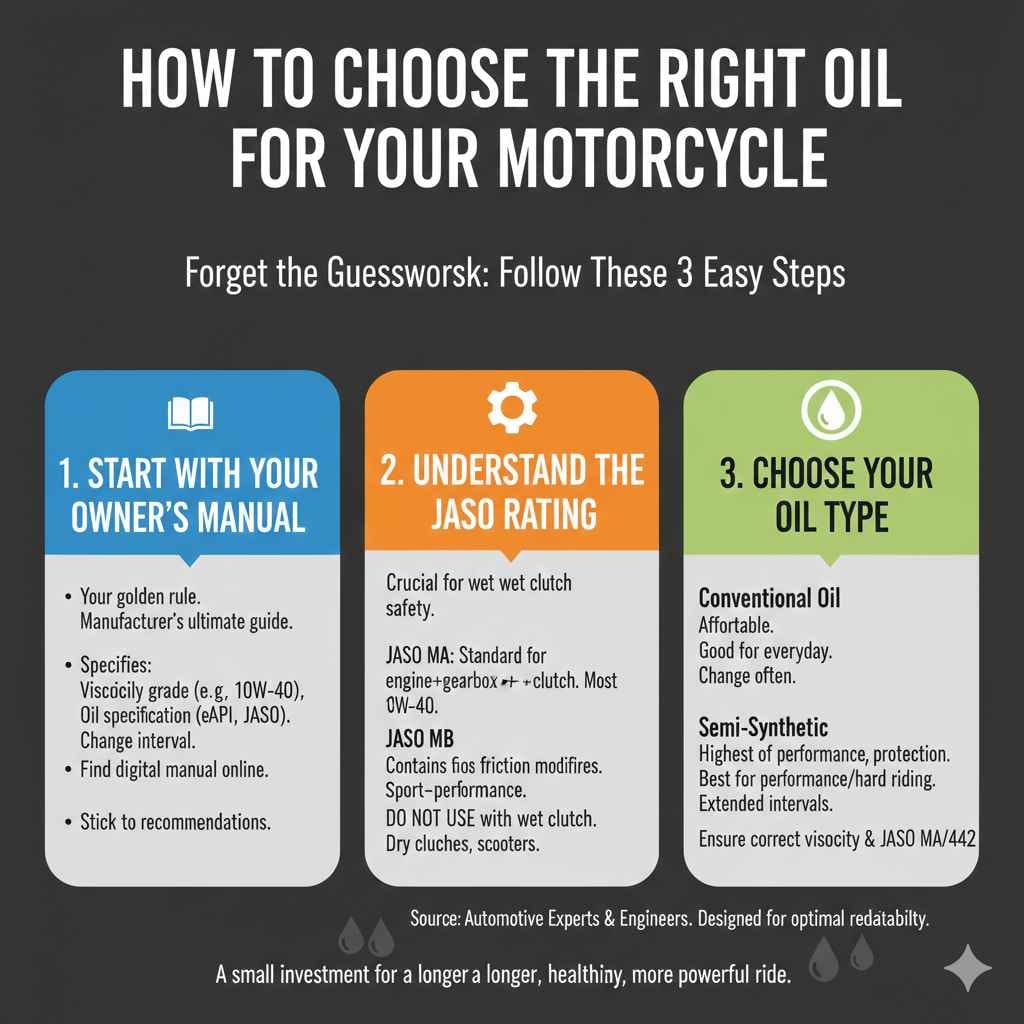
Now for the good part: choosing the right oil is actually very simple once you know what to look for. Forget the guesswork; just follow these three easy steps to ensure you’re giving your bike exactly what it needs.
Step 1: Always Start with Your Owner’s Manual
This is your golden rule. Your motorcycle’s manufacturer has spent millions of dollars on research and development to determine the perfect oil for your specific model. The owner’s manual is your ultimate guide. It will tell you:
- The recommended viscosity grade (e.g., 10W-40, 20W-50).
- The required oil specification (e.g., API SG, JASO MA2).
- The oil change interval.
If you don’t have your physical manual, you can almost always find a digital version on the manufacturer’s website. Stick to these recommendations, and you can’t go wrong.
Step 2: Understand the JASO Rating
When you look at a bottle of motorcycle oil, you’ll see a code on it that you won’t find on car oil: the JASO rating. JASO stands for the Japanese Automotive Standards Organization. This rating is the most important indicator that an oil is safe for your motorcycle’s wet clutch.
Here’s a simple breakdown of the ratings:
| JASO Rating | What It Means | Best For |
|---|---|---|
| JASO MA | The original standard for oils used in a single system (engine, gearbox, and wet clutch). No friction modifiers. | Most motorcycles. |
| JASO MA2 | A higher standard delivering the best clutch performance. Ideal for modern, high-performance bikes. | Sportbikes and bikes that require optimal clutch feel and engagement. |
| JASO MB | Contains friction modifiers. DO NOT USE with a wet clutch. | Motorcycles with dry clutches or scooters with automatic transmissions (CVTs). |
For almost all manual transmission motorcycles, you should look for an oil that is rated JASO MA or JASO MA2. The label on the back of the bottle will clearly show this certification.
Step 3: Choose Your Oil Type (Conventional, Synthetic, or Blend)
Finally, you’ll choose between conventional, synthetic, or semi-synthetic oil. Again, your owner’s manual may have a recommendation, but you often have some flexibility here.
- Conventional Oil: This is the most affordable option. It’s refined from crude oil and provides good lubrication for standard, everyday riding. It does break down faster than synthetics, so you’ll need to stick closely to your oil change schedule.
- Full Synthetic Oil: This is engineered in a lab for the highest level of performance and protection. It offers superior resistance to heat and breakdown, flows better in cold weather, and can extend the time between oil changes. It’s the best choice for high-performance bikes or for riders who push their machines hard.
- Semi-Synthetic (or Synthetic Blend): This is a mix of conventional and synthetic oils, offering a balance between performance and price. It provides better protection than conventional oil but is more affordable than full synthetic. It’s a great all-around choice for many riders.
The choice here often comes down to budget and riding style. But no matter which type you choose, make sure it has the correct viscosity and the all-important JASO MA/MA2 rating.
Frequently Asked Questions (FAQ)
1. What if I used car oil in my motorcycle just once by accident?
If you used it for a very short ride, you might be okay. The best course of action is to drain the car oil immediately and completely. Refill it with the correct motorcycle-specific oil and replace the oil filter. The main danger is clutch damage, which happens over time with slippage, so acting quickly can prevent lasting harm. Do not continue to ride with the wrong oil in it.
2. Is there any car oil that is safe for a motorcycle?
Some older, non-energy-conserving car oils (often diesel oils like Shell Rotella T4) that do not have friction modifiers have been used by some riders in the past. However, this is a risky gamble. Modern car oil formulations change, and it’s far safer and simpler to just buy an oil that is certified with the JASO MA or MA2 rating, which guarantees it is safe for your wet clutch.
3. What does “10W-40” mean on an oil bottle?
This is the oil’s viscosity grade. The “10W” indicates how easily the oil flows at cold temperatures (the “W” stands for Winter). The “40” represents the oil’s viscosity at normal operating temperatures. A lower first number is better for cold starts, and the second number indicates its thickness when hot. Always use the viscosity grade recommended in your owner’s manual.
4. My motorcycle has a dry clutch. Can I use car oil then?
Some motorcycles, like many BMWs and Moto Guzzis, have a dry clutch, similar to a car. In these specific cases, the clutch is separate from the engine oil. However, you still have the issue of the integrated transmission. The engine oil must still be robust enough to protect the gearbox gears. It is still highly recommended to use a motorcycle-specific oil to handle the shearing forces of the transmission, even if a wet clutch is not a concern.
5. How is diesel engine oil different from car or motorcycle oil?
Diesel engine oil (like Shell Rotella or Delo 400) is designed for heavy-duty applications. It has high levels of detergents to handle soot and a robust anti-wear additive package. Some diesel oils lack friction modifiers and have been used in motorcycles. However, they are not specifically formulated for high-revving engines and wet clutch performance. For peace of mind and guaranteed compatibility, a JASO-rated motorcycle oil is always the superior choice.
6. Will using car oil really void my motorcycle’s warranty?
Yes, absolutely. Every manufacturer specifies the type of oil that must be used to maintain the warranty. Using a fluid that does not meet those specifications (like an “Energy Conserving” automotive oil) gives the manufacturer grounds to deny any warranty claims related to the engine, clutch, or transmission. It’s a huge financial risk to save a few dollars on an oil change.
7. Can I use motorcycle oil in my car?
While it wouldn’t cause the catastrophic damage that car oil causes in a bike, it’s not a good idea. Motorcycle oil is more expensive and lacks the friction-modifying additives that modern cars use to maximize fuel economy. Your car’s gas mileage would likely suffer. It’s always best to use the right fluid for the right vehicle.
Conclusion: The Right Choice for a Healthy Bike
At the end of the day, your motorcycle is more than just a machine; it’s a source of freedom and enjoyment. Giving it the right care is a small price to pay for its reliability and longevity. While the idea of using that convenient bottle of car oil in your garage is tempting, the risks far outweigh the benefits. The unique design of a motorcycle—with its integrated gearbox, high-revving engine, and all-important wet clutch—demands an oil specifically formulated to handle those challenges.
Choosing a motorcycle-specific oil with the correct viscosity and a JASO MA or MA2 rating is one of the easiest and most effective things you can do to protect your investment. It ensures your clutch grips firmly, your transmission shifts smoothly, and your engine is protected from the extreme heat and stress of the ride. So next time you’re ready for an oil change, walk past the car oil and grab the bottle made for your bike. Your motorcycle—and your wallet, in the long run—will thank you for it.