
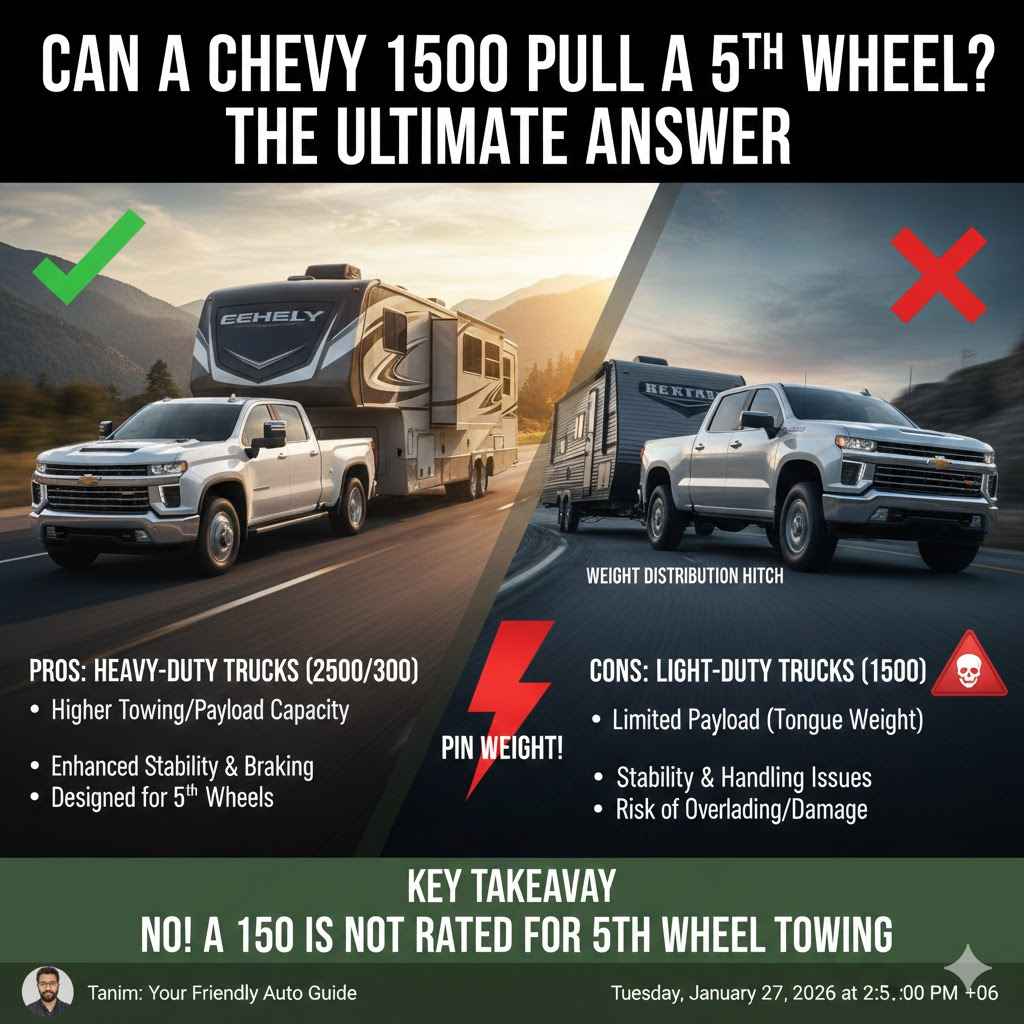
Yes, a properly equipped Chevrolet 1500 can pull certain lightweight 5th wheel trailers. However, it’s crucial to match your truck’s specific payload capacity with the trailer’s pin weight. Exceeding these limits is unsafe and can damage your truck. This guide will show you how to check everything safely and confidently.
Thinking about hitting the open road with a 5th wheel trailer? It’s a fantastic dream. You get more space and a smoother towing experience. But then comes the big question: is your trusty Chevy 1500 up for the job? You see bigger trucks pulling them all the time, and it can be confusing.
Many people wonder if their half-ton truck can handle that kind of weight. The good news is, it might be possible! The bad news is that it’s not as simple as looking at one number in a brochure. Don’t worry, though. I’m here to walk you through every step. We’ll break down the numbers, show you exactly what to look for, and help you make a safe choice. Let’s figure this out together.
Understanding the Basics: Why This Question is Tricky
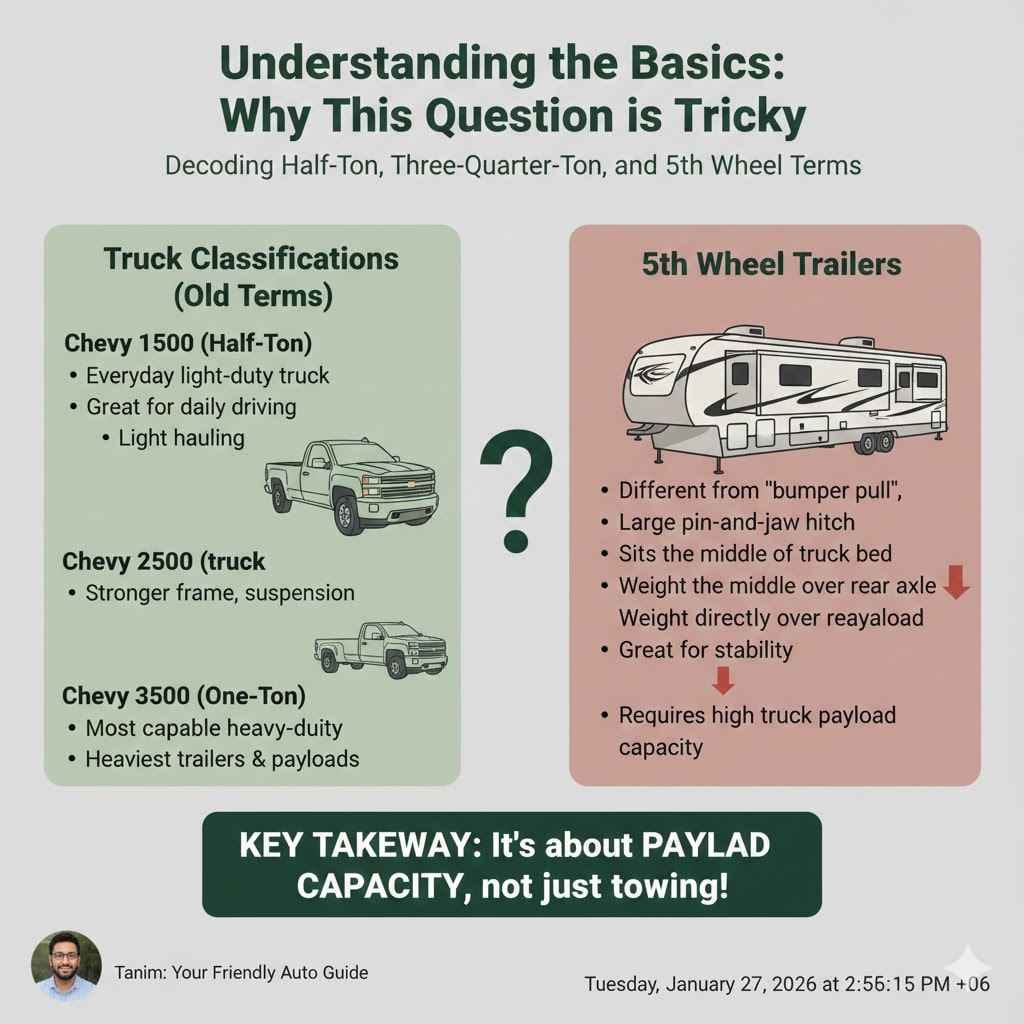
Before we dive into the numbers, let’s clear up a few things. You often hear trucks called “half-ton,” “three-quarter-ton,” and “one-ton.” These are old terms, but they give us a basic idea of a truck’s capability.
- Chevy 1500 (Half-Ton): This is your everyday light-duty truck. It’s great for daily driving, light hauling, and pulling smaller trailers.
- Chevy 2500 (Three-Quarter-Ton): This is a heavy-duty truck. It has a stronger frame, suspension, and engine, designed for bigger jobs.
- Chevy 3500 (One-Ton): This is the most capable heavy-duty truck, built for the heaviest trailers and payloads.
A 5th wheel trailer is different from a regular “bumper pull” travel trailer. Instead of connecting to a hitch on your bumper, it uses a large pin-and-jaw hitch (like a semi-truck) that sits in the middle of your truck bed. This puts the trailer’s weight directly over your truck’s rear axle. This is great for stability, but it also means the truck itself has to carry a lot of weight. This is why the answer isn’t so simple.
The Key Numbers You MUST Know: Towing vs. Payload
When you see truck commercials, they love to shout about massive towing capacity numbers. But for a 5th wheel, another number is far more important. Let’s break down the two you need to know.
Towing Capacity: The Big, Often Misleading Number
Towing capacity is the total weight your truck is rated to pull behind it. For example, a new Chevy 1500 might be advertised with a towing capacity of over 13,000 pounds. That sounds like plenty, right?
Here’s the catch: that number is usually for a specific, often basic, truck model with nothing in it but a 150-pound driver. It doesn’t account for your family, your camping gear, or the heavy 5th wheel hitch itself. Towing capacity is a good starting point, but it’s not the final answer.
Payload Capacity: The REAL Limiting Factor for 5th Wheels
Payload capacity is the most important number for 5th wheel towing. Pay close attention to this one. Payload is the total weight your truck can safely carry in and on itself. This includes everything you add to the truck’s factory weight.
What counts as payload? A lot more than you think:
- You and all your passengers
- The 5th wheel hitch (they can weigh 100-200 pounds!)
- Coolers, firewood, tools, and any other gear in the cab or bed
- And most importantly, the trailer’s “pin weight”
For a Chevy 1500, you will almost always run out of payload capacity long before you reach your maximum towing capacity. This is the secret that most people miss.
What is Pin Weight?
Pin weight is the downward force that the 5th wheel trailer puts on the hitch in your truck bed. Think of it as the portion of the trailer’s weight that your truck has to physically carry. This pin weight counts 100% against your payload capacity.
A good rule of thumb is that a 5th wheel’s pin weight is about 15% to 25% of its total loaded weight. For a 10,000-pound trailer, that could be 1,500 to 2,500 pounds of pin weight pushed down into your truck bed. That’s a huge amount for a half-ton truck!
How to Find Your Chevy 1500’s Real-World Capacities
So, how do you find the real numbers for your specific truck? Forget the commercials and brochures. You need to look at the stickers right on your vehicle. It’s easy, I promise.
Step 1: Find the Tire and Loading Information Sticker
Open your driver’s side door. Look on the door frame (the B-pillar) for a yellow and white sticker. This is the “Tire and Loading Information” sticker, and it holds the key.
Look for the line that says: “The combined weight of occupants and cargo should never exceed XXXX lbs or XXXX kg.”
That number is your truck’s specific payload capacity as it left the factory. This is your most important number. Write it down!
Step 2: Check Your Owner’s Manual
Your owner’s manual has a section on towing. It will have detailed charts that show the maximum towing capacity based on your truck’s specific engine, axle ratio, cab style, and whether it’s 2WD or 4WD. This will give you the maximum trailer weight you can consider.
Step 3: Use an Online VIN Decoder
For a tech-savvy approach, you can use your truck’s Vehicle Identification Number (VIN) to find its specs. The National Highway Traffic Safety Administration (NHTSA) offers a free VIN decoder that can provide details about your vehicle’s factory build. Many manufacturers also have towing guides on their websites where you can look up your year and model.
Let’s Do the Math: A Real-World Example
Numbers can be intimidating, so let’s walk through an example. This will show you exactly how payload gets used up so quickly.
Imagine we have a 2021 Chevy Silverado 1500. We open the driver’s door and find the payload sticker says 1,750 lbs.
- Start with your payload capacity: 1,750 lbs
- Subtract your passengers: You (200 lbs) + your partner (150 lbs) + two kids (150 lbs total) = 500 lbs.
Remaining Payload: 1,750 – 500 = 1,250 lbs
- Subtract your cargo: A heavy-duty 5th wheel hitch (150 lbs) + a cooler, some tools, and firewood (100 lbs) = 250 lbs.
Remaining Payload: 1,250 – 250 = 1,000 lbs
After loading up your family and gear, you have 1,000 pounds of payload capacity left for the trailer’s pin weight. This is your real-world limit.
Now, let’s find a trailer. If we assume the pin weight is 20% of the total trailer weight, we can calculate the maximum size trailer you can safely handle:
1,000 lbs (available payload) / 0.20 (20% pin weight) = 5,000 lbs (maximum trailer GVWR)
In this realistic scenario, your truck can only safely handle a 5th wheel that weighs a maximum of 5,000 pounds when fully loaded. This is a far cry from the 13,000+ pounds you might see in an ad, and it highlights why payload is the number that truly matters.
Finding a “Half-Ton Towable” 5th Wheel: What to Look For
Luckily, RV manufacturers know there’s a market for lighter trailers. They build specific “half-ton towable” or “lite” 5th wheel models. But you still need to be a savvy shopper and verify every number yourself.
Here’s a checklist of what to look for on a trailer’s spec sheet:
- Unloaded Vehicle Weight (UVW) or Dry Weight: This is the weight of the empty trailer as it comes from the manufacturer. It’s a starting point, but you will be adding weight to it.
- Gross Vehicle Weight Rating (GVWR): This is the absolute maximum the trailer can weigh when fully loaded with water, propane, food, and all your gear. This is the number you should use for your safety calculations.
- Hitch Weight or Pin Weight: This is the manufacturer’s estimate of the pin weight. Be aware that this is often based on the empty trailer (UVW). The real-world pin weight will be higher once you load it up.
Here is a sample table of what you might see when shopping for lightweight 5th wheels. Notice how the pin weights can vary.
| Example Trailer Model | GVWR (Max Loaded Weight) | UVW (Empty Weight) | Advertised Pin Weight | Estimated Loaded Pin Weight (20% of GVWR) |
|---|---|---|---|---|
| Scamp 19′ Deluxe | 3,500 lbs | 2,900 lbs | 400 lbs | 700 lbs |
| Escape 5.0 | 5,500 lbs | 4,055 lbs | 680 lbs | 1,100 lbs |
| Keystone Cougar Half-Ton 25RES | 9,500 lbs | 7,820 lbs | 1,480 lbs | 1,900 lbs |
As you can see from the table, even trailers marketed as “Half-Ton” can have pin weights that would easily overload a typical Chevy 1500 once the trailer is loaded and you account for passengers and gear in the truck.
Pros and Cons of Towing a 5th Wheel with a Chevy 1500
Deciding to use a 1500 for a 5th wheel has its trade-offs. It’s important to be honest about them.
Pros
- Better Daily Driver: A Chevy 1500 is smaller, more maneuverable in parking lots, and more comfortable for everyday driving when you’re not towing.
- Improved Fuel Economy: You’ll save money on gas during your daily commute compared to a heavy-duty truck.
- Lower Purchase Price: A 1500 is generally less expensive to buy and maintain than its 2500 or 3500 counterparts.
Cons
- Extremely Limited Trailer Choice: Your options will be restricted to a very small number of ultra-lightweight 5th wheel models.
- Thin Safety Margins: You will likely be operating very close to your truck’s maximum payload and axle weight ratings. There is little room for error in loading.
- Increased Wear and Tear: Towing at or near maximum capacity puts more strain on your truck’s engine, transmission, brakes, and suspension over time.
- Less Stability: A lighter truck will be more affected by crosswinds and suction from passing semi-trucks, which can make for a more stressful driving experience.
Essential Upgrades for Your Chevy 1500
If you find a compatible 5th wheel and decide to move forward, a few upgrades are highly recommended for safety and performance. Consider these non-negotiable.
- Trailer Brake Controller: This is a must-have. A brake controller is a device mounted in your cab that activates the trailer’s brakes in sync with your truck’s brakes. Most modern trucks come with an integrated brake controller (IBC), but if yours doesn’t, you must have one installed.
- Upgraded Suspension: A heavy pin weight will cause the rear of your truck to “sag.” This can affect steering and headlight aim. Installing suspension airbags or helper springs can level out your truck and improve ride quality.
- Load Range “E” Tires: Your standard passenger (P-metric) tires are not designed for heavy loads. Upgrading to Light Truck (LT) tires with a Load Range E rating gives you stiffer sidewalls for better stability and safety.
- Professional Hitch Installation: A 5th wheel hitch must be bolted directly to the frame of your truck. This is not a DIY job for a beginner. Have it professionally installed to ensure it’s done safely and correctly.
Is It Worth It? When to Consider a 2500 Instead
So, we come back to the big question. While a Chevy 1500 can technically pull a small 5th wheel, should it?
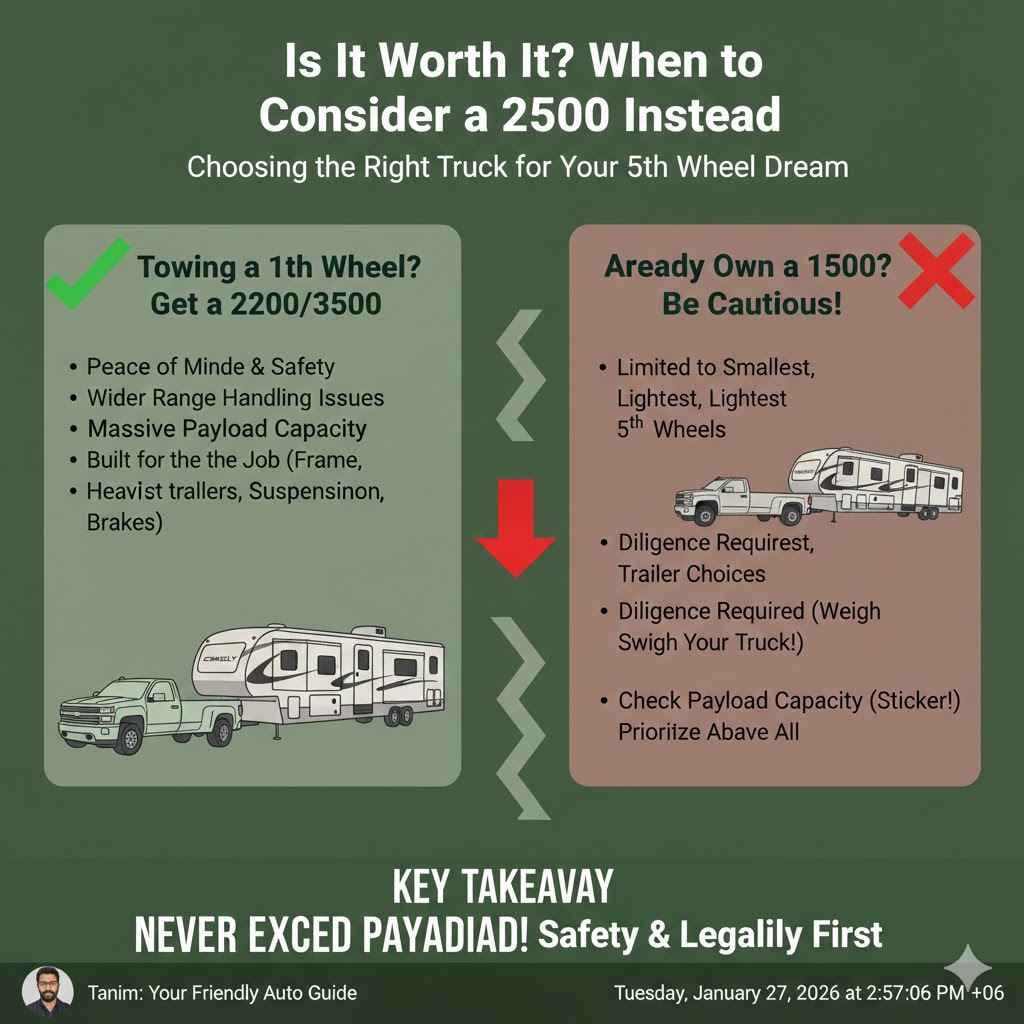
Here’s my honest advice: If you don’t own a truck yet and your primary goal is to tow a 5th wheel, buy a three-quarter-ton (2500) or one-ton (3500) truck. The peace of mind, wider range of trailer choices, and massive safety buffer are absolutely worth it. A heavy-duty truck is built from the ground up for this kind of work.
If you already own a Chevy 1500 and love it, and you are willing to be limited to the smallest, lightest 5th wheels on the market, then it can be done. But you must be diligent. Weigh your truck, do the math, check every number, and prioritize safety above all else. For great general information on matching a truck and trailer, industry resources like the RVIA Towing Guide can provide additional context.
Never, ever exceed your truck’s payload capacity. It’s the law, and more importantly, it’s about keeping you, your family, and everyone else on the road safe.
Frequently Asked Questions (FAQ)
Can any Chevy 1500 pull a 5th wheel?
No. Only a 1500 with a high enough payload capacity can handle the pin weight of the very lightest 5th wheel models. Factors like engine size, axle ratio, and cab configuration all affect this. You must check the specific ratings for your individual truck.
What is the most important number to check for 5th wheel towing?
Payload capacity. You will almost always exceed your truck’s payload capacity long before you reach its maximum towing capacity when pulling a 5th wheel. Find this number on the yellow “Tire and Loading Information” sticker on the driver’s side door jamb.
Where do I find my truck’s payload capacity?
On the “Tire and Loading Information” sticker inside the driver’s side door frame. Look for the phrase “The combined weight of occupants and cargo should never exceed XXXX lbs.” That number is your payload.
What happens if I overload my truck?
Overloading your truck is extremely dangerous. It can lead to brake failure, tire blowouts, suspension damage, and an inability to control the vehicle, potentially causing a serious accident. It can also void your truck’s warranty and may lead to legal trouble.
Do I need a special license to pull a 5th wheel?
In most states, you do not need a special license as long as the combined weight of your truck and trailer (the GCWR) is under 26,001 pounds. However, laws vary by state, so it is always best to check with your local DMV to be certain.
Can a Chevy 1500 with the 3.0L Duramax diesel pull a 5th wheel?
While the 3.0L Duramax engine has excellent torque for pulling, the engine itself is heavier than the gas V8s. This extra engine weight often reduces the truck’s overall payload capacity, making it even more challenging to find a compatible 5th wheel. Always check the payload sticker on the specific truck.
What’s the difference between a 5th wheel and a gooseneck hitch?
Both hitches mount in the truck bed, but they connect differently. A 5th wheel uses a large, flat plate with a jaw that locks onto a “king pin.” A gooseneck uses a ball hitch in the bed that connects to a coupler on the trailer. 5th wheels are almost exclusively for RVs, while goosenecks are more common for livestock and flatbed trailers.
Your Final Answer and A Safer Journey
So, can a Chevy 1500 pull a 5th wheel? The ultimate answer is a very cautious “yes, but only the right truck with the right trailer.” It is not a simple yes or no. It requires you to become a student of your truck’s capabilities, to do the math carefully, and to accept the limitations of a light-duty truck.
Your journey should be about enjoyment and adventure, not stress and worry. By putting safety first and respecting your vehicle’s limits, you ensure that every trip is a good one. Check your stickers, know your weights, and tow with confidence. The open road is waiting for you.