
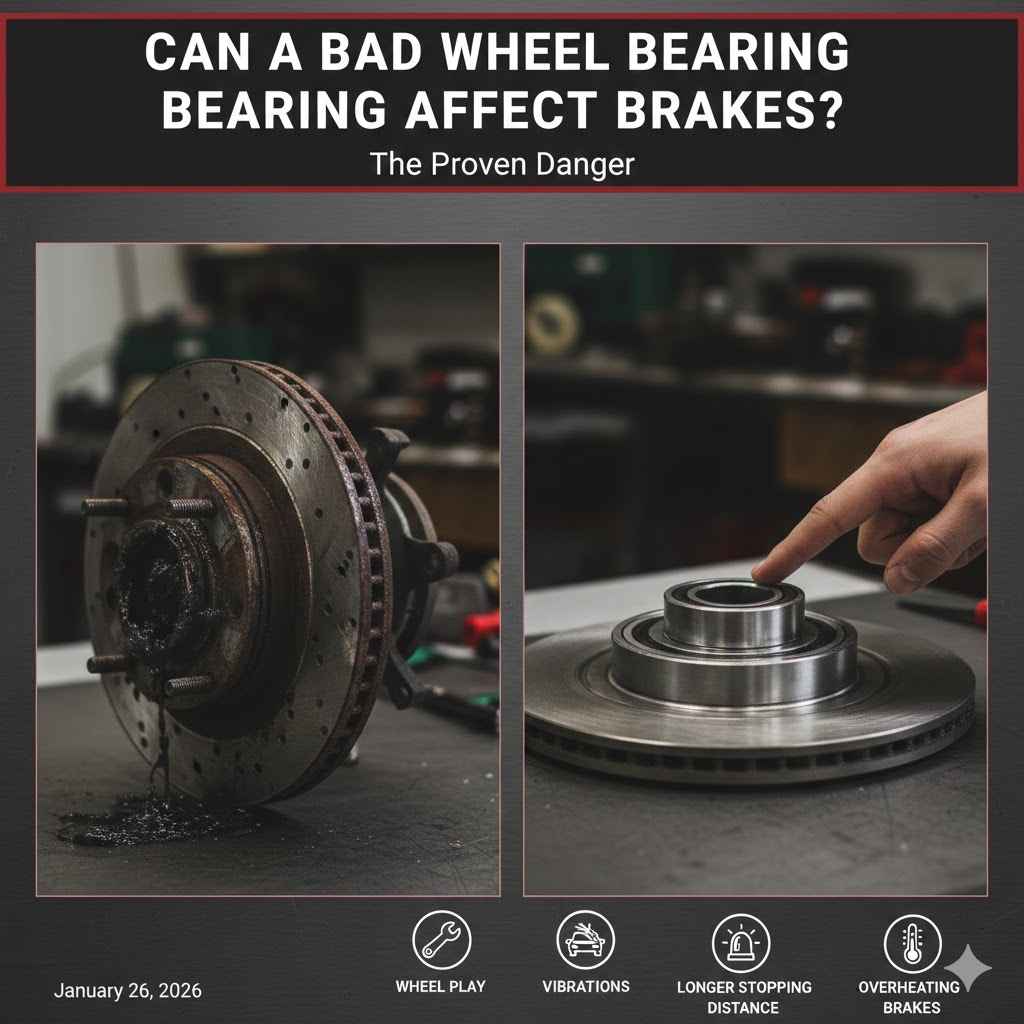
Yes, a bad wheel bearing can absolutely affect your brakes. A failing bearing causes the wheel to wobble, which makes the brake rotor move erratically. This leads to a pulsating brake pedal, uneven pad wear, and grinding noises. In severe cases, it can cause brake failure, making it a serious safety hazard.
Have you ever hit the brakes and felt a strange vibration or heard a grinding noise? You might think it’s just your brakes, but the real culprit could be hiding right behind your wheel. It’s a small part called a wheel bearing, and when it goes bad, it can cause big problems for your ability to stop safely.
It can be frustrating when your car makes a new, scary noise. But don’t worry. We’re going to figure this out together. I’ll walk you through exactly how a bad wheel bearing impacts your brakes, what signs to look for, and what you need to do to stay safe on the road. Let’s get you back in control.
What is a Wheel Bearing, Anyway?
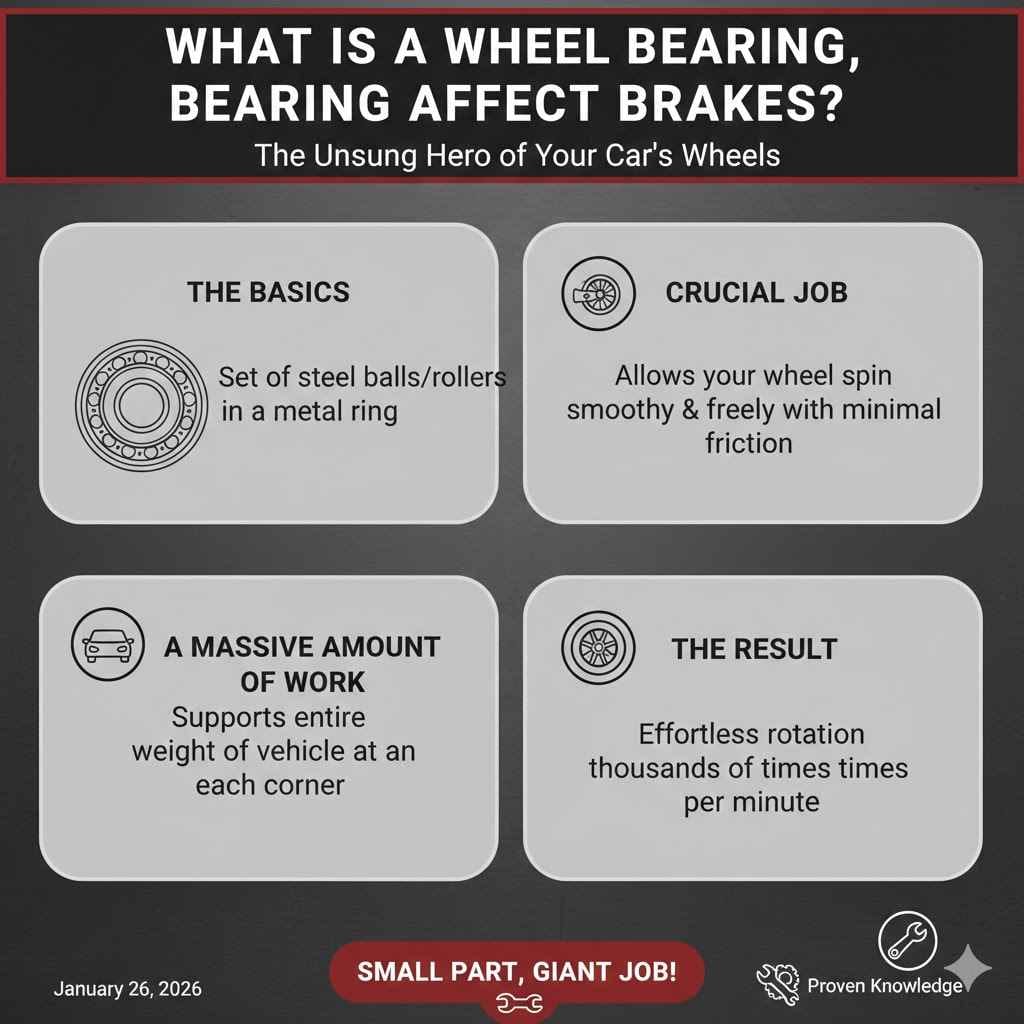
Before we dive into the problems, let’s talk about what a wheel bearing actually is. Think of it as a set of steel balls or rollers held together in a metal ring. This little powerhouse sits inside the wheel hub, and its job is simple but crucial: it allows your wheel to spin smoothly and freely with very little friction.
Imagine trying to spin a heavy wheel on a fixed axle without a bearing. It would be incredibly difficult and create a lot of grinding and heat. The wheel bearing makes it effortless. It supports the entire weight of your vehicle at that corner while letting the wheel rotate thousands of times per minute. It’s a small part that does a massive amount of work.
How Your Brakes and Wheel Bearings Work Together
Now, let’s look at how your brakes and wheel bearings are connected. They are neighbors that have to work in perfect harmony. Here’s a quick rundown of the setup:
- The Wheel Bearing is pressed into the Wheel Hub.
- The Brake Rotor (the shiny metal disc) is bolted directly onto the wheel hub.
- The Brake Caliper (which holds the brake pads) sits over the rotor.
- Your Wheel is then bolted onto the hub, sandwiching the rotor in place.
When you press the brake pedal, the caliper squeezes the brake pads against the spinning rotor. The friction slows the rotor, which slows the hub, which slows your wheel. For this to work perfectly, the rotor needs to spin perfectly straight and true. And what ensures the rotor and hub spin straight? You guessed it—the wheel bearing.
The Real Danger: 5 Ways a Bad Wheel Bearing Destroys Your Brakes
When a wheel bearing wears out, it develops “play” or looseness. This means it can no longer hold the wheel hub perfectly steady. That small amount of wobble is where all the trouble begins. Here’s exactly how a failing bearing can directly impact your braking system.
1. It Creates a Wobble and Vibration
This is the most common effect. A loose bearing allows the entire wheel hub assembly to wobble as it spins. Since your brake rotor is bolted directly to that hub, the rotor wobbles too. This is often called “rotor runout.”
When you press the brake pedal, the brake pads try to clamp down on a rotor that is wobbling back and forth. This creates a pulsing or vibrating sensation that you can feel in the brake pedal and sometimes in the steering wheel. Many people misdiagnose this as a “warped rotor,” but a bad bearing is often the root cause.
2. It Causes Uneven and Premature Brake Pad Wear
A wobbling rotor doesn’t make even contact with the brake pads. As it wobbles, it will push the brake pads in and out of the caliper piston slightly. This constant movement causes the pads to wear down unevenly.
You might notice that one pad is much thinner than the other or that the pad surface is tapered. This not only reduces the life of your brake pads but also significantly reduces your stopping power because the pads aren’t making full, solid contact with the rotor.
3. It Can Damage the Brake Rotor and Caliper
If the wobble from a bad wheel bearing becomes severe, things can get much worse. The out-of-control movement of the rotor can cause it to physically strike the brake caliper bracket or the caliper itself. This can lead to:
- Grooves and scoring on the brake rotor.
- Damage to the brake caliper, which can cause it to seize or leak fluid.
- Broken brake pad hardware, like clips and springs.
This kind of damage is not just expensive to fix; it can lead to a sudden and complete loss of braking ability on that wheel.
4. It Can Trigger Your ABS Light
On most modern cars, the Anti-lock Braking System (ABS) sensor is part of the wheel bearing and hub assembly. This sensor reads a magnetic ring (called a tone ring) to measure your wheel speed. This data tells the ABS computer when a wheel is about to lock up during hard braking.
A failing wheel bearing can damage this delicate sensor or cause the tone ring to wobble. The sensor gets an erratic signal, which confuses the ABS computer. This often triggers the ABS warning light on your dashboard and can cause the ABS to activate incorrectly, or not at all when you need it most. For more detail on how these systems work, the National Highway Traffic Safety Administration (NHTSA) has great info on vehicle safety technologies.
5. It Creates a Spongy or Long Brake Pedal
As the wobbly rotor pushes the brake pads apart, it forces the piston back into the brake caliper. This creates a small air gap. The next time you press the brake pedal, you have to push the pedal further to close that gap before the pads make contact with the rotor. This can make your brake pedal feel soft, spongy, or like it has to travel a long way before the brakes engage.
Symptoms of a Bad Wheel Bearing vs. Bad Brakes
It can be tough to tell if your problem is the bearing or the brakes, as the symptoms can overlap. Here’s a table to help you spot the differences.
| Symptom | Likely a Bad Wheel Bearing If… | Likely a Brake Problem If… |
|---|---|---|
| Grinding/Growling Noise | The noise is constant while driving and changes pitch when you turn. It may get louder or quieter when braking. | The noise only happens when you press the brake pedal. |
| Vibration/Pulsing | You feel a vibration in the steering wheel or floor that is present while driving and may change with speed. It gets worse when braking. | The pulsing or vibration is only felt in the brake pedal, and only when you are actively braking. |
| Vehicle Pulling | The car pulls to one side constantly, even when you aren’t braking. | The car only pulls to one side when you press the brakes (this is often a stuck caliper). |
| ABS Light On | The light comes on along with a humming or grinding noise from a wheel. | The light comes on with no other noises, possibly indicating a sensor issue or brake fluid problem. |
How to Check for a Bad Wheel Bearing (The Wiggle Test)
If you suspect a bad wheel bearing, you can perform a simple check at home to confirm it. Safety first! Make sure your car is on a level surface, in park, with the parking brake on.
- Safely Jack Up the Car: Place wheel chocks behind the opposite wheels. Use a proper jack at the vehicle’s designated lift point and secure the car with a jack stand. Never rely on a jack alone to hold the vehicle.
- Grab the Wheel: Place one hand at the top of the tire (12 o’clock position) and the other at the bottom (6 o’clock position).
- Push and Pull: Try to rock the wheel in and out. Push with your top hand while you pull with your bottom hand, then reverse.
- Feel for Play: If you feel any movement, clunking, or looseness, you likely have a bad wheel bearing. A healthy bearing will have no play at all.
- Check Side-to-Side: You can also grab the wheel at the 3 o’clock and 9 o’clock positions and try to wiggle it. Side-to-side play can also indicate a bad bearing, but it can sometimes point to a worn tie rod end, so the top-and-bottom test is more definitive for bearings.
If you feel any movement, it’s time to get it replaced. Don’t delay this repair.
The Danger of Waiting: Why You Must Fix It Now
Ignoring a bad wheel bearing is not just bad for your brakes—it’s incredibly dangerous. The problem will only get worse, and the consequences can be severe.
Escalating Damage and Costs
What starts as a simple bearing replacement can quickly spiral into a much more expensive repair. The table below shows how the cost can grow if you wait too long.
| Repair Stage | What Needs Replacing | Estimated Cost Range |
|---|---|---|
| Early Catch (Noise Only) | Wheel Bearing/Hub Assembly | $250 – $500 |
| Delayed Repair (Vibration Starts) | Bearing/Hub + Brake Rotor + Brake Pads | $500 – $800 |
| Severe Neglect (Grinding/Damage) | Bearing/Hub + Rotor + Pads + Brake Caliper + ABS Sensor | $800 – $1,500+ |
*Costs are estimates and can vary widely based on vehicle make/model and labor rates.
The Ultimate Risk: Wheel Separation
In the most extreme cases, a completely failed wheel bearing can cause the wheel hub to break apart. This can lead to the wheel and tire detaching from your vehicle while you are driving. This is a catastrophic failure that can cause a complete loss of control and a potentially fatal accident. This is not to scare you, but to stress the importance of this repair. It is a fundamental part of your car’s safety system.
What Are Your Repair Options?
Once you’ve confirmed you have a bad wheel bearing, you have two main options:
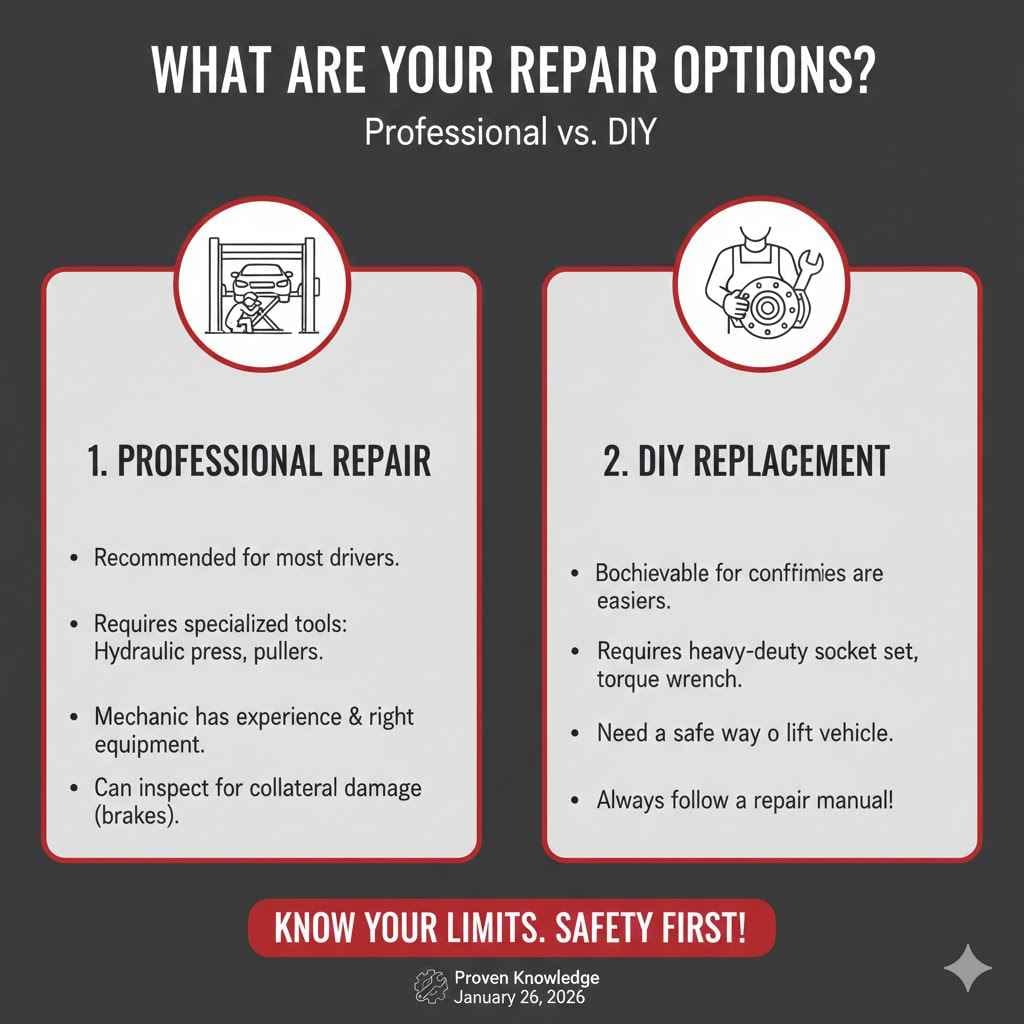
1. Professional Repair
For most drivers, this is the recommended path. Replacing a wheel bearing, especially a press-in type, requires specialized tools like a hydraulic press, slide hammers, and bearing pullers. A professional mechanic has the right equipment and experience to do the job safely and correctly. They can also inspect your brakes and other suspension components for any collateral damage.
2. DIY Replacement
If you are a confident DIYer with a good set of tools, replacing a bolt-on wheel hub assembly is an achievable weekend project. These are common on many modern cars and don’t require a press. However, you will still need a heavy-duty socket set, a torque wrench, and a safe way to lift and support your vehicle. Always follow a repair manual specific to your vehicle. You can often find great tutorials and parts from reputable retailers.
Frequently Asked Questions (FAQ)
1. How long can I drive on a bad wheel bearing?
You shouldn’t. While a bearing might make noise for hundreds of miles, it’s impossible to predict when it will fail completely. The longer you wait, the more damage you cause to your brakes and the greater the safety risk. It’s best to get it fixed as soon as you diagnose the problem.
2. Will replacing the wheel bearing fix my brake problems?
It will fix the root cause of the brake problems (the wobble). However, if the bad bearing has already damaged your brake pads and rotors, you will likely need to replace them as well to restore smooth, powerful braking.
3. Can a bad wheel bearing cause my car to not stop?
Yes, in a worst-case scenario. If the wobble becomes so severe that it damages the brake caliper or causes a brake line to fail, you could lose braking on that wheel. A complete bearing failure can also lead to wheel detachment, which is a total loss of control.
4. Is a humming sound always a wheel bearing?
Not always, but it’s the most common cause. A humming or droning noise that changes with vehicle speed (but not engine speed) can also be caused by uneven tire wear, a problem with the differential, or other driveline components. However, if the noise changes when you turn, it’s very likely a wheel bearing.
5. What does a bad wheel bearing sound like?
It usually starts as a faint hum or drone, like road noise from aggressive tires. As it gets worse, it turns into a growl or a grinding noise, similar to the sound of metal being rubbed together. It’s often louder when turning in one direction and quieter when turning the other.
6. How much does it cost to replace a wheel bearing?
The cost varies greatly by car model. For a bolt-on hub assembly, you can expect to pay between $250 and $500 for parts and labor. For a press-in bearing, which requires more labor, the cost can be between $400 and $800 per wheel.
7. Can I replace a wheel bearing myself?
If your car uses a bolt-on “hub assembly,” it can be a manageable DIY job for someone with mechanical experience and the right tools. If it uses a “press-in” bearing, it’s best left to a professional, as it requires a large hydraulic press to install correctly.
Your Brakes Are Counting On It
So, can a bad wheel bearing affect your brakes? The answer is a resounding yes. It’s not just a possibility; it’s a certainty. From annoying vibrations to dangerous brake damage, a failing bearing puts your entire braking system at risk.
Your car’s ability to stop is its single most important safety feature. Listening to your car and acting on warning signs like a humming noise or a vibration is one of the best things you can do as a responsible car owner. By catching a bad wheel bearing early, you’re not just saving yourself from a more expensive repair down the road—you’re protecting yourself, your passengers, and everyone else you share the road with.
Don’t ignore the signs. Get that bearing checked out and drive with the peace of mind that comes from knowing your car is safe and reliable. You’ve got this!