
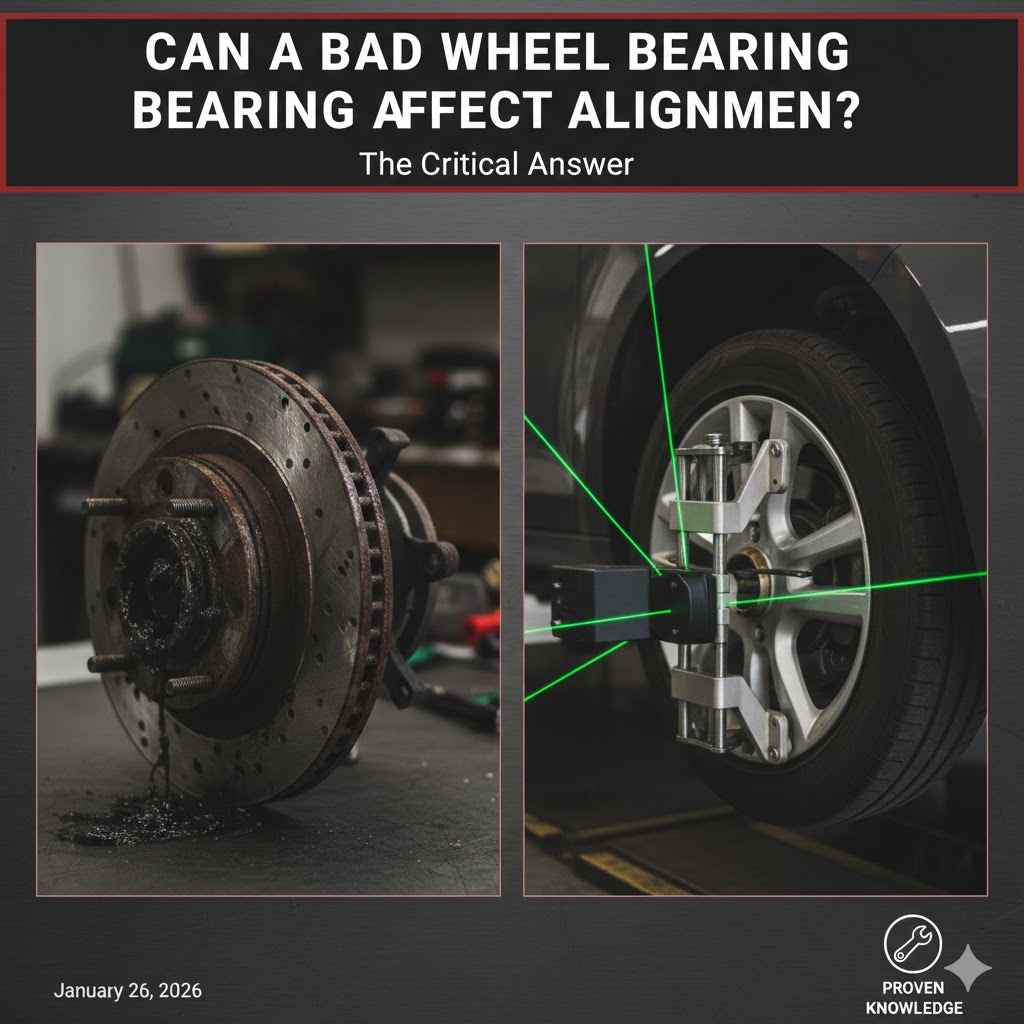
Yes, a bad wheel bearing absolutely affects your car’s alignment. The looseness and play from a worn-out bearing cause the wheel to wobble, which directly throws off the precise angles of the alignment. It is crucial to replace the faulty wheel bearing before performing a wheel alignment to avoid wasting money on a useless service.
Ever feel your car pulling to one side? Or maybe you hear a strange humming sound that gets louder as you speed up. Your first thought might be, “I need an alignment.” While that’s a good guess, sometimes the real problem is hiding just behind your wheel. A small but mighty part called a wheel bearing could be the true culprit.
Dealing with car troubles can be frustrating, but you’ve come to the right place. I’m Dustin, and I’m here to make car care simple. We’re going to break down the connection between your wheel bearings and alignment. You’ll learn how to spot the signs, understand the problem, and make the right decision for your car and your wallet. Let’s get you back on the road, driving straight and safe.
What is a Wheel Bearing Anyway?
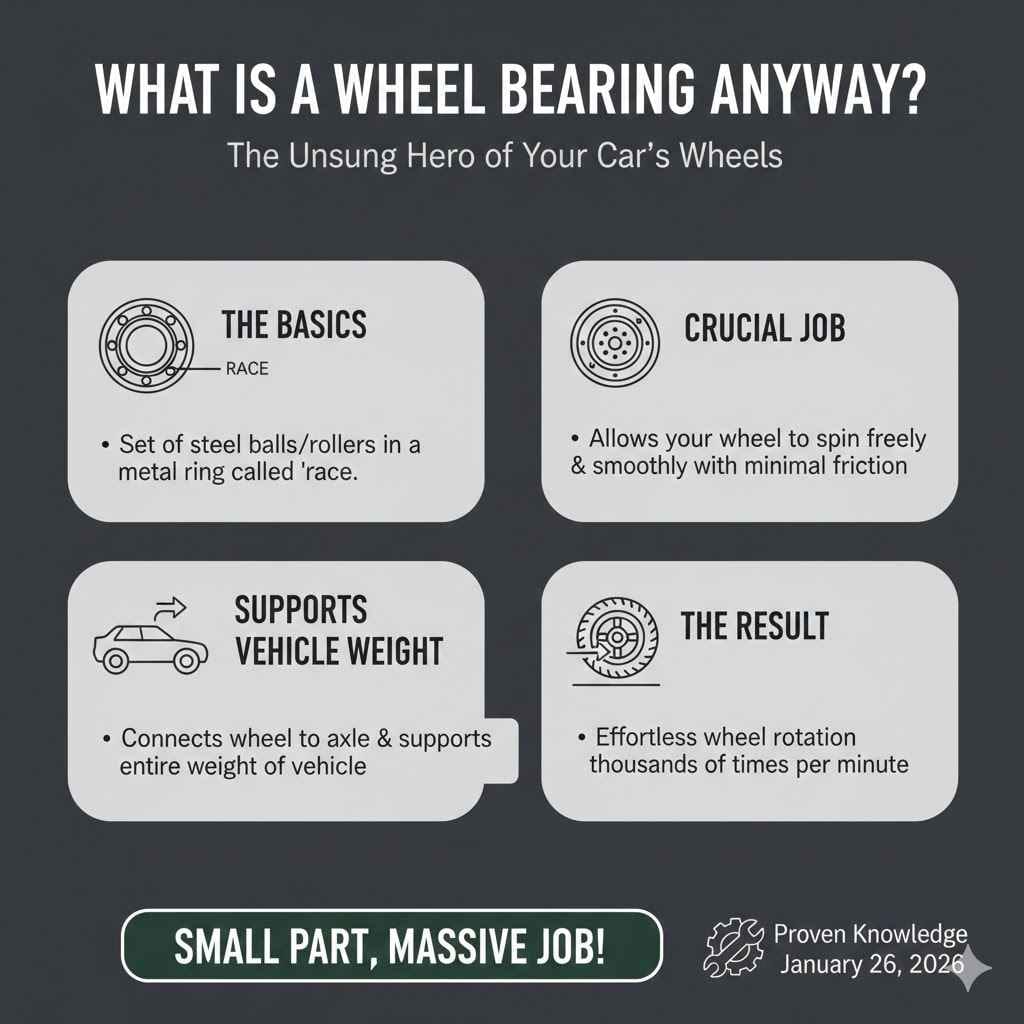
Before we dive deep, let’s talk about what a wheel bearing does. Think of it as the ankle for your car’s wheel. It’s a set of small, strong steel balls or rollers held together in a metal ring called a race. This simple part has a huge job: it allows your wheel to spin freely and smoothly with almost no friction.
Your wheel bearing assembly is pressed into the wheel hub, connecting the wheel to the axle. It supports the entire weight of your vehicle while you’re driving. When it’s working correctly, you don’t even know it’s there. But when it starts to fail, it can cause a whole host of problems you’ll definitely notice.
Understanding Wheel Alignment
Now, let’s look at wheel alignment. Imagine you’re trying to walk with your shoes pointed slightly inward or outward. You wouldn’t walk straight, and the soles of your shoes would wear out unevenly. Wheel alignment is the same concept for your car.
It’s the process of adjusting the angles of the wheels so they are perfectly parallel to each other and perpendicular to the ground. A mechanic adjusts three main angles:
- Camber: The inward or outward tilt of the top of the tire when viewed from the front.
- Toe: The direction your tires are pointing compared to the centerline of the vehicle, like being “toe-in” or “toe-out.”
- Caster: The angle of your steering axis when viewed from the side of your vehicle. This affects steering stability.
When these angles are set to the manufacturer’s specifications, your car drives straight, your steering feels responsive, and your tires wear down evenly.
The Critical Link: How a Bad Bearing Destroys Your Alignment
So, can a bad wheel bearing affect alignment? The answer is a resounding yes. Here’s how it happens.
A healthy wheel bearing holds the wheel hub assembly tightly and securely. There is no “play” or extra movement. It spins smoothly on its axis and that’s it.
A failing wheel bearing, however, becomes loose. The internal parts wear down, creating a gap. This gap allows the entire wheel and tire assembly to wobble or shake, even if it’s just a tiny amount. This looseness is often called “play.”
This play is the real problem. When a mechanic tries to perform an alignment, they are measuring and setting the camber, toe, and caster angles to very precise degrees. But if the wheel itself can wobble back and forth because of a bad bearing, those angles are no longer fixed. They are constantly changing as you drive.
Trying to align a car with a bad wheel bearing is like trying to measure a moving target. The alignment might seem correct on the machine in the shop, but the second you drive off, the wobbly wheel will throw all those perfect angles right out the window. Your car will still pull, and your tires will continue to wear unevenly.
Why Fixing the Bearing First is Non-Negotiable
If you suspect you have a bad wheel bearing, you must fix it before you even think about getting an alignment. Taking your car for an alignment with a bad bearing is a complete waste of time and money. Any reputable mechanic will check for loose components like wheel bearings before starting an alignment. If they find one, they should stop the service and tell you it needs to be replaced first.
Signs of a Bad Wheel Bearing vs. Bad Alignment
It can be tricky to tell if you have a bad bearing, bad alignment, or both. Let’s break down the common symptoms for each so you can become a better automotive detective.
Common Symptoms of a Bad Wheel Bearing
A failing wheel bearing usually gives you some audible clues. Listen carefully for these sounds:
- Humming or Growling Noise: This is the most common sign. It’s a low-pitched humming, growling, or roaring sound that gets louder as you increase speed. It often sounds like loud road noise or like you’re driving on knobby off-road tires.
- Noise Changes When Turning: The humming sound may get louder or quieter when you turn left or right. For example, if the noise gets louder when you turn left, the bad bearing is likely on the right side of the car (as more weight is transferred to that side).
- Clicking or Snapping Sounds: You might hear a clicking noise that gets faster as the vehicle speeds up.
- Wobbling or Vibration: You may feel a slight vibration or wobble in the steering wheel, which can get worse at certain speeds.
- ABS Light: On many modern cars, the wheel speed sensor is integrated with the wheel bearing assembly. A failing bearing can damage the sensor, triggering your ABS warning light.
Common Symptoms of Bad Alignment
Bad alignment symptoms are more about how the car feels and how the tires look.
- Vehicle Pulling to One Side: If you have to constantly fight the steering wheel to keep the car driving in a straight line, your alignment is likely off.
- Crooked Steering Wheel: When you’re driving straight, the steering wheel should be centered. If it’s off-center to the left or right, you need an alignment.
- Uneven or Rapid Tire Wear: This is a tell-tale sign. Check your tires. If the inside or outside edges are wearing down faster than the middle, your alignment is the problem. This is often called “camber wear” or “toe wear.”
- Squealing Tires: If your tires squeal when you take normal turns at slow speeds, it’s a sign they are being dragged sideways instead of rolling smoothly.
Symptom Comparison Table
Use this table to help you narrow down the issue. Sometimes, you might have symptoms from both columns, which means both parts need attention.
| Symptom | Likely Cause: Bad Wheel Bearing | Likely Cause: Bad Alignment |
|---|---|---|
| Humming/Growling Noise at Speed | Very Likely | Unlikely |
| Vehicle Pulls to Left or Right | Possible (due to wobble/drag) | Very Likely |
| Uneven Tire Wear | Possible (due to wobble causing bad camber) | Very Likely |
| Vibration in Steering Wheel | Likely | Possible (but more likely tire balance) |
| Crooked Steering Wheel | Unlikely | Very Likely |
| ABS Warning Light On | Possible | Unlikely |
How to Check for a Bad Wheel Bearing Yourself (The Shake Test)
You can do a simple physical check at home to confirm if your wheel bearing is loose. This is often called the “shake test” or “wobble test.” It requires a car jack and jack stands for safety.
Safety First! Never work under a car supported only by a jack. Always use properly rated jack stands on a flat, level surface. For more information on vehicle safety, you can refer to resources from the National Highway Traffic Safety Administration (NHTSA).
Step-by-Step Guide to the Shake Test:
- Park and Secure the Vehicle: Park on a solid, level surface like a garage floor or flat driveway. Put the car in Park (or in gear for a manual) and engage the emergency brake. Place wheel chocks behind the wheels on the opposite end of the car that you plan to lift.
- Loosen the Lug Nuts: Before lifting the car, use a lug wrench to slightly loosen the lug nuts on the wheel you want to test. Don’t remove them, just break them free.
- Safely Lift the Vehicle: Place your car jack under the vehicle’s designated lift point. Raise the car until the tire is a few inches off the ground.
- Position the Jack Stand: Place a jack stand securely under the vehicle’s frame or designated support point near the jack. Slowly lower the jack until the car’s weight is resting firmly on the jack stand. Leave the jack in place as a backup.
- Perform the Test: Grab the tire with your hands at the 12 o’clock and 6 o’clock positions. Try to push and pull the wheel, wiggling it back and forth. There should be no movement or clunking sounds. If you feel any play or hear a clunk, you most likely have a bad wheel bearing.
- Double-Check: Now, move your hands to the 9 o’clock and 3 o’clock positions. Wiggle the wheel from side to side. If you feel play in this direction but not in the 12-and-6 direction, the problem might be a worn tie rod end instead of a wheel bearing. If it’s loose in both directions, the wheel bearing is the prime suspect.
- Lower the Vehicle: Once you’re done, raise the car slightly with the jack, remove the jack stand, and slowly lower the vehicle to the ground. Tighten the lug nuts in a star pattern to the proper torque specification.
The Correct Order of Operations: Repair and Alignment
If your shake test reveals a bad wheel bearing, you now have a clear plan of action. The proper repair process is simple and sequential.
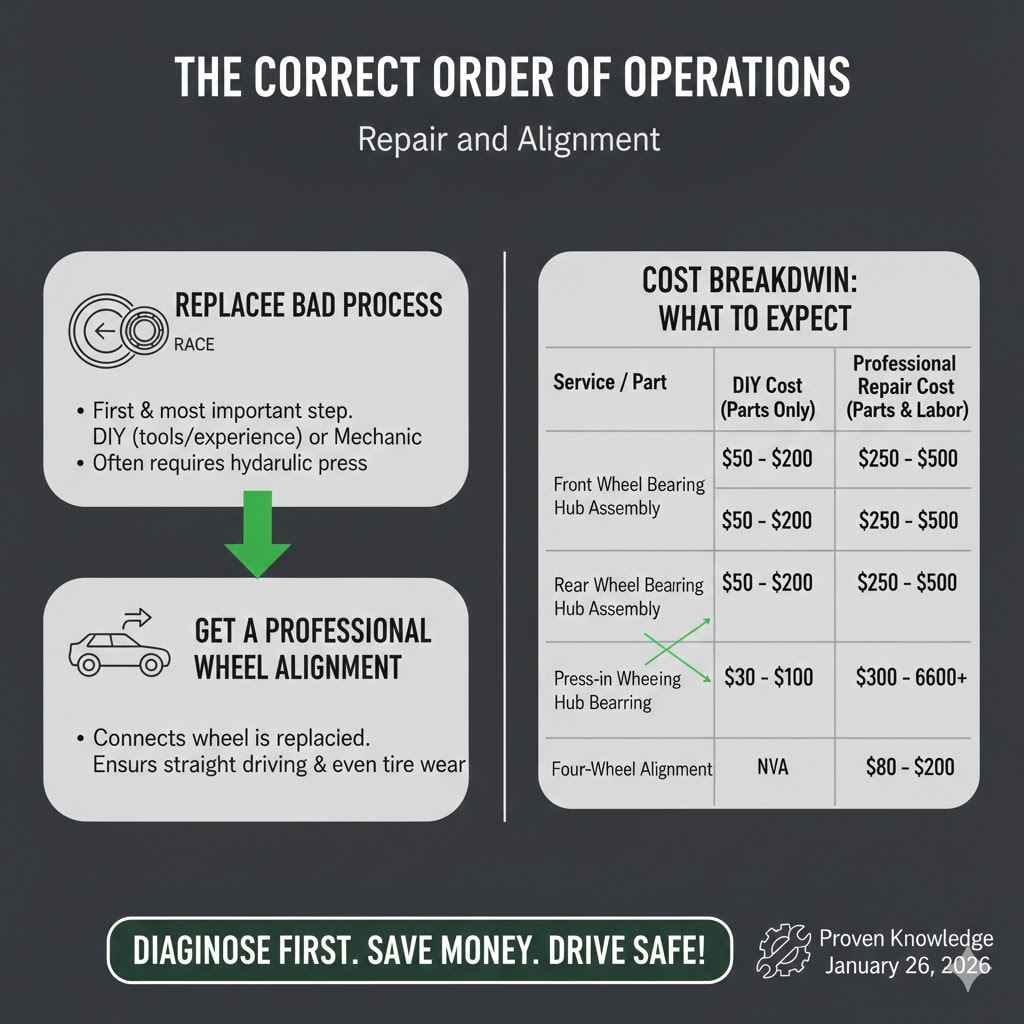
- Replace the Bad Wheel Bearing: This is the first and most important step. You can choose to do this yourself if you have the right tools and experience, or take it to a trusted mechanic. Replacing a wheel bearing can be a complex job, often requiring a hydraulic press to remove the old bearing and install the new one.
- Get a Professional Wheel Alignment: After—and only after—the new wheel bearing is installed and the wheel is tight and secure, you should get a four-wheel alignment. This will correct any angle issues caused by the old, failing bearing and ensure your car drives straight and your tires wear properly.
Cost Breakdown: What to Expect
Repair costs can vary widely depending on your vehicle’s make and model, your location, and whether you do the work yourself. Here is a general estimate to give you an idea.
| Service / Part | DIY Cost (Parts Only) | Professional Repair Cost (Parts & Labor) |
|---|---|---|
| Front Wheel Bearing Hub Assembly | $50 – $200 per wheel | $250 – $500 per wheel |
| Rear Wheel Bearing Hub Assembly | $50 – $200 per wheel | $250 – $500 per wheel |
| Press-in Wheel Bearing (requires more labor) | $30 – $100 per wheel | $300 – $600+ per wheel |
| Four-Wheel Alignment | N/A (Requires professional equipment) | $80 – $200 |
As you can see, investing in an alignment before fixing a $300 wheel bearing problem means you’ll just have to pay for another alignment after the bearing is replaced. Diagnosing the root cause first saves you money and headaches.
Frequently Asked Questions (FAQ)
1. Is it safe to drive with a bad wheel bearing?
It is not safe. A slightly noisy wheel bearing can be driven on for a short time, but it should be addressed as soon as possible. A completely failed wheel bearing can cause the wheel to seize up or, in a worst-case scenario, detach from the vehicle while you are driving, leading to a total loss of control.
2. Does replacing a wheel bearing fix alignment?
No, replacing the wheel bearing does not fix your alignment. It only fixes the mechanical looseness in the wheel. After the replacement, the car’s alignment angles will still be off from where they should be, so you will need a separate alignment service to correct them.
3. Is a wheel alignment always necessary after replacing a wheel bearing?
Yes, it is highly recommended. The process of replacing a wheel bearing involves removing the hub and other suspension components. This disassembly and reassembly will almost certainly knock your alignment out of its proper specification. Getting an alignment afterward ensures everything is set back to factory standards.
4. How can I be sure the noise is a wheel bearing?
The most reliable sign is a humming or roaring noise that gets louder with speed and changes pitch or intensity when you turn the steering wheel. The shake test described earlier is also a very effective way to confirm physical looseness in the wheel.
5. Can I replace a wheel bearing myself to save money?
Maybe. If your vehicle uses a bolt-on hub assembly, the replacement can be a manageable DIY project for someone with decent mechanical skills and the right tools (like a torque wrench and breaker bar). However, if your car has a press-in bearing, it requires specialized tools like a shop press, making it a job best left to a professional mechanic.
6. What happens if I ignore bad alignment?
Ignoring bad alignment will cause your tires to wear out very quickly and unevenly, costing you hundreds of dollars in premature tire replacement. It also puts extra stress on your suspension components and makes the vehicle less safe to handle, especially in emergency situations.
7. How often should I get my car’s alignment checked?
It’s a good idea to have your alignment checked once a year or every 12,000 miles. You should also have it checked anytime you install new tires, replace suspension parts, or after hitting a major pothole or curb.
Your Path to a Smooth, Straight Ride
So, we’ve untangled the mystery. A bad wheel bearing is more than just an annoying noise—it’s a direct threat to your car’s alignment, tire life, and overall safety. By allowing the wheel to wobble, it makes a proper alignment impossible and wastes your hard-earned money on a service that won’t stick.
Now you have the knowledge to be your car’s best advocate. You can listen for the tell-tale hum, perform a simple shake test, and understand the crucial relationship between these two systems. Remember the golden rule: fix the bearing first, then get the alignment.
Taking a proactive approach to car maintenance not only saves you money but also gives you the confidence and peace of mind that you’re driving a safe, reliable vehicle. Keep listening to your car, trust your instincts, and you’ll be able to handle whatever the road throws your way.