
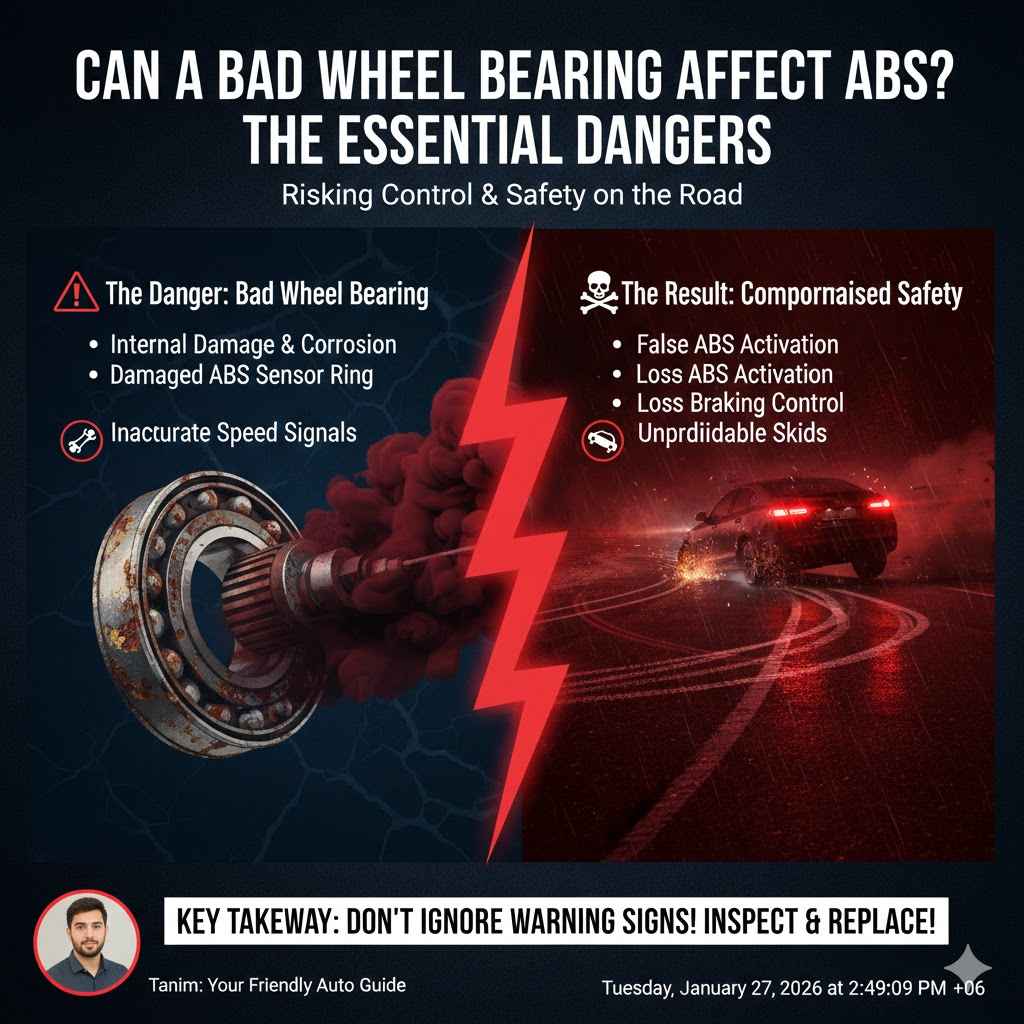
Yes, a bad wheel bearing can definitely affect your ABS. The wheel bearing assembly holds the magnetic ring that the ABS sensor reads. When the bearing fails, it creates a wobble or sends metal debris onto the sensor, causing faulty speed readings. This confusion triggers the ABS warning light and can disable your anti-lock brakes.
It’s one of those moments every driver dreads. You’re driving along, and suddenly, a new light pops up on your dashboard. This time, it’s the ABS light, shining a bright, concerning amber. Your mind starts racing. Is it the brakes? Is it something expensive? What’s going on? It’s a frustrating and common problem, but don’t worry. You’ve come to the right place.
Many drivers are surprised to learn that the cause isn’t always a complex electrical issue. Sometimes, the culprit is a simple mechanical part: a bad wheel bearing. In this guide, I’ll walk you through exactly how these two seemingly separate parts are connected. We’ll cover the signs, the dangers, and what you need to do next. Let’s demystify that dashboard light together.
What Exactly is a Wheel Bearing?
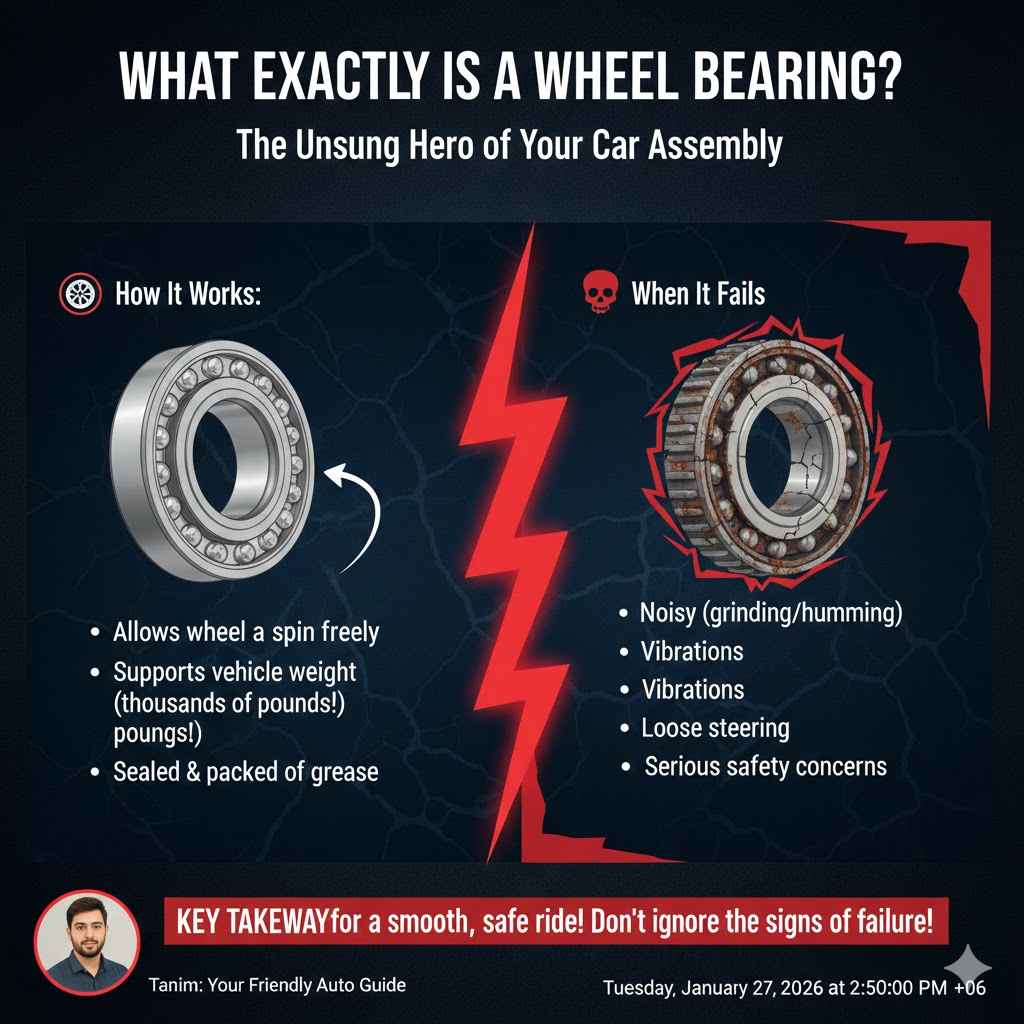
Before we dive into the connection with your ABS, let’s get clear on what a wheel bearing does. Think of it as the unsung hero of your car’s wheel assembly. A wheel bearing is a set of small, steel balls or rollers held together in a metal ring called a race. Its one and only job is to allow your wheel to spin freely with as little friction as possible.
Imagine the axle on a skateboard. The bearings are what let the wheels spin smoothly for a long time after you push off. Your car’s wheel bearings do the same thing, but they have to support the entire weight of your vehicle—thousands of pounds—while spinning thousands of times per minute. They are sealed units, packed with grease to keep them lubricated and protected from dirt and water.
When a wheel bearing is working correctly, you don’t even know it’s there. It does its job silently and efficiently. But when it starts to fail, the problems can range from a simple noise to serious safety concerns.
Understanding Your Car’s ABS (Anti-lock Braking System)
Now, let’s talk about the ABS, or Anti-lock Braking System. This is a crucial safety feature found in almost every modern car. Its purpose is to prevent your wheels from locking up and skidding during a hard or emergency stop. When you slam on the brakes in a car without ABS, the wheels can lock, and the car can slide uncontrollably.
With ABS, you can maintain steering control even while braking heavily. The system works by rapidly “pumping” the brakes for you—much faster than a human ever could. This is what creates that pulsing or vibrating feeling in the brake pedal during a hard stop. It’s a sign the system is doing its job!
To do this, the ABS needs to know exactly how fast each wheel is turning. It uses four key components:
- Wheel Speed Sensors: There is one sensor at each wheel that monitors its rotational speed.
- Tone Rings (or Reluctor Rings): A notched or toothed ring that spins with the wheel. The sensor reads these notches to measure speed.
- Hydraulic Control Unit: This unit contains valves that can adjust the brake fluid pressure to each wheel individually.
- Electronic Control Module (ECU): The “brain” of the system. It reads the signals from the sensors and tells the hydraulic unit what to do.
If the ECU detects one wheel is slowing down much faster than the others (a sign it’s about to lock up), it instantly reduces brake pressure to that specific wheel, allowing it to spin again. This happens over and over, ensuring maximum braking power without losing control.
The Critical Connection: How a Bad Bearing Triggers the ABS Light
So, how does a simple mechanical part like a wheel bearing interfere with a complex electronic system like the ABS? The answer lies in the design of modern wheel hub assemblies. In most cars today, the wheel bearing, the hub, and the ABS tone ring are all integrated into one single unit.
The ABS wheel speed sensor is mounted right next to this hub assembly. Its job is to read the teeth or magnetic signals from the tone ring as the wheel spins. This precise measurement is how the ABS computer knows your wheel speed.
When a wheel bearing starts to fail, it develops “play” or “wobble.” The internal rollers or balls wear down, and the once-tight fit becomes loose. This looseness creates two major problems for the ABS system:
- Incorrect Sensor Gap: The ABS sensor is positioned a very specific, tiny distance from the tone ring. The wobble from a bad bearing causes this distance to change constantly as the wheel rotates. The sensor can’t get a clean, consistent reading, and the signal it sends to the ABS computer becomes erratic and nonsensical. The computer sees this jumbled data, assumes the sensor has failed, and triggers the ABS warning light.
- Debris and Damage: As the bearing wears out, tiny metal shavings can break off. These metallic particles can stick to the magnetic tip of the ABS sensor or contaminate the tone ring itself. This debris blocks the sensor from getting a clear reading, much like mud on a camera lens. In severe cases, the excessive movement can cause the tone ring to physically hit the sensor, damaging one or both components permanently.
In either case, the ABS computer receives a signal that doesn’t make sense. To be safe, its programming tells it to shut down the anti-lock braking feature and turn on the warning light to alert you. Your regular brakes will still work, but you will not have the anti-lock functionality in an emergency.
Signs and Symptoms to Watch For
Recognizing the early signs of a failing wheel bearing can save you from bigger headaches down the road. It’s important to distinguish between symptoms of the bearing itself and the ABS problems it can cause.
Common Symptoms of a Bad Wheel Bearing
- A Humming or Growling Noise: This is the most common sign. The noise gets louder as you speed up and may change or disappear when you turn. For example, if the bad bearing is on the front right, the noise might get louder when you turn left (putting more weight on it) and quieter when you turn right.
- Vibration in the Steering Wheel: A worn bearing can cause a subtle vibration that you feel through the steering wheel. This vibration often worsens with speed or during turns.
- Vehicle Pulling to One Side: A loose or dragging bearing can cause the car to pull to the affected side, especially while braking.
- Uneven Tire Wear: The wobble from a bad bearing can lead to abnormal and accelerated wear on the inside or outside edge of your tire.
- A Clicking or Snapping Sound: You might hear this sound when turning or driving over bumps.
Symptoms that a Bad Bearing is Affecting Your ABS
- The ABS Light is On: This is the most obvious sign. The faulty signal from the wheel speed sensor tells the computer there’s a problem, illuminating the light.
- The Traction Control Light is On: Many cars use the same wheel speed sensors for both the ABS and traction control systems. A bad signal can often trigger both warning lights.
- Brakes Behaving Strangely: You might feel the ABS engaging at low speeds for no reason, like when pulling into a parking spot. The brake pedal might pulse or feel like it’s fighting back when it shouldn’t be.
- ABS Fails to Engage: In a real emergency stop, you might find that the wheels lock up and skid because the ABS system has shut itself off due to the faulty sensor reading.
The table below breaks down common symptoms to help you pinpoint the issue.
| Symptom | Likely Cause Related to Wheel Bearing | Other Possible Causes |
|---|---|---|
| Humming/Growling Noise | Worn internal rollers of the wheel bearing. | Cupped tires, differential problem. |
| ABS Warning Light On | Erratic signal from wheel speed sensor due to bearing wobble or debris. | Failed ABS sensor, low brake fluid, faulty ABS module. |
| Steering Wheel Vibration | Excessive play in the bearing causing wheel imbalance. | Unbalanced tires, worn suspension parts, warped brake rotors. |
| Car Pulls to One Side | Increased friction from a failing bearing. | Bad alignment, uneven tire pressure, sticking brake caliper. |
The Essential Dangers of Ignoring the Problem
It can be tempting to ignore a dashboard light or a strange noise, especially if the car still seems to be driving okay. However, when it comes to a bad wheel bearing, ignoring the signs can lead to dangerous and expensive consequences.
First and foremost is the safety risk. As we’ve discussed, a bad wheel bearing can disable your ABS. The National Highway Traffic Safety Administration (NHTSA) has shown that ABS significantly reduces the risk of crashes, especially on wet or slippery roads. Without it, your stopping distances will increase, and you could lose steering control during an emergency maneuver. You’re not just driving with a noise; you’re driving with a compromised safety system.
Beyond the ABS issue, the bearing itself can fail completely. This is often called “catastrophic failure.” When this happens, the wheel can seize up or, in the worst-case scenario, detach from the vehicle entirely while you are driving. The potential for a serious accident is extremely high.
Finally, letting it go will cost you more money in the long run. A wobbly wheel bearing puts immense stress on other components. It can damage your hub assembly, axle, brake components, and suspension parts. A repair that might have started as a few hundred dollars for a bearing can quickly turn into a multi-thousand-dollar repair bill for a whole corner of your car’s suspension.
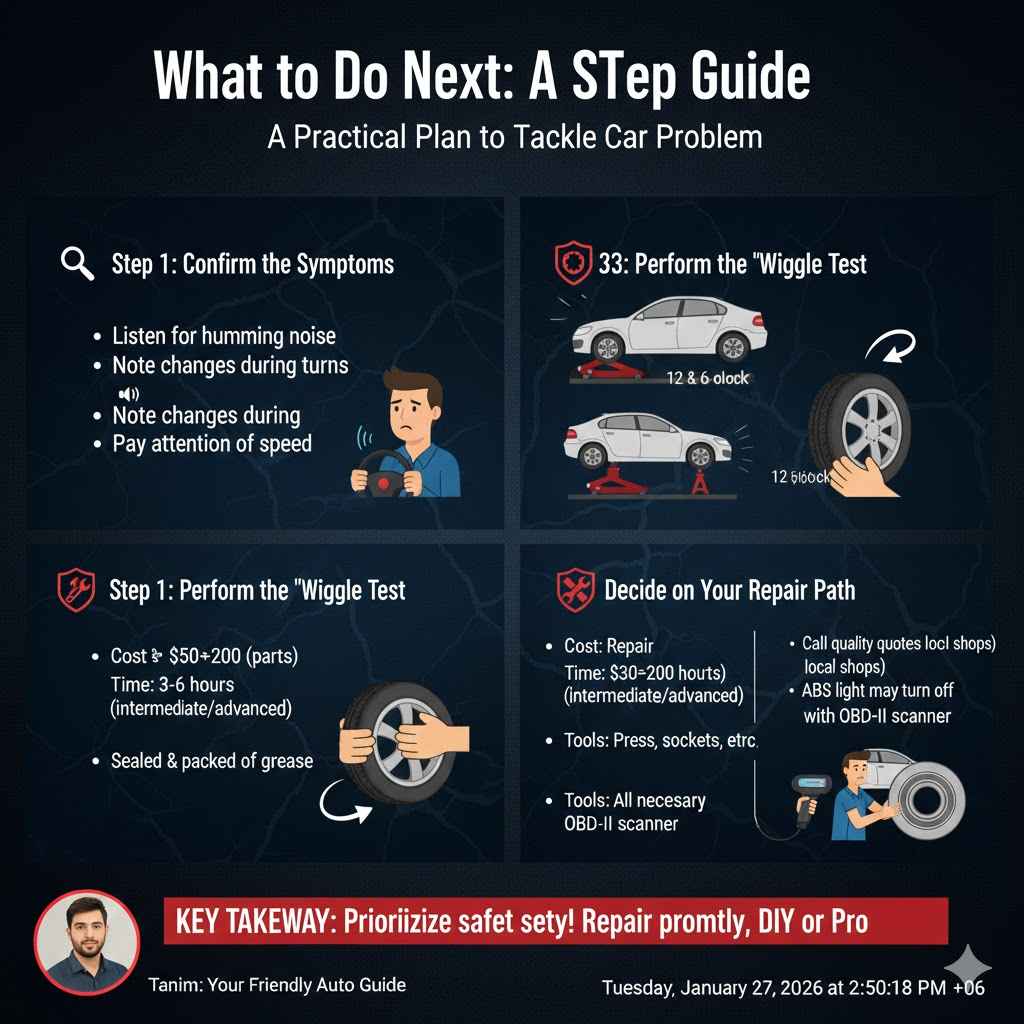
What to Do Next: A Step-by-Step Guide
Okay, so you suspect you have a bad wheel bearing that’s affecting your ABS. What now? Here’s a simple, practical plan to tackle the problem with confidence.
Step 1: Confirm the Symptoms
Pay close attention while driving. Go to a safe, empty parking lot and listen carefully. Does the humming noise change when you turn left versus right? Does it get louder with speed? Make notes of what you hear and feel. This information will be incredibly helpful whether you’re fixing it yourself or explaining it to a mechanic.
Step 2: Perform the “Wiggle Test”
This is a classic diagnostic test you can do at home. Please prioritize safety first!
- Park your car on a flat, level surface and engage the parking brake.
- Loosen the lug nuts on the suspect wheel slightly, but don’t remove them.
- Use a proper car jack to lift the corner of the car until the tire is off the ground.
- Crucially, place a jack stand securely under the vehicle’s frame as a safety backup. Never work on a car supported only by a jack.
- Grab the tire at the 12 o’clock and 6 o’clock positions. Try to push and pull, wiggling it back and forth.
- Next, grab the tire at the 3 o’clock and 9 o’clock positions and do the same.
If you feel any looseness, play, or hear a clunking sound, you have almost certainly found a bad wheel bearing.
Step 3: Decide on Your Repair Path: DIY or Pro?
Replacing a wheel bearing is considered an intermediate to advanced DIY job. While it can save you a lot of money on labor, it requires specialized tools that most home mechanics don’t own, such as a heavy-duty press to push the old bearing out and the new one in. Some modern bearings come as a complete bolt-on hub assembly, which is much easier but still requires some know-how.
Be honest with yourself about your skill level, tools, and time. If you’re not 100% confident, taking it to a trusted professional is the safest and smartest choice.
| Aspect | DIY Repair | Professional Repair |
|---|---|---|
| Cost | $50 – $200 for the part. No labor cost, but may need to rent or buy tools. | $300 – $800+ per wheel (parts and labor combined). |
| Time | 3-6 hours for a first-timer. Can be a full weekend project if issues arise. | 1-3 hours. |
| Tools Required | Jack, jack stands, socket set, torque wrench, breaker bar, and possibly a hub puller or hydraulic press. | Professionals have all necessary tools, including vehicle lifts and hydraulic presses. |
| Skill Level | Intermediate to Advanced. Requires mechanical knowledge and a focus on safety. | Beginner-friendly. Just need to find a reputable shop. |
Step 4: Get the Repair Done
If you choose the professional route, call a few local shops for quotes. Explain the symptoms clearly (“I hear a humming noise from the front right wheel, and my ABS light is on”). This will help them give you a more accurate estimate.
If you’re tackling it yourself, watch several video tutorials for your specific make and model. Buy a quality replacement part—this is not an area to cut corners. A cheap bearing will fail prematurely, and you’ll be doing the job all over again.
After the new bearing is installed, the ABS light may turn off on its own after a short drive. If it doesn’t, the code may need to be cleared with an OBD-II scanner, or there could be a separate issue with the sensor itself that also needs to be addressed.
Frequently Asked Questions (FAQ)
1. Can I still drive my car with a bad wheel bearing and an ABS light on?
It is strongly advised not to. While your regular brakes will likely still work, you are driving with a compromised safety system (no ABS) and a mechanical part that could fail catastrophically. The safest choice is to get it repaired as soon as possible.
2. How much does it cost to replace a wheel bearing?
The cost varies widely by car model and location. For a professional repair, expect to pay between $300 and $800 per wheel. Luxury or heavy-duty vehicles can be more. The part itself typically costs between $50 and $200 if you do it yourself.
3. Will replacing the wheel bearing fix the ABS light?
In most cases, yes. Since the bad bearing is what’s causing the faulty signal, replacing the entire hub assembly (which includes a new tone ring) will restore the correct signal to the ABS sensor. The light should go off after the repair, sometimes after a short drive to allow the computer to reset.
4. What does a bad wheel bearing sound like?
The most common sound is a low-pitched humming, growling, or rumbling noise. It’s often compared to the sound of driving on a rumble strip or having loud, knobby off-road tires. The noise typically gets louder the faster you go.
5. Can a bad wheel bearing cause other problems?
Absolutely. A failing bearing can cause uneven tire wear, damage to your brake components (caliper and rotor), and put extreme stress on your CV axle and suspension. In the worst-case scenario, it can lead to wheel separation.
6. Is the ABS sensor part of the wheel bearing?
Not usually, but they are right next to each other. The ABS tone ring is often integrated into the wheel bearing/hub assembly. The ABS sensor is a separate part that reads that ring. When you replace the hub assembly, you get a new tone ring, but the sensor is typically reused unless it was also damaged.
7. How long do wheel bearings last?
Wheel bearings are designed to last a long time, often 100,000 miles or more. However, their lifespan can be shortened by hitting potholes, curbs, driving through deep water, or using improper installation techniques.
Your Path to a Safe and Quiet Ride
That glowing ABS light on your dashboard can be unsettling, but now you know that the answer isn’t always hidden in a maze of wires and computers. The mechanical health of your wheel bearings is directly tied to the performance of your advanced safety systems. The connection is real, the symptoms are clear, and the solution is straightforward.
By listening to your car and understanding these warning signs, you’re no longer in the dark. You can diagnose the problem with confidence, make an informed decision about the repair, and ensure your vehicle remains safe and reliable. Whether you decide to roll up your sleeves and tackle the job yourself or hand the keys to a trusted mechanic, you are taking control. And that’s what smart car ownership is all about.