
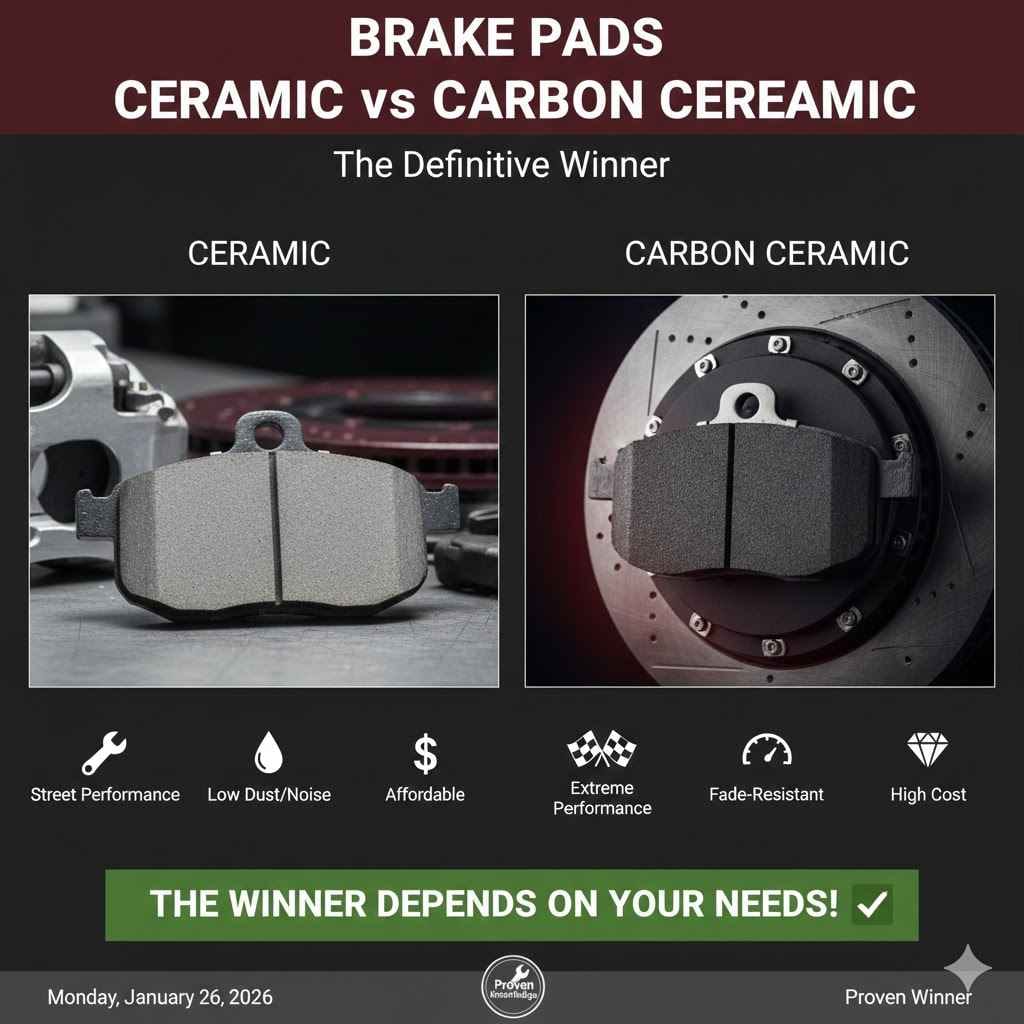
For everyday drivers, standard ceramic brake pads are the definitive winner. They offer the best balance of quiet performance, low dust, and affordability for cars, trucks, and SUVs. Carbon-ceramic brakes are an extremely expensive, high-performance option designed specifically for supercars and dedicated track use, making them impractical for normal driving.
Hi, I’m Dustin Hall. If you’ve ever looked into upgrading your brakes, you’ve probably seen the words “ceramic” and “carbon-ceramic” thrown around. It’s easy to think they’re similar, or that one is just a slightly better version of the other. This confusion can make choosing the right brake pads feel overwhelming.
Are you worried about picking the wrong part? Concerned about cost, noise, or stopping power? You’re in the right place. Many drivers face this same challenge. The good news is that it’s much simpler than it sounds.
In this guide, we’ll break down the difference between ceramic and carbon-ceramic brake pads in simple, clear terms. We’ll help you understand exactly what you need for your car, so you can feel confident in your choice. Let’s get you the right brakes for your ride.
What Are Brake Pads and Why Do They Matter?
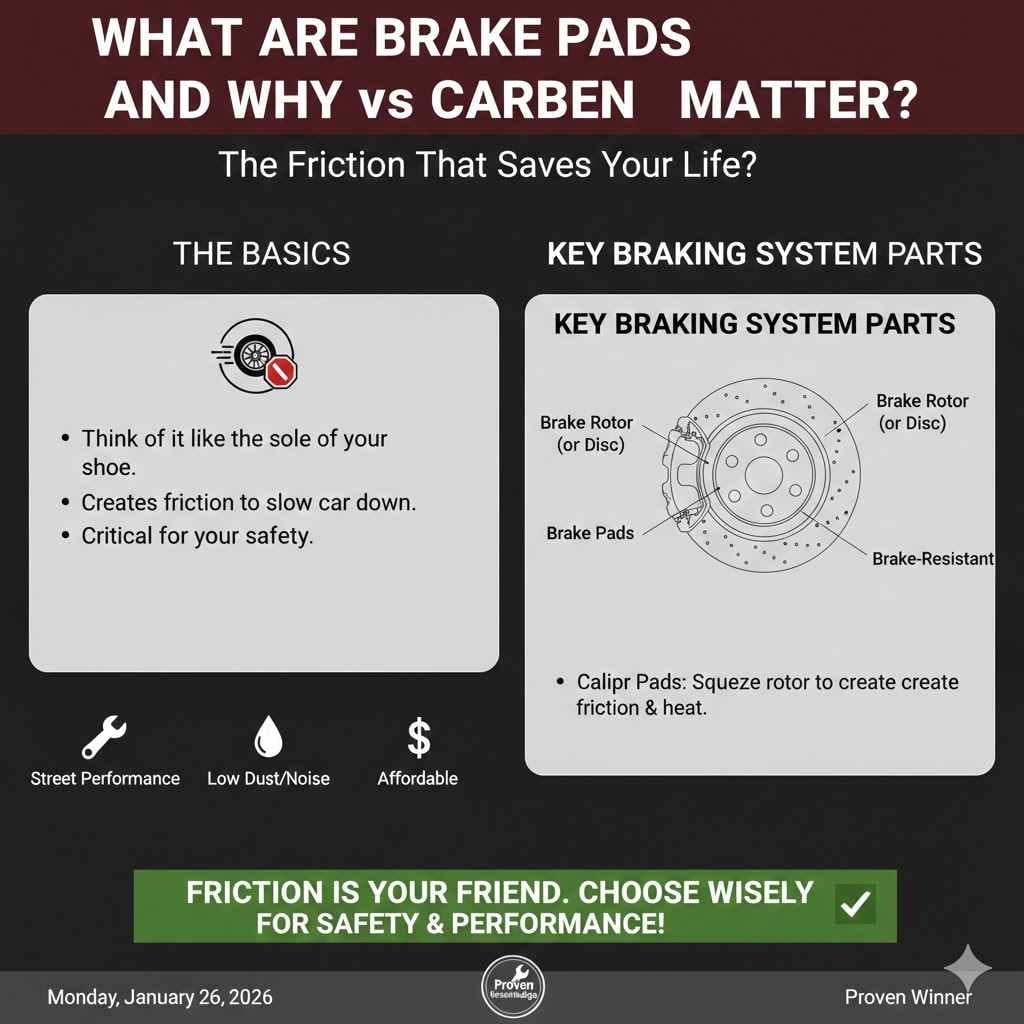
Before we dive into the different types, let’s quickly cover what a brake pad actually does. Think of it like the sole of your shoe. When you want to stop running, you plant your foot and the friction between your shoe and the ground slows you down. Brake pads do the same thing for your car.
Your car’s braking system has a few key parts:
- Brake Rotor (or Disc): A heavy metal disc that spins with the wheel.
- Caliper: A clamp that fits over the rotor.
- Brake Pads: Two pads that sit inside the caliper, on either side of the rotor.
When you press the brake pedal, the caliper squeezes the brake pads against the spinning rotor. This friction creates massive amounts of heat and slows your car down. The material your brake pad is made from determines how well it handles that friction and heat. That’s why choosing the right material is so important for your safety and your car’s performance.
Meet the Contenders: A Simple Breakdown
The names “ceramic” and “carbon-ceramic” sound alike, but they describe two vastly different technologies built for entirely different purposes. Let’s meet our two contenders.
What Are Standard Ceramic Brake Pads?
Ceramic brake pads are the most popular choice for modern passenger cars, and for good reason. They are made from a dense ceramic material, similar to pottery or tile, but much stronger. This ceramic material is mixed with copper fibers and other filling agents to help with friction and heat dissipation.
Think of them as the modern, premium option for daily driving. They were developed as an improvement over older semi-metallic and organic pads. Their key benefits for you, the everyday driver, are:
- Quiet Operation: They are known for being incredibly quiet, producing little to no squeaking or grinding sounds.
- Low Dust: They produce a fine, light-colored dust that doesn’t stick to your wheels, keeping them much cleaner.
- Consistent Performance: They provide smooth, reliable stopping power in a wide range of everyday driving conditions.
- Long Life: They are gentle on brake rotors, meaning both the pads and the rotors tend to last longer.
If you drive a typical sedan, SUV, or truck, ceramic pads offer a fantastic balance of comfort, performance, and value.
What Are Carbon-Ceramic Brakes?
This is where things get a bit more exotic. Carbon-ceramic brakes are not just a different type of pad; they are a complete braking system. The pads and the rotors are made from a composite material called Carbon Fiber-Reinforced Silicon Carbide (C/SiC).
This technology comes directly from the world of motorsports, like Formula 1 and endurance racing, where vehicles need to brake from incredibly high speeds over and over without fail. You’ll find them as a high-priced option on supercars from brands like Porsche, Ferrari, and Lamborghini.
Here’s what makes them special:
- Incredible Heat Resistance: They can handle extreme temperatures (over 1,800°F or 1,000°C) without losing performance. This phenomenon, known as “brake fade,” is when brakes get too hot and stop working effectively. Carbon-ceramics virtually eliminate it.
- Extremely Lightweight: A carbon-ceramic rotor can be 50% lighter than a standard iron rotor of the same size. This reduction in “unsprung weight” helps improve a car’s handling, acceleration, and ride quality.
- Very Long Lifespan: Under normal street driving conditions, a carbon-ceramic brake system can last the lifetime of the vehicle.
- Exceptional Stopping Power: At high speeds and high temperatures, their stopping power is immense.
However, this high-tech performance comes with major trade-offs, especially for a normal driver.
Head-to-Head Comparison: Ceramic vs. Carbon-Ceramic
Seeing the key differences side-by-side makes the choice much clearer. This table breaks down everything you need to know.
| Feature | Standard Ceramic Pads | Carbon-Ceramic Brake System |
|---|---|---|
| Ideal Use | Daily driving, commuting, family cars | Supercars, dedicated track cars, motorsports |
| Cost | Affordable ($50 – $150 for a set of pads) | Extremely Expensive ($5,000 – $20,000+ for a full system) |
| Stopping Power | Excellent for everyday situations; works great when cold | Exceptional at high speed; can feel less effective when cold |
| Noise Level | Very quiet, smooth, and comfortable | Can be noisy and squeal, especially at low speeds or when cold |
| Brake Dust | Very low amount of light-colored dust | Also very low dust, similar to ceramic |
| Heat Resistance | Good for normal driving, but can fade with repeated, hard track use | Virtually immune to brake fade; designed for extreme heat |
| Lifespan | Very good, typically lasts 30,000 to 70,000 miles | Extremely long, can last over 100,000 miles or the life of the car |
| Vehicle Type | Sedans, SUVs, minivans, trucks | Porsche, Ferrari, Lamborghini, high-end performance models |
A Deeper Dive into the Key Differences
Now that you’ve seen the overview, let’s explore the most important factors in more detail so you can understand why one is perfect for your daily commute and the other belongs on a racetrack.
Performance and Stopping Power
For most of us, stopping power means being able to safely brake at a stoplight or avoid a hazard on the highway. Standard ceramic pads are perfect for this. They have a great initial “bite,” meaning they work effectively the moment you touch the pedal, even on a cold morning. Their performance is consistent and predictable, which is exactly what you want for safe, everyday driving.
Carbon-ceramic brakes are different. They are designed to work best when they are very hot. In normal city driving, they might not reach their optimal temperature. This can make them feel a bit less responsive or “grabby” than you’re used to. Where they truly shine is on a racetrack, braking from 150 mph down to 50 mph lap after lap. In that scenario, their stopping power is far superior, as regular ceramic pads would quickly overheat and fade.
Noise and Comfort
This is a huge win for standard ceramic pads. One of their biggest selling points is how quiet they are. The materials used are designed to create friction without high-frequency vibrations, which are the cause of brake squeal. If you value a smooth, silent ride, ceramic pads are your best friend.
Carbon-ceramic brakes, on the other hand, are notorious for being noisy. It’s not uncommon for them to squeak, squeal, or groan, especially at low speeds. While supercar owners might tolerate this as part of the “race car experience,” it would be incredibly annoying on a family SUV during the school run.
Brake Dust
Tired of your shiny wheels being covered in black, grimy dust? Both options are great here. Standard ceramic pads produce a very small amount of fine, light-colored dust that is barely noticeable and easy to wash off. This is a massive improvement over older semi-metallic pads, which are known for coating wheels in a thick layer of dark dust.
Carbon-ceramic brakes are also excellent in this department, producing minimal dust. For both types, you’ll enjoy cleaner wheels for longer.
The Big One: Cost
This is, without a doubt, the most significant difference. It’s the factor that single-handedly decides which brake is right for 99% of people. A set of high-quality ceramic brake pads for your car might cost between $50 and $150.
A carbon-ceramic brake conversion is in a completely different universe. You can’t just buy the pads; you have to buy the entire system, including pads, rotors, and often calipers. A full set for a performance car can cost anywhere from $5,000 to over $20,000. For example, replacing the carbon-ceramic brakes on a Porsche 911 can easily cost more than a reliable used car!
The sky-high price is due to the incredibly complex and energy-intensive manufacturing process. Creating these materials requires specialized equipment and takes weeks. This advanced manufacturing, as discussed by sources like the U.S. Department of Energy when exploring carbon fiber components, is what drives the cost so high.
Which Brake Pad is Right for You?
Let’s make this really simple. Here’s a quick checklist to help you decide with absolute confidence.
Choose Standard Ceramic Brake Pads If…
- You drive a normal car, truck, or SUV for daily commuting, errands, and road trips.
- You want your brakes to be quiet and smooth.
- You hate seeing your wheels covered in ugly black brake dust.
- You are looking for a reliable, safe, and affordable braking solution.
- Your budget for a full brake pad replacement is in the hundreds, not the thousands.
Choose Carbon-Ceramic Brakes If…
- You own a supercar or a high-performance vehicle that came with them from the factory (e.g., a Ferrari 488, Porsche GT3 RS, or Lamborghini Huracán).
- You frequently participate in high-speed track days where brake fade is a serious concern.
- The cost of a $15,000 brake job does not make you flinch.
- You prioritize ultimate high-temperature performance above all else, including noise and cold-weather feel.
The Definitive Winner for the Everyday Driver
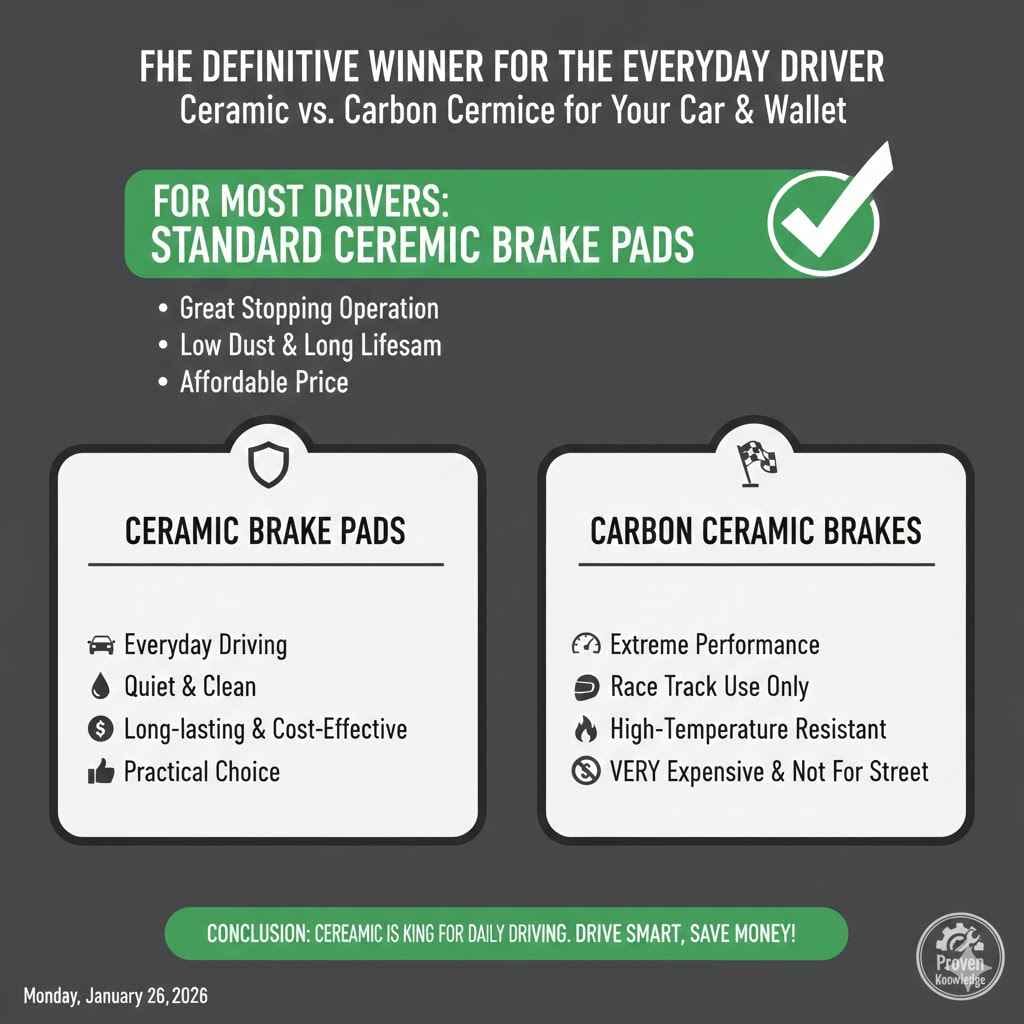
For the vast majority of drivers, the definitive winner is clear: standard ceramic brake pads. They deliver exactly what you need for daily driving: great stopping power, ultra-quiet operation, low dust, and a long lifespan, all at a price that makes sense.
Carbon-ceramic brakes are an incredible piece of engineering. They are a marvel of material science that allows supercars to perform amazing feats on the racetrack. However, they are a highly specialized tool for a very specific job. Using them on a daily driver would be like using a Formula 1 racing tire to go grocery shopping—it’s expensive, impractical, and simply not what it was designed for.
So, when it’s time to replace your brake pads, you can confidently choose a quality set of ceramic pads, knowing you’re getting the best technology for your car and your wallet.
Frequently Asked Questions (FAQ)
Can I put carbon-ceramic brake pads on my regular car?
Technically, aftermarket conversion kits exist, but it’s not practical or recommended. You can’t just swap the pads; you need to replace the entire system (pads, rotors, calipers), which is incredibly expensive. The performance benefits would not be noticeable in daily driving, and you’d likely experience more noise and reduced performance when the brakes are cold.
Are ceramic pads better than semi-metallic pads?
For most daily drivers, yes. Ceramic pads are quieter, produce less dust, and are gentler on the brake rotors than semi-metallic pads. Semi-metallic pads can offer slightly better performance in very aggressive or heavy-duty situations (like towing), but for general use, ceramic pads provide a more comfortable and cleaner experience.
Why are carbon-ceramic brakes so expensive?
The cost comes from the complex, time-consuming, and energy-intensive manufacturing process. Creating the carbon fiber and silicon carbide composite material involves multiple stages and extremely high temperatures over several weeks. It’s a low-volume, highly specialized process, unlike the mass production of standard iron rotors.
Do I need to replace my rotors when I change my brake pads?
It’s always a good idea to have your rotors inspected when you change your pads. Most auto shops recommend replacing or “resurfacing” the rotors at the same time. A new, flat rotor surface ensures your new pads wear evenly and provide the best possible performance. If your rotors are worn too thin, warped, or have deep grooves, they must be replaced for safety.
How long do ceramic brake pads last?
The lifespan of ceramic brake pads depends heavily on your driving style and conditions. On average, they can last anywhere from 30,000 to 70,000 miles. Gentle highway driving will lead to a longer lifespan, while aggressive city driving with lots of stop-and-go traffic will wear them out faster.
What’s that squealing sound when I brake?
A high-pitched squealing sound is often caused by the “wear indicator,” a small metal tab built into the brake pad. When the pad material wears down to a certain point, this tab scrapes against the rotor, creating a loud noise to alert you that it’s time for new pads. If you hear this, get your brakes checked right away.
Are carbon-ceramic brakes worth the money?
For a professional race car driver or a supercar owner who regularly visits the track, absolutely. The resistance to brake fade at extreme temperatures is a critical safety and performance feature. For anyone else, they are not worth the immense cost. The benefits simply don’t apply to public roads.
Conclusion: Drive with Confidence
Choosing the right parts for your car shouldn’t be a source of stress. Now you know the real story behind ceramic and carbon-ceramic brakes. One is the practical, comfortable, and smart choice for your daily drive, while the other is a specialized piece of racing technology for the world’s fastest cars.
By choosing standard ceramic brake pads, you are equipping your car with a modern, reliable, and high-performing system that will keep you safe on the road without breaking the bank. You can now walk into an auto parts store or talk to your mechanic with the confidence of knowing exactly what your car needs and why. Happy—and safe—driving!