

Changing your spark plugs and wires restores engine performance, improves fuel economy, and ensures reliable starts. This simple maintenance task prevents rough idling, poor acceleration, and misfires. Fresh plugs and wires lead to a smoother, more efficient engine, reducing harmful emissions and preventing costly damage to your catalytic converter.
Hey there, Dustin Hall here. Have you ever felt your car just isn’t running right? Maybe it struggles to start, feels sluggish when you press the gas, or idles a little rough at a stoplight. These little annoyances can be frustrating, but the fix is often simpler and cheaper than you think. Often, the culprits are two small but mighty parts: your spark plugs and wires.
Don’t worry, you don’t need to be a master mechanic to understand this. In this guide, I’ll walk you through everything you need to know. We’ll cover what these parts do, why replacing them is so important, and the amazing benefits you’ll feel once you do. Let’s get your car running like new again!
What Do Spark Plugs and Wires Actually Do?
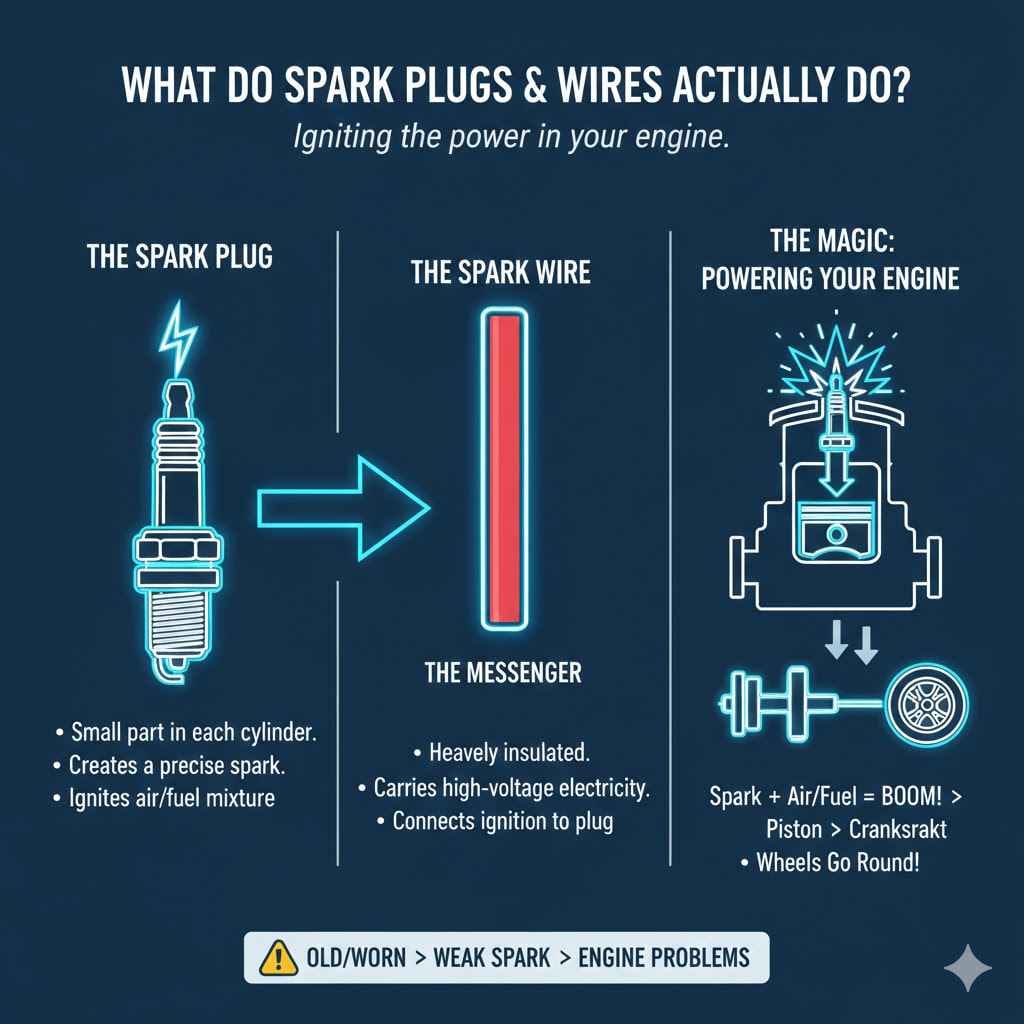
Let’s make this super simple. Imagine your car’s engine is like a powerful, controlled campfire. To get that fire started, you need a spark. That’s exactly what a spark plug does!
- The Spark Plug: This small part sits inside each cylinder of your engine. Its only job is to create a tiny, precise bolt of lightning—a spark—at exactly the right moment.
- The Spark Plug Wire: This is the messenger. It’s a heavily insulated wire that carries the high-voltage electricity from your car’s ignition system to the spark plug.
Together, they ignite the mixture of air and fuel in the cylinder. This tiny explosion pushes the piston down, which turns the crankshaft, and ultimately, makes your wheels go round. This happens thousands of times every minute. When your plugs and wires are old and worn out, that spark becomes weak and unreliable, causing a chain reaction of problems throughout your engine.
Telltale Signs Your Spark Plugs and Wires Are Failing
Your car is pretty good at telling you when something is wrong. You just have to know what to listen (and feel) for. If your spark plugs and wires are on their way out, you’ll likely notice one or more of these common symptoms:
- Rough Idling: Does your car shake or vibrate when you’re stopped at a red light? A weak spark can cause incomplete combustion, making the engine run unevenly.
- Trouble Starting: If you have to crank the engine for a long time before it finally starts, it could be a sign that your spark plugs aren’t strong enough to ignite the fuel easily.
- Poor Acceleration: When you press the gas pedal, does your car hesitate or feel sluggish? Worn plugs can’t keep up with the engine’s demand for power, leading to a lazy response.
- Engine Misfires: A misfire feels like a stumble or hiccup from the engine, especially under load (like going up a hill). This happens when a cylinder fails to fire correctly.
- Bad Fuel Economy: Are you visiting the gas station more often than you used to? A weak spark wastes fuel, as not all of it gets burned. New plugs can restore your MPG.
- The Check Engine Light: Your car’s computer is smart. If it detects an engine misfire or another ignition problem, it will often trigger the check engine light to let you know something is wrong.
If you’re experiencing any of these issues, it’s a good idea to check your spark plugs. It’s a simple fix that can make a world of difference.
The 5 Major Benefits of New Spark Plugs and Wires
Replacing these parts isn’t just about fixing a problem; it’s about making your car run better in every way. Think of it as a tune-up that brings back the performance and efficiency your car had when it was new. Here are the top five benefits you’ll enjoy.
1. Improved Fuel Economy
This is the benefit everyone loves because it saves you money. Worn-out spark plugs have a wider gap and may be covered in carbon deposits. This makes it harder for them to create a strong spark. Your engine’s computer tries to compensate, but the result is often incomplete combustion—meaning gas is wasted.
When you install fresh spark plugs, they deliver a consistent, powerful spark that ignites the air-fuel mixture completely. Every drop of gasoline is used to its full potential. According to the U.S. Department of Energy, fixing a serious maintenance issue like a faulty spark plug can improve your gas mileage by up to 40%, although a typical tune-up often results in a 4% improvement. Over a year, that adds up to real savings in your wallet.
2. Smoother, More Powerful Engine Performance
Do you remember how responsive and smooth your car felt when you first got it? New spark plugs and wires can bring that feeling back. A healthy ignition system ensures that every cylinder fires on time, every time. This translates to:
- A Stable, Quiet Idle: No more shaking or rough vibrations at stoplights. Your engine will hum along smoothly.
- Quick and Crisp Acceleration: When you need to merge onto the highway or pass another car, your vehicle will respond instantly without hesitation.
- Consistent Power Delivery: The engine will feel stronger and more capable, especially when climbing hills or carrying a heavy load.
Misfires caused by bad plugs rob your engine of power and create a jarring, unpleasant driving experience. A new set of plugs and wires eliminates these misfires, restoring the smooth, reliable performance you expect from your car.
3. Reliable, Easy Starts Every Time
There’s nothing more frustrating than a car that won’t start, especially when you’re in a hurry. Old spark plugs require more voltage to create a spark, which can be a problem, particularly in cold or wet weather. The battery has to work harder, and if the spark is too weak, the engine may not start at all.
New spark plugs have clean electrodes and are precisely gapped to the manufacturer’s specification. They create a strong, hot spark with minimal effort, allowing the engine to fire up instantly, even on the coldest mornings. This reduces wear and tear on your starter motor and battery, helping them last longer too.
4. Reduced Harmful Emissions (A Greener Ride)
Taking care of your car is also about taking care of the environment. Your vehicle’s emission system is designed to minimize the release of harmful pollutants. The catalytic converter plays a huge role in this, but it can only do its job if the engine is running efficiently.
When spark plugs are failing, they cause unburned fuel to be dumped into the exhaust system. This raw fuel can overheat and damage the expensive catalytic converter. Furthermore, incomplete combustion increases the output of hydrocarbons—a major component of smog. According to the Environmental Protection Agency (EPA), a well-maintained car produces significantly fewer emissions. By ensuring your engine burns fuel completely, new spark plugs help your car run cleaner, pass emissions tests, and reduce your carbon footprint.
5. Prevents Serious (and Expensive) Engine Damage
This is arguably the most important benefit of all. Ignoring worn spark plugs isn’t just an inconvenience; it can lead to catastrophic and costly repairs down the road.
Here’s how:
- Catalytic Converter Failure: As mentioned, engine misfires send unburned fuel into the exhaust. This fuel can ignite inside the catalytic converter, melting its delicate internal structure. Replacing a catalytic converter can cost anywhere from $1,000 to over $3,000.
- Damage to Ignition Coils and Wires: When a spark plug is hard to fire, it puts immense strain on the ignition coil and the spark plug wire. The coil has to generate much higher voltage, which can cause it to overheat and fail prematurely.
- Engine Damage: In extreme cases, a prolonged misfire can lead to carbon buildup on valves and pistons, or even cause detonation (engine knock), which can damage internal engine components.
A set of spark plugs and wires is one of the cheapest forms of insurance you can buy for your engine. Spending a small amount now on this routine maintenance can save you thousands in future repair bills.
How Often Should You Change Spark Plugs and Wires?
The golden rule is to always check your owner’s manual. Every car is different, and the manufacturer provides the most accurate maintenance schedule. However, here are some general guidelines based on the type of spark plug your car uses.
| Spark Plug Type | Average Replacement Interval | Description |
|---|---|---|
| Copper | Every 20,000 – 30,000 miles | Standard, older technology. Good conductor but wears out the fastest. Often used in older vehicles. |
| Platinum | Every 60,000 – 80,000 miles | A durable upgrade from copper. The platinum tip resists erosion, giving it a much longer lifespan. |
| Iridium | Every 100,000 – 120,000 miles | The premium option. Iridium is extremely hard and has a very high melting point, making these plugs incredibly long-lasting and efficient. |
Spark plug wires don’t always need to be changed with every plug change, but it’s good practice to replace them every 60,000 to 80,000 miles, or whenever they show signs of cracking, burning, or wear. Many modern cars use a “coil-on-plug” system and don’t have traditional spark plug wires at all.
Is This a DIY Job? (Spoiler: You Can Probably Do It!)
For many cars, especially those with 4-cylinder engines, changing spark plugs is a fantastic beginner DIY project. It’s rewarding, saves you money on labor costs, and helps you get more familiar with your car. The key is to be patient, organized, and have the right tools.
Essential Tools and Supplies
You don’t need a professional garage, just a few key items:
- Socket Wrench Set: You’ll need a ratchet and a few extension bars.
- Spark Plug Socket: This is a special deep socket with a rubber insert inside to grip the spark plug securely. They come in different sizes (most commonly 5/8″ or 13/16″), so make sure you get the right one for your car.
- Spark Plug Gap Gauge: A small, cheap tool used to measure and set the gap on the new spark plug.
- Torque Wrench: This is highly recommended to ensure you don’t over-tighten or under-tighten the new plugs.
- New Spark Plugs and Wires: Make sure you buy the correct parts for your car’s year, make, and model.
- Dielectric Grease: A small packet of this helps protect the connection and makes future removal easier.
A Simple, Step-by-Step Guide to Changing Spark Plugs
Safety First! Always work on a cool engine. The exhaust manifold and engine block can cause severe burns if hot.
- Locate the Spark Plugs: Open the hood and find the spark plug wires or ignition coils. They are usually on the top or side of the engine, often covered by a plastic engine cover that you may need to remove.
- Work on One Cylinder at a Time: This is the most important rule! To avoid mixing up the firing order, only remove and replace one spark plug wire and plug at a time.
- Remove the Wire/Coil: Gently twist and pull the spark plug wire boot (or unbolt and lift the ignition coil) off the spark plug. Never pull on the wire itself.
- Clean the Area: Before removing the old plug, use compressed air or a brush to clean any dirt or debris from around the spark plug hole. You don’t want anything falling into your engine’s cylinder.
- Remove the Old Spark Plug: Place the spark plug socket over the plug, attach your ratchet with an extension, and turn it counter-clockwise to loosen and remove it.
- Check the New Plug: Before installing the new plug, use your gap gauge to make sure the distance between the two electrodes is correct according to your owner’s manual.
- Install the New Spark Plug: Carefully thread the new plug into the hole by hand to avoid cross-threading. Once it’s snug, use your torque wrench to tighten it to the manufacturer’s specified torque.
- Apply Dielectric Grease: Put a small dab of dielectric grease inside the spark plug wire boot. This prevents it from getting stuck and ensures a good electrical connection.
- Reconnect the Wire/Coil: Push the wire boot or coil firmly back onto the new spark plug until you feel it click or seat securely.
- Repeat for All Cylinders: Move on to the next cylinder and repeat the process until all spark plugs have been replaced.
That’s it! Once you’re done, start the car and listen to your smooth-running engine. You did it!
Understanding the Ignition System: Plugs, Wires, and Coils
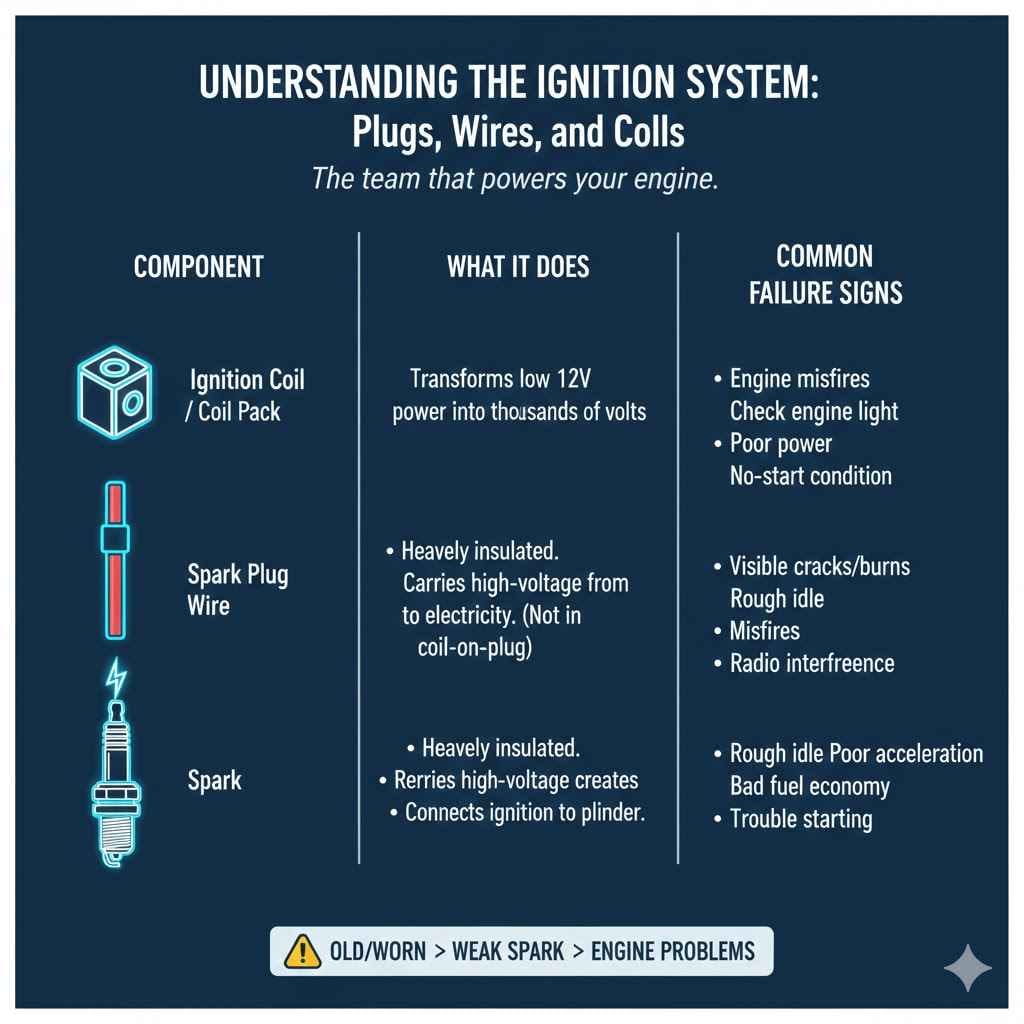
It can be confusing to hear terms like wires, coils, and plugs used together. They are all part of the same team, but they have different jobs. Here’s a simple breakdown:
| Component | What It Does | Common Failure Signs |
|---|---|---|
| Ignition Coil / Coil Pack | Transforms the car battery’s low 12-volt power into the high thousands of volts needed to create a spark. | Engine misfires, check engine light, poor power, no-start condition. Often fails on a single cylinder. |
| Spark Plug Wire | Carries that high-voltage electricity from the coil to the spark plug. (Not present in coil-on-plug systems). | Visible cracks or burns, rough idle, misfires, radio interference. |
| Spark Plug | Receives the high-voltage electricity and creates the actual spark inside the engine cylinder. | Rough idle, poor acceleration, bad fuel economy, trouble starting. |
Frequently Asked Questions (FAQ)
What happens if I don’t change my spark plugs?
If you don’t change your spark plugs, you’ll experience a gradual decline in engine performance. This includes poor fuel economy, rough idling, hesitation, and difficulty starting. Over time, it can lead to engine misfires, which can damage your expensive catalytic converter and put extra strain on other ignition components.
Can I just change the spark plugs and not the wires?
Yes, you can. However, if the wires are old, cracked, or near their recommended replacement interval, it’s a good idea to change them at the same time. Bad wires can cause the same problems as bad plugs, and since you’re already working in that area, replacing them together is efficient and ensures the entire system is healthy.
How much does it cost to replace spark plugs and wires?
If you do it yourself, the cost is just the parts, which can range from $20 to $100 depending on your car and the type of plugs you choose. If you take it to a mechanic, the cost for parts and labor typically ranges from $150 to $400. V6 or V8 engines often cost more because they have more plugs and some may be harder to access.
Do all cars have spark plug wires?
No, many modern cars do not have traditional spark plug wires. They use a “coil-on-plug” (COP) ignition system where each spark plug has its own dedicated ignition coil sitting directly on top of it. This design is more efficient and eliminates the need for wires as a maintenance item.
What is “gapping” a spark plug?
Gapping refers to setting the correct distance between the center and side electrodes at the tip of the spark plug. This gap must be set to a precise specification (found in your owner’s manual) for the spark to be effective. While many modern plugs come pre-gapped, it’s always a good practice to double-check them with a gap gauge before installation.
Can new spark plugs increase horsepower?
New spark plugs won’t add horsepower to your engine, but they can restore lost horsepower. Over time, worn plugs reduce your engine’s efficiency and power. Installing a fresh set simply brings the engine back to its original factory performance level, which can make it feel noticeably more powerful and responsive.
Your Car Deserves a Fresh Start
Taking care of your car doesn’t have to be complicated or intimidating. Changing your spark plugs and wires is one of the most impactful and affordable maintenance tasks you can perform. It’s a direct investment in your car’s health, performance, and longevity.
From saving money at the pump to enjoying a smoother, more reliable ride, the benefits are immediate and obvious. You’ll prevent costly future repairs, reduce your environmental impact, and gain the confidence that comes from knowing your car is in top shape. Whether you decide to tackle it yourself this weekend or have a trusted mechanic do it for you, don’t put it off. Give your engine the strong spark it needs to perform its best.