
No, “wheel ants” are not a real thing. It’s a slang term for a rhythmic clicking or ticking sound from your wheels. This noise is almost always a sign of a real mechanical issue, such as a failing CV joint, a loose lug nut, or a bad wheel bearing, which requires immediate attention for your safety.
Have you heard a strange clicking or ticking sound coming from your wheels while you drive? It can be worrying. You might have even heard someone mention “wheel ants” and wondered what on earth they were talking about. Is your car infested with some strange, metallic pest?
Don’t worry, it’s not a real insect. But that sound is very real, and it’s your car’s way of telling you something is wrong. Ignoring it can lead to bigger, more expensive problems, and can even be unsafe. In this guide, I’ll walk you through what that clicking noise really means, what causes it, and how you can figure out the next steps. We’ll even cover a few simple checks you can do yourself to feel more confident about your car.
The Myth of “Wheel Ants”: What Are People Talking About?
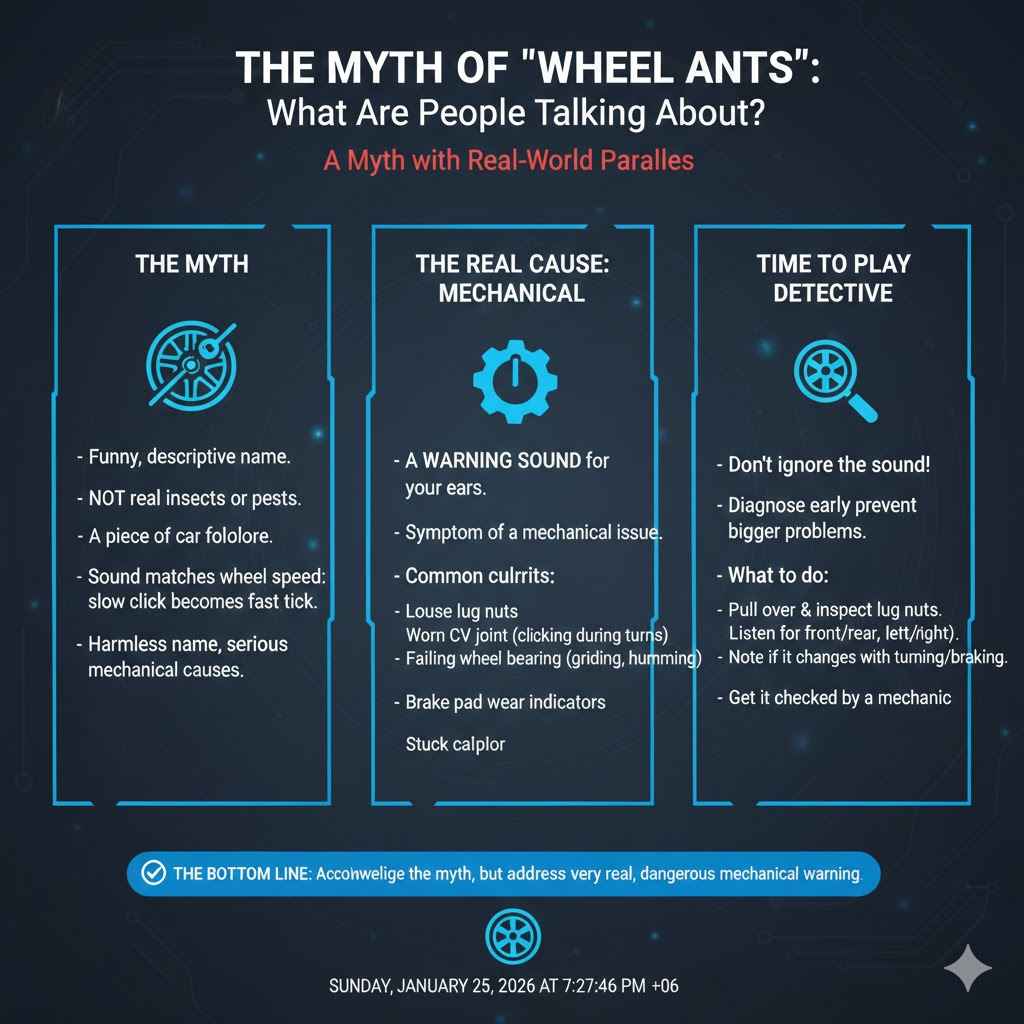
Let’s clear this up right away. The term “wheel ants” is just a funny, descriptive name someone came up with for a rhythmic clicking noise that sounds like tiny creatures marching inside your wheel. It’s a myth, a piece of car folklore. There are no insects, pests, or critters causing this sound.
The sound is mechanical. It’s a symptom of a part that is loose, worn out, or broken. The reason the myth persists is that the sound often matches the speed of your wheels—ticking slowly as you pull away and getting faster as you speed up, just like little ants marching faster and faster.
While the name is harmless, the real causes are not. Think of that clicking sound as a warning light for your ears. It’s time to play detective and find the true source of the problem before it gets worse.
The Real Culprits: 7 Common Causes of Clicking Wheels
Since we know it’s not actually ants, let’s look at the real mechanical parts that are likely crying out for help. That clicking noise can be traced back to several key components in your wheel, brake, and suspension systems.
1. The Worn-Out CV Joint
One of the most common causes of a clicking wheel is a failing Constant Velocity (CV) joint. This is especially true if you hear the noise most when you are turning.
- What it is: Your CV joints are part of the axle that connects your transmission to your wheels. They are complex, flexible joints that allow your wheels to turn and move up and down with the suspension while still receiving power from the engine.
- Why it fails: A CV joint is protected by a flexible rubber boot filled with grease. If this boot tears, the grease leaks out and dirt gets in. Without lubrication, the metal parts of the joint grind against each other and wear out quickly.
- The sound it makes: A distinct clicking or popping sound that gets louder and more frequent when you’re making a sharp turn. You might hear a single click when shifting from drive to reverse as well.
2. The Dangerous Loose Lug Nut
This is a serious safety issue that you should check immediately if you hear a clicking sound. Lug nuts are what hold your wheels onto your car.
- What it is: The large nuts that you see on the face of your wheel, securing it to the vehicle’s hub.
- Why it happens: They can become loose if they weren’t tightened properly the last time a wheel was removed, perhaps after a tire change or brake service. Temperature changes can also sometimes cause them to loosen over time.
- The sound it makes: A rhythmic clicking or ticking sound as the wheel wobbles slightly on the studs. The sound is often most noticeable at low speeds. Ignoring this can cause the wheel to completely detach from the car while you are driving.
3. The Grinding Wheel Bearing
A bad wheel bearing usually starts as a humming or grinding noise, but it can also cause a clicking sound in its later stages of failure.
- What it is: A set of steel balls or rollers held in a ring that allows your wheel to spin with very little friction.
- Why it fails: Like CV joints, wheel bearings are sealed with grease. If the seal breaks, contamination from water and dirt will destroy the bearing. Age and mileage also cause them to wear out.
- The sound it makes: Typically a humming, roaring, or grinding noise that gets louder as you increase speed. Sometimes it changes pitch or goes away when you turn one way or the other. It can also manifest as a clicking or snapping sound as the bearing falls apart internally.
4. Debris in Your Brakes
Sometimes, the cause is much simpler than a failing part. A small object can get lodged where it doesn’t belong.
- What it is: A small rock, twig, or other piece of road debris that has become trapped between the brake rotor (the shiny disc) and the dust shield or brake caliper.
- Why it happens: It’s just bad luck! Driving over a gravel road or loose pavement can easily kick a small stone into a tight space.
- The sound it makes: A high-pitched ticking or scraping sound that is constant and matches wheel speed. It might go away on its own, but often it needs to be manually removed.
5. Warped Brake Rotors
Your brake rotors can also be a source of clicking, especially if other components are slightly loose.
- What it is: Brake rotors are the metal discs that your brake pads squeeze to stop the car. Warping means the surface of the rotor is no longer perfectly flat.
- Why it happens: Rotors get extremely hot during braking. Hard braking, towing, or just age can cause them to warp.
- The sound it makes: A warped rotor usually causes a pulsation in the brake pedal when you slow down. However, it can also cause a rhythmic clicking or tapping sound as the high spot on the rotor hits the brake pad with each revolution.
6. Worn Suspension Parts
The clicking might not be coming from the wheel itself, but from the suspension parts connected to it.
- What they are: Components like ball joints, tie rod ends, and sway bar links allow your wheels to steer and absorb bumps.
- Why they fail: These are all moving parts that wear out over time. The protective rubber boots can tear, leading to a loss of grease and contamination, similar to a CV joint.
- The sound they make: Popping, clunking, or clicking noises, often heard when going over bumps, turning the steering wheel, or starting and stopping.
7. Hubcap Noises
If you have plastic wheel covers (hubcaps) instead of alloy wheels, the source of the noise might be surprisingly simple.
- What it is: The decorative plastic cover that snaps onto a steel wheel.
- Why it happens: The plastic clips that hold the hubcap in place can break or weaken over time. This allows the hubcap to move around and make a clicking or rattling sound as the wheel turns.
- The sound it makes: A light plastic-on-metal ticking or clicking that changes with wheel speed.
Your Action Plan: How to Diagnose That Clicking Sound
Okay, so you hear a click. Don’t panic! You can do a little detective work in a safe place to help narrow down the cause. Find an empty parking lot where you can drive slowly without any distractions.
- Listen Closely: Roll down your windows and turn off the radio. Try to pinpoint which wheel the sound is coming from. Is it the front? The back? The left or right side?
- Does it Change with Speed? Drive slowly in a straight line. Does the clicking speed up as the car speeds up? This confirms it’s related to something that rotates, like a wheel, axle, or rotor.
- Does it Happen When Turning? Now, turn the wheel sharply to the left and drive in a slow circle. Then do the same turning to the right. Is the noise louder or only present when turning? If yes, a bad CV joint is a very likely suspect.
- Does it Happen When Braking? As you coast slowly, gently apply the brakes. Does the sound change or stop? If it does, you should focus your attention on the brake system (warped rotor, debris, etc.).
- Does it Happen Over Bumps? Drive slowly over a small speed bump or uneven pavement. If you hear a clunk or pop, it’s more likely related to a suspension component like a ball joint or sway bar link.
This simple process can give you (or your mechanic) a huge head start in finding the real culprit behind the “wheel ants.”
Here is a simple table to help you keep track of the sounds:
| Sound Description | When It Happens | Most Likely Cause | DIY Fix or Pro Fix? |
|---|---|---|---|
| Rhythmic clicking/popping | Primarily when turning | Bad CV Joint | Pro Fix |
| Ticking or light clunking | At low speeds, straight or turning | Loose Lug Nuts | DIY Check (Urgent!) |
| Humming, grinding, or clicking | Constant, gets louder with speed | Bad Wheel Bearing | Pro Fix |
| High-pitched metallic ticking/scraping | Constant, matches wheel speed | Debris in Brakes | Possible DIY Fix |
| Clicking with brake pedal pulsation | When braking | Warped Brake Rotor | Pro Fix |
| Clunking or popping | When going over bumps or turning | Worn Suspension Part | Pro Fix |
| Light plastic rattling or clicking | Constant, matches wheel speed | Loose Hubcap | DIY Fix |
DIY Fixes You Can Handle: Checking Lug Nuts and Debris
While most of these issues require a trip to the mechanic, there are a couple of things you can safely check yourself. This can give you peace of mind or even solve the problem right then and there.
How to Safely Check and Tighten Your Lug Nuts
A loose lug nut is a major safety hazard, but it’s also easy to check. You will need a torque wrench for this job. Guessing the tightness with a standard wrench is not safe enough. You can find your car’s specific torque value in your owner’s manual or with a quick online search.
- Park on a Level Surface: Make sure your car is on flat, solid ground. Put the car in Park (or in gear for a manual) and engage the parking brake. Your safety is the #1 priority.
- Get Your Tools: You’ll need a torque wrench and a socket that fits your car’s lug nuts.
- Set the Torque Wrench: Adjust the torque wrench to the specification listed in your owner’s manual (usually measured in foot-pounds or ft-lbs).
- Tighten in a Star Pattern: Place the socket on a lug nut and tighten until the wrench makes a “click” sound. Do NOT overtighten. To ensure the wheel is seated evenly, always tighten the nuts in a star pattern. This means you tighten one nut, then the one opposite it, and so on, rather than going in a circle.
- Check All Wheels: Repeat this process for all the lug nuts on all four wheels. Even if the sound is only coming from one, it’s good practice to check them all.
For more official information on wheel and tire safety, resources like the National Highway Traffic Safety Administration (NHTSA) provide excellent guidelines for consumers.
When to Put Down the Wrench and Call a Mechanic
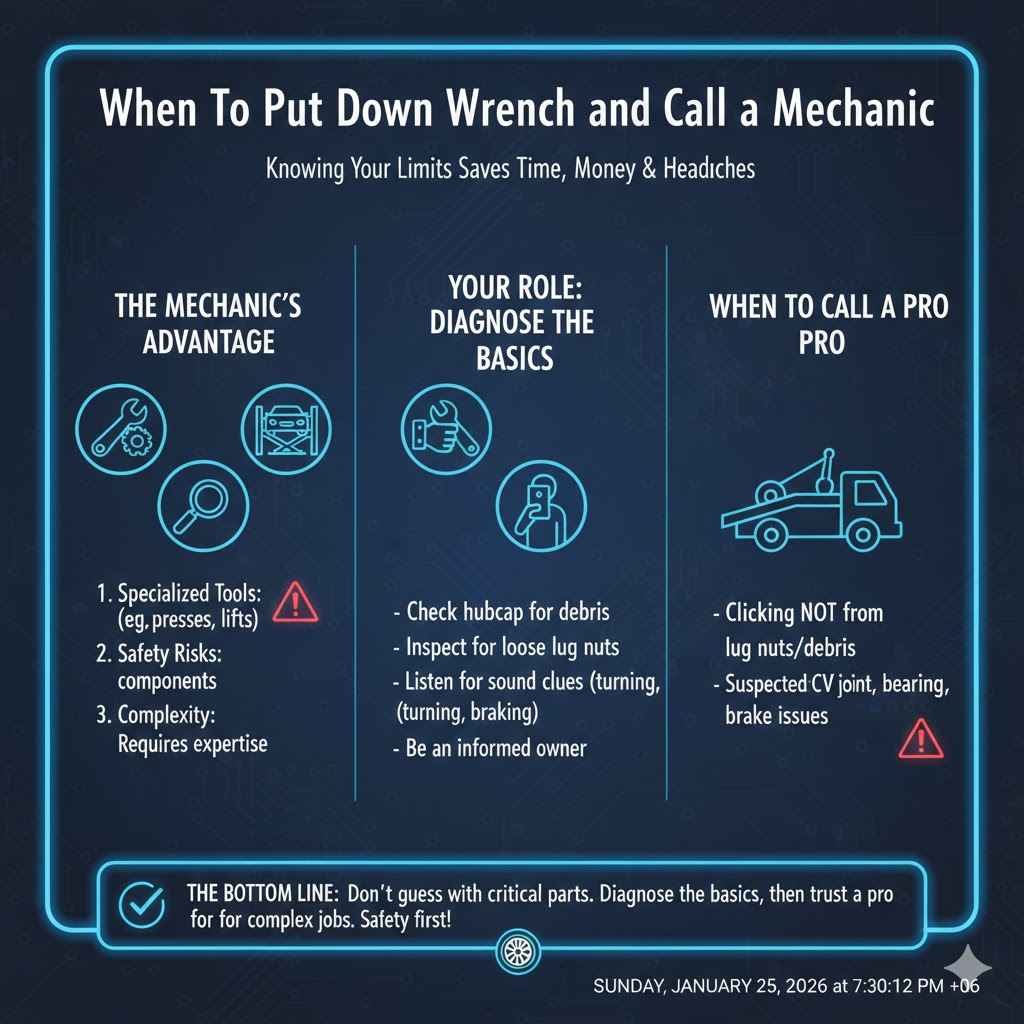
Your confidence is important, and so is knowing your limits. If the clicking sound isn’t caused by a loose hubcap, obvious debris, or loose lug nuts, it’s time to call a professional. Issues with CV joints, wheel bearings, brakes, and suspension are not beginner DIY jobs. Here’s why:
- Specialized Tools: These repairs often require tools like bearing presses, ball joint separators, and hydraulic lifts that most people don’t have in their garage.
- Safety Risks: These parts are critical to your car’s ability to steer, stop, and stay stable. A mistake during one of these repairs could lead to a very dangerous situation on the road.
- Complexity: Replacing a CV axle or pressing in a new wheel bearing is a complex job that requires technical knowledge and experience to do correctly.
Don’t be discouraged! Being able to diagnose the sound and check the basics is a huge step. When you call the mechanic, you can confidently say, “I hear a clicking sound from the front right wheel, especially when I turn left. I already checked and confirmed the lug nuts are tight.” This helps the technician diagnose the problem faster and shows you’re an informed car owner.
Frequently Asked Questions (FAQ)
What exactly are “wheel ants”?
“Wheel ants” is just a slang term for a rhythmic clicking or ticking sound coming from a car’s wheel area. It’s a myth; the sound is caused by a real mechanical problem, not insects.
Is a clicking sound from my wheel dangerous?
Yes, it can be very dangerous. A clicking wheel could be a sign of loose lug nuts, which could cause a wheel to fall off, or a failing CV joint, which could leave you stranded. You should have the sound investigated immediately.
How much does it cost to fix a clicking wheel?
The cost varies widely depending on the cause. Tightening lug nuts is free if you do it yourself. Removing debris from a brake might cost under $100. Replacing a CV axle can cost between $250 and $700, while a wheel bearing replacement can range from $300 to $800 or more, depending on your vehicle.
Can I drive with a clicking wheel?
It is not recommended. Since the cause is unknown, you could be driving with a loose wheel or a part that’s about to fail completely. It’s safest to limit driving until the vehicle has been inspected by a qualified mechanic.
What does a bad CV joint sound like?
A bad CV joint typically makes a loud clicking or popping sound that is most noticeable when you are making a sharp turn. The sound will often get faster as the wheel spins faster.
Why do my wheels click after getting new tires?
The most common reason for this is that the service shop did not properly torque the lug nuts. They may be too loose. This is a serious safety concern, and you should check the lug nut torque immediately or return to the shop.
Can a small rock really cause a loud clicking sound?
Absolutely. If a small, hard pebble gets wedged between the rotating brake rotor and the stationary brake dust shield, it can make a surprisingly loud and persistent metallic ticking sound with every revolution of the wheel.
Conclusion: You’ve Got This!
So, the shocking truth about “wheel ants” is that they aren’t real—but the sounds they represent certainly are. That rhythmic clicking is your car’s way of speaking to you, and now you know how to understand its language. It’s a warning sign from a mechanical part that needs attention.
By listening carefully and performing a few simple checks, you can confidently narrow down the possibilities. You’ve learned about the most common culprits, from the critical CV joint to the simple loose hubcap. More importantly, you know how to check for the most dangerous and easy-to-fix problem—loose lug nuts—and you know when it’s time to trust a professional for the bigger jobs.
Don’t let strange car noises intimidate you. Every sound has a source, and every problem has a solution. Stay curious, stay safe, and be proud of the steps you’re taking to become a more knowledgeable and confident car owner.