

Carbon wheels can be worth it for serious performance drivers seeking the absolute best in handling, acceleration, and braking by reducing weight. However, for most everyday drivers, their extremely high cost, risk of damage from potholes, and difficult repairs make high-quality aluminum alloy wheels a much more practical and cost-effective choice.
Have you ever seen a high-end sports car and noticed its stunning, intricate wheels? Chances are, you might have been looking at carbon fiber wheels. They are the talk of the performance world, promising amazing benefits. But they also come with a jaw-dropping price tag. This can leave you wondering, “Are they just for supercars, or could they be right for me?”
It’s a common question, and the answer isn’t a simple yes or no. You don’t need to be a race car driver or an engineer to figure this out. I’m here to break it all down for you in plain, simple English. In this guide, we’ll walk through exactly what carbon wheels are, explore their real-world pros and cons, and help you decide if they are a smart investment for your car. Let’s get started!
What Exactly Are Carbon Fiber Wheels?
Before we can decide if they’re worth it, let’s quickly cover what they are. Think of a normal wheel, which is usually made of aluminum alloy. It’s melted down and poured into a mold or forged from a solid block.
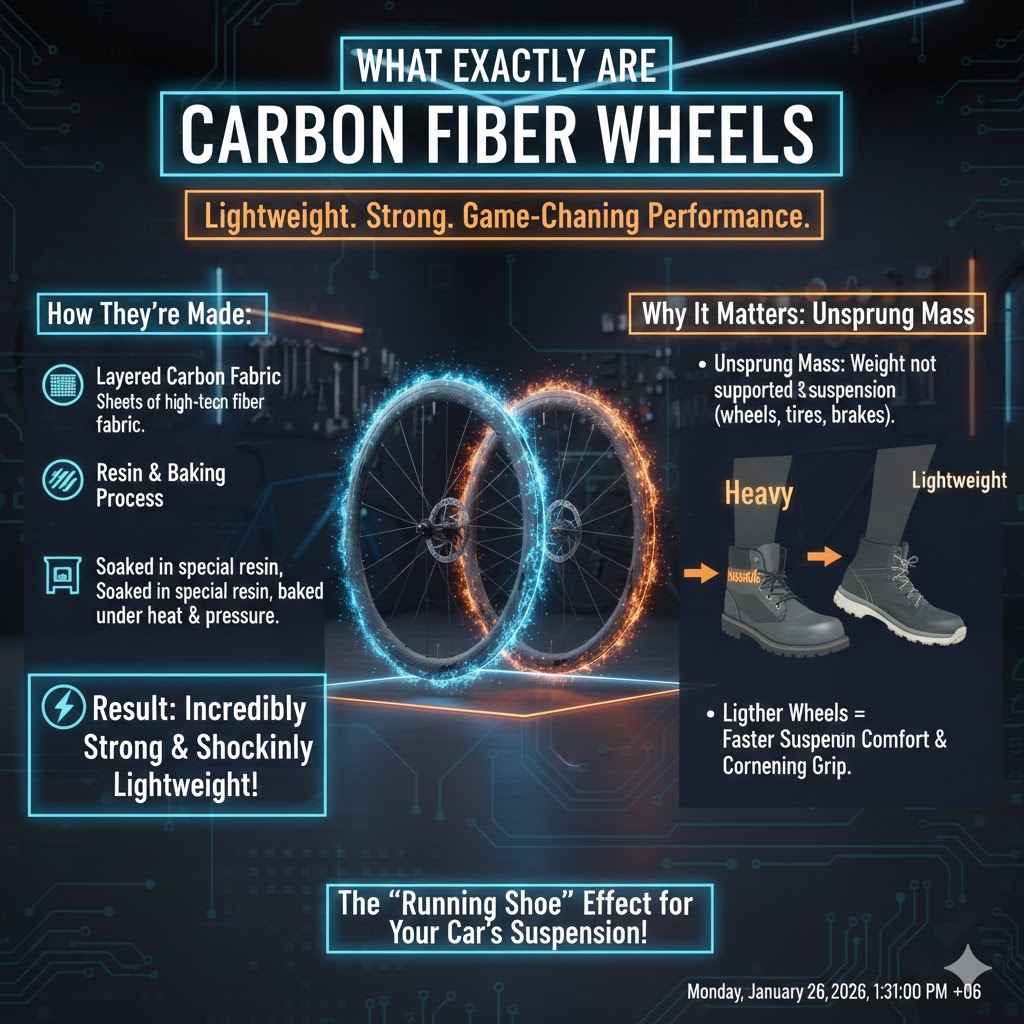
Carbon fiber wheels are different. They aren’t made from metal at all. Instead, they are built from layers of carbon fiber fabric—the same high-tech stuff used in race cars and aerospace. These sheets of fabric are soaked in a special resin and then baked under immense pressure and heat. This process creates a wheel that is incredibly strong and shockingly lightweight.
The main goal is to reduce weight in the most important place possible: the wheels themselves.
Why Weight on Your Wheels Matters So Much
You might think, “A few pounds off each wheel can’t make that big of a difference, right?” But in the car world, this is a huge deal. The weight of your wheels, tires, and brakes is called “unsprung mass.”
Imagine trying to run in heavy, steel-toed work boots. Now, imagine running in lightweight, modern running shoes. You can start, stop, and change direction much faster and with less effort in the running shoes. Your car’s suspension feels the exact same way.
Unsprung mass is any part of your car that isn’t supported by the suspension springs. Lighter wheels give your suspension less work to do. This allows it to react faster to bumps and keep your tires glued to the road, which improves everything from ride comfort to cornering grip.
The Big Benefits: Why People Love Carbon Wheels
The high price tag exists for a reason. Carbon wheels offer some serious performance advantages that get enthusiasts very excited. Let’s look at the pros.
1. Massive Weight Reduction
This is the number one benefit. A carbon fiber wheel can be 40-50% lighter than a traditional aluminum alloy wheel of the same size. Saving 10-15 pounds per corner might not sound like much, but when it’s unsprung mass, the effect is multiplied. This leads to several direct improvements:
- Faster Acceleration: Your engine has less weight to spin up, so your car feels quicker off the line.
- Better Braking: There is less mass to slow down, which can reduce your stopping distances.
- Sharper Handling: The suspension can keep the tires in contact with the road more effectively, leading to more responsive steering and better grip in corners.
2. Incredible Strength and Stiffness
For its weight, carbon fiber is significantly stronger and stiffer than aluminum. What does this mean for a wheel? When you take a corner hard, a metal wheel can actually flex slightly under the load. This tiny flex can make the steering feel a little less precise.
A carbon fiber wheel is much more rigid. It doesn’t flex. This rigidity means that every tiny input you make with the steering wheel is transferred directly to the tires and the road. The result is a sharper, more connected, and more confident driving feel, especially during spirited driving or on a track.
3. The Ultimate “Wow” Factor
Let’s be honest—carbon wheels look incredible. The unique weave pattern of the carbon fiber is a symbol of high performance and cutting-edge technology. For owners of supercars, show cars, or high-end performance vehicles, carbon wheels are a statement piece. They signal that no expense has been spared in the pursuit of performance and style. They are exclusive, rare, and instantly recognizable.
4. Potential for Quieter Ride
This is a less-talked-about benefit, but it’s a real one. Carbon fiber has natural vibration-damping properties. This means it can absorb some of the high-frequency vibrations that travel from the road up into the car’s cabin. The result can be a slightly quieter and smoother ride on certain road surfaces, as some of that harshness and road noise is filtered out by the wheels themselves.
The Reality Check: The Downsides of Carbon Wheels
Of course, it’s not all sunshine and faster lap times. Carbon wheels come with some significant drawbacks that you absolutely must consider before even thinking about buying them.
1. The Astonishing Cost
This is the biggest hurdle for almost everyone. A single carbon fiber wheel can cost as much as a full set of very high-quality forged aluminum wheels. A set of four can easily run from $10,000 to $20,000 or even more.
For that price, you could buy a reliable used car or make some massive performance upgrades to your engine, suspension, and brakes combined. The cost alone puts them out of reach for the vast majority of drivers.
2. Durability and Repair Concerns
This is arguably the most important practical consideration. Aluminum wheels are tough. If you hit a nasty pothole with an aluminum wheel, it will most likely bend. A bent wheel can often be repaired by a professional wheel repair shop for a reasonable price.
Carbon fiber is different. It’s incredibly strong, but it’s also brittle. If you hit that same pothole with a carbon fiber wheel, it’s less likely to bend and more likely to crack or shatter. A cracked carbon fiber wheel cannot be safely repaired. It must be replaced, meaning you’re out thousands of dollars for a single wheel.
While manufacturers have made huge strides in making them more durable for road use, the risk of a catastrophic failure from a severe impact is always there. This makes many people nervous about using them for daily driving on imperfect public roads.
3. Potentially Harsher Ride
Wait, didn’t we just say they can offer a quieter ride? Yes, but there’s a flip side. The same stiffness that improves handling can also make the ride feel harsher over sharp bumps like expansion joints or small potholes. An aluminum wheel has a little bit of “give” that can help absorb these sharp impacts. A super-stiff carbon wheel transfers more of that sharp jolt directly to the suspension and, ultimately, to you.
4. Limited Availability and Options
You can find aluminum wheels in thousands of styles, sizes, and finishes to fit nearly any car imaginable. Carbon fiber wheels are a niche, specialty product. The selection of sizes and styles is much more limited, and they are typically only made for high-performance sports cars and supercars. Finding a set that fits your specific vehicle might be difficult or impossible.
Carbon vs. Aluminum Wheels: A Head-to-Head Comparison
To make things easier, let’s put everything into a simple table. This helps visualize the key differences between the most common wheel types.
| Feature | Carbon Fiber Wheels | Forged Aluminum Wheels | Cast Aluminum Wheels |
|---|---|---|---|
| Weight | Extremely Light | Light | Standard/Heavy |
| Strength | Very High / Stiff | High | Good |
| Cost | Extremely High ($$$$) | High ($$$) | Low / Moderate ($$) |
| Durability (Impact) | Can crack/shatter on severe impact. Less forgiving. | Tends to bend, not break. Very durable. | More brittle than forged; can crack. |
| Repairability | Generally not repairable if cracked. | Often repairable if bent. | Sometimes repairable, depends on damage. |
| Best For | Track use, supercars, show cars. | Performance driving, daily use, track days. | Everyday driving, budget-conscious buyers. |
So, Who Are Carbon Wheels REALLY For?
After looking at all the pros and cons, we can see that carbon wheels are a specialized tool for specific situations. They are not a one-size-fits-all upgrade.
The Dedicated Track Enthusiast
If you regularly take your car to the racetrack and are chasing every last tenth of a second off your lap times, then yes, carbon wheels could be worth it. On the smooth, predictable surface of a track, the risk of pothole damage is gone. Here, the weight savings and stiffness can provide a real, measurable performance advantage that you can feel in every corner.
The Supercar or Hypercar Owner
For someone who owns a car that already costs hundreds of thousands of dollars, a $20,000 set of wheels is a proportional expense. These cars are built for the highest levels of performance, and carbon wheels help unlock their full potential. It’s about achieving the absolute pinnacle of engineering and design, where cost is a secondary concern.
The “Money is No Object” Custom Car Builder
If you’re building a unique show car and want the ultimate aesthetic and a great story to tell, carbon wheels are a showstopper. They are a clear sign of a no-compromises build and will draw attention and admiration from fellow enthusiasts.
Who They Are NOT For: The Average Driver
If you use your car for commuting, running errands, and the occasional road trip, carbon wheels are almost certainly not worth it. The performance gains would be unnoticeable on public roads, while the huge cost and risk of damage from everyday hazards like potholes are very real. You would get far more enjoyment and a better return on your money by investing in high-quality tires or a premium set of lightweight forged aluminum wheels for a fraction of the price.
As the U.S. Department of Energy notes, reducing a vehicle’s weight is a key way to improve its efficiency and performance. While their focus is often on the body and chassis, the principle of using advanced materials like carbon fiber to reduce vehicle weight applies directly to wheels as well. However, the cost-benefit balance is very different for wheels compared to other components.
Your Smart Decision Checklist
Still on the fence? Ask yourself these simple questions. Your honest answers will give you a clear direction.
- What is my realistic budget? Can I comfortably afford to spend $10,000+ on wheels and not worry if one gets damaged?
- How do I use my car 95% of the time? Is it a daily commuter on city streets or a weekend toy for the racetrack?
- How are the roads in my area? Am I constantly dodging potholes, or are my local roads generally smooth?
- Am I prepared for the replacement cost? If I destroy one wheel, can I afford to buy a replacement immediately without financial stress?
- What is my ultimate goal? Is it measurable performance (lap times), stunning looks, or simply a reliable and enjoyable driving experience?
If your answers point toward budget constraints, daily driving, and pothole-ridden roads, a great set of forged or even flow-formed aluminum wheels will give you 90% of the benefit for 20% of the cost. That’s the smart money move for most people.

Frequently Asked Questions (FAQ)
Can carbon fiber wheels be repaired?
Generally, no. If a carbon fiber wheel sustains a structural crack from an impact, it is considered unsafe and must be replaced. Unlike an aluminum wheel that bends, carbon fiber fails by fracturing. Some companies offer cosmetic repairs for surface-level scratches in the clear coat, but any damage to the carbon structure itself is a deal-breaker.
Are carbon wheels safe for daily driving?
Modern carbon wheels from reputable manufacturers are engineered and tested to be very safe for normal driving conditions. They must pass the same safety standards as metal wheels. The main risk isn’t a spontaneous failure but rather damage from a severe road hazard, like a deep pothole or hitting a curb, which can cause a crack.
How much do carbon wheels really cost?
The price varies by brand and size, but you should expect to pay between $2,500 and $5,000 per wheel. A full set typically costs anywhere from $10,000 to $20,000 or more. This is significantly more than even high-end forged aluminum wheels, which usually range from $3,000 to $7,000 for a set.
Do carbon wheels improve gas mileage?
Technically, yes, but the improvement is tiny. Lighter wheels reduce the overall mass of the car, which means the engine uses slightly less energy to move it. However, the gain in fuel economy is so small (likely less than 1%) that you would never notice it in real-world driving. You should not buy carbon wheels to save money on gas.
Are carbon wheels noisy?
No, quite the opposite. Carbon fiber is excellent at damping vibrations. This means carbon wheels can actually reduce the amount of road noise and high-frequency vibrations that get transmitted into the car, potentially leading to a quieter ride on many surfaces.
How do you clean carbon fiber wheels?
You clean them just like you would a high-quality painted wheel. Use a pH-neutral car soap, plenty of water, and a soft microfiber wash mitt. Avoid harsh, acidic wheel cleaners or abrasive brushes, as these can damage the protective clear coat finish over the carbon weave.
What’s the difference between real carbon wheels and “carbon-look” wheels?
This is a big one! A “carbon-look” or “hydro-dipped” wheel is just a standard aluminum wheel with a cosmetic finish applied to mimic the look of carbon fiber. It offers zero weight savings or performance benefits. A true carbon fiber wheel is constructed entirely from carbon fiber composite material. Be sure you know what you’re buying!
Conclusion: The Final Verdict
So, are carbon wheels worth it? The answer truly depends on who you are and what you’re looking for. They represent the absolute peak of wheel technology, offering undeniable performance gains in weight, strength, and handling that can be felt on a racetrack.
However, for the everyday driver, they are a luxury item with serious practical downsides. The astronomical cost and the ever-present risk of an expensive, unrepairable failure from a simple pothole make them a high-stakes gamble. The small benefits they offer in daily driving simply cannot justify the immense price tag for most people.
Think of it this way: Carbon wheels are like a specialized tool for a master craftsman. In the right hands and the right environment, they are brilliant. But for everyday tasks, a simpler, more robust tool is often the better and smarter choice. You now have all the information you need to look at your car, your budget, and your driving style and make the decision that’s perfect for you. Drive safe, and enjoy the ride!