

Not all Honda CR-Vs are All-Wheel Drive (AWD). Most CR-V models come standard with Front-Wheel Drive (FWD), while AWD is offered as an available upgrade on lower trims and is often standard only on the highest-level trims. Always check the specific vehicle’s details to be sure.
Have you ever wondered if the Honda CR-V you’re driving, or the one you’re thinking about buying, has All-Wheel Drive? It’s a super common question, and the answer isn’t as simple as a yes or no. Getting it wrong can affect everything from your confidence in a snowstorm to your budget for gas and maintenance. Don’t worry, you’re in the right place for a clear, simple answer. I’m here to walk you through it, step-by-step, with no confusing mechanic talk. Together, we’ll figure out exactly what kind of drivetrain your CR-V has and what that means for you.
The Short Answer: No, Not All CR-Vs are AWD
Let’s clear this up right away: Honda does not make every CR-V with All-Wheel Drive. For most of its history, the Honda CR-V has come with Front-Wheel Drive (FWD) as the standard setup. All-Wheel Drive (AWD) is typically offered as an optional feature you can choose to add when buying the car new. On the very top trim levels, like the Touring or Black Edition in recent years, AWD might come standard, but for the popular LX, EX, or EX-L trims, it’s an upgrade.
Why do they do this? It’s all about giving you choices. FWD systems are generally lighter and more fuel-efficient, which helps keep the price of the car down and saves you money at the gas pump. AWD systems provide better traction and stability in slippery conditions but cost a bit more upfront and can slightly lower your fuel economy. By offering both, Honda lets drivers pick the option that best fits their climate, driving needs, and budget.

Understanding the Basics: FWD vs. AWD in Your CR-V
Before we dive into how to check your specific vehicle, let’s quickly cover what these terms actually mean. Think of it like a shopping cart. It’s simple, I promise!
What is Front-Wheel Drive (FWD)?
In a Front-Wheel Drive vehicle, the engine only sends power to the two front wheels. Those front wheels are responsible for both pulling the car forward and steering. Imagine pulling a shopping cart from the front—that’s the basic idea behind FWD. It’s a very efficient setup, which is why it’s so common.
- Good for: Everyday driving, dry roads, and better fuel economy.
- How it feels: Predictable and stable in most conditions.
What is All-Wheel Drive (AWD)?
In an All-Wheel Drive vehicle, the engine can send power to all four wheels. Honda’s system is particularly smart; it primarily runs in FWD to save fuel during normal driving. But when it senses a front wheel slipping—on snow, ice, or even wet pavement—it automatically sends power to the rear wheels to give you extra grip. Imagine having a friend push your shopping cart from the back while you pull from the front—that extra help is what AWD provides.
- Good for: Snowy or icy climates, heavy rain, gravel roads, and added driving confidence.
- How it feels: More stable and secure when the weather gets bad.
How to Tell if Your Honda CR-V has All-Wheel Drive
Okay, so how do you find out for sure if your CR-V is FWD or AWD? Here are three easy methods, starting with the simplest. You can do this!
Method 1: Check for the AWD Badge
This is the quickest and easiest way. Walk to the back of your CR-V and look at the tailgate or rear hatch. On most models equipped with All-Wheel Drive, Honda places a small badge that clearly says “AWD.” It’s usually on the opposite side of the “CR-V” emblem. If you see that badge, you’re all set—you have AWD. If there’s no badge, your vehicle is most likely Front-Wheel Drive. However, badges can be removed, so if you want to be 100% certain, move on to the next method.
Method 2: Look Up Your Vehicle Identification Number (VIN)
Your car’s VIN is like its unique fingerprint. It contains a ton of information about how your vehicle was built, including its drivetrain. You can find the 17-digit VIN in a few places:
On a small metal plate on the driver’s side of the dashboard, visible through the windshield.
On a sticker inside the driver’s side door jamb.
On your vehicle’s registration or insurance card.
Once you have the VIN, you can use a free online VIN decoder. The National Highway Traffic Safety Administration (NHTSA) offers a reliable one. Simply type in your VIN, and it will pull up a report with your vehicle’s specs. Look for a field labeled “Drivetrain” or “Drive Type.” It will clearly state whether you have Front-Wheel Drive or All-Wheel Drive.
Method 3: A Quick Look Underneath (For the Curious)
If you’re feeling a little adventurous, you can take a peek under the back of your CR-V. You don’t need to lift the car, just look from behind. On an AWD model, you will see a component called the rear differential. It looks like a small, pumpkin-shaped metal casing in the center of the rear axle, with shafts (called axles) coming out of it that connect to the rear wheels. You’ll also see a long bar (the driveshaft) running from the front of the car to this differential. If you look under a FWD CR-V, this whole setup will be missing. The rear will just have a simple axle beam connecting the two wheels.
A Look Back: Honda CR-V Drivetrain Options Through the Generations
The Honda CR-V has been a favorite for decades, and its drivetrain options have evolved over time. Understanding this history can be helpful, especially if you’re buying a used model.
| Generation | Model Years | Standard Drivetrain | Optional Drivetrain | Notes |
|---|---|---|---|---|
| First Gen | 1997-2001 | Real Time 4WD | None | All first-gen CR-Vs in North America came with what Honda called “Real Time 4WD,” an early version of their automatic AWD system. |
| Second Gen | 2002-2006 | Front-Wheel Drive (FWD) | Real Time 4WD | This is when Honda began offering FWD as the standard option to improve fuel economy and lower the starting price. |
| Third Gen | 2007-2011 | Front-Wheel Drive (FWD) | Real Time 4WD | Continued the trend of FWD standard and AWD optional across most trims. The system was improved for faster engagement. |
| Fourth Gen | 2012-2016 | Front-Wheel Drive (FWD) | Real Time AWD | Honda officially began branding its system as “Real Time AWD.” FWD remained standard on LX, EX, and EX-L trims. |
| Fifth Gen | 2017-2022 | Front-Wheel Drive (FWD) | Real Time AWD | AWD became standard on the top Touring trim, but remained an option for LX, EX, and EX-L. |
| Sixth Gen | 2023-Present | Front-Wheel Drive (FWD) | Real Time AWD | AWD is standard on higher trims like the Sport Touring Hybrid, but FWD is standard on popular trims like LX and EX. |
Honda’s Smart System: “Real Time AWD with Intelligent Control” Explained
You might see the phrase “Real Time AWD with Intelligent Control System” when looking at modern CR-Vs. It sounds complicated, but the idea behind it is wonderfully simple and efficient.
Unlike some older 4WD systems that are always on or need to be manually engaged, Honda’s Real Time AWD is designed to be smart and automatic. Here’s how it helps you:
- Saves Fuel: During normal, everyday driving on dry roads, your CR-V operates almost entirely in Front-Wheel Drive. This is great because it means you get the best possible gas mileage.
- Reacts Instantly: The “Intelligent Control” system is constantly monitoring for wheel slip. The moment a front wheel starts to lose traction, it instantly and automatically sends power to the rear wheels. You don’t have to flip a switch or press a button—it just works.
- Helps You Start Moving: The system is also proactive. For example, when you’re stopped on a slippery hill, it will send some power to the rear wheels as you start to accelerate to prevent wheel spin from the very beginning.
In short, you get the fuel efficiency of a FWD car most of the time, with the added safety and traction of AWD precisely when you need it. It’s the best of both worlds.
Choosing the Right CR-V for You: FWD vs. AWD
If you’re in the market for a new or used CR-V, you might be wondering which one is right for you. It really comes down to your personal needs. Let’s break down the pros and cons to make the decision easier.
When is FWD a Great Choice?
A Front-Wheel Drive CR-V is an excellent and practical choice for many drivers. You should seriously consider FWD if:
- You live in a mild climate: If you rarely see snow, ice, or heavy rain, the extra grip of AWD might be unnecessary.
- You prioritize fuel economy: FWD CR-Vs consistently get slightly better gas mileage, saving you money over the life of the car. Check official numbers at FuelEconomy.gov to see the difference for specific model years.
- Your budget is tighter: FWD models are less expensive to purchase, whether new or used. They also have slightly lower maintenance costs over time since there’s no rear differential to service.
When Should You Choose AWD?
An All-Wheel Drive CR-V offers incredible peace of mind and capability. You should definitely choose AWD if:
- You live in a region with snow and ice: This is the biggest reason to get AWD. It provides significantly better traction for starting from a stop and staying stable in winter conditions.
- You frequently drive in heavy rain: AWD can help prevent hydroplaning and provides better grip on slick, wet roads.
- You travel on unpaved or gravel roads: The extra traction is a huge benefit on loose surfaces.
- You value maximum stability and confidence: Even in dry conditions, some drivers prefer the planted, secure feeling that an AWD system provides during cornering or sudden maneuvers.
FWD vs. AWD Side-by-Side Comparison
| Feature | Front-Wheel Drive (FWD) | All-Wheel Drive (AWD) |
|---|---|---|
| Purchase Price | Lower | Higher (Typically a ~$1,500 option when new) |
| Fuel Economy | Better (Usually 1-2 MPG higher) | Slightly lower |
| Performance | Excellent for most daily driving conditions. | Superior traction in snow, ice, rain, and on loose surfaces. |
| Maintenance | Simpler and slightly less expensive. | Requires rear differential fluid changes periodically. |
| Weight | Lighter | Heavier |
| Best For | Drivers in mild climates focused on efficiency and cost. | Drivers in four-season climates or those wanting maximum traction. |
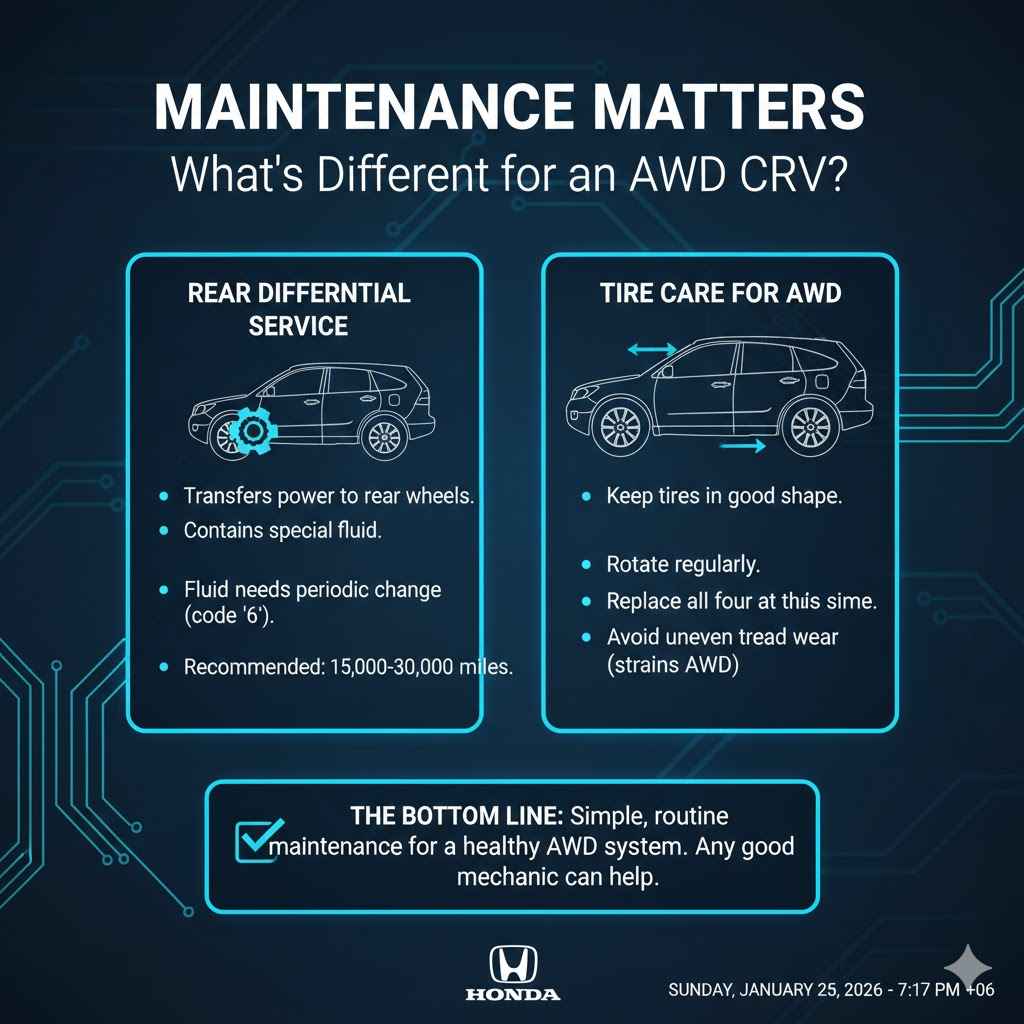
Maintenance Matters: What’s Different for an AWD CR-V?
The good news is that maintaining a Honda CR-V is straightforward, whether it’s FWD or AWD. However, there is one key difference to be aware of if you have an AWD model: the rear differential.
The rear differential is the part that transfers power to the rear wheels. It contains a special fluid that needs to be changed periodically to keep everything running smoothly. Honda’s Maintenance Minder system will let you know when it’s time by showing a specific code (usually code “6”). Generally, this service is recommended every 15,000 to 30,000 miles, depending on your driving habits.
Another important tip for all AWD vehicles is to keep your tires in good shape. It’s crucial to rotate them regularly and replace all four tires at the same time. Using tires with different amounts of tread wear can strain the AWD system. But don’t worry, this is simple, routine maintenance that any good mechanic can handle for you.
Frequently Asked Questions (FAQ)
Is Honda’s AWD system good in snow?
Yes, absolutely. Honda’s Real Time AWD is excellent in snow. It provides fantastic traction to help you get started from a stoplight or climb a snowy driveway. Remember, AWD helps you “go,” but it doesn’t help you stop or turn any better—that’s the job of your tires. Always pair your AWD CR-V with a good set of all-season or winter tires for the best performance in snow.
Does AWD make a CR-V safer?
AWD can contribute to safety by preventing you from getting stuck and by providing better stability in slippery conditions, which can help you avoid an accident in the first place. However, it’s just one part of the safety equation. Modern safety features like anti-lock brakes (ABS), vehicle stability assist (VSA), and good tires are just as important.
Can you add AWD to a FWD Honda CR-V?
No, this is not a practical or cost-effective conversion. Adding AWD to a FWD vehicle would require extensive modifications, including a new transmission, driveshaft, rear differential, axles, and suspension components. It is far easier and cheaper to sell your FWD model and purchase an AWD version.
Is AWD the same as 4WD (Four-Wheel Drive)?
While they sound similar, they are different. AWD is an automated system that is on all the time and decides for you when to send power to different wheels. It’s perfect for on-road use in variable conditions. 4WD is typically a more rugged system found on trucks and large SUVs. It often needs to be manually engaged by the driver and is designed for serious off-road situations. For a vehicle like the CR-V, AWD is the perfect, more efficient choice.
How much more does an AWD CR-V cost?
When buying new, the AWD option typically adds about $1,500 to the price of a CR-V. In the used market, the price difference can vary but AWD models usually hold their value slightly better, especially in regions with snowy winters.
Does using AWD hurt my gas mileage?
An AWD system adds a little extra weight and mechanical parts, so an AWD CR-V will have a slightly lower MPG rating than its FWD counterpart—usually by just one or two miles per gallon. Because Honda’s system is smart and only engages the rear wheels when needed, the impact on your fuel economy is minimal compared to older, full-time 4WD systems.
Your Confident Conclusion
So, are all Honda CR-Vs All-Wheel Drive? Now you know the definitive answer is no. Most come standard as Front-Wheel Drive, with AWD available as a smart, capable upgrade. You’re now equipped with the knowledge to walk out to your driveway and tell for sure what you have, using the badge, your VIN, or even a quick peek underneath.
More importantly, you understand what the difference really means for you as a driver. Whether you’re sticking with a fuel-efficient FWD model for sunny climates or opting for the all-weather confidence of an AWD version, you can now make an informed choice that perfectly fits your life. You’ve got this!