
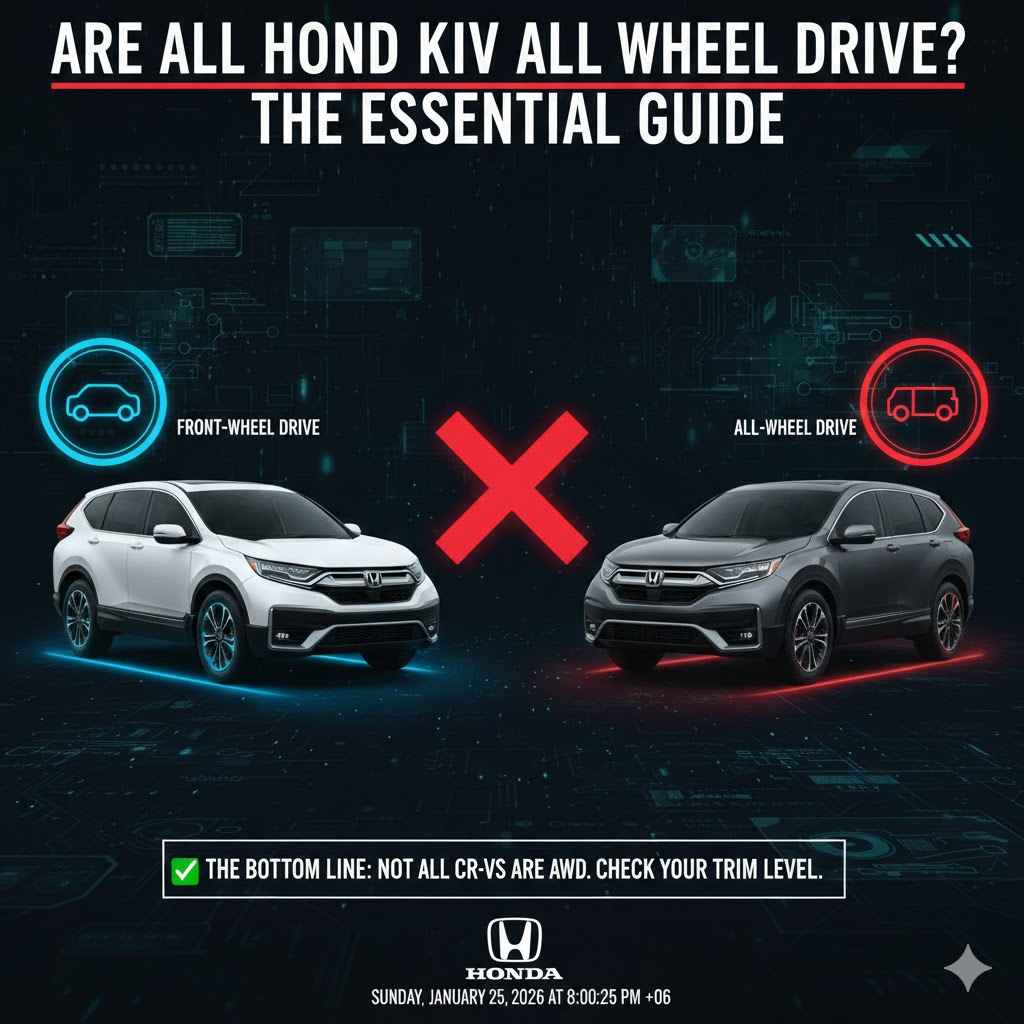
Not all Honda CR-Vs are All-Wheel Drive (AWD). Base models typically come standard with Front-Wheel Drive (FWD), while AWD is available as an optional upgrade on lower trims and is often standard on the highest-level trims. It’s essential to check the specific vehicle’s features to confirm if it has AWD.
Hey everyone, Dustin Hall here. If you’re looking at a Honda CR-V, you’ve probably asked yourself a very common question: “Is this thing All-Wheel Drive?” It’s a great question! The CR-V is one of the most popular SUVs out there, known for its reliability and practicality. But the whole FWD vs. AWD thing can be confusing, especially when you’re just trying to find the right car for you and your family.
Don’t worry, I’m here to clear it all up. Many people assume that because it’s an SUV, AWD is a given, but that’s not always the case with the CR-V. Today, we’re going to break it all down in simple, easy-to-understand terms. We’ll look at how to tell if a CR-V has AWD, what the difference really means for you, and which models have it. Let’s get you feeling confident about your choice.
First Things First: What’s the Difference Between FWD and AWD?
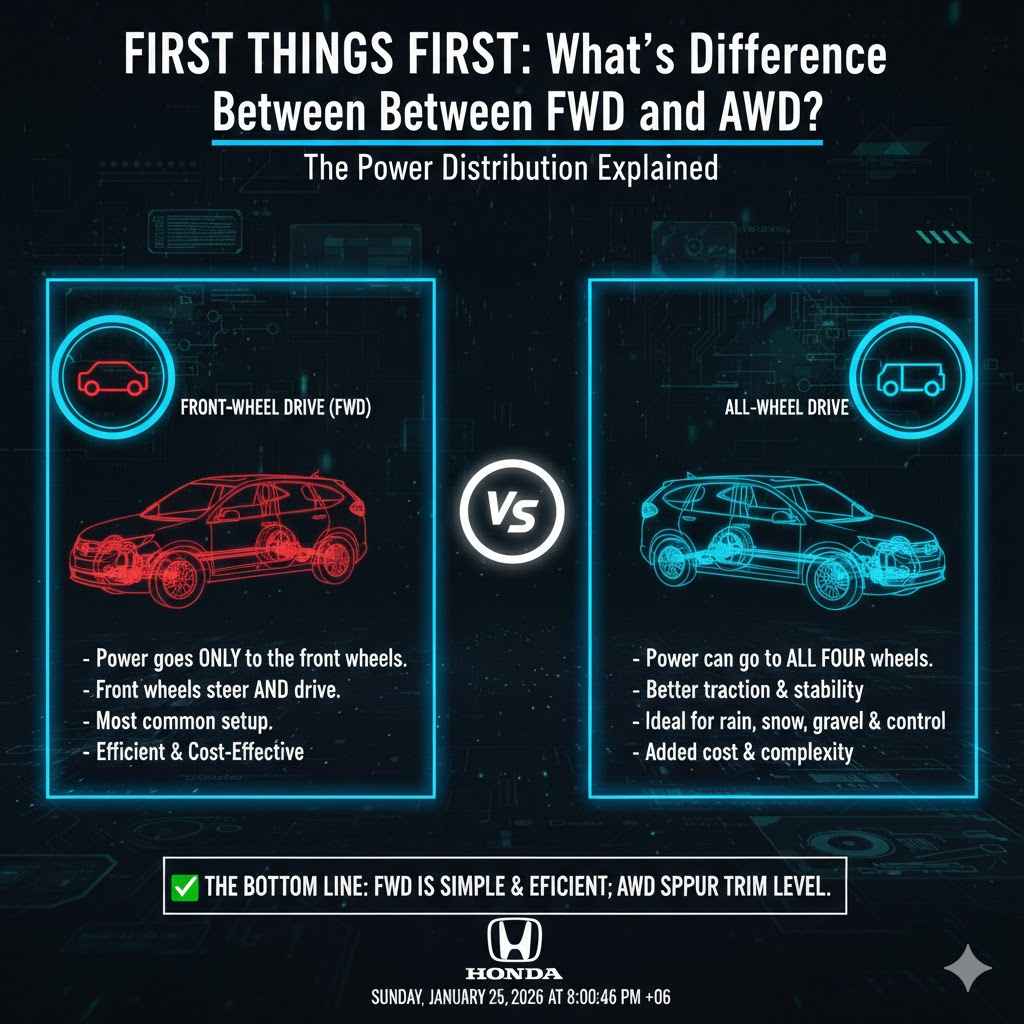
Before we dive into the specifics of the CR-V, let’s quickly cover the basics. Think of it like this: your car’s engine creates power, and the drivetrain sends that power to the wheels to make them spin. The main difference between Front-Wheel Drive (FWD) and All-Wheel Drive (AWD) is which wheels get that power.
- Front-Wheel Drive (FWD): The engine only sends power to the two front wheels. These wheels are responsible for both steering and moving the car forward. This is the most common setup for cars and smaller SUVs because it’s efficient and cost-effective.
- All-Wheel Drive (AWD): The engine can send power to all four wheels. This gives you much better traction and stability, especially in slippery conditions like rain, snow, or on gravel roads.
Imagine trying to push a grocery cart on a slippery floor. If you only push from the front (like FWD), the back might slide around. But if you could push from all four corners at once (like AWD), you’d have much more control. That’s the simple idea behind AWD.
Honda’s Smart System: Real Time AWD™ Explained
Honda doesn’t just use a standard AWD system. They use a smart system called “Real Time AWD with Intelligent Control System™.” That’s a long name, but the idea is simple and brilliant.
Instead of sending power to all four wheels all the time (which can waste fuel), the CR-V acts like a FWD vehicle during normal driving. This helps you get great gas mileage on your daily commute. However, the moment the system detects that the front wheels are losing grip—like on a patch of ice or during a quick acceleration—it instantly and automatically sends power to the rear wheels to help you stay in control.
Here’s what makes it so effective:
- It’s Automatic: You don’t have to press any buttons or pull any levers. The car does all the thinking for you.
- It’s Fast: The system reacts in a fraction of a second, often before you even realize a wheel has slipped.
- It’s Efficient: By running in FWD most of the time, it saves you money at the gas pump compared to older, full-time 4WD systems.
This “on-demand” approach gives you the best of both worlds: the fuel efficiency of a FWD car with the added safety and traction of AWD when you need it most.
Which Honda CR-V Models Have AWD? A Generation-by-Generation Look
This is the big question! The answer is that AWD has almost always been an option rather than a standard feature, except on the very top trim levels. This means you can find both FWD and AWD versions of the same model year. Here’s a breakdown of recent CR-V generations to help you know what to look for.
The Current Generation (6th Gen: 2023 – Present)
For the newest CR-Vs, Honda has kept its strategy consistent. The base trims start with FWD to keep the price accessible, while the premium and hybrid models often include AWD as a standard feature.
| 2023+ Trim Level | Standard Drivetrain | Available Drivetrain |
|---|---|---|
| LX | FWD | AWD (Optional) |
| EX | FWD | AWD (Optional) |
| Sport Hybrid | FWD | AWD (Optional) |
| EX-L | FWD | AWD (Optional) |
| Sport-L Hybrid | AWD | N/A (Standard) |
| Sport Touring Hybrid | AWD | N/A (Standard) |
The Previous Generation (5th Gen: 2017 – 2022)
This was an incredibly popular generation of the CR-V, and the FWD/AWD split was very similar. AWD was an available upgrade on every single trim level, giving buyers maximum flexibility.
| 2017-2022 Trim Level | Standard Drivetrain | Available Drivetrain |
|---|---|---|
| LX | FWD | AWD (Optional) |
| EX | FWD | AWD (Optional) |
| EX-L | FWD | AWD (Optional) |
| Touring | FWD | AWD (Optional) |
Note: For this generation, the top-tier Touring trim often had AWD included as standard in many regions, but it’s always best to check the specific vehicle.
How to Tell If a Specific Honda CR-V is AWD: 4 Easy Steps
Okay, so you’re standing in front of a used CR-V on a dealership lot or at a private seller’s home. How do you know for sure if it has AWD? Here are four simple ways to check, from easiest to most definite.
1. Look for the Badge
This is the simplest method. Walk around to the back of the CR-V and look at the tailgate, usually on the bottom right side. If the vehicle is equipped with All-Wheel Drive, it should have a chrome or black badge that clearly says “AWD”. If you don’t see this badge, it is most likely a Front-Wheel Drive model. However, be aware that badges can be removed or fall off, so it’s always good to use a second method to confirm.
2. Check the VIN (Vehicle Identification Number)
The VIN is like your car’s fingerprint—a unique 17-digit code that tells you everything about it. You can find the VIN on a plate on the driver’s side dashboard (visible through the windshield) or on a sticker inside the driver’s side door jamb.
Once you have the VIN, you can use an online decoder to get a full report on the vehicle’s original specifications. A reliable and official resource for this is the National Highway Traffic Safety Administration (NHTSA) VIN Decoder. Just type in the VIN, and it should tell you the vehicle’s drivetrain.
- Locate the 17-digit VIN on the dashboard or driver’s door jamb.
- Go to the NHTSA’s website or another reputable VIN decoding service.
- Enter the VIN into the search box.
- Review the vehicle details section, which will list the drivetrain as “All-Wheel Drive” or “Front-Wheel Drive”.
3. Do a Quick Visual Inspection Under the Car
This might sound intimidating, but it’s actually pretty easy and is the most surefire way to know. You don’t need to lift the car; you just need to peek underneath the back.
On an AWD vehicle, a long metal tube called a driveshaft runs from the front of the car to the back. This shaft connects to a pumpkin-shaped metal lump in the middle of the rear axle called the rear differential. The differential is what sends power to the back wheels.
Here’s what to do:
- From the rear of the CR-V, crouch down and look underneath, right in the center.
- If you see the rear differential and two axles (called half-shafts) going out to the rear wheels, it is an AWD model.
- If you only see a simple beam (a solid bar) going across between the rear wheels with no central “pumpkin,” it is a FWD model.
It’s a very clear difference once you see it. The FWD rear axle is very plain, while the AWD setup has a lot more mechanical parts back there.
4. Check the Original Window Sticker or Paperwork
If you’re buying from a dealer or a meticulous private owner, they might have the original Monroney sticker (the window sticker from when the car was new). This sticker lists every single feature and option the car came with from the factory, including the drivetrain. It will clearly state “Real Time AWD” if the vehicle is equipped with it. If you’re looking at a used car listing online, ask the seller if they have a picture of the window sticker.
Is a CR-V with AWD Worth It for You?
Now that you know how to spot an AWD model, the next question is: do you actually need it? The answer really depends on where you live and how you drive. Let’s look at the pros and cons.
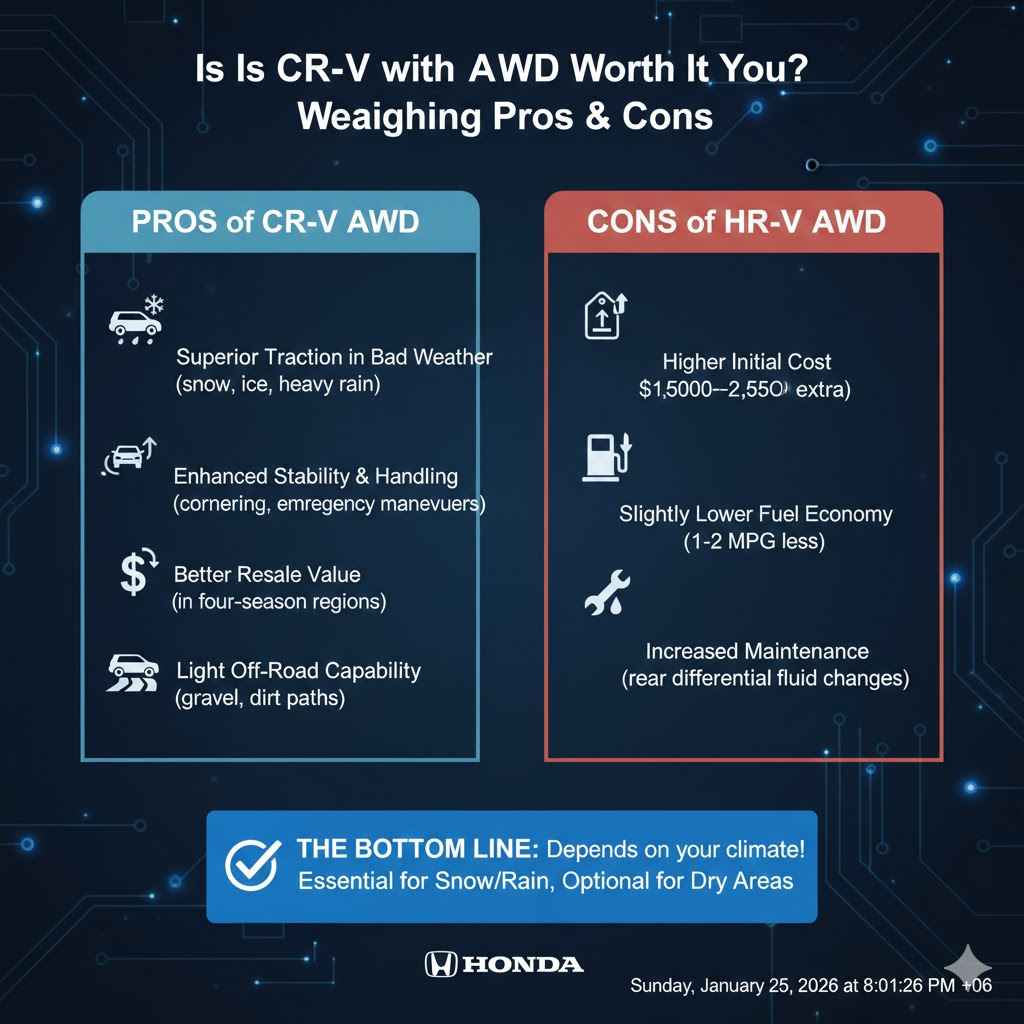
Pros of Honda CR-V AWD
- Superior Traction in Bad Weather: This is the number one benefit. If you live in an area with snow, ice, or frequent heavy rain, AWD provides a massive confidence boost and safety advantage. It helps you get going from a stop and prevents your wheels from spinning.
- Enhanced Stability and Handling: Even on dry roads, AWD can improve stability when cornering quickly or during emergency maneuvers. It helps keep the car planted and secure.
- Better Resale Value: In regions with four seasons, AWD is a highly sought-after feature. This means your CR-V will likely have a better resale value and be easier to sell down the road compared to a FWD version.
- Light Off-Road Capability: While a CR-V isn’t a rock-crawling Jeep, AWD gives you the ability to confidently handle gravel roads, dirt paths to a campsite, or a grassy field for parking at an event.
Cons of Honda CR-V AWD
- Higher Initial Cost: The AWD option typically adds $1,500 to $2,500 to the price of a new or used CR-V.
- Slightly Lower Fuel Economy: The extra components of the AWD system add weight and create a tiny bit of drag, which results in slightly lower MPG. The difference is usually small, around 1-2 MPG, but it adds up over the life of the car.
- Increased Maintenance Costs: The AWD system has extra parts, specifically the rear differential and transfer case. These parts require fluid changes periodically (usually every 30,000 miles or so). While not overly expensive, it is an extra maintenance item that FWD models don’t have.
So, who is it for? If you live in the Snowbelt or a rainy part of the country, the benefits of AWD are undeniable. The added safety and peace of mind are well worth the costs. However, if you live in a sunny, dry climate like Southern California or Florida, you can likely save money by sticking with a FWD model, which will still be a fantastic and reliable vehicle.
Frequently Asked Questions (FAQ)
1. Is Honda CR-V AWD the same as 4WD?
No, they are different. AWD (All-Wheel Drive) is an automated system that is always on and sends power where it’s needed, making it perfect for on-road slippery conditions. 4WD (Four-Wheel Drive) is a more rugged system, typically found on trucks and large SUVs, that you have to manually engage. 4WD is better for serious off-roading, but AWD is smoother and more efficient for everyday driving.
2. Can I add AWD to my FWD Honda CR-V?
Technically, it might be possible, but it is not practical or cost-effective. It would require a massive and expensive conversion, including a new transmission, driveshaft, rear axle, and computer systems. It’s far easier and cheaper to simply sell your FWD vehicle and buy one that came with AWD from the factory.
3. Does AWD use more gas in a CR-V?
Yes, but only slightly. Because Honda’s Real Time AWD system primarily runs in FWD mode during normal driving, the fuel economy penalty is minimal, usually just 1 or 2 miles per gallon less than its FWD counterpart.
4. How often should I service the AWD system on my CR-V?
The main service item is changing the rear differential fluid. Honda typically recommends doing this every 15,000 to 30,000 miles, depending on the model year and your driving conditions. It’s a simple and relatively inexpensive service that is crucial for keeping the AWD system healthy.
5. Is a FWD CR-V still good in the snow?
A FWD CR-V can be perfectly adequate in light snow, especially if you install a good set of winter or all-weather tires. Tires are the most important factor for winter traction. However, for deep snow, ice, or steep, slippery hills, an AWD model will provide significantly better performance and safety.
6. Do all new Honda CR-V Hybrids have AWD?
Not necessarily. For the latest generation (2023+), the base Sport Hybrid trim comes standard with FWD, and AWD is an option. However, the higher-level hybrid trims, like the Sport-L and Sport Touring, come standard with AWD.
7. What does the “AWD” light on the dashboard mean if it comes on?
If a warning light related to the AWD system illuminates on your dashboard while driving, it means the system has detected a fault. The vehicle is usually still safe to drive (likely operating in FWD mode only), but you should have it inspected by a qualified mechanic as soon as possible to diagnose and fix the issue.
Your Confidence is Key
So, are all Honda CR-Vs All-Wheel Drive? The answer is a clear “no.” It’s an excellent feature that’s available on most models but standard on only a few. Now you know that FWD is the default for many trims, and you’re armed with four easy ways to identify an AWD model for yourself.
Choosing between FWD and AWD really comes down to your personal needs, your local climate, and your budget. There’s no wrong answer here. A FWD CR-V is a wonderfully efficient and reliable vehicle, while an AWD CR-V adds a fantastic layer of safety and capability for those who need it.
The most important thing is that you feel confident and informed when you’re looking at a car. You now have the knowledge to walk up to any CR-V, new or used, and know exactly what you’re looking at. Happy driving!