
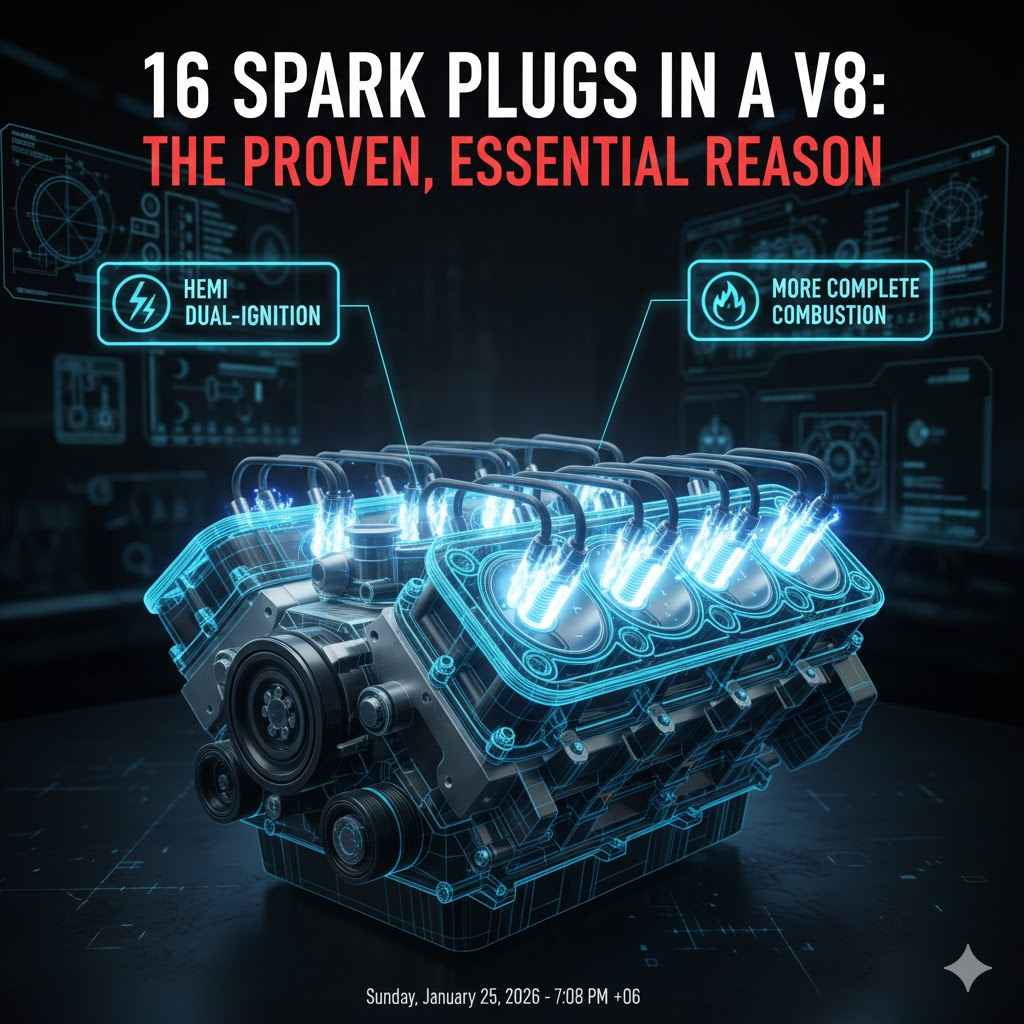
Some V8 engines, like the famous HEMI, have 16 spark plugs—two per cylinder—for a proven, essential reason: to create a more powerful and efficient engine. This dual-plug design ensures fuel burns more completely, which boosts horsepower, improves gas mileage, and reduces harmful emissions. It’s a smart engineering choice, not a mistake.
You pop the hood, ready to tackle a spark plug change on your V8, and your heart sinks. You count the spark plug wires or coils and do a double-take. Eight on one side, eight on the other. That’s sixteen total! Wait, isn’t a V8 supposed to have eight spark plugs? It’s a confusing moment for many car owners, and you might wonder if you’re seeing things or if something is seriously unusual about your engine.
Let me put your mind at ease: you’re not going crazy. Seeing 16 spark plugs in a V8 is completely normal for certain engines, especially the well-known HEMI. It’s a deliberate design, and it’s actually a pretty brilliant piece of engineering. There’s a proven and essential reason for every single one of those plugs.
In this guide, I’ll walk you through exactly why your V8 has two spark plugs per cylinder. We’ll break down the simple science behind it, explore the benefits it gives your vehicle, and discuss what it means for you when it’s time for maintenance. Let’s get you feeling confident and knowledgeable about what’s under your hood!
The Golden Rule of Engines and the Big Exception
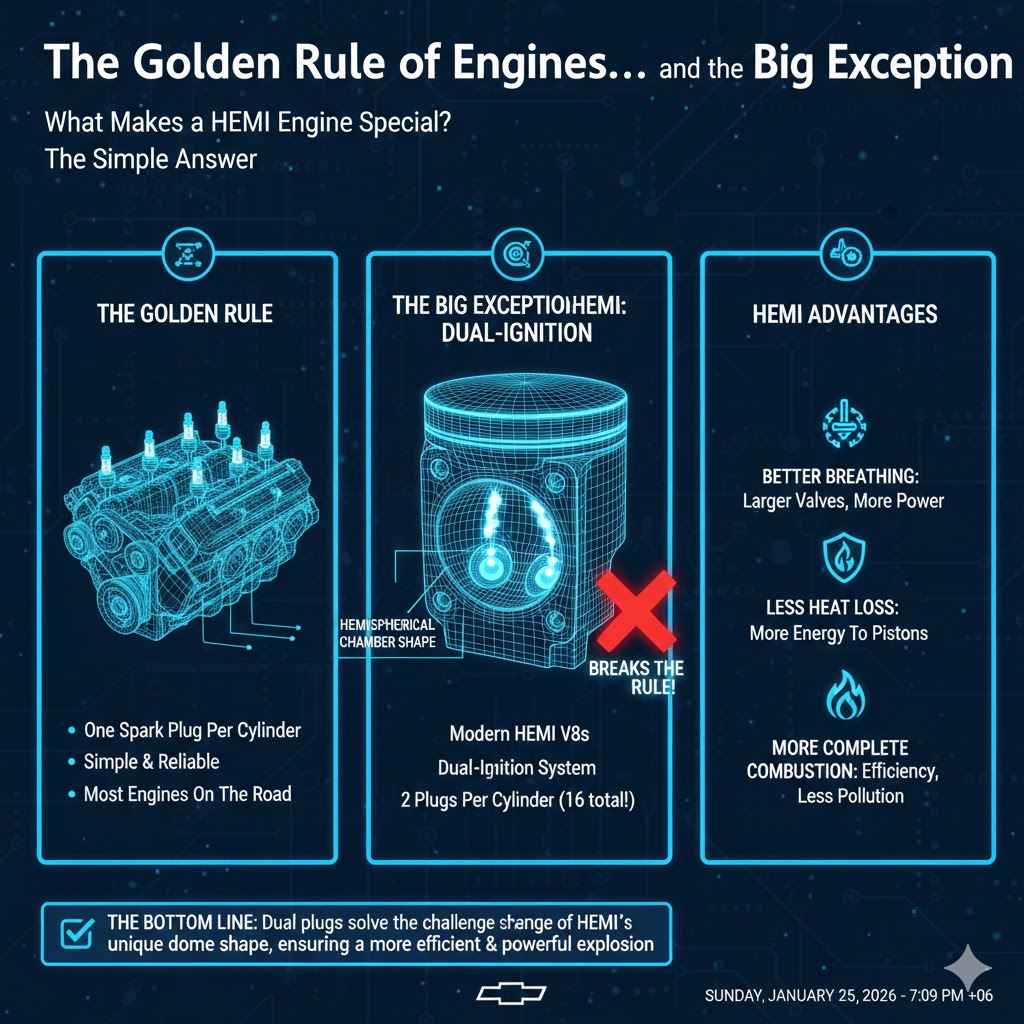
For most of automotive history, the rule has been beautifully simple: one spark plug for every cylinder. A 4-cylinder engine has four spark plugs. A V6 engine has six. And logically, a V8 engine should have eight. For the vast majority of engines on the road today, this rule holds true. The spark plug sits at the top of the cylinder, and its job is to ignite the mixture of air and fuel, creating a small explosion that pushes the piston down and powers your car.
It’s a straightforward, reliable system that has worked for over a century. So, why would any engineer decide to double the number of plugs? This is where we meet the big exception to the rule: the dual-ignition system, most famously used in modern HEMI V8 engines found in many Dodge, Ram, Chrysler, and Jeep vehicles.
These engines break the “one-plug-per-cylinder” rule for a very good reason. To understand it, we first need to look at the unique shape of the engine’s combustion chamber that started it all.
What Makes a HEMI Engine Special?
The term “HEMI” is short for hemispherical. It describes the shape of the combustion chamber—the space at the top of the cylinder where the magic happens. Imagine cutting a ball perfectly in half. That dome shape is a hemisphere.
Why use this shape? A hemispherical chamber has a few key advantages:
- Better Breathing: The dome shape allows for larger intake and exhaust valves. Think of it like having bigger doors on a room—more air and fuel can get in, and exhaust can get out more easily. This “better breathing” is the first step to making more power.
- Less Heat Loss: The dome shape has less surface area than a flatter, more complex shape. This means less heat from the combustion escapes into the metal of the engine, keeping more of that energy focused on pushing the piston down.
However, this wonderful dome shape has one significant challenge. Because it’s so wide and open, a single spark plug placed in the center sometimes struggles to ignite all the fuel and air mixture evenly and quickly. The flame has a long way to travel to reach the edges of the chamber. This can lead to incomplete combustion, which is a triple threat: it wastes fuel, reduces power, and creates more pollution. And that’s where the second spark plug comes in to save the day.
The Proven Reason for 16 Spark Plugs: A Perfect Burn
Placing a second spark plug on the opposite side of the dome-shaped chamber was the elegant solution to the HEMI’s only real problem. When both plugs fire at the exact same time, they create two flame fronts that spread toward each other, consuming the air-fuel mixture from both sides at once.
Think of it like lighting a long piece of paper. If you light it from just one end, the flame slowly works its way to the other. But if two people light it from opposite ends simultaneously, it burns up in half the time. That’s exactly what’s happening inside your engine, thousands of times per minute. This faster, more complete burn provides four massive benefits.
1. More Power and Torque
When the fuel and air in the cylinder burn more completely, the explosion is more powerful and uniform. This creates a stronger downward push on the piston. A stronger push on the piston translates directly into more horsepower and torque—the “oomph” you feel when you press the gas pedal. The dual-plug system ensures that every last drop of fuel is converted into raw power, unlocking the full potential of the engine’s design.
2. Improved Fuel Economy
Wasted fuel is wasted money. In an engine with incomplete combustion, tiny, unburned droplets of fuel are pushed out with the exhaust. A dual-plug system minimizes this waste. By burning the mixture so thoroughly, the engine extracts the maximum amount of energy from every gallon of gas. While powerful V8s are not typically known for being fuel sippers, this efficiency gain helps them perform better than they otherwise would, giving you a few more miles per gallon.
3. Lower Emissions
What comes out of your tailpipe is directly related to how well the fuel burns inside your engine. Incomplete combustion creates harmful pollutants like hydrocarbons and carbon monoxide. By ensuring a complete burn, the two-spark-plug system drastically reduces these emissions. This allows a large, powerful V8 engine to meet the strict air quality standards set by government bodies like the U.S. Environmental Protection Agency (EPA). It’s a clever way to make a big engine run cleaner.
4. Smoother Engine Operation
A consistent and complete burn in every cylinder leads to a smoother, more stable engine. The power delivery from each piston stroke is more even, which reduces engine vibration and leads to a more pleasant driving experience. You’ll notice this as a smoother idle and a more refined feeling when accelerating.
Which V8 Engines Have 16 Spark Plugs?
The most common engines you’ll find with this dual-plug setup are the modern Chrysler HEMI V8s. If you drive a Dodge Challenger, Dodge Charger, Ram 1500, Jeep Grand Cherokee, or Chrysler 300 with a V8, there’s a very good chance you have 16 spark plugs under your hood.
Here’s a quick-reference table of common HEMI engines that use this design:
| Engine Size | Commonly Found In | Number of Spark Plugs |
|---|---|---|
| 5.7L HEMI V8 | Ram 1500, Dodge Charger, Dodge Challenger, Jeep Grand Cherokee, Chrysler 300 | 16 |
| 6.1L SRT HEMI V8 | Older SRT models (e.g., Dodge Challenger SRT8, Jeep Grand Cherokee SRT8) | 16 |
| 6.4L (392) HEMI V8 | Dodge Challenger/Charger Scat Pack, Jeep Grand Cherokee SRT, Ram 2500/3500 | 16 |
| 6.2L Supercharged HEMI V8 (Hellcat) | Dodge Challenger/Charger Hellcat, Jeep Grand Cherokee Trackhawk, Ram 1500 TRX | 16 |
It’s worth noting that while Chrysler is the most famous user of this technology in modern passenger vehicles, the idea itself isn’t new. Dual-ignition systems have been used for decades in high-performance applications like aircraft engines and top-tier racing engines, where reliability and maximum power are absolutely critical.
What This Means for You and Your Wallet
Okay, so the engineering is cool, but what does having 16 spark plugs mean for you as the owner? It primarily affects one thing: maintenance.
The Spark Plug Change: More Time and More Cost
When it’s time for a tune-up, the reality is that you’ll be buying 16 spark plugs instead of the usual eight. This will naturally increase the cost of the parts. If you’re paying a mechanic to do the job, the labor cost will also be higher because the process simply takes longer. There are twice as many plugs to remove and install.
Furthermore, on these V8 engines, one set of plugs is usually easy to access on the top or side of the engine. However, the second set is often located lower down, near the exhaust manifold. These can be more difficult to reach, sometimes requiring special tools like swivel sockets and extensions. This added complexity contributes to the longer labor time.
Let’s compare the job for a standard V8 versus a dual-plug HEMI V8:
| Maintenance Task | Standard V8 (8 Plugs) | Dual-Plug HEMI V8 (16 Plugs) |
|---|---|---|
| Number of Spark Plugs | 8 | 16 |
| Estimated Parts Cost (DIY) | $40 – $120 | $80 – $240 |
| Estimated Labor Time (DIY) | 1 – 2 hours | 2 – 4 hours |
| Estimated Mechanic Cost (Parts & Labor) | $200 – $400 | $400 – $750+ |
While the cost is higher, remember the benefits you’re getting in return: better performance, improved efficiency, and a cleaner-running engine. It’s the price of that advanced engineering.
Can You Do It Yourself?
Absolutely! Changing 16 spark plugs is not technically harder than changing eight; it just requires more patience and time. If you’re comfortable with basic hand tools and have tackled a spark plug job before, you can certainly handle this. The key is to take your time, make sure you have the right tools (especially those swivel sockets!), and change one plug at a time to avoid mixing up the wires or coils.
How to Be Sure Your V8 Has 16 Spark Plugs
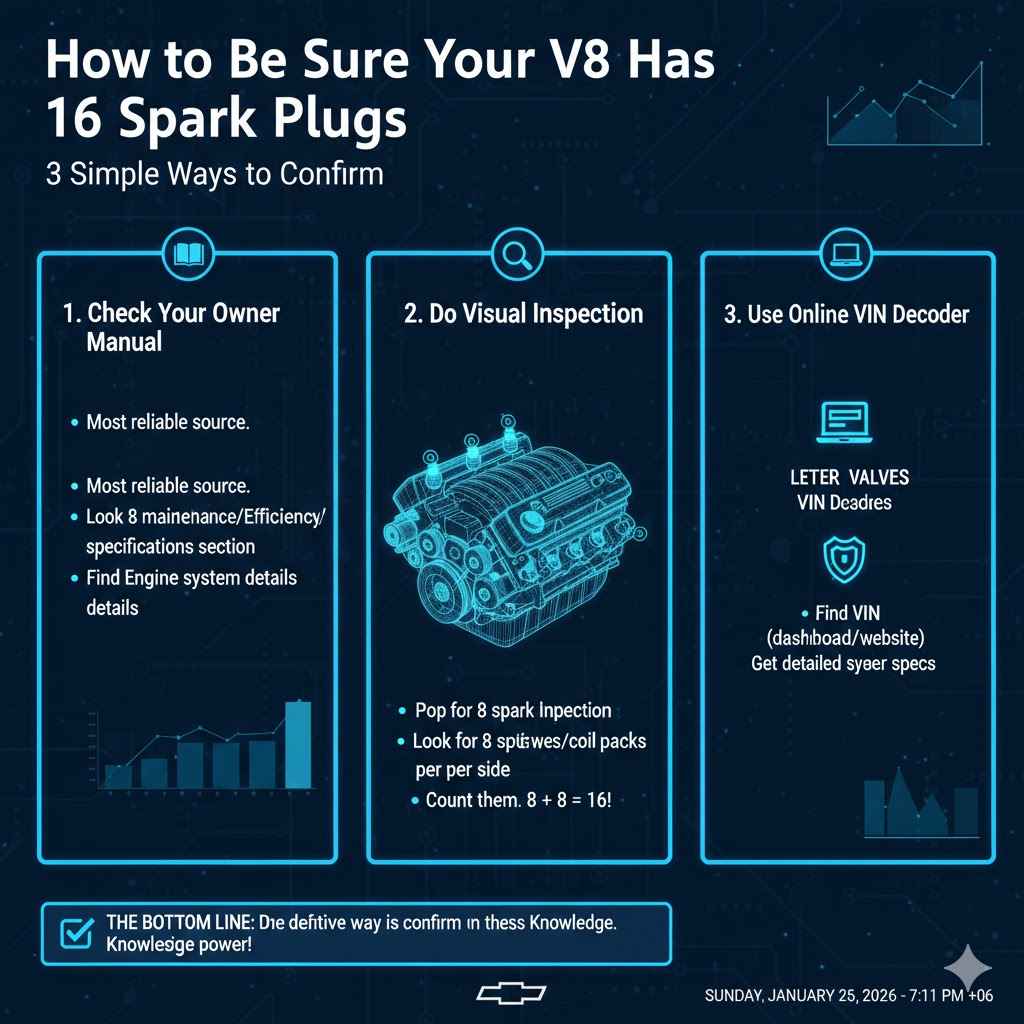
If you’re still not sure about your specific vehicle, here are three simple ways to confirm:
- Check Your Owner’s Manual: This is the most reliable source of information. Look in the maintenance or specifications section for details on the ignition system and spark plugs.
- Do a Visual Inspection: Pop the hood and look at the valve covers on each side of the engine. You’ll see either spark plug wires or “coil-on-plug” units (small rectangular boxes) bolted on top. Count them. If you see eight per side, you have a 16-plug engine.
- Use an Online VIN Decoder: You can find websites that allow you to enter your vehicle’s Vehicle Identification Number (VIN) to get a detailed breakdown of its features and engine specifications.
Frequently Asked Questions (FAQ)
Do all V8 engines have 16 spark plugs?
No, definitely not. The vast majority of V8 engines from manufacturers like Ford, Chevrolet, and Toyota use the traditional one-plug-per-cylinder design, meaning they have eight spark plugs. The 16-plug design is a hallmark of modern Chrysler HEMI V8 engines.
Can I just replace 8 of the 16 spark plugs to save money?
This is not recommended. Spark plugs should always be replaced as a full set. The two plugs in each cylinder work together as a team. If you mix old and new plugs, you can create an imbalance in combustion, which can lead to poor performance, rough idling, and even potential engine issues down the road. Always change all 16 at the same time.
Is it harder to change 16 spark plugs than 8?
The process for each individual spark plug is the same. The job isn’t technically “harder,” but it is longer and requires more endurance. The main challenge often comes from accessing the second set of plugs, which may be located in tighter spaces near the hot exhaust manifold. With the right tools and a bit of patience, it is a very manageable DIY project.
What happens if one of the 16 spark plugs goes bad?
If one spark plug fails, the cylinder it’s in will not fire efficiently. You would likely experience classic symptoms of a misfire: a rough idle, engine hesitation or stumbling during acceleration, a flashing check engine light, and a noticeable drop in power and fuel economy. Because there are two plugs, the cylinder might still fire weakly, but the problem will be apparent.
Why don’t all engines use two spark plugs per cylinder?
It comes down to design philosophy and cost. Many modern engines use different technologies to achieve efficient combustion, such as advanced fuel injection systems, variable valve timing, and specially shaped pistons. These designs can achieve excellent power and efficiency with just one spark plug. Adding a second plug adds complexity and cost to manufacturing and maintenance, so it’s only used when the engine’s design—like the wide HEMI chamber—specifically benefits from it.
Are all 16 spark plugs the same type?
In most modern HEMI engines, yes, all 16 spark plugs are identical. However, in some older or different dual-ignition systems, there could be different plug types for the intake and exhaust sides of the cylinder. Your best bet is to always consult your owner’s manual or check with your local auto parts store to ensure you are buying the correct plugs for your specific vehicle.
How often should I change the spark plugs in a 16-plug engine?
The replacement interval is determined by the type of spark plug used, not the number of them. Most modern vehicles use long-life iridium or platinum spark plugs, which typically have a replacement interval of around 100,000 miles. Less expensive copper plugs may need to be changed every 30,000 miles. Always follow the specific recommendation in your vehicle’s maintenance schedule.
Conclusion: A Smart Design for a Powerful Engine
So, the mystery of the 16 spark plugs in a V8 is solved. It’s not a typo or a strange anomaly; it’s a clever and purposeful engineering solution designed to get the absolute best performance from the legendary HEMI engine. By using two spark plugs to create a faster, more complete burn, engineers were able to maximize power, increase fuel efficiency, and reduce emissions, all at the same time.
For you, the proud owner of one of these powerful machines, it means a slightly higher cost and a bit more time spent on maintenance day. But it also means you get to enjoy the incredible performance and smoother operation that this advanced design provides every time you get behind the wheel.
Understanding the “why” behind your car’s design is one of the best ways to become a more confident and empowered owner. Now, when you see those 16 coils or wires, you won’t feel confused—you’ll know you’re looking at a smart piece of engineering built for power and efficiency.