Winter Brake Problems: Squealing, Freezing and Road Salt Damage
Quick answer: In winter, a brake squeal that disappears after a few stops is often moisture or light rotor surface rust; a brake that keeps squealing, pulls, smells hot, or leaves one wheel much hotter than the others usually points to sticking hardware or pad wear; and persistent grinding or a soft pedal means stop driving and have the system inspected immediately.
Winter brake problems usually fall into three groups: a short squeal after a wet cold start is often surface rust, drag or one hot wheel points to a sticking caliper or frozen parking-brake cable, and grinding means stop driving. Ignore the wrong symptom and you can overheat a rotor, wear pads to metal, lose braking balance, or turn minor corrosion into a caliper or brake-line repair.
This guide ties winter noises, freeze-ups, and salt damage to the part most likely at fault and shows which signs need same-day attention.
How to narrow it down: The fastest winter brake diagnosis is symptom-based. We separate a brief first-stop noise from a noise that repeats on every stop, then check for three observable clues: whether the pedal feels normal, whether the vehicle pulls or feels sluggish, and whether one wheel is noticeably hotter than the others after a short drive. From there, inspection usually focuses on pad thickness and evenness, rotor condition, caliper slide movement, parking-brake release, brake-fluid level, and corrosion at lines, brackets, hubs, and hardware.
Winter brake problems by failure mode
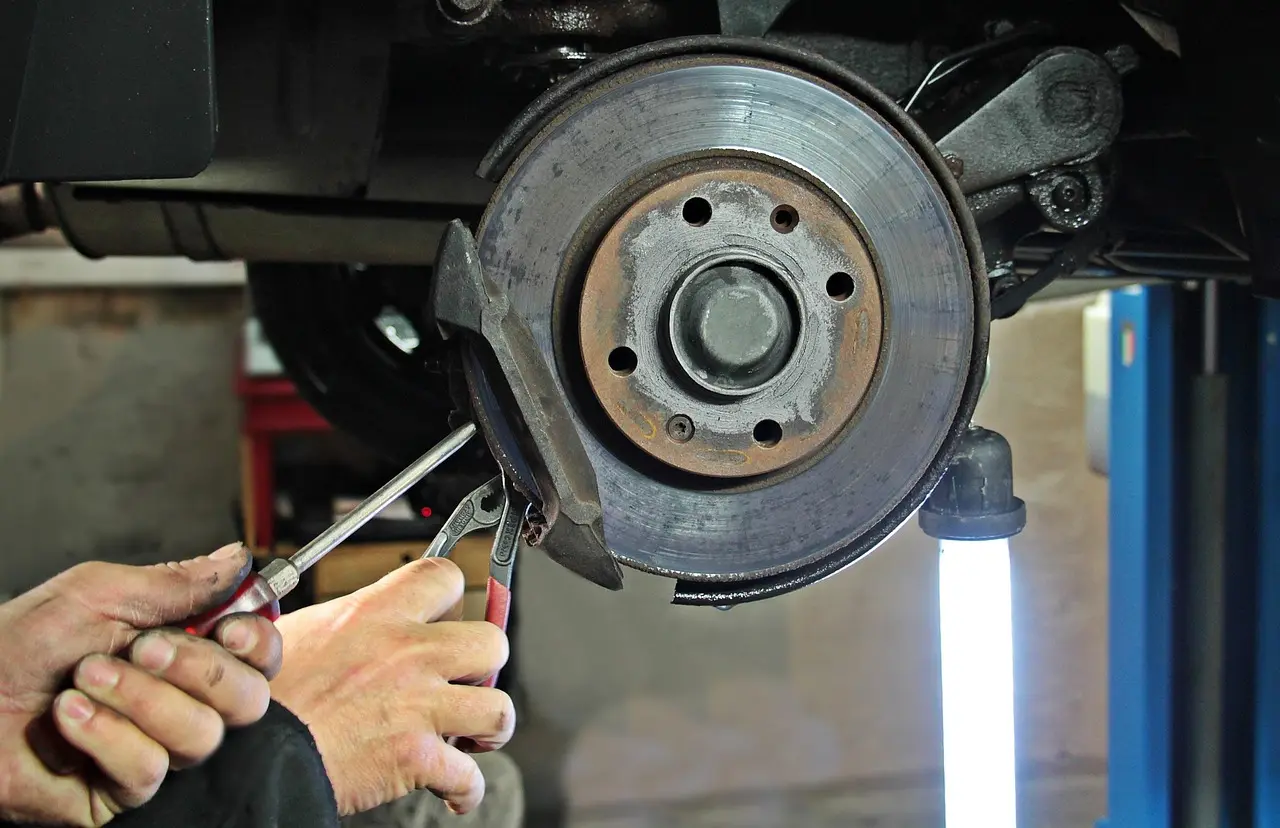


Most winter brake complaints trace to temporary rotor moisture, sticking mechanical hardware, or salt-driven corrosion, and the safest next step depends on whether the symptom clears quickly or keeps returning under normal braking.
Temporary moisture noise versus actual wear or damage
A brief squeal on the first stop after a cold, wet night often comes from light surface rust or a thin film of moisture on the rotor face. That noise should fade within a few brake applications.
If the squeal stays, gets sharper, or returns every stop, treat it differently. A high-pitched squeal that keeps coming back usually traces to a pad wear indicator touching the rotor, pads worn near the backing plate, brake dust or grit at the pad face, or glazed pads or rotors.
That distinction matters in winter because the same commute can leave harmless morning rust one day and expose sticking hardware the next. Noise duration, pedal feel, and wheel temperature tell you more than the weather by itself.
Freeze-up and sticking in calipers, pads, and parking brake parts
Cold itself does not usually “freeze the brakes” solid inside the hydraulic system. The usual winter trouble is water, slush, or salt getting into exposed moving parts, then freezing or speeding corrosion where parts need to slide freely.
On floating calipers, the first seizure point is often the slide pins or pad abutment hardware. When a pin seizes, one pad drags harder than the other, the rotor runs hot, and the vehicle may pull or feel sluggish after a short drive.
Parking-brake cables and rear parking-brake hardware can also stick after wet snow, especially if the brake was applied while the system was soaked and then parked in subfreezing weather.
Salt corrosion on rotors, lines, hubs, and hardware
Road salt does more than leave orange dust on the rotor hat. Winter moisture and spray speed corrosion on brake lines, caliper brackets, slide-pin bores, rotor edges, wheel hubs, and centering rings, and freeze-thaw cycling spreads that damage into seams and hidden underside areas. General winter-road guidance also notes that deicing salts accelerate vehicle corrosion, especially on underbody components exposed to spray and trapped moisture FHWA.
Brake lines need close attention because they live in the salt-spray zone along the underside. A line can corrode under clips or coating long before a leak is obvious from above; any brake-fluid leak or hydraulic warning sign is a safety issue that should be addressed immediately NHTSA.
Rotor rust is easier to see, but visible does not mean harmless. Light overnight rust usually cleans off. Pitting, heavy scaling, and deep scoring do not.
Why the same symptom can come from different parts
The same sound can come from very different faults. Squeal may be morning moisture, glazed pads, a wear indicator scraping the rotor, or seized pad hardware. Grinding after snow may be metal-to-metal pad wear, trapped rust scale, or a dragging inner pad on a frozen slide pin.
That is why winter diagnosis works best as symptom-to-component mapping. Start with the symptom, then narrow it by duration, pedal feel, pull, heat at one wheel, and visible corrosion.
Why do my brakes squeal in cold weather?
A short squeal in cold weather is often moisture or light surface rust on the rotor, but persistent squeal points to worn pads, glazed friction material, dust, or sticking hardware. The key test is whether the noise clears after a few stops or keeps returning during normal braking.
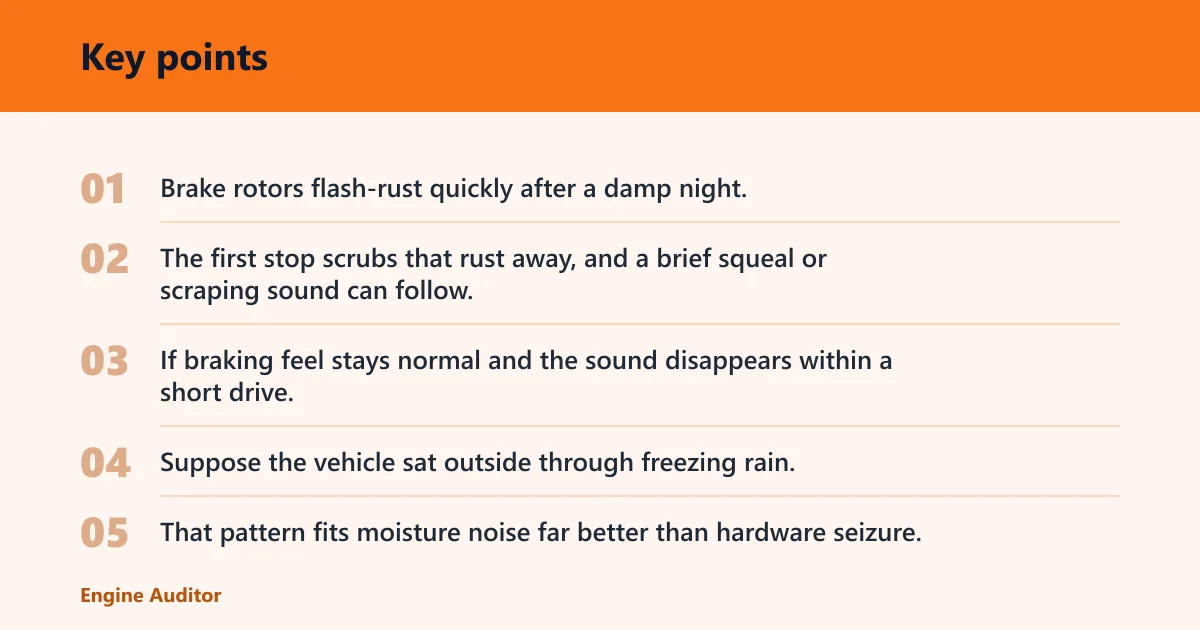
Cold moisture, surface rust, and first-stop squeal
Brake rotors flash-rust quickly after a damp night. The first stop scrubs that rust away, and a brief squeal or scraping sound can follow. If braking feel stays normal and the sound disappears within a short drive, this is usually a near-term inspection issue, not a stop-driving issue.
Suppose the vehicle sat outside through freezing rain, then squealed on the first stop leaving a parking lot but went quiet by the second traffic light. That pattern fits moisture noise far better than hardware seizure.
Glazed pads and pad compound behavior in low temperatures
Glazed pads have a hardened, shiny surface that slides on the rotor instead of biting cleanly. Cold weather can make that more obvious because the pad starts out less compliant, then squeals until some heat builds.
Semi-metallic pads tend to be noisier in cold, wet conditions because of their metallic content and greater tendency to pass vibration. Ceramic pads are often quieter, but they can still squeal if glazed, contaminated, or paired with rough rotor surfaces.
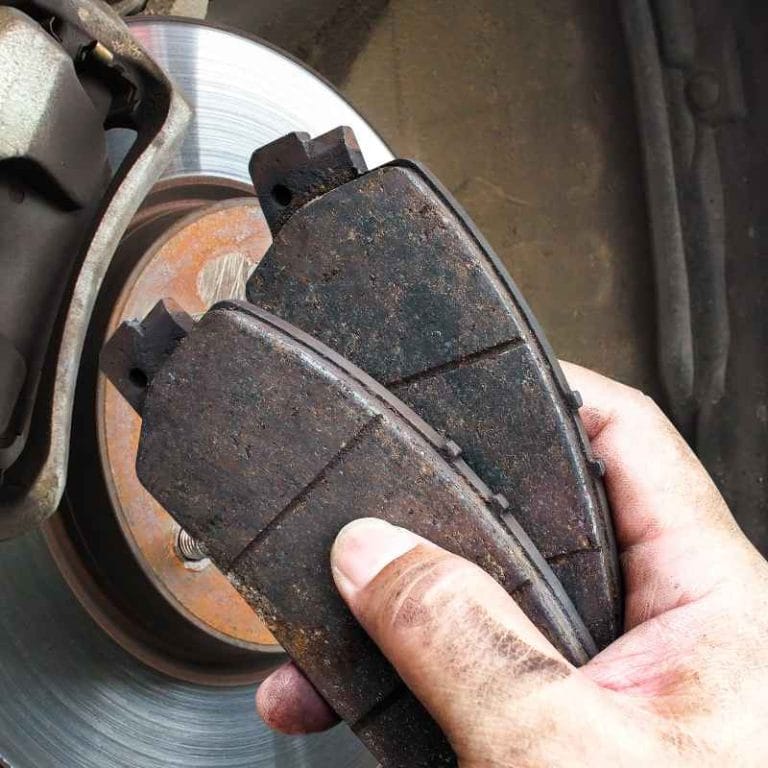
Pad wear also matters. Many shops flag pads at about 3 mm of friction material, and some drivers start planning service around 4 mm to leave a little extra margin; exact replacement thresholds and wear rates vary by manufacturer and driving use, so the service limit in the vehicle manual and a visual inspection matter more than mileage alone.
When squeal points to pad wear indicators or hardware trouble
If the squeal is present warm or cold, dry or wet, check pad thickness and hardware condition. There is no universal brake pad mileage interval: wear changes with vehicle weight, driving style, terrain, and corrosion, so manufacturers and brake makers generally emphasize inspection and service-limit measurements over fixed mileage promises.
Uneven wear is the winter clue many people miss. If the inner pad is much thinner than the outer pad on a floating caliper, suspect seized slide pins or sticking pad ears in the bracket rather than simple normal wear.
Brake anti-squeal paste has a role here, but only on the correct contact points. Use a brake lubricant approved for pad backing plates and hardware contact points where the brake maker calls for it, and keep it off the friction surface of the lining and rotor. If a product label or service information does not specifically approve a contact point, do not assume it belongs there.
Can brakes freeze up in winter?
Yes, brakes can freeze up in winter, usually at exposed mechanical parts rather than inside the fluid circuit. The common trouble spots are caliper slide pins, pad abutments, and parking-brake parts, with one dragging wheel, heat, odor, or a vehicle pull giving the first warning.
What actually freezes on disc and parking-brake systems
Park a wet vehicle after slush driving and ice can lock pads lightly to the rotor, freeze a parking-brake cable, or trap packed snow around rear brake hardware. A light freeze can break free gently on the first movement. A true mechanical seizure does not clear that easily.
If the parking brake will not release after a storm, avoid forcing repeated moves against a stuck wheel. That can overheat the affected brake once it partly releases and leave the pad dragging.
How floating calipers develop drag when slide pins seize
Floating calipers rely on slide pins to center the caliper so both pads share the load. When corrosion dries out the pin grease or the pin boots let water in, the caliper stops moving freely. Then one pad stays in contact with the rotor.
Dragging pads create a hot wheel, a burning smell, reduced fuel economy, and pull. They also create noise that can sound like worn pads, especially after a snowstorm when the inner pad is rust-stuck and the outer pad still looks usable at a quick glance.
Cleaning and correct lubrication are the repair path, not extra pad spray or random grease. Slide pins need the right brake-compatible lubricant and intact boots; anti-squeal paste is for specific contact points, not a replacement for slide-pin grease.
Wheel hubs and centering rings can rust-freeze too
Winter seizure is not limited to the caliper. Salt and moisture at the wheel hub and aluminum rim interface can rust-freeze the wheel to the hub, and centering rings can seize in place as corrosion builds.
On the correct non-friction contact areas, a suitable separating paste can help limit corrosion bonding at the hub and centering-ring interface. Keep it off braking friction surfaces and follow vehicle or wheel service information for application points.
Picture a compact SUV with aluminum wheels parked outside after two days of salted slush. The brakes release fine, but a tire change later shows the wheel frozen to the hub face. That is a hub-interface corrosion problem, not a caliper failure.
Temporary ice versus mechanical seizure
Temporary ice usually changes quickly once the vehicle starts moving and the brake warms slightly. Mechanical seizure keeps the same wheel dragging, heating, or squealing even after several miles.
If one wheel is too hot to approach safely, or the vehicle pulls strongly, stop driving. That is beyond normal winter stickiness.
How does road salt damage brake parts?
Road salt damages brake parts by holding moisture against metal, speeding corrosion, and working into moving joints and hidden seams. In practice, that means pitted rotors, seized caliper hardware, rust-frozen hub interfaces, and brake lines that can corrode in the underside spray zone before they leak.
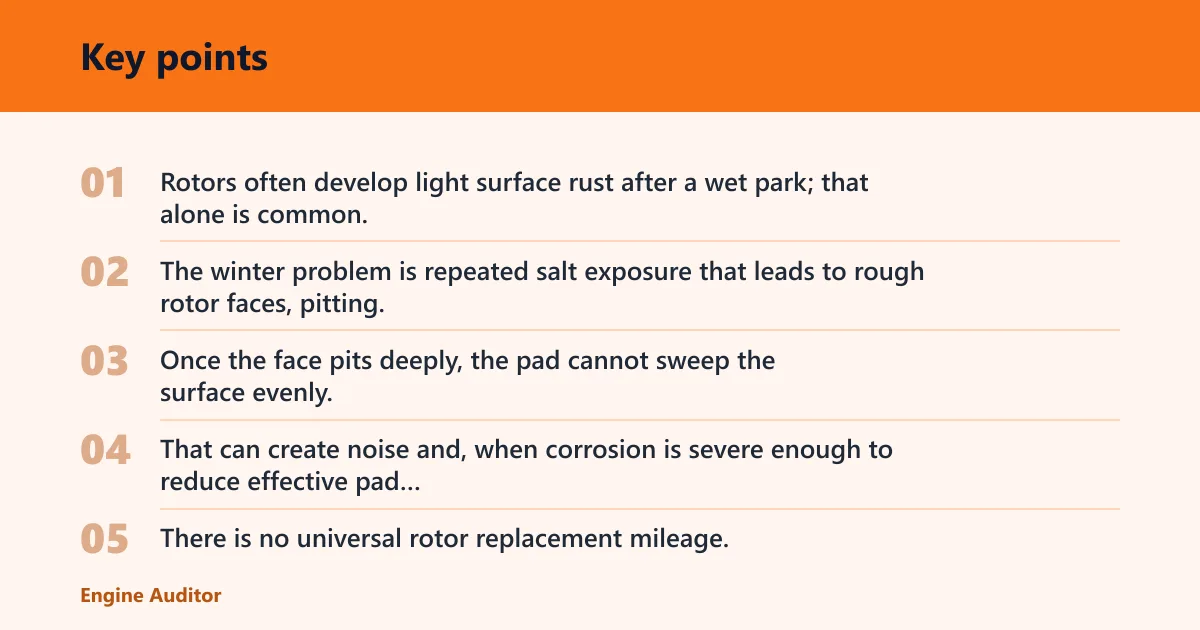
Rotor pitting, scaling, and scoring after salt exposure
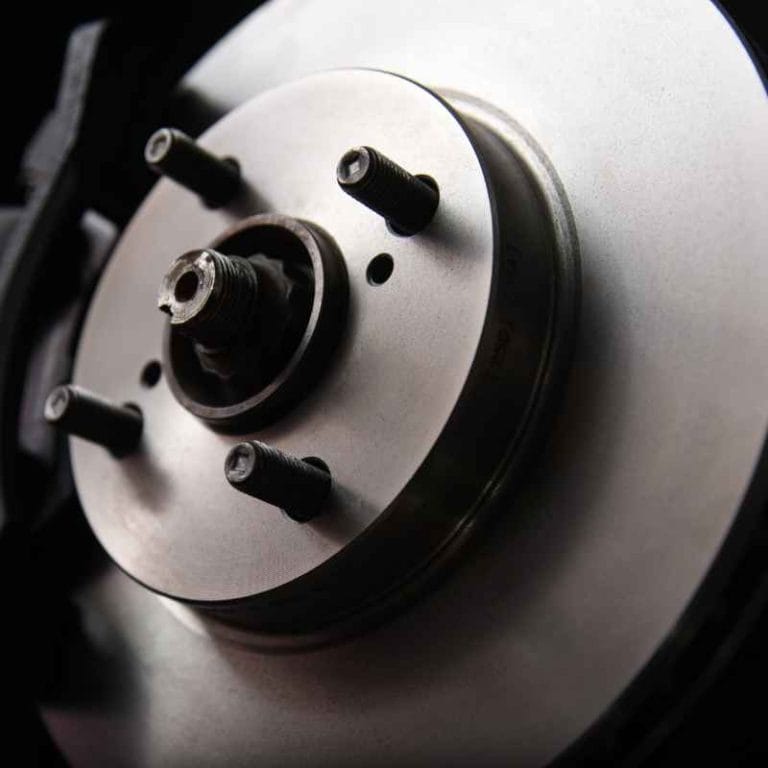
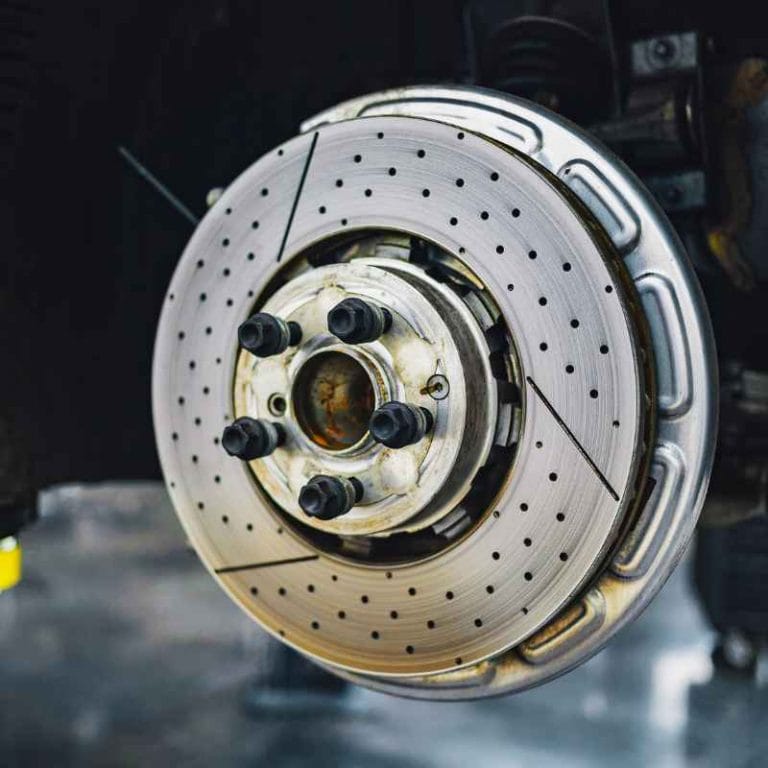
Rotors often develop light surface rust after a wet park; that alone is common. The winter problem is repeated salt exposure that leads to rough rotor faces, pitting, and heavy rust scale around the edges or cooling vanes.
Once the face pits deeply, the pad cannot sweep the surface evenly. That can create noise and, when corrosion is severe enough to reduce effective pad contact, sometimes longer stopping distances, pedal pulsation, or steering-wheel vibration if the friction surface becomes uneven.
There is no universal rotor replacement mileage. Some rotors last well past one pad set, while others need replacement sooner because they reach minimum thickness, develop severe scoring, or corrode badly in salt use. The manufacturer minimum-thickness specification and actual rotor condition are the deciding factors, not a generic mileage estimate.
Caliper corrosion and seized slide hardware
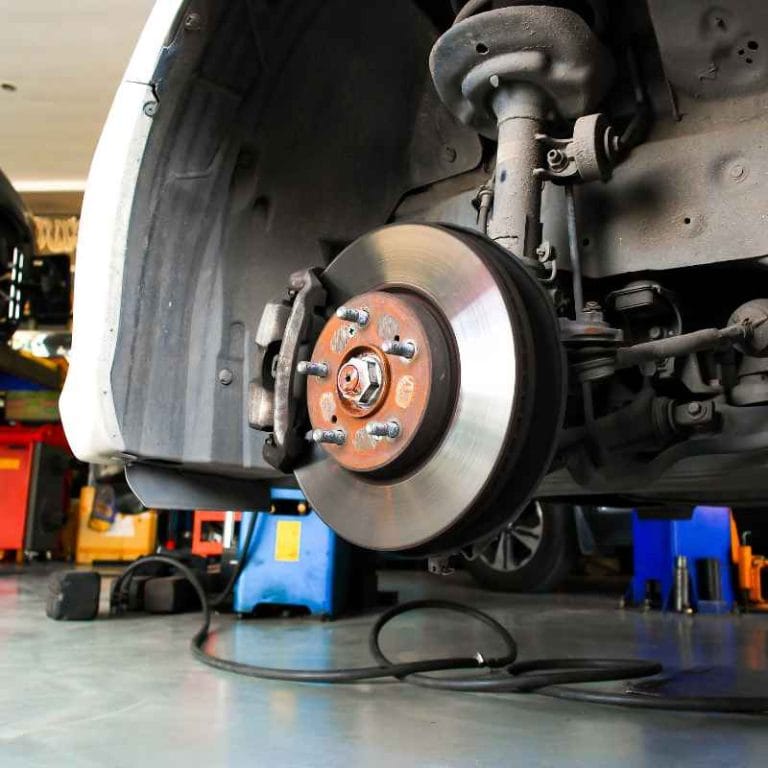
Caliper brackets, pad abutment clips, and slide-pin bores collect salt slurry. Once corrosion lifts the hardware or narrows the pad channels, the pads stop retracting smoothly. That creates a dragging pad symptom long before the caliper piston itself fails.
This is one reason winter brake noise cannot be judged by pad thickness alone. A pad can have material left and still grind because the inner pad is stuck against a scored rotor.
Brake line corrosion in the salt-spray zone
Steel brake lines run where slush and brine hit hardest: along the frame, rear axle area, underbody clips, and bends near flexible hose junctions. Salt packs into retainers and traps moisture under dirt, so corrosion often starts where a visual check is hardest. General road-weather guidance and safety advisories both recognize that deicing chemicals accelerate underbody corrosion, which is why brake-line inspection matters most in regions with repeated salt exposure FHWA NHTSA.
A soft or spongy pedal could mean air in brake lines, a leak, or a failing master cylinder. In winter, add line corrosion high on the list, because a line can thin long before a visible wet spot appears.
If the fluid reservoir drops without an obvious pad-wear explanation, or the pedal sinks, have the system inspected immediately. Line corrosion is a same-day issue because failure can jump from warning to rupture fast.
Freeze-thaw cycling and hidden underside damage
Snowstorm road salt does not stop working when the roads dry. Brine creeps into seams, then repeated thawing and refreezing cracks loose scale, opens coatings, and exposes fresh metal on hardware, lines, and brackets.
That is why post-storm brake checks should include the hidden underside, not only the visible rotor face through the wheel spokes.
Brake symptom matrix
Use the matrix as a triage tool: a noise that clears in the first few brake applications is different from one that repeats every stop, and a wheel that only feels lightly iced at first movement is different from a wheel that remains hot, smells burnt, or makes the vehicle pull after a short drive.
| Symptom | Likely component | Likely cause | Urgency | Immediate next step |
|---|---|---|---|---|
| Squeal on first few stops | Rotor face and pad surface | Moisture film or light surface rust; if persistent, glazed pads, dust, or wear indicator | Low if it clears quickly; moderate if it stays | Drive a short distance and note whether noise fades; if not, inspect pad thickness, rotor finish, and hardware |
| Grinding after snow | Pads, rotors, slide hardware | Worn pads, trapped rust scale, scored rotor, or seized inner pad on a floating caliper | High | Stop driving and inspect or tow; grinding often means the pads are gone and the rotors are being damaged |
| Frozen caliper or one wheel dragging | Caliper slide pins, pad abutments, parking-brake parts | Corrosion, dried lubricant, ice around hardware, or stuck cable | High | Do not continue a normal trip; check for heat, pull, or smell and arrange service |
| Soft pedal | Brake lines, fluid circuit, master cylinder | Air in lines, fluid leak, line corrosion, or master-cylinder fault | Immediate | Stop driving and inspect for leaks and fluid loss; tow if pedal travel is abnormal |
| Salt-corroded lines | Steel brake lines and fittings | Salt-spray exposure, trapped moisture under clips, underside corrosion | Immediate if severe corrosion or wetness is present | Have the lines inspected the same day; replace compromised sections before a rupture |
More specific urgency guide: Treat “freeze-up” as a brief ice bond only if it breaks free right away and the wheel then rolls normally with no continued heat, smell, or pull. Treat “dragging” as a mechanical fault when the same wheel remains hot after a short drive, the car resists coasting, the brake smell persists, or the inner and outer pad wear are visibly uneven.
What does grinding after a snowstorm usually mean?
Grinding after a snowstorm usually means more than harmless moisture. The leading suspects are pads worn into the rotor, rust scale trapped at the rotor face, or a seized slide pin that leaves one pad dragging. If grinding continues beyond a brief first stop, stop driving.
Worn pads versus trapped rust scale
Grinding noise often means the pads are gone and the rotors are being damaged. That is the worst-case version, and it should be ruled out first.
But winter adds another path: rust flakes or scale can break loose from the rotor hat or outer edge and get trapped between pad and rotor. That can create a harsher scrape that started only after storm exposure.
Scored rotors, grooves, and metal-to-metal contact
Look for grooves you can catch a fingernail on, blue heat marks, or a rotor face that looks heavily furrowed. Those signs point to actual rotor damage, not a damp morning film.
If the steering wheel shakes or the pedal pulses during braking, inspect the rotors for scoring, hot spots, and corrosion-related unevenness. Winter pitting can trigger the same complaint drivers often call “warped rotors.”
Dragging pads from seized slides or frozen hardware
A seized floating caliper can grind only on one side, often the inner pad. That is why a wheel-off inspection matters. The outer pad can still have life left while the hidden inner pad is nearly metal.
Say your right-front brake grinds after a slushy highway trip, and that wheel smells hot at the next stop. The more likely cause is stuck hardware or a seized slide pin than all four pads suddenly wearing out overnight.
Which winter brake checks matter most?
The most useful winter brake checks are the ones tied to actual symptoms: pad thickness and even wear for squeal or drag, rotor surface condition for grinding or pulsation, fluid level and appearance for a soft pedal, and line and hardware corrosion after salted-road driving.
Pad thickness thresholds and uneven wear
- Check the friction material, not the metal backing plate.
- If pads are near about 3 mm, treat replacement as due soon.
- Compare inner and outer pads on the same axle if visible.
- Uneven wear suggests seized slides, pad binding, or caliper trouble.
Pad life is highly variable, and most manufacturers do not promise a fixed mileage. Use mileage only as rough context; visible thickness, even wear, noise, and service-limit measurements should drive the decision.
Rotor surface checks for grooves, pitting, and pulsation clues
Look for heavy lip buildup, grooves, rough orange-brown pitting, and dark heat spots. Light rust that cleans off is one thing; pits that remain after normal driving are another.
If the pedal or steering wheel pulses under braking, rotor thickness variation, corrosion roughness, or scoring is more likely than simple morning moisture.
Brake fluid condition, level, and leak signs
Brake fluid should be inspected as part of winter diagnosis because pedal complaints can overlap. Clear fluid is generally a better sign than very dark fluid, though color alone does not prove failure.
Many manufacturers and brake-system suppliers call for periodic fluid replacement because brake fluid absorbs moisture over time; a common service interval is about every 2 years, but owners should follow the maintenance schedule for their specific vehicle Bosch. More urgent than age is any soft or sinking pedal, dampness at a wheel, or a falling reservoir level.
Brake lines, caliper slides, hubs, and centering rings
After heavy salt exposure, inspect line routing, flex-hose junctions, caliper brackets, slide-pin boots, hub faces, and centering rings. These are the common winter seizure and corrosion points that stay hidden behind a wheel or under the vehicle.
Which products and service points prevent repeat winter issues?
The right winter brake products target specific contact points, not the whole assembly. Use anti-squeal paste where pad and hardware contact need noise control and corrosion resistance, use proper slide-pin lubricant inside the guide system, and protect hub and centering-ring interfaces from rust freeze.
Brake anti-squeal paste in winter service
A suitable anti-squeal paste is a brake lubricant formulated for specific brake contact points exposed to spray. In winter, the useful features are compatibility with brake hardware, resistance to washout at contact points, and the ability to stay in place without contaminating friction surfaces.
Because product formulas and approved uses vary by manufacturer, treat exact temperature and corrosion-performance claims as product-specific, not universal. The safe rule is to use only a brake lubricant whose maker approves it for the exact contact point you are servicing and to follow the pad or vehicle service information when it differs.
Correct application points and restrictions
Apply paste only where the brake design calls for it: backing-plate contact points, pad ears, selected abutment areas, studs, pins, and drum-brake contact points.
Never spread it on the friction surface of the lining or the brake disk. Noise treatment and lubrication are not the same as contaminating the pad or rotor.
Slide-pin lubrication on floating calipers
Use the lubricant specified for slide pins and renew damaged boots. This is the first service point to address when one pad wears faster than its mate or one wheel drags after slush driving.
Separating paste on hub and centering-ring interfaces
On the correct non-friction contact areas, separating paste helps prevent corrosion bonding between the wheel hub and aluminum wheel, and at centering rings where dissimilar materials can seize together. Follow vehicle or wheel service information for the correct application points.
When should you stop driving and get brakes inspected?
Stop driving if the pedal is soft or sinking, a wheel is dragging or smoking, the car pulls hard under light braking, or grinding continues after the first stop. Those symptoms point to hydraulic loss, seized hardware, or metal-to-metal contact rather than harmless winter moisture.
Tow-now symptoms
- Soft or spongy pedal
- Visible brake fluid leak or sudden reservoir drop
- One wheel extremely hot, smoking, or hard to rotate
- Persistent grinding
- Strong pull while braking
Short-trip-to-service symptoms
- Brief first-stop squeal that clears
- Mild surface rust noise with normal pedal feel
- Light pulsation without severe loss of braking
- Minor squeal that persists but no drag, leak, or pull
Even these lower-urgency symptoms should move up the list if the vehicle has just been through repeated snowstorm salt exposure or a freeze-thaw week. Corrosion keeps working in the background.
Frequently asked questions
How does road salt damage brake lines?
Salt spray collects on steel brake lines along the underside, especially at clips, bends, and hose junctions where moisture stays trapped. Corrosion can thin the line wall before a visible leak appears, which is why a soft pedal or fluid loss deserves same-day inspection.
How does road salt damage rotors and calipers?
On rotors, salt speeds pitting, scaling, and rough friction surfaces that can cause noise or pulsation. On calipers, it corrodes brackets, pad channels, and slide-pin areas, making pads bind or drag even when the piston itself has not failed.
Why are my brakes grinding after a snowstorm?
Grinding after a snowstorm can mean pads are worn to metal, rust scale is trapped at the rotor face, or a seized slide pin is holding one pad against the rotor. If the sound continues beyond the first stop, stop driving and have the brake inspected immediately.
When should I stop driving and get my brakes inspected?
Stop driving for a soft or sinking pedal, fluid loss, persistent grinding, a smoking or very hot wheel, or a strong pull under braking. Those symptoms suggest hydraulic trouble or a seized brake, and they carry far more risk than ordinary first-stop winter squeal.
Products related to this article
Sponsored / affiliate links. As an Amazon Associate I earn from qualifying purchases. I may earn additional commission from eligible campaigns.